Categories
Books Interviews

Distancing Ourselves from Our Fiction

(The reason for this title will become apparent at the end of this post.)

I’m delighted to welcome back to the blog my friend, colleague and brilliant author. It’s Sue Barnard! Sue’s next book, Finding Nina, will be published in just a week and I decided to ask her a few questions about the writing process.

Finding Nina is ‘part-prequel, part-sequel to the bestselling Nice Girls Don’t.’ Did you write Nice Girls Don’t knowing there would be a prequel/sequel or did the idea for Finding Nina come later?

Nice Girls Don’t was originally written as a stand-alone story, with no plans for a prequel or sequel.  Only after it was published did I realise that a loose end had been unintentionally left dangling.  Thankfully it didn’t affect the outcome of Nice Girls Don’t, but it did leave open the possibility of a spin-off. Finding Nina is in many ways a backstory for one of the characters who barely steps out of the shadows in Nice Girls Don’t.  I enjoyed exploring that particular character in more depth and letting her have her own say.

Was it hard to fit the new novel around the existing story? Did you wish you’d written anything differently in Nice Girls Don’t?
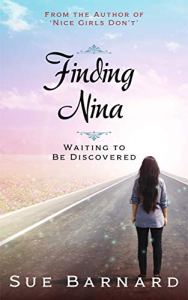
Finding Nina by Sue BarnardI had to make sure that the events of the two books coincided.  The action of Nice Girls Don’t takes place over just a few months (from April to July 1982), but Finding Nina covers a much longer timespan – from 1943 to 2004.  I had to write out a timeline of events covering the entire period, and work from that.

I also set myself the task of making sure that Finding Nina would still make sense to anyone who hadn’t read Nice Girls Don’t.  I hope I’ve succeeded.  The two stories do complement each other, but both can be read in isolation.

How much of the plot did you know before you began writing?

Very little, apart from my original one-sentence premise.  Building an entire story around that proved to be quite a challenge!

Did you write the novel from beginning to end, or did you write scenes and fit them together afterwards?

A bit of both. I tried to work from beginning to end, but some scenes were written out of sequence as they occurred to me, and were slotted in later.

How much of the first draft is in the final version?

In terms of the plot, most of it is still there – although the actual text went through several revisions along the way (including rearranging the order of some scenes following feedback from beta-readers). But one particular scene from an earlier draft didn’t make the final cut, because I realised that it didn’t add anything to the story.

Did you write any of it in longhand or was it all typed on the computer?

It was all typed on the laptop, apart from odd notes jotted down by hand (or on my phone) if ideas occurred to me when I was away from the computer.  It was interesting trying to make sense of them afterwards.

I suppose that could be a metaphor for my whole life…

Ooh, that made me pause for thought!

Thank you so much for answering my questions, Sue. Here’s some more information:

Finding Nina

1943: A broken-hearted teenager gives birth in secret. Her soldier sweetheart has disappeared, and she reluctantly gives up her daughter for adoption.

1960: A girl discovers a dark family secret, but it is swiftly brushed back under the carpet. Conventions must be adhered to.

1982: A young woman learns of the existence of a secret cousin. She yearns to find her long-lost relative, but is held back by legal constraints.  Life goes on.

2004: Everything changes…

More About Sue

Sue BarnardSue Barnard is a British novelist, editor and award-winning poet who was born in North Wales some time during the last millennium.  She speaks French like a Belgian, German like a schoolgirl, and Italian and Portuguese like an Englishwoman abroad.  She now lives in Cheshire, UK, with her extremely patient husband and a large collection of unfinished scribblings.

Her mind is so warped that she has appeared on BBC TV’s Only Connect quiz show, and she has also compiled questions for BBC Radio 4’s fiendishly difficult Round Britain Quiz. This once caused one of her sons to describe her as “professionally weird.” The label has stuck.

Sue’s own family background is far stranger than any work of fiction. She would write a book about it if she thought anybody would believe her.

Finding Nina, which is her sixth novel, is not that book.

Blog   Facebook   G+   Twitter   Instagram   Amazon  Goodreads  RNA

Also by Sue Barnard

The Ghostly Father  Nice Girls Don’t  The Unkindest Cut of All  Never on Saturday  Heathcliff

Sue Barnard - Romance with a Twist

Finding Nina … is not that book.” That’s the sentence that spawned the title of this post. Why do authors need to keep asserting that our fiction isn’t autobiographical? Why do interviewers always expect it to be? Why do I need to say, about my new novel, Cultivating a Fuji, that Martin isn’t me?

Food for a different post, perhaps.

Categories
Books The writing process

Word Tip 6: Track and Compare

Microsoft Word Tips for Authors

Welcome to the next in a series of tips on using Microsoft Word, geared towards authors.
Most Word advice is rather complicated and full of things you’ll never need to know.
I shall do my best to keep it simple, because you’re not stupid… just busy.
Please note: 
– Not all versions of Word are the same, but most are near enough.
– There are different ways of doing the same thing. I shall demonstrate just one (or two).

When you work with an editor, any changes you make to the document you’re working on must be seen by both of you. The usual way to do this is to use the feature called Track Changes.

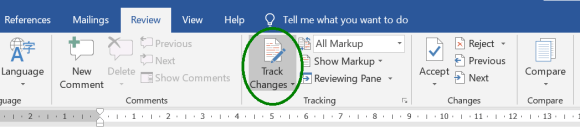
Before you start, turn on Track Changes, which you’ll find in the Review tab. When it’s turned on, the rectangle is highlighted in grey.

Word Track Changes Feature

Then everything you type or delete shows up as a change, with different colours to indicate the different people working on the document. You can also select a portion of text and click New Comment to add a comment about that text.

When working on a document that has been edited by someone else, you should step through the changes by clicking Next in the Changes box. This will show you the text changes as well as the comments. If you click Next in the Comments box, you will see the comments only and not the text changes.

For each change you jump to, you’ll probably want to either accept it or reject it, either by using the options in the Changes box or by right clicking and choosing Accept or Reject. If you reject the change, you might want to add a comment (explained above) to let the editor know why you’ve rejected it. It’s probably better to leave the change in place and just add a comment.

What if someone has changed a document without using Track Changes? That’s what Compare is for. And along with Compare, if you click the litle arrow, is a function called Combine, which is useful when two or more people are working on a document at the same time.

If you have any questions about Track Changes, Compare, Combine or any of the features mentioned in this series of posts, please ask.

Next week, think before you replace.

Links to Previous Word Tips

  • Tip 1: A Matter of Style
    About heading styles.
  • Tip 2: Make Your Novel a Trampoline
    How to jump swiftly and gracefully between chapters.
  • Tip 3: That’s Not What I Wrote
    How to stop Word making changes you don’t want.
  • Tip 4: How Not to Jump to a New Page
    Press Enter until a new page appears? Please don’t.
  • Tip 5: How Not to Indent a Line
    The space bar is not for indentation.


Categories
Books Interviews Reviews Social anxiety

Articles and Reviews

There are two more days of the blog tour for Cultivating a Fuji with Rachel’s Random Resources. I’m amazed at the wonderful reviews that have brightened my days, and at all the attention that has been paid to them, as well as to my articles and interviews.

Here they are, so far:

Articles and Interviews (via RRR and elsewhere)

Link Date Title
Joan Livingston 6th May Meet Martin Carter of Cultivating a Fuji

Sue Barnard 10th May ————————–
What’s this thing with social anxiety?
Fiona Mcvie 10th May ————————–
Author Interview
Jen Wilson 14th May ————————–
Cultivating a Fuji from a Historical Aspect
WWBB 15th May ————————–
Quell those Negative Thoughts
B for bookreview 16th May ————————–
Romantic Relationships – the Missing Link
Jo Fenton 16th May ————————–
Themes in Cultivating a Fuji
donnasbookblog 18th May ————————–
Why I chose to write about a guy with Social Anxiety
BetweenTheLines 20th May ————————–
I do like to be beside the seaside

Reviews

Link Date Quotes
Splashes Into Books 13th May This is a very moving story.

There are many other characters and the author does an amazing job of developing them all.

It is an intriguing and thought-provoking story, a very different read with a dramatic twist at the end that had me rethinking assumptions I’d made when reading the earlier part of the book.

The Bookwormery 15th May ————————–
[I] found it to be a moving description of social anxiety and just how traumatic a simple meeting can be for sufferers….yes there’s humour, but I found this to be a sad, poignant and thought provoking tale.
FNM 15th May ————————–
This is a book that is guaranteed to stay with you long after you read it, it is a book that really makes you think with a few surprises along the way.
Jan’s Book Buzz 15th May ————————–
Drori tells a story that can only come from a place of empathy and recognition. It says: “I know you. I see you. I hear you. I understand you.”
Cheryl M-M’s Book Blog 15th May ————————–
I think the way Drori went about this was thought provoking. It’s a stage with Martin smack bang in the middle with a spotlight on him.
In de Boekenkast 16th May ————————–
Cultivating a Fuji is a very touching story about how hard it can be to fit in the crowd. Martin’s character is well-developed and even the minor personalities have their own past and problems in this wonderful story.
Grace J Reviewerlady 17th May ————————–
What a beautiful book! This is a novel I will reflect on time and time again.

This isn’t a ‘preachy’ read; rather it is one of understanding and compassion, and it has brought another excellent author into my world.

Extremely enjoyable, providing much food for thought and, in my humble opinion, no less than five stars will do it justice!

Radzy Writes 17th May ————————–
These scenes were deeply uncomfortable for me, as someone who experienced bullying, so I’d be mindful of how you feel, but it’s written sensitively and in a beautifully validating way.

The thing I appreciated most about this novel was the way the author constructed a novel elevating social anxiety as a real, difficult thing. She either experiences the illness herself or has done her work. Where the Curious Incident with The Dog in the Night-time is a beautiful novel explaining autism, this, for me, is the work to explain social anxiety.

Mai’s Musings 18th May ————————–
Even when I wasn’t reading the book I found I was thinking about it and counting down to when I could pick it up again.

This is an extremely important book for helping people gain an understanding of social anxiety, and just how deeply it can affect the entire lives of sufferers.

Book Lovers’ Booklist 19th May ————————–
Author Miriam Drori has written a compelling, heart-warming and thought-provoking UpLit exploration of loneliness and social anxiety.

It was impossible not to be gripped by Martin’s journey, which begins with a business trip to Japan.

And, then there’s a whammy of an ending that’ll leave you gasping…

Nesie’s Place 19th May ————————–
This is Martin’s story but there are multiple POVs to show not everyone thinks badly or only want to ridicule him. People want to help… they just don’t know how.

Cultivating a Fuji is a good read lovers of contemporary and literary fiction will enjoy, and the twisty conclusion will linger long after the story’s end.

What Cathy Read Next 19th May ————————–
Not everyone is without sympathy for Martin either but sometimes, as the book shows, people willing to help him (such as his boss, John) don’t know the best way to go about it or may inadvertently choose the wrong way.

There were some great scenes full of humour…

I really enjoyed the second part of the book in which we learn of Martin’s life following his return from Japan.

Cultivating a Fuji does a great job of highlighting the experiences of those with social anxiety disorder and the challenges they face using the medium of fiction.

Doublestackedshelves 20th May ————————–
I think the resilience Martin inadvertently learned from his school years, sets him on the path he takes, and propels the story forward into a new chapter in his life.

There are plenty of moments of contrition in this book, and the feel is generally cathartic. I did find certain aspects troubling, as I think we are meant to.

From Under the Duvet 20th May ————————–
Miriam Drori has sensitively exposed the reality of living with social anxiety and the impact it has on all involved while creating a character I love in an uplifting, memorable novel.

Cultivating a Fuji by Miriam Drori

Categories
Books Reviews Social anxiety

Dancing with Reviews

Apologies. There is no Word tip today. I’ve been too busy with my new book. Next week…

Cultivating a Fuji is only two days old and already there are several reviews. That’s because of the blog tour organised by Rachel’s Random Resources – a very worthy resource.

What pleases me most about all the reviews so far is that the reviewers understood what I was trying to do with this novel… well, almost.

Here’s a table of the reviews so far:

Website Date Quotes
The Bookwormery 15th May [I] found it to be a moving description of social anxiety and just how traumatic a simple meeting can be for sufferers….yes there’s humour, but I found this to be a sad, poignant and thought provoking tale.
FNM 15th May This is a book that is guaranteed to stay with you long after you read it, it is a book that really makes you think with a few surprises along the way.
Jan’s Book Buzz 15th May Drori tells a story that can only come from a place of empathy and recognition. It says: “I know you. I see you. I hear you. I understand you.”
Cheryl M-M’s Book Blog 15th May I think the way Drori went about this was thought provoking. It’s a stage with Martin smack bang in the middle with a spotlight on him.
In de Boekenkast 16th May Cultivating a Fuji is a very touching story about how hard it can be to fit in the crowd. Martin’s character is well-developed and even the minor personalities have their own past and problems in this wonderful story.

One of them has a question I’d like to ponder over.

This review and this review (because it’s on WordPress and Blogger) says, “Drori approaches the topic of social anxiety from the perspective of an outsider, someone living without anxiety, which is an interesting way to go about it.”

Martin does have a voice. It’s true that the novel begins with the views of those around him, but Martin’s thoughts and feelings are there, too.

Cheryl goes on to say, “I wonder if the author decided to approach it this way in an attempt to get more readers or people to relate, and in doing so have a better understanding of social anxiety and how our actions can have an impact on the lives of others.”

I did have something like that in mind. I wanted readers who had met someone like Martin to recognise what they might have thought about him before trying to understand how Martin feels.

But Martin’s point of view comes out strongly, and suggestions that he doesn’t have feelings are raised and refuted by characters in the novel and shown to be false by Martin himself.

Cultivating a Fuji by Miriam Drori


Categories
Books The writing process

I’m a Naughty Girl

I'm a Naughty Girl

It’s time to admit it. I broke three rules. Yes, three rules of writing, possibly more. And all in one book: Cultivating a Fuji, out tomorrow. Here are the rules:

  • Minor characters don’t have backstories.
  • Always begin with something exciting that draws the reader in.
  • No head-hopping.

BUT rules can be broken, as long as the writer understands the rules and breaks them knowingly. What do I mean?

Minor characters don’t have backstories

In this story, it was important to me for readers to understand these characters. I didn’t want readers to view them simply as villains who mistreat Martin. They are all people with lives of their own. Like most of us, their minds are mostly occupied by their own problems. When they encounter Martin, we need to remember that they don’t have the emotional space to handle such an alien character. And sometimes, something in a minor character’s life causes them to act in a positive way.

Fortunately, the first two reviewers liked the fact that minor characters are developed.

Always begin with something exciting that draws the reader in

This simply didn’t work. When I tried rearranging scenes to accomplish this, I found myself breaking a different rule: The main character’s point of view should come first. I think the story begins in an interesting way, but it’s not exciting because it’s reflective. Martin begins by looking back on his life.

No head-hopping

This is an important rule. When a writer doesn’t understand this rule, changes in point of view can be frustrating for a reader. But if done properly, it can work well. Virginia Woolf accomplished this in To the Lighthouse. In Cultivating a Fuji, there is one chapter in which two people meet, and it’s important to know what each of them is thinking. I think I got it right.

There. I’ve admitted to my misdemeanours. I hope you agree they were in a good cause!

Cultivating a Fuji - Front Cover~~~~~~~~~~~~~~~~~~~~~~~~~~~~~~~~~~~

CULTIVATING A FUJI is released tomorrow, Wednesday, 15th May, but there’s no need to wait. This is what you can do now:

Categories
Books Bullying Social anxiety

Body Image and Mental Health


bodyimage_twitter_image_1200x675_yellow

In the UK, today is the start of Mental Health Awareness Week, and this year’s theme is: body image.

I know, mostly through meeting social anxiety sufferers online, that body image is huge among the causes or aggravators of social anxiety. People worry that they’re too tall, too short, too thin, too fat, too ugly. It doesn’t matter if these self-perceptions are true; they’re very real for their owners. For people with social anxiety, poor body image is another reason – sometimes the main reason – for them to cover up and hide themselves as much as possible.

And yet, there are other people who are just as tall, short, etc., who are happy with their bodies. Eurovision viewers are about to get another look at Netta, who seems perfectly content with hers.

Here’s a quote – from one of the many who kindly agreed for their words to be published anonymously in my non-fiction book, Social Anxiety Revealed:

I was told I was funny looking, ugly and weird and people laughed at me and I haven’t been able to shake it off, no matter how hard I try. Deep down, I know I’m not ugly, but when I’m in social situations my mind completely changes and there are those doubts and comments that people have made to me creeping around, and I begin to think I’m the ugliest person there.

Martin, the main character in my new novel, Cultivating a Fuji, doesn’t worry about the way he looks. He might have scolded himself for wearing the wrong clothes at a party, but he’s presumably fine with his body, because it’s not something he thinks about. The reason for that is probably that body image is not one of the things he was teased about at school.

For the person quoted above, it probably did start at school. Children can keep laughing at the victim for something that isn’t true, with no idea that this often causes poor self-image that can last for the rest of the victim’s life. This is why adults, who hopefully know better, need to intervene.

Cultivating a Fuji - Front Cover~~~~~~~~~~~~~~~~~~~~~~~~~~~~~~~~~~~

CULTIVATING A FUJI is released this Wednesday, 15th May, but there’s no need to wait. This is what you can do now:

Categories
Books The writing process

Word Tip 5: How Not to Indent a Line

Microsoft Word Tips for Authors

Welcome to the next in a series of tips on using Microsoft Word, geared towards authors.
Most Word advice is rather complicated and full of things you’ll never need to know.
I shall do my best to keep it simple, because you’re not stupid… just busy.
Please note: 
– Not all versions of Word are the same, but most are near enough.
– There are different ways of doing the same thing. I shall demonstrate just one (or two).

Your next line is the start of a new paragraph and you’ve decided you want the first line of the paragraph to begin further in from the margin… indented. So you press the space bar a few times and the paragraph’s first line is indeed indented.

Shocked

No! That would have been fine on a typewriter. But nowadays we use fonts that have proportional spacing. We might change fonts in a document. The space taken up by six spaces at the beginning of one line might not be the same as the space taken up by six spaces at the beginning of a different line. You’ll struggle and fail to line up your indentations. Your document will look messy.

A better method is to press the Tab button. That will jump to the same place every time, providing that all tabs are defined the same way for all your paragraphs.

An even better method is to modify the style, which, unless you’ve changed it, is called the Normal style. Here’s how:

  1. With the cursor on a paragraph, click the little arrow in the bottom right corner of Home → Styles.
  2. Hover over Normal in the Styles box and click the arrow that appears.
  3. Click Modify.
  4. Click Format → Paragraph.
  5. Click Indents and Spacing
  6. Click the arrow under Special: and choose First line.
  7. Under By:, set the amount of space you want to leave on the first line of each paragraph. (Mine is set to 1.27 cm.)
  8. Click OK twice.

Every Normal paragraph will have its first line indented by the amount you defined.

Next week we’ll look at Track Changes and Compare.

Questions and suggestions for future topics are welcome in the comments below.

Links to Previous Word Tips

  • Tip 1: A Matter of Style
    About heading styles.
  • Tip 2: Make Your Novel a Trampoline
    How to jump swiftly and gracefully between chapters.
  • Tip 3: That’s Not What I Wrote
    How to stop Word making changes you don’t want.
  • Tip 4: How Not to Jump to a New Page
    Press Enter until a new page appears? Please don’t.
Categories
Books The writing process

Word Tip 4: How Not to Jump to a New Page

Microsoft Word Tips for Authors

Welcome to the next in a series of tips on using Microsoft Word, geared towards authors.
Most Word advice is rather complicated and full of things you’ll never need to know.
I shall do my best to keep it simple, because you’re not stupid… just busy.
Please note: 
– Not all versions of Word are the same, but most are near enough.
– There are different ways of doing the same thing. I shall demonstrate just one (or two).

You’ve reached the end of a Chapter 1. You want Chapter 2 to begin on a new page. So you keep pressing Enter until, lo and behold, “Chapter 2” is on the next page.

Shocked

No! Don’t do it! Here’s why:

Every time a change is made in Chapter 1 that affects the number of lines in the chapter, Chapter 2 will no longer appear at the top of the next page. If you’ve done this for every chapter in the novel, you’ll have to go through the document correcting the number of Enters before each new chapter.

What should you do instead? I’m going to mention two methods.

Method 1

Word Show-Hide Button
Show/Hide button

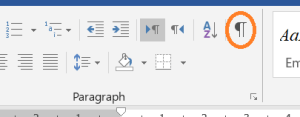
Choose Insert and then Page Break (or just press Ctrl/Enter). This jumps to the next page, solving the problem. But you can’t see the page break unless you press the Show/Hide button on the Home tab. This means you (or someone else) might inadvertently add something before the page break that should go after, or vice versa. This is why I prefer…


Method 2

Remember the styles I mentioned in Tip #1? If you defined your chapter headings with Heading 1 style, you can define the Heading 1 style to always begin on a new page. Here’s how:

  1. With the cursor on a chapter heading, click the little arrow in the bottom right corner of HomeStyles.
  2. Hover over Heading 1 in the Styles box and click the arrow that appears.
  3. Click Modify.
  4. Click FormatParagraph.
  5. Click Line and Page Breaks and then Page break before.
  6. Click OK twice.

Every Heading 1 paragraph will now appear at the top of a new page.

Of course, while you’re doing that, you might find other Heading 1 definitions to change.

Method 2 might look longer than Method 1, but you only have to do this once in order to make every chapter heading start on a new page.

Questions and suggestions for future topics are welcome in the comments below.

Links to Previous Word Tips

  • Tip 1: A Matter of Style
    About heading styles.
  • Tip 2: Make Your Novel a Trampoline
    How to jump swiftly and gracefully between chapters.
  • Tip 3: That’s Not What I Wrote
    How to stop Word making changes you don’t want.
Categories
Books Holidays

Cherry Blossom

Cherry Blossom
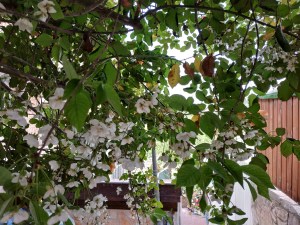
Cherry blossom in Jerusalem (not as colourful as in Japan, but still pretty)

The Philosopher’s Path in Kyoto, Japan is renowned for the cherry blossom that adorns the cherry trees that line its route.

Martin and Fiona get to visit it towards the end of their story, but they have to imagine the blossom. It’s autumn, not spring.

My husband and I also enjoyed our walk along this path, five years ago, in autumn. We didn’t see the cherry blossom either, but we did get to taste a Fuji apple on our trip. Martin and Fiona also experience the sweet, juicy taste of a Fuji apple.

Why am I telling you all this? Read my novel to find out.

Cultivating a Fuji - Front Cover

May 15, 2019 is Launch Day.

.

CULTIVATING A FUJI is released on 15th May, but there’s no need to wait.

Categories
Books The writing process

Word Tip 3: That’s Not What I Wrote

Microsoft Word Tips for AuthorsWelcome to the next in a series of tips on using Microsoft Word, geared towards authors.
Most Word advice is rather complicated and full of things you’ll never need to know.
I shall do my best to keep it simple, because you’re not stupid… just busy.
Please note: 
– Not all versions of Word are the same, but most are near enough.
– There are different ways of doing the same thing. I shall demonstrate just one (or two).

Sometimes the text in your Word document doesn’t look the same as what you typed.

I’m not talking about typos. We all make those occasionally. I’m talking about words that Word changes off its own bat. Microsoft calls this AutoCorrect. The idea is that it can change some of your typos and spelling mistakes automatically, because it knows better than you what you meant to write, or it thinks it does.

What if it doesn’t? What if you wanted to make up a word in your novel? What if your character talks funny and you wanna show some of her peculiar jargon, ini’? You don’t want Word to automatically change any of your carefully-chosen quirks, do you?

Personally, I know of very few words that I want Word to change automatically. I don’t mind seeing squiggly lines around my novel, but I think, apart from rare cases, making automatic changes is a step too far.

How do you stop Word making automatic changes?

Choose the following sequence of options:

File –> Options –> Proofing –> AutoCorrect Options… –> AutoCorrect

There’s a box called Replace text as you type. You can untick (uncheck) it. Then Word won’t change anything automatically. But what if certain automatic changes might be useful?

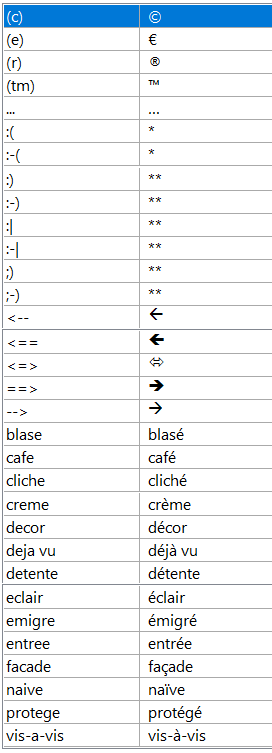
I decided to keep that box ticked (checked) and delete most of the strings it was changing. These are the ones I kept:

MS Word AutoCorrect Items

Questions and suggestions for future topics are welcome in the comments below.

Links to Previous Word Tips

  • Tip 1: A Matter of Style
    About heading styles.
  • Tip 2: Make Your Novel a Trampoline
    How to jump swiftly and gracefully between chapters.