Author, editor, attempter of this thing called life. Social anxiety warrior. Re-Connections, a collection of short stories, published with Ocelot Press, 15/10/2025.
In my previous post, I mentioned how a trip to Britain is unlike any other. Our visit to the London Transport Museum is also unlike a visit to any other transport museum could be. Why? Because we remember.
Years ago, before we moved away, we travelled on those old buses and trains that fill the museum. We remember the bus conductor, who rang the bell to signal to the driver that he (always he) could continue to the next stop, took our money and printed tickets using the machine that hung on her neck. “Only five standing,” he’d call out.
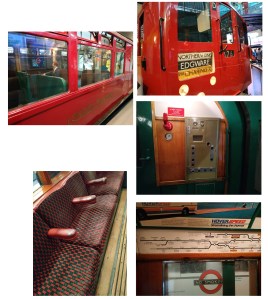
And we love revisiting the old tube trains, which really functioned just as they do today, except that they were much quieter. None of that, “Mind the gap between the train and the platform edge.” And definitely no, “See it, say it, sorted.”
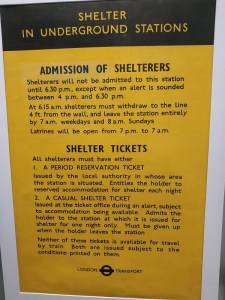
Of course, we see exhibits that even we aren’t old enough to remember. I find the film of the underground during the war very interesting and educational, as well as this notice. On all the occasions that I watched films of people sheltering from the bombs in underground stations during the war, I never realised how organised a procedure this was.
“I didn’t think you’d be interested in that,” said David of this museum.
The money tree we discovered on a different walk. Who said money doesn't grow on trees!
I’ve been away. Again. To a place that will always be special for me. Despite the forty-three years that have passed since I left Britain, it will never feel like any of the other countries I visit.
I have to admit that things have changed over that time. Now, if you sit in a pub, all the conversations around you contain that B word. Various associated terms float towards you in that noisy but cosy place. Terms like “no deal”, “remain” and “leave”. But pubs themselves remain the same: the bar where you order, the drinks, the food, the pleasant, friendly atmosphere.
And then there was Whaley Bridge. Despite its name, it’s a small town. If you live in Britain, you’ll no doubt have heard of it. We hadn’t. We just followed a hiking route that happened to end up in that town, which was convenient for us because we could catch a train back from there to Buxton, where we were staying.
The first sign we saw of something unusual was when we walked close to Toddbrook Reservoir.
“That’s strange,” said David.
“What?” I asked.
“The reservoir is empty.”
I looked across the field and, sure enough, there was no water in the reservoir.
The money tree we discovered on a different walk. Who said money doesn’t grow on trees!
The second sign was that our footpath was closed, with a notice saying it was closed for three months. We retraced our steps to the edge of the town, where a helpful resident told us which way to go to walk to the town centre.
Then we met two men, who told us a better way to walk (through a park) and said the authorities didn’t really know how long the work would take, but it would definitely be longer than three months. The conversation then diverted to the purpose of the reservoir and the history of a long-abandoned railway line. It was very interesting, but I won’t go into it here.
We followed their advice, reached the town centre via the park, and ordered and consumed cream teas before taking the train back.
Strange happenings always come in threes, or at least this series did. My friend Gill, who lives in that area, asked me, on Scrabble, what we’d done that day.
“We walked to Whaley Bridge,” I replied.
“Lucky it’s still there,” she commented.
Huh? What was that about? I googled “Whaley Bridge” and discovered the worrying events that took place just last month. The whole saga made it to the national news, despite the preoccupation with the B word. That’s why those we spoke to didn’t think to tell us what happened. It’s probably a result of sounding British, even though we’re not, any more… almost but not quite.
If you don’t know what happened at Whaley Bridge, you can google it, too.
When you’ve experienced everything you’re ever going to experience, it’s time to write: THE END.
…said I, although I’m probably not the first!
I’m back home after an amazing trip to China and Tibet. I’ve posted my photos and videos on Facebook, which must mean I’m well and truly back, and you’re welcome to view them, whether or not you’re a friend of mine there.
Labrang Monastery
Today, I’m thinking about firsts. Yes, even at my age, there are firsts.
The first time I went to China. The first time I went to Tibet. The first time I slept nearly 4,000 metres above sea level. The first time I climbed to almost 5,000 metres. My first plane ride in which the air pressure was increased as we took off. The first video I created for one of my books:
I’m taking a break, but Martin isn’t. You can still read about him in Cultivating a Fuji.
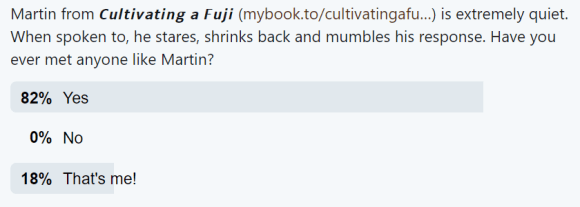
Just before I go, here’s the interesting result of the poll I’ve been running on Twitter this past week.
Look at that middle number: 0%.
In other words, of those who answered the poll, not one will have any difficulty imagining what he’s like. Either you’ll see yourself in him or he’ll remind you of someone you’ve met.
Think about it. If you’re one of the 18% and see yourself in Martin, you can compare your experience with his. If you’re one of the 82%, this is your chance to look inside his head and maybe gain an understanding of what’s behind the behaviour that you’ve witnessed.
And when you’ve answered the question – for which many thanks – you can read what I wrote about a question writers of fiction are often asked, on the wonderful Spirit Writer blog of Sandy Cee.
There are many other characters and the author does an amazing job of developing them all.
It is an intriguing and thought-provoking story, a very different read with a dramatic twist at the end that had me rethinking assumptions I’d made when reading the earlier part of the book.
————————–
[I] found it to be a moving description of social anxiety and just how traumatic a simple meeting can be for sufferers….yes there’s humour, but I found this to be a sad, poignant and thought provoking tale.
————————–
This is a book that is guaranteed to stay with you long after you read it, it is a book that really makes you think with a few surprises along the way.
————————–
Drori tells a story that can only come from a place of empathy and recognition. It says: “I know you. I see you. I hear you. I understand you.”
————————–
Cultivating a Fuji is a very touching story about how hard it can be to fit in the crowd. Martin’s character is well-developed and even the minor personalities have their own past and problems in this wonderful story.
————————–
These scenes were deeply uncomfortable for me, as someone who experienced bullying, so I’d be mindful of how you feel, but it’s written sensitively and in a beautifully validating way.
The thing I appreciated most about this novel was the way the author constructed a novel elevating social anxiety as a real, difficult thing. She either experiences the illness herself or has done her work. Where the Curious Incident with The Dog in the Night-time is a beautiful novel explaining autism, this, for me, is the work to explain social anxiety.
————————–
Even when I wasn’t reading the book I found I was thinking about it and counting down to when I could pick it up again.
This is an extremely important book for helping people gain an understanding of social anxiety, and just how deeply it can affect the entire lives of sufferers.
————————–
This is Martin’s story but there are multiple POVs to show not everyone thinks badly or only want to ridicule him. People want to help… they just don’t know how.
Cultivating a Fuji is a good read lovers of contemporary and literary fiction will enjoy, and the twisty conclusion will linger long after the story’s end.
————————–
Not everyone is without sympathy for Martin either but sometimes, as the book shows, people willing to help him (such as his boss, John) don’t know the best way to go about it or may inadvertently choose the wrong way.
There were some great scenes full of humour…
I really enjoyed the second part of the book in which we learn of Martin’s life following his return from Japan.
Cultivating a Fuji does a great job of highlighting the experiences of those with social anxiety disorder and the challenges they face using the medium of fiction.
————————–
I think the resilience Martin inadvertently learned from his school years, sets him on the path he takes, and propels the story forward into a new chapter in his life.
There are plenty of moments of contrition in this book, and the feel is generally cathartic. I did find certain aspects troubling, as I think we are meant to.
————————–
Miriam Drori has sensitively exposed the reality of living with social anxiety and the impact it has on all involved while creating a character I love in an uplifting, memorable novel.
————————–
Miriam Drori, the author, is a marvellous storyteller, especially in her ability to create real and relatable characters. You will be charmed by the story of Martin and all the people he meets. In this book, even the minor walk-on characters are fully developed with fascinating back stories.
————————–
It’s such a beautiful and thought provoking story.
The first half of this book completely and utterly broke my heart then tenderly pieced it back together, filling it with so much joy. This is really an uplifting novel.
————————–
I thought the choice to tell the story from both Martin’s perspective and the perspective of those around him added depth to the emotional landscape. The author seems to understand the challenges faced by those of us with social anxiety as well as the troubles that exist for others who try to interact with us.
————————–
This is a very cleverly constructed novel and beautifully written. There’s no preaching or wallowing. The author presents the issue of social anxiety and gives us a view from both sides: from those who experience it and those who feel that it’s OK to put others down and induce such misery. There’s hope and despair, love and disappointment, achievement and failure, happiness and missed opportunities in this richly textured book that’s rewarding and poignantly enjoyable to read.
And here are the articles I’ve written recently, mostly about the novel:
Welcome to the next in a series of tips on using Microsoft Word, geared towards authors. Most Word advice is rather complicated and full of things you’ll never need to know. I shall do my best to keep it simple, because you’re not stupid… just busy. Please note: – Not all versions of Word are the same, but most are near enough. – There are different ways of doing the same thing. I shall demonstrate just one (or two).
I expect you all know about Ctrl/C, Ctrl/X, Ctrl/V and Ctrl/S. But do you know about Ctrl/B – bold, Ctrl/I – italics and Ctrl/U – underline?
To see lists of all the keyboard shortcuts, search for keyboard shortcuts in Help.
There are other ways of performing these actions, but if you know the keyboard shortcut, it can save time.
Here’s one that I’ve found very useful: Shift/F3. Select a string and press Shift/F3. It has three modes: lower case, UPPER CASE and Title Case.
That’s how I introduced myself at this poetry reading:
I’ve never thought of myself as a poet, but I’m very proud of these poems and of the way I performed them at February’s IAWE (Israel Association of Writers in English) Parlour Reading. Perhaps I need to reinvent myself.
Welcome to the next in a series of tips on using Microsoft Word, geared towards authors. Most Word advice is rather complicated and full of things you’ll never need to know. I shall do my best to keep it simple, because you’re not stupid… just busy. Please note: – Not all versions of Word are the same, but most are near enough. – There are different ways of doing the same thing. I shall demonstrate just one (or two).
How do you write the word café? Or über? Or soupçon? Or Señor?
Word has a list showing how to write each diacritic mark. It’s the sort of list you can remember because it’s really quite guessable. Here it is: (I accessed this by clicking Help, searching for ‘diacritic’ and choosing Keyboard shortcuts for international characters.)
To insert this
Press
à, è, ì, ò, ù,
À, È, Ì, Ò, Ù
CTRL+` (ACCENT GRAVE), the letter
á, é, í, ó, ú, ý
Á, É, Í, Ó, Ú, Ý
CTRL+’ (APOSTROPHE), the letter
â, ê, î, ô, û
Â, Ê, Î, Ô, Û
CTRL+SHIFT+^ (CARET), the letter
ã, ñ, õ
Ã, Ñ, Õ
CTRL+SHIFT+~ (TILDE), the letter
ä, ë, ï, ö, ü, ÿ,
Ä, Ë, Ï, Ö, Ü, Ÿ
CTRL+SHIFT+: (COLON), the letter
å, Å
CTRL+SHIFT+@, a or A
æ, Æ
CTRL+SHIFT+&, a or A
œ, Œ
CTRL+SHIFT+&, o or O
ç, Ç
CTRL+, (COMMA), c or C
ð, Ð
CTRL+’ (APOSTROPHE), d or D
ø, Ø
CTRL+/, o or O
¿
ALT+CTRL+SHIFT+?
¡
ALT+CTRL+SHIFT+!
ß
CTRL+SHIFT+&, s
So, for example, to type the word café, type caf, hold down Ctrl and press ′ (apostrophe), then release the Ctrl button and press e. Voila!
While we’re on the subject of apostrophes, have you noticed how apostophes at the beginning of words in novels and other writing often appear the wrong way round?
That’s because… I should backtrack. You probably have smart quotes set up. That’s the feature that makes quotation marks at the beginning and end of a quote mirror each other. To see whether you have smart quotes set up, and to change the setting:
File → Options → Proofing → AutoCorrect Options → AutoFormat As You Type
Under Replace as you type, the option “Straight quotes” with “smart quotes” should be ticked (checked).
That brings us back to the problem of words that start with apostrophes.
Well, I happen to think it is. But it’s easily fixed. Word got it wrong because it thinks your apostrophe is a quote mark. All you need to do is a simple copy and paste, using an apostrophe that’s the right way round.
Next week… ooh, I’ve reached the end of the posts I planned, but there must be more possibilities. What did you always want to do with Word but didn’t know how? What would you like to be able to do in Word? You might find the option exists, but you didn’t know about it. Now is the time to ask me. Really – don’t be shy!
Welcome to the next in a series of tips on using Microsoft Word, geared towards authors. Most Word advice is rather complicated and full of things you’ll never need to know. I shall do my best to keep it simple, because you’re not stupid… just busy. Please note: – Not all versions of Word are the same, but most are near enough. – There are different ways of doing the same thing. I shall demonstrate just one (or two).
I was all ready to save you from automatic saves, today, but it turns out you don’t need saving, although your document does!
Once upon a time, Word’s default was to automatically save documents regularly. This meant that if you messed up your document by, for example, replacing a word that appears within other words (see Word Tip 7), you coudn’t return to the saved version because it had been automatically saved in the meantime.
But that is no longer the case. Now, if you look at:
File → Options → Save
you’ll see something called AutoRecover, which is probably set to jump into action every 10 minutes. This is good, I think. AutoRecover doesn’t affect your document; it saves its own version. If you close your computer without saving, if an update happens while you’re away from the computer, you will be offered the option of using the AutoRecover version.
However, as Microsoft says:
Important: AutoRecover does not replace the Save command. You must still save your document when you finish working on it.
Not just when you finish, in my opinion. Get into the habit of pressing Ctrl/S frequently. This is the best way of making sure you don’t lose a large chunk of work. And don’t forget to do backups.