Categories
Books Israel

Booths and Tales

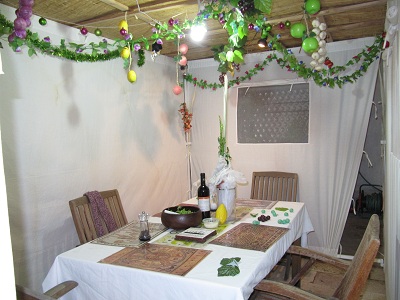
If you wandered around towns in Israel this past week, you will have seen strange constructions dotted around, fitted into every possible space – on the ground and on balconies. They’re temporary dwellings to remind us of similar dwellings in which the Children of Israel lived during the forty years that they wandered through the desert.

Yes, it was the festival of Succoth, during which Israelis, religious and secular, honour the tradition of building, eating in and sometimes sleeping in booths. I was lucky enough to be invited to eat in the Sukkah of David and Ruth:

In this wonderfully-decorated sukkah, I was treated to a delicious vegetarian meal and delightful company.

***

In other news, the Society of Authors has now made a recording of the Twitter story, for which I contributed the last line – read by a real actor. Here it is:

Categories
Books

Facts about Writers

Do you want to know what makes a writer tick?

Here are a couple of facts. The first is brilliantly funny. It’s here.

And if you’re still in the mood for something more serious, this is what Amos Oz says in A Tale of Love and Darkness:

… that sour blend of loneliness and lust for recognition, shyness and extravagance, deep insecurity and self-intoxicated egomania, that drives poets and writers out of their rooms to seek each other out, to rub shoulders with one another, bully, joke, condescend, feel each other, lay a hand on a shoulder or an arm round a waist, to chat and argue with little nudges, to spy a little, sniff out what is cooking in other pots, flatter, disagree, collude, be right, take offence, apologise, make amends, avoid each other, and seek each other’s company again.

The period Oz is discussing was a century ago, but what he says is still true today, the difference being that you can now do some of those things without leaving your room.

Happy writing!

Categories
Books Israel

Yesterday was a good day

Yesterday morning, I read Nicola Morgan’s blog post about  a tweetathon being organised by the Society of Authors as a protest against BBC Radio 4’s plan to cut the number of short stories it broadcasts. It seemed like a worthy idea and a fun activity, so at one o’clock my time I read the first line of the story and composed and tweeted my suggestion for the second line. At two o-clock I read the chosen second line and tried for the third line. Then the fourth. At four o’clock I tweeted my suggestion for the last line and took my laptop down to the kitchen to listen while I cleared up. Soon after five I thought I’d better check to make sure I hadn’t won  and discovered that I had. My last line was chosen to conclude the story.

Here’s the completed story. I’m thrilled.

Later on, I played Scrabble with my husband and my son, both good players, and I won easily.

Good things always come in threes, right? But there was no more time left yesterday. So, early this morning, I met my friend Marallyn and we sat outside in a quiet little cafe and discussed writing. We’ve often done this before, but not recently as Marallyn was away all summer. I’m looking forward to writing with her next week.

Categories
Books Israel

Improvement

It’s not often I get a chance to attend talks by authors, so I was happy to be able to go to one yesterday evening. I heard readings by Evan Fallenberg (from his new book, When We Danced on Water) and Abby Frucht (who is in Israel to teach creative writing), followed by a discussion on writing. A very pleasant evening.

And it was made more pleasant by the journey there and back. Despite my previous experience, I decided to brave the light railway again. What a difference! I left the house at 6:00 and arrived in the centre of town at 6:30. I couldn’t have done that by bus. I got a seat both ways and we didn’t stop for long at stations.

Now all I need is a sticker:

Categories
Books Social anxiety

Friends

I’ve always found it difficult to make friends – not because I don’t want them, although it probably seems that way. I tend not to contact potential friends because I’m sure those people don’t need or want me.

Online friends are easier to make, although the same doubts can appear here, too. When online friends become offline friends too, that’s wonderful. Such friends have the advantage of being able to see inside my head, as it were. Gill is one of those, and I’ll always be thankful that I rediscovered her online.

So I was delighted when I received the Liebster Award from Rosalind Adam.

Everyone says Liebster means “friend” in German, but I studied German and remember that friend is Freund. Liebster has to be connected to love. When I looked it up, I found: sweetheart, beloved person, darling. I’m not sure that’s exactly what’s meant here, so I’m taking it to mean a special friend.

The rules for this award vary from blog to blog. I chose these:

The Liebster Award is meant to connect us even more and spotlight new bloggers who have less than 200 followers – but hopefully not for long. The rules are:

1.Show your thanks to the blogger who gave you the award by linking back to them.
2.Reveal your top 5 picks and let them know by leaving a comment on their blog.
3.Post the award on your blog.
4.Bask in the love from the most supportive people on the Internet – other writers.
5.And best of all – have fun and spread the karma!

Actually the 200-followers thing only makes sense for blogs that display the followers and aren’t on WordPress so my list is only a guess:

Do visit them all. And many thanks to all  my friends. I love you all.

♥♥♥♥♥♥♥♥♥♥♥♥♥♥♥♥♥♥♥♥♥♥♥♥♥♥♥♥♥♥


Categories
Books

A Change of Mind

I promised to write something about Howard Jacobson’s The Finkler Question. I did write the post. But I decided not to post it. It was too personal. Sorry. I’ll be back on Thursday.

Categories
Books

Writing for Readers

There’s an interesting discussion going on, described by Catdownunder. It caused me to ponder the following question:

If you write for readers, which readers do you write for?

Presumably, the answer is that you write for the majority. Which begs the question:

What about the rest of us?

Do we always have to put up with what the majority want?

I’m thinking of Jodi Picoult’s book, Nineteen Minutes. I read it because someone told me it’s about bullying. The book says several important things about bullying and I felt a lot of empathy towards the main character, despite the terrible crime he committed.

But.

I didn’t like the ending. I felt as if the author said, “My readers want a surprise, so I’ll tack one onto the end and then go through the book and throw in some foreshadowing.”

Also, the back-cover blurb mentions nothing about bullying. Would the majority of readers be put off if they knew that was the topic?

And what about readers who don’t know what they want? Must they be limited in their reading by people who tell them, “This is what you want”? Like my mother, who insisted on reading the Alice books to me because I was supposed to like them.

Catdownunder suggests another way, one that sounds more difficult to pull off but is probably more satisfying for the reader, whoever he or she is.

Categories
Books

My 80-Day Word Challenge

On May 1st, I joined several other writers hoping to write 80,000 words in 80 days. For the first three days, I wrote just over a thousand words each day. Then I got stuck and couldn’t decide how to continue my story. After a few days of not writing, I continued but didn’t write every day and usually didn’t write as many as a thousand words on the days I did write.

Now that the challenge has ended, I can tell you my grand total:

26,122

I didn’t quite make it. I didn’t get anywhere near. But I’m not disappointed. I wrote a lot more than I would have done without the challenge, and next time I’m going to do better. As long as I internalise some of the lessons I learned.

Like Annalisa, who managed 43,457 words, I’m going to list those lessons:

  • I like to write in the garden, but I can write elsewhere, like the bedroom, the living room, a bus.
  • A week on holiday doesn’t mean a week away from writing. It means three weeks away from writing: one on holiday and two more to get back to the routine.
  • To write a thousand words a day, I need to plan properly beforehand. I need to get to know the characters, find out the details and, above all, to work out the plot. Anything can change while I’m writing, but I don’t want to come to a standstill.
  • No disaster will occur if I’m not on Facebook and Twitter 24 hours a day.
  • I need to find a better hiding place for my pens. The drawer of my desk is too obvious.
  • I will get to the end of the story before I hit 80,000. That’s all right, because when I go through it, I’ll think of all the things I should have written.

Many thanks to Sally Quilford for organising this. I’m looking forward to the next one.

Categories
Books Social anxiety

I’m me and that’s all right

At the end of December, I wrote some new year resolutions. I don’t think I’ve kept any of them, including the first:

  • Read at least one book every week.

But I’ve come to the conclusion that I don’t want to read a book every week. I want to savour books. I want to remember parts that made an impression on me, and think about what they mean. To me.

The book I’m reading now, Eat Pray Love by Elizabeth Gilbert has a lot to say and plenty that I want to remember. Like: when you interrupt others, you’re saying, “I believe that what I am saying is more important than what you are saying.” And that has to mean, “I believe that I am more important than you.” Not that I do much interrupting, but it’s an insight into those who do.

The book is also full of jokes, which also say something. Like: “Sometimes the best way to get over someone is to get under someone else.”

And I’ve never read anything before that makes depression humorous. Maybe I should try that with social anxiety.

I’ve taken so long to read this book that I’ve had to renew it at the library. But I’m totally OK with that.

I’m also not beating myself up over not keeping up with the 80,000 words in 80 days challenge. I can’t write that fast – especially when I also have to work out what’s going to happen next in my story. But that’s OK, because joining that group of writers has made me think about my novel every day and I’ve got further with it than I would have done without that incentive.

And maybe I haven’t kept any of those resolutions, but I’ve kept another one: not to hate myself to love myself.

Do you love yourself?

Categories
Books

The Power of Twitter

Yesterday was an unusual day on Twitter. Or maybe it wasn’t. I don’t usually look at the trending topics. Yesterday I did. I looked at a topic called #lessinterestingbooks, because it was started by the author Nicola Morgan.

This is what happened: Nicola started a topic, just for fun. The idea was to change the names of existing books to make them, well, less interesting. The idea spread like wildfire, and in a very short time, people all over the world were composing less interesting book titles, and Nicola’s hashtag was at number one. (If you want a fuller explanation of what happened, you can read about it on Nicola’s blog.)

Of the many titles I looked at, I saved one of them: The Da Vinci Assembly Language by @lukedones, whoever that is. I really liked that one, but possibly you have to be a former computer programmer to appreciate it.

Anyway, apart from the fun of reading the titles, I think there are some interesting lessons to learn from all this:

  • Twitter, used in the right way, is a very important tool.
  • There are a lot of bored people out there looking for a new game or any excuse to do something other than what they’re supposed to be doing.
  • I, of course, was much too busy to spend my time making up silly titles or reading them. Well, I only wrote two or three and read … hundreds.

And not just that. Some people used the hashtag incorrectly. Instead of making up names, they tweeted real names of books they found less interesting, or they wrote something like “all school history books” or “book name, which I was made to read at school” or “all books” or “I don’t read.” From which I deduce:

  • Some people just don’t get it. But then it’s possible that the use of the hashtag changed somewhere along the lines, a bit like the game, Chinese Whispers.
  • A lot of people don’t read (but we knew that anyway)
  • A lot of people are put off reading at school

I was put off reading at school. I was made to read books I wasn’t mature enough to understand, and so I found reading boring. I thought it wasn’t my thing. It took me years to get back into the habit of reading again and longer to believe I could write.

So I think the education system – every education system – needs to be changed. It needs to acknowledge that pupils are all unique. It should stop insisting that all children in a certain class/form/grade have to read the same books. I realise that would make the teacher’s job harder, but wouldn’t that be better than churning out people who never want to read again?