I just spent a few days in Berlin, which is probably what triggered my entry for the 100 word challenge. I’ll try and make next week’s lighter.
This week’s challenge is to add 100 words to:
….The flame flickered before….
The Last Candle
She opened the door of a kitchen cupboard, bare apart from one solitary candle. Only one by which to remember all those they’d taken. Her father, her mother and her two brothers. Her whole family. What would she do when this one burned out? She struck a match and lit it, fastidiously blowing out the match and throwing it in the bin. Then she sat and watched, seeing the images of those she loved inside the flame. She knew it was only a matter of time.
The single remaining candle turned out to be enough. The flame flickered before they broke down the door.
There aren’t many writers’ conferences in Israel, but there was one this week and there will be another next week. This week’s, in Bar Ilan University, was free and I decided to go along yesterday.
I attended all five sessions and they were excellent. The first, with Joseph Skibell and E. Ethelbert Miller discussed memoir writing. I loved the way their advice was interspersed with humorous asides. I think it was E. Ethelbert Miller who talked about being the baby of the family. He said, “Growing up, I thought my name was Shh.”
They gave us an exercise to sketch a floor plan of our first house and list five sensory details from it, and then discuss it with a partner. In a second exercise, we recalled a gift we’d received, reflecting on why it was valuable, what was symbolic about it and the stories behind it.
In the poetry session with Linda Zisquit and Joy Katz, they invited people to relate a memory. Then they told us to “write a poem about something that scares you.” Writing the poem was pretty scary in itself, as I don’t write poetry. Not only did I write it, but I read it out loud.
“We need a volunteer. You.” The finger is pointing at me. Me! “Stand up. Turn round. Tell us about a memory.” “But….” “Just do it.” I want to say, “You don’t understand.” I want to say, “I can’t do this.” I want to say, “I suffer from social anxiety.” Ten thousand eyes are looking at me. Ten thousand ears are waiting for me to talk. “No – sorry.” I sit down and rest my head on my knees.
In the fiction session with Evan Fallenberg and Joan Legant, we analysed a whole (three-paragraph) story by Etgar Keret and then wrote two paragraphs of our own story, starting with one of four prompts. The main advice from the session was: resist. Resist the obvious plot and resist obvious words.
In a fascinating concluding session, Etgar Keret himself was interviewed by Evan Fallenberg. I wrote down just two of the many interesting things he said.
In couple therapy, there’s an exercise in which one partner falls backwards and lets the other partner catch them. So, when you’re writing close your eyes, fall backwards and wait for the story to catch you. Sometimes it does. Other times you find yourself on the floor with a bump on your head.
Only when you’re writing can you do anything you want. You can be rude to your mother, make a lot of noise, anything. Etgar doesn’t want to compromise this freedom for any audience by making his stories more universal.
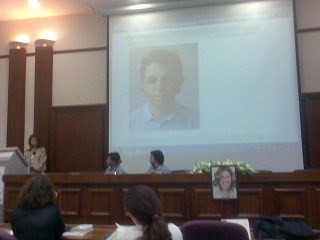
At the very end I took an awful picture with my phone.
Creative Writing Conference, 08 May, 2012
Keret is on the right and the screen shows his picture as it appears on the cover of his latest book: Suddenly, a Knock on the Door.
This week’s prompt is “RUBY”. I found myself being influenced by some Stones. Sorry the theme is similar to my last story. I think they complement each other.
Goodbye Ruby
Monday, she’s the office executive, toiling long after the others have left.
Tuesday, she’s the doting mother, kissing away pain and remembering to listen.
Wednesday, she’s the caring daughter, running errands for those who no longer can.
Thursday, she’s the volunteer, giving to society for no financial gain.
Friday, she’s the exercise freak, working out to work off all the excess grams.
Weekend, she’s the cleaner, the cook, the hostess, the party-goer.
They’re full of praises. They say she’s wonderful. They’re amazed she manages to do so much. I know one role she’s forgotten about. Goodbye Ruby. I’ll miss you.
I had fun with the sonnet, so I thought I’d try again. This time I have to write 107 words including:
….I’m exhausted. Shut the door behind you….
Here goes….
He’s making for the door. I don’t blame him, but I was looking forward to this evening so much.
Work was a nightmare today. Then I had to dump everything and rush to collect the kids and Tom had broken his finger so I dragged them all to the hospital, then home for homework and food and stopping them from fighting and they wouldn’t go to bed and I nagged and threatened.
I prepared the meal in a hurry. We ate in silence. I was tired.
And now I can’t keep my eyes open. I’m exhausted. “Shut the door behind you,” I mumble. I think it banged.
I never really thought I’d succeed in writing 100k words in 100 days, which was Sally Quilford’s challenge starting on 1st January. But I joined to see what I’d manage. And Sally wrote:
As far as I’m concerned, if you get to 9th April having written 30k words, and it’s more than you’d normally write, you’ve done well!
Firstly, I’ve been helping to edit a series of novels by David Rory O’Neill. The novels are all connected but can all be read alone. Together, they span over a century and are full of very reachable characters, who overcome personal issues and historical events, keeping readers turning the pages. I love the stories, and sometimes find myself continuing with the editing when I should be doing other things.
One of these books, The Prairie Companions, will be free to download for a few days from tomorrow. This is a wonderful chance to sample a lovely set of novels.
—o—
I’ve just completed an online course. I’ve never taken an online course before, so I can’t compare it with anything, but this course was everything I expected and a lot more.
It’s Sally Quilford’s Pocket Novel Workshop. She’s running another one in June, and I highly recommend it. I found it extremely helpful and enjoyable. Sally hands out plenty of information and sets useful exercises. Her expert comments on the exercises provide very helpful advice for all participants.
If you’re wondering about this genre, I did too, once. Until one day when I felt things were getting on top of me and I happened to have a romance with me and I let it take me away to another world. Pocket novels are a form of escapism. Sometimes, it’s just what you need.
Three days ago, someone I follow on Twitter retweeted a competition announcement by Writers & Artists (@Writers_Artists). Contestants had to write a Twitter story using the word disguise and the hashtag #flashtwiction. So I wrote one:
20:30 “A thief! Brilliant disguise! Come in.” 23:30 “So, madam. You opened the door and welcomed him in. Is that right?” #flashtwiction
I didn’t expect to win it and didn’t even wait to find out who won. Just today, I happened to press the right button to discover that I was one of two winners and they’re going to send me a copy of Writers’ & Artists’ Yearbook 2012. Isn’t that exciting?
I’m surprised at people who don’t know the rule about danglers. I suppose it’s a bit like the offside rule in football. I must admit I don’t understand that one, but as I’m not interested in football I’ve never bothered to find out. Danglers though… if you’re a writer, that seems an important one to know.
After moving to a 5-2 lead in the decider, Murray played the game of his life to break to love and then held another three break points at 5-5.
It looks okay – if you don’t know about tennis, that is. If you do, it doesn’t make any sense because, if Murray had been leading 5-2, he wouldn’t have needed to win any more games to get to 5-5. No, it was Djokovic who was leading 5-2.
When I gave a presentation on editing, I created this slide about danglers:
I have to face up to it. I’m never going to write 100,000 words in 100 days, which is what I pledged set out to attempt to do by joining Sally Quilford’s challenge.
BUT I’m not disappointed. I have written something every day since the challenge began. Sometimes I managed over 1,000 words. Other days I wrote fewer words. Today, I wrote all 120 words of a whole piece and that’s enough for today. I shall spend the rest of the day reading, editing and critiquing.
For me, writing 1,000 words every day is too much. Writing something every day is possible and is a practice I plan to continue after the challenge ends.
I’ve read two recent blog posts about foreign settings in books – one by Rachelle Gardner, the other by Nicola Morgan.
In my son’s English class, when he was about nine, the pupils were made to read an American book written totally in a dialect I found hard to follow. My son didn’t understand it at all. When the same book was suggested for my younger son’s class, I complained and the book was changed.
There’s no point in reading a book you can’t understand, but as long as you can, does setting matter? Personally, I like to read about places I’ve never seen. I also like to read about places that are familiar.
What about other readers? Are they usually interested in books set in foreign places? Apparently, Americans are less willing to read books with foreign settings than readers in other countries.
I have another question about setting. I generally set my stories in England, where I used to live. I would like to write stories set in Israel, where I live now. But I think readers generally expect specific topics to appear in any book set in Israel: war, political conflict, etc. I think they believe Israel is one of those countries where it’s impossible to lead an ordinary life. Am I wrong?