Author, editor, attempter of this thing called life. Social anxiety warrior. Re-Connections, a collection of short stories, published with Ocelot Press, 15/10/2025.
Today, 23rd March, is a day for going out and for celebrating coming out.
I, together with the rest of the citizens of this country (hopefully) will be going out to vote. It’s only a year since we last voted and we all hope the next government will last for longer. Unfortunately, it’s unlikely that the election results will give a better advantage to any party.
Voting in 2013
Today is also an anniversary. Twelve years ago, I began this blog, tentatively, anonymously, scared to own up to having social anxiety, even though I knew it was obvious. Optimistcally, I called the blog and myself “An’ de walls came tumblin’ down.” They haven’t tumbled, but they have some large chinks.
Nevertheless, a lot has happened in that time. It could all be summed up in the words “I came out.” It’s made a big difference to me that I can write about having social anxiety and give presentations about it, even though it’s still hard to talk about.
Where were you, twelve years ago? Have you changed over the years?
Today, I’m delighted that author Paula R. C. Readman has come to visit. Her story is one of perseverence against all odds. I am in awe.
The power to be able to change the direction of your life has always been strong in me. I guess it started in school after reading Alfred Lord Tennyson’s poem The Brook. The poem spoke to me about the certainty of changes as the brook makes its journey down the valley as it heads towards the river. The line that’s repeated throughout the poem is ‘Men may come and men may go, but I shall go on forever.’
To me, the poem talks about the driving force of the brook to remain on course with its aim to reach the river, its final destination, no matter what obstacles stand in its way. Like the brook, we all have to deal with barriers that stop us from following our dreams. Mine was the lack of a good education and my dyslexia. I was diagnosed in my junior school but it wasn’t followed up in my senior school. Thus I was labelled slow of learning, which I found very frustrating.
I’ve always had a deep love of books and spent my teenage years at the weekends in a library near to where I lived. I would spend all day reading books on different subjects until closing time. With the help of a librarian assistant who filled in a form for me I was able to take books home to read during the week until my next visit.
At sixteen while travelling to work, I would read novels on the bus. Whenever I got stuck on a word I couldn’t pronounce I would look it up in a small dictionary I carried, to know what the meaning was, so I could try to understand the context in which it was being used. I knew my lack of an education was holding me back, plus I felt deeply embarrassed, too. Being titled slow of learning at school haunted me while I sought work and limited my expectations of life.
By the time I was in my thirties, life had thrown me a few spanners and stopped me from following my dream to be an artist. I failed to get into college, unable to pass the English entry exam to do an art course. Art was the only subject I managed to shine in at school. I loved drawing. My parents’ marriage had broken up when I was in my teens, so they weren’t very encouraging. On the whole I was expected to be self-sufficient, so I became my own driving force wanting to better myself.
I worked mainly in low paying jobs, so money has always been tight for me. My first marriage broke down and I was left supporting myself and a young son while paying off a mortgage and loans. This didn’t leave me much time to think about my dream of being an artist. It was only when I met my second husband, Russell, that I could once again follow my creative heart.
One day at work with my fortieth birthday looming, I decided to become a writer instead of being an artist, to tackle my fear of writing head on. I decided if third world children could learn from books then so could I.
I set myself a challenge to have something published by the time I hit fifty. First I started with non-fiction and wrote several articles connected to my family history. Then I wrote a short story which I showed my work colleague, Lisa Moulds. She told me she wanted to know more about the character. This led me to write a novel.
The novel suffered thirty-five rejections so I set it aside, deciding I needed to work on my writing skills. So for years, I focused on writing short stories and tried to get published that way. I felt I needed to build a body of published work. I wrote a second novel and tried to get that one published too, but once again, more rejections. Slowly, my short stories were beginning to be published which helped build my confidence. Then in 2012, I won the Harrogate Crime Writing Festival & Writing Magazine Short Crime Story competition. My winning story Roofscapes became my inspiration for my third novel. This suffered thirty-seven rejections but I wasn’t willing to give up. With the help of an online friend, Kim Martins, I spent eight months working with her and learnt how to edit. I submitted it to Darkstroke who accepted it. In 2020 I had three books published, and this year I’m pleased to be able to say the first novel I wrote has been accepted for publication. I guess the power of belief is still flowing strong in me.
About Paula
Paula R. C. Readman is married, has a son and lives in Essex, England, with two cats. After leaving school with no qualifications, she spent her working life mainly in low paying jobs. In 1998, with no understanding of English grammar, she decided to beat her dyslexia, by setting herself a challenge to become a published author. She taught herself ‘How to Write’ from books her husband purchased from eBay. After making the 250th purchase, Russell told her ‘Just get on with the writing.’ Since 2010 she has mainly been published in anthologies in Britain, Australia and America and won several writing competitions. In 2020 she had her first crime novella The Funeral Birds published by Demain Publishing, a single collection of short stories Days Pass Like A Shadow published by Bridge House Publishing. Her first crime novel Stone Angels was published by Darkstroke, who will now be publishing Seeking the Dark, May 2021.
Next week’s post in this series will be from… me. I want to show you that belief doesn’t have to be connected to writing! These posts don’t even have to be about true stories, although next week’s will be.
If you want to take part, do let me know via Contact above or social media.
Here to start this new series is friend and fellow author: Val Penny. Welcome back to the blog, Val. Where are you taking this theme?
I had always wanted to write a novel, and indeed had written a story for my little sister when we were both small children. I still have that book.
However, as I grew up and started work, I spent my time writing opinions and documents to the extent that any ideas of writing fiction had to be put to one side. Interestingly, though, life does not travel in a straight line and after I was diagnosed with breast cancer, I took early retirement.
I was lucky, the disease was diagnosed early, my husband was able to attend every chemotherapy appointment with me and a local charity provided drivers to take me to each of my daily radiotherapy appointments. However, the treatment left me exhausted and unable to undertake any of my interests or hobbies. Also, I don’t know if you’ve noticed, but day-time television programmes leave a lot to be desired! I was tired, but not too tired to complain.
My husband bought me lots of novels and I read voraciously. Then I started a blog to allow me to review the books I read: www.bookreviewstoday.com but even that didn’t hold my interest.
Eventually, my husband said to me, “If you know so much about what makes a good book, why don’t you write one?”
I doubted that I had the talent or the energy to complete a novel, but my husband encouraged me. He believed in me. He still does and he made me believe in myself. When I sent off my manuscript to two different publishers and was accepted by both, his belief and mine seemed justified.
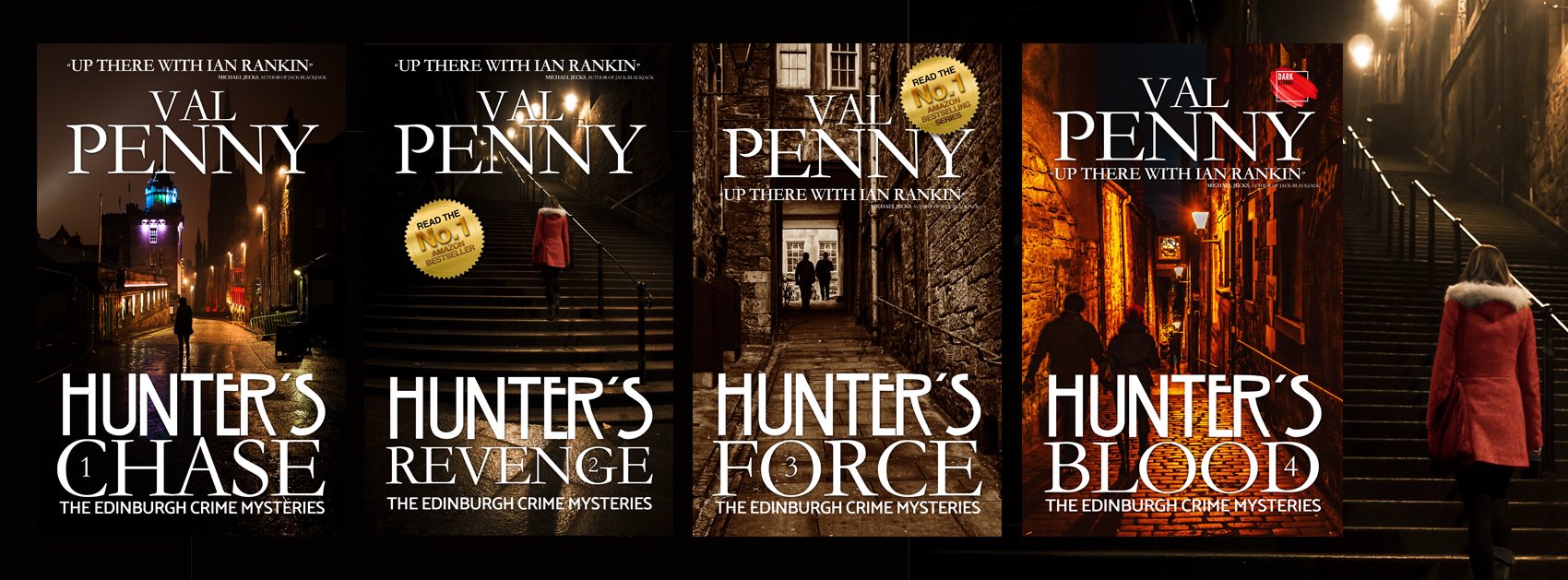
Without my husband setting me the challenge and having the belief in me to write a book, I never would have done it. Now I have five published novels and a nonfiction book under my belt. If you enjoy crime fiction, read The Edinburgh Crime Mysteries published by darkstroke.
Ah, where would we be without our other halves!
About Val Penny
Val Penny’s crime novels, Hunter’s Chase, Hunter’s Revenge, Hunter’s Force,Hunter’s Blood and Hunter’s Secret form the bestselling series The Edinburgh Crime Mysteries. They are set in Edinburgh, Scotland, published by darkstroke Her first non-fiction book Let’s Get Published is also available now and she has most recently contributed her short story, Cats and Dogs to a charity anthology, Dark Scotland.
Val is an American author living in SW Scotland with her husband and two cats.
Next Friday, look out for an amazing story of belief by Paula R C Readman.
To post in this series, you don’t have to be an author and the post doesn’t have to be about writing. Tell us about belief making things happen, whether true or fictional, personal or not.
If you want to take part, let me know via Contact above, or through social media.
My new novel, Style and the Solitary, is the story of Asaf and Nathalie. Everyone believes Asaf is guilty apart from Nathalie. She is sure he’s innocent and, spurred on by her confidence in him, he gradually changes and opens up.
The Power of Belief will be my 2021 blog theme. Do you have a story in which someone’s belief that something can happen has made that dream come true? It can be a personal account, or one you’ve heard about. It can be made up, from a story you wrote or one you read.
From next Friday, and every Friday for as long as it lasts, I will post these stories here on my blog. Do contact me if you want to take part. First up next week is crime writer, Val Penny.
~~~~~
Style and the Solitary will be published by Darkstroke on 26th April. The ebook can be pre-ordered now from Amazon.
GREEN. If that were the solution to a cryptic crossword clue, what might the clue be? Answer: a new genre.
As it happens, a new genre (for me) is exactly what my latest novel is written in. It’s a murder mystery, called Style and the Solitary. Set in my adopted city of Jerusalem, it begins with a murder and a suspect – a suspect who is unable to defend himself. Fortunately, there’s someone who believes in his innocence.
Style and the Solitary will be published by Darkstroke on 26th April, 2021.
GREEN is also the dominant colour in the gorgeous new cover.
Is there anything you want to say about the colour green, or anything else for that matter? You’re welcome to comment below.
No doubt, I’ll be writing more about this novel in the coming weeks. Topics will include Jerusalem, NaNoWriMo, friendship and maybe even social anxiety.
In the meantime, Cultivating a Fuji, my uplit novel set in Bournemouth (UK) and Japan has been rereleased and is available on Amazon.
For a short while, the paperback on Amazon UK is only at this link.
My husband and I are lucky to have been on some amazing trips around the world. One of them took place seven years ago in Japan. In three action-packed weeks, we toured a country that is like no other – modern yet traditional, beautiful and quaint.
Street performance in Kanazawa
We dressed in traditional clothes and consumed local food and drink.
But we remained most definite outsiders. In three weeks, we couldn’t possibly begin to know what it’s like to live in this weird and wonderful land. And it’s only as an outsider that I’m able to write about Japan.
Fortunately, Martin, the main character in my novel: Cultivating a Fuji, also visits Japan as an outsider. Unfortunately, he has lived his whole life as an outsider, starting at school where he was ostracised and bullied.
When Martin is sent to represent his company in Japan, nobody believes he can succeed. He surprises everyone, including himself, but that’s only the beginning.
Edition 2 of Cultivating a Fuji will be released on 22nd February 2021. You can pre-order it now from Amazon at mybook.to/CultivatingAFuji.
What’s New?
Not a lot, so don’t buy it if you’ve read it. I’ve made minor improvements to the text. And I’ve changed the very beginning and the very end.
The beginning is important because the first sentence needs to make an impression, but the story remains the same.
The ending is now the one I really wanted for the first edition, before I allowed myself to be persuaded by a suggestion from an author I admire. Instead of explaining why my ending worked better, or simply ignoring the suggestion, I persuaded myself that she knew better.
So, for me, this novel has been a lesson in trusting myself as an author. It’s important to listen to what readers have to say, but ultimately the decision must remain with the author.
Fortunately, this novel has been enjoyed by many and I hope it continues to satisfy readers and make them reflect.
It’s been a while since I wrote my Word Tips for Authors. However, I recently thought of a new one:
When you’ve finished editing a manuscript using Track Changes as described in Tip 6, you need to accept all changes and turn off Track Changes in order to continue with publication. My advice is to read the whole manuscript again at this point.
Why? Because sometimes things aren’t what they seem. I’ve noticed several mistakes in novels that I believe arose because the manuscript wasn’t read at this stage. For example, sometimes there are words that shouldn’t be there, like:
At the back of the bus was a the girl.
Probably, ‘a’ was changed to ‘the’ or vice versa and it wasn’t clear, while Track Changes was on, that the change wasn’t made correctly.
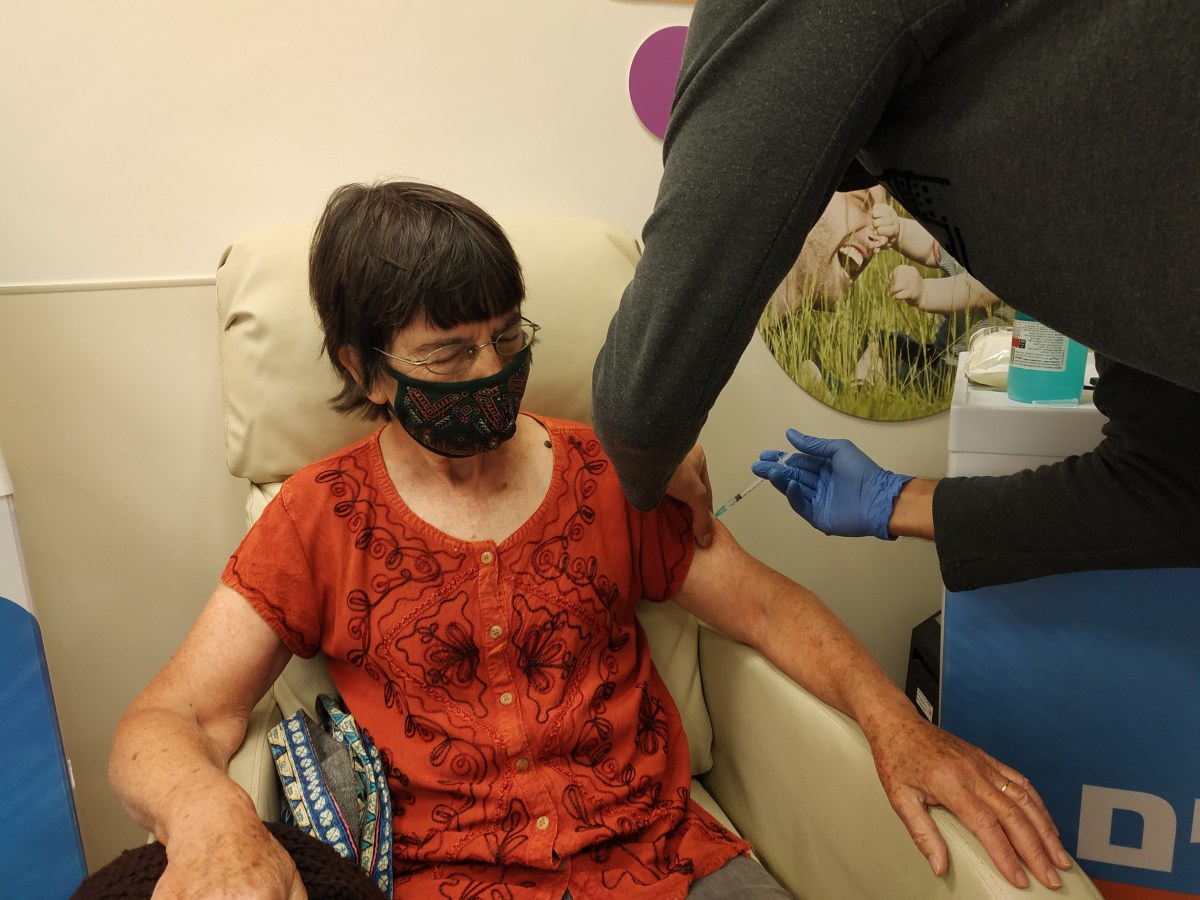
Yesterday, I got the first of two doses of the Covid-19 vaccination. The process was easy and well organised, and I’m feeling fine, thank you.
No country is perfect, Israel included, but it’s in times like these that I feel most proud of my little country. I think this article does a good job of explaining why Israel has succeeded in vaccinating a much higher proportion of its population than any other country. Basically, it’s due to our health service and the way it’s run, with clinics all over the country, and our ability to mobilise in times of emergency.
When makes me annoyed? When I read in the foreign press that Israel is going ahead with vaccinating while Palestinians have to wait. The fact is that Israeli Arabs have the same rights to health care (including vaccinations) as everyone else in Israel. Those who live in the Palestinian Authority have their own systems in place, independent of Israel. Israel is not responsible for their vaccination programme, although it will probably help them.
My appointment for the second injection is in three weeks. I would love for it to be followed by a trip to the UK, my home away from home. Sadly, I don’t see that happening.
Stay safe and healthy, everyone, wherever you are.
2020 – the year when nothing happened. Hang on… is that true? Something must have happened. Let’s see.
Best Holiday (Vacation)
We only had one proper holiday, but it was a wonderful, action-packed tour of neighbouring Egypt in January. I’m so glad we made the last-minute decision to join the tour.
Best Book Read
I read several wonderful books, this year. This was the best. A combination of secrets, lies, and great plotting and writing was what made this novel stand out.
Best Book Written
No contest there. I wrote only one book and wouldn’t have completed that without NaNoWriMo and our wonderful municipal liaisons. (I’m still editing it and hope to have it finished soon.)
Best Book Published
I’m proud to have my short story, Gruesome in Golders Green, in this fabulous collection of short stories, all inspired by the city I grew up in.
Best Photo of Me
Taken by my son for Independence Day.
Best Addition to the Family
Our granddaughter! She’s almost six months old, now.
Yes, some bad things happened, too. The main one was losing a very good friend.