A lot of things have changed since I was young. One of the things is that we talk about mental health. That is, we talk about certain types of mental illnesses and disorders, while others are still off the radar.
One of the disorders that is still not talked about much is social anxiety disorder, which I defined here.
There are reasons for that. By definition, people who have social anxiety don’t like to draw attention to themselves at all. They particularly don’t want to admit to what feels like a very big failing. But it needs to be talked about, because a lot of people out there are suffering needlessly. They suffer from loneliness, from a lack of empathy and understanding, from embarrassment, from anxiety itself.
So, for my contribution to World Mental Health Day, I’m linking to an article I wrote last year for Stigma Fighters: Pressing the Button.
Help me if you can, I’m feeling down.
And I do appreciate your being ’round.
Help me get my feet back on the ground…
The Beatles
I suffer from HAY fever. No, not that hay fever; I’m glad to say that has never troubled me. I’m talking about that HAY question, the conversation starter: How are you? At least it’s usually a conversation starter. Except that, in my case, it usually isn’t.
When I hear that question, I break out coughing, sneezing and spluttering. No, not literally, but the anxiety-filled equivalent: panic. Spluttering inside and nothingness outside. Confidence in one thing only: this will not go well. And through it all, I force myself to continue.
“Fine, thanks. How are you?”
Answer.
Here’s where every other conversation slips seamlessly into something meaningful. In the current conversation, there’s a pause that lasts slightly too long until the other person moves away to talk to someone more fun, more interesting, more communicative. Clearly I’m boring and miserable, and I don’t want to talk.
Oh, but I do. It’s just that a topic for discussion with someone I hardly know doesn’t come to me. Yes, I could make it up. I could sit alone in my garden or at my computer and make up a conversation between two relative strangers. I could make the speakers hesitate if the plot demands it. I could make the words flow if I want them to. Because the speakers are puppets and I’m pulling the strings.
Who’s pulling my strings when I’m down there on the stage? Whoever it is, is slacking on the job, or letting the strings go slack.
I began this post thinking that it would end in a plea for help. Please tell me what to say to someone I hardly know to stop them before they glide away. But maybe I know what to say. I just have to be able to rummage around the jumbled handbag of my mind and pull out the words I need at the right time. Or to put the words in the front pocket well in advance, so that they’re easy to find when I need them.
There, I’ve answered my own question. But don’t let that stop you from offering advice. It will still be appreciated.
Following on from my announcement of changes to my blog, this post links all three themes of my blog: writing, social anxiety and living in Israel.
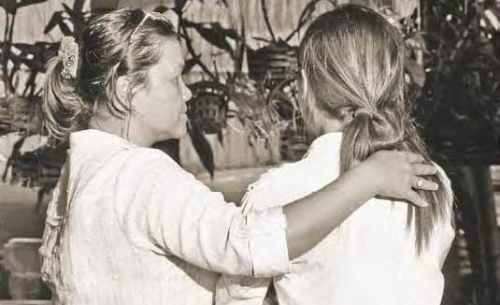
I get it when women say they need to talk problems over with women friends. There’s something about the conversations that makes them different from conversations with men. Yet, for most of my life, I didn’t have any women I was close enough to to confide in. Social anxiety caused that. It told me to keep my distance from women… from everyone… because while I needed them, they didn’t need me or want my friendship and I shouldn’t cling to them.
I still don’t meet other women very often, but I’m getting better at it. There’s one I often meet. We write together and talk, too. And two days ago I met up with someone I haven’t seen for many years. I even initiated the meeting and travelled all the way to Haifa for it. Well, for this country it’s a long way. The bus journey from Jerusalem to Haifa takes all of two hours.
We had a pleasant and interesting chat together. She also gave me a brief but fascinating tour of Rambam Hospital, where she works. In particular, I saw how the underground carpark can be turned into a whole hospital in times of emergency. Amazing!
Sir Winston Churchill at the Churchill Building, Technion
As I was in Haifa anyway, I did a bit of research for a novel I began in November and plan to return to. I wandered around The Technion Institute of Technology and found some details to add or change in the novel. It was hot and humid and the paths of the campus, up there on the Carmel mountain, are very steep, but I’m glad I went.
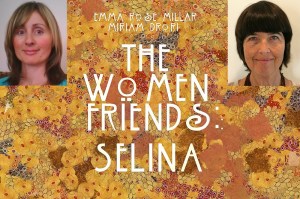
The title of this post also has a different significance for me and connects to the exciting news I hinted at in my last post. Along with another author – the lovely Emma Rose Millar, who appears again at the end of this post – I have been working on two novellas based on the painting The Women Friends by Klimt. The first, which will be published early in 2017 by Crooked Cat, tells the story of Selina, a country girl, desperate to escape the demons of her past and searching for solace in the glittering city of Vienna. The second novella follows Janika, who is Jewish. It begins when the first novella finishes, in 1938, a time when Vienna wasn’t a good place for a Jew to be in, to say the least.
So that’s my big exciting news. If you’re interested, you can also read about how I’m spending the summer over on Nancy Jardine’s blog. How are you spending your summer? Or winter, if you’re in the other half of the world?
~~~~~~~~~~~~~~~~~~~~~~~~~~~~~~~~~~~~~~~
Author of the Day
Today, I highlight two authors – the two who appear in the post.
Emma Rose Millar writes historical fiction. Five Guns Blazing, set in the eighteenth century and written together with Kevin Allen, follows a convict’s daughter from London to Barbados. More information is on Emma’s blog.
Nancy Jardine is a multi-talented author, who writes historical romantic adventures, intriguing contemporary mystery thrillers and YA time travel historical adventures. Her published novels are too numerous to list here, but can be found on Nancy’s blog.
I started in late middle age with Breton dancing and although exhausting it was such fun to be moving in rhythm with other people. Metaphor for life, perhaps?
The comment got me thinking about my relationship with dancing.
It began at the age of four with ballet. I had private lessons because the class was on Saturdays and I couldn’t join that for religious reasons. But I was allowed to take part in the annual concert, which was also on a Saturday. We walked to the hall because travel wasn’t allowed, and the teacher took the clothes I had to change into and wasn’t allowed to carry. I enjoyed ballet. I would probably have enjoyed the class more than the private lessons. I’d have enjoyed dancing in rhythm with other girls, but religion prevented me from doing that. I took some of the ballet exams. The best remark I got was that I had a very good sense of rhythm.
I don’t remember how I picked up the twist. Maybe from watching it on the telly. Maybe we did it at summer schools. I remember being good at it. I remember dancing it on the last day of primary school.
There were never many occasions to dance while I was at school. A wedding here, a party there. It was something I knew how to do. I watched what everyone else did and copied them. I always had confidence in my ability to dance. They laughed at me when I spoke, but never when I danced.
Being different (with a dance group in an Indian village)
At university there were several opportunities to dance. I loved them all. In particular, I liked dancing to the Rolling Stones’ song, Brown Sugar. I didn’t know what it was about; I just loved the music. And I loved jumping around in time with the music and in time with all the other dancers. This was something I could do at least as well as everyone else.
People I worked with were surprised to see me dance at all, let alone better and in a more liberated way than most. They assumed anxiety over talking must extend to every other activity. They were wrong.
I don’t know why it took me so long to discover folk dancing in Israel. For once, this was an activity in which I could be in step with everyone else. In everyday life I was always out of step. The only problem is that there’s more to going dancing than dancing. It’s also a time for talking.
My conclusion? Dancing is not a metaphor for my life. It’s a metaphor for what my life might have been.
If this post seems a bit confused, I think that’s because writing it has confused me. In the words of Fagin in the musical Oliver, I think I’d better think it out again. Can you help? Help me get my feet back on the ground? No, Beatles. I’m happier jumping in the air.
It’s probably unfair of me to call out this particular person. There are probably millions of people in the world who would do the same kind of thing. But yesterday it happened to be this one and she upset me. Not massively – just a bit.
She followed me on Twitter and I followed her back, as you do. Then she sent me a message and I replied and she wrote back. Here’s the conversation:
It was an interesting question. I considered my answer carefully. According to her Twitter profile, she lives in Hawaii and is an author, mentor, speaker, entrepreneur and visual thinker. I chose to ignore all that and think of her as a person. She chose to ignore my choice and answer as my mentor. I didn’t ask for her advice; she just gave it.
But, Susan McIntire, you don’t know me, so how do you know whether your advice has any relevance for me? How do you know whether calling a friend to discuss meeting is ridiculously easy for me? Or even whether I have a friend to call? How do you know whether your advice will be useful for me or the opposite – that it’ll make me feel like a failure because what for you is ridiculously easy doesn’t feel like that for me?
So thank you, Susan McIntire. I know you mean well (and probably want to find new clients) but I’d rather you didn’t do that to me.
As Firefox likes to say: Well, this is embarrassing!
But this really is.
At the beginning of the scavenger hunt that I described in my previous post, Tali, who runs Israel ScaVentures, held up some cards with words on them and asked us to think of associations. Words like DANGER and OPPORTUNITY.
I’m not good at these excercises. My mind tends to go blank when it’s expected to be spontaneous. Fortunately I didn’t have to say anything; the others all come up with associated words.
Then Tali held up a card with the word
I didn’t suggest anything for that word, either.
All the words were connected to our activities for the rest of the morning. WALLS was no exception.
Moses Montefiore, the British philanthropist, decided to build the neighbourhood of Yemin Moshe in an attempt to alleviate the poverty and overcrowding within the old city walls. 15,000 people lived there at the time (mid-19th century).
Montefiore also used money bequeathed by the American, Judah Touro, to set up the adjacent neighbourhood of Mishkenot She’ananim. Its high walls and barred windows were designed to give people the confidence to move into it.
Attacks by Arabs during the 1930s prompted the destruction of internal walls so that fighters could move around Yemin Moshe without detection. The five iron gates were also built at that time, effectively walling in the neighbourhood.
Tali Kaplinski Tarlow of Israel ScaVentures
But before we learned all that, when Tali held out that card with the word WALLS, I thought of an association immediately. But I didn’t say it. I was too embarrassed. What I thought of was social anxiety and the way it builds an imaginary wall around a person, keeping that person separate from the rest of society. It’s the reason for the title of this blog. It’ll come up in the interview I’m posting on Thursday.
But it didn’t come out of my mouth on Sunday.
As I might have written in a story about me, “She sighed, slowly shaking her head from side to side.”
That’s it. Finished. I am no longer passionate about raising awareness of social anxiety.
Why? I just read this article. It says, “Passion is something that takes place in a bedroom not a boardroom.” Except that in my case it should say, “Passion is something that takes place in a bedroom, not a personal computer.” Outside the bedroom, passion is a cliché.
The only trouble is, I don’t know what to replace it with. My goal is to raise awareness of social anxiety? Shouldn’t “goal” be reseverved for the football pitch? My ambition is to raise awareness of social anxiety? Isn’t “ambition” a word for job fairs?
The jury’s still out on this. No, I don’t mean that – I’m not in a courtroom.
PS I’m not poking fun at the article, which was written by a cousin of mine. I agree that marketing needs to be stripped of meaningless words. But I’m not a company; I’m just me. Please may I still be passionate?
Times have changed. If I ever thought about mental illness in my youth, it was in connection with “mental asylums” as they were called then.
Today, attitudes are very different, but there is still a stigma attached to mental health issues. That’s why I decided to add my story to a website called, “Stigma Fighters.” It’s an American site and they’re looking for donations that will help it become a non-profit organisation.
Many thanks to Ailsa Abraham for the link and endless thanks to Gill, who changed my life.
Before I deal with the topic of this post, here’s a reminder of a competition to win a signed copy of Neither Here Nor There. More information on my Facebook page. You have a bit more than a day to enter the competition.
Edit: Actually it was 2 days. Now it’s one. Until midnight GMT on Thursday night.
***
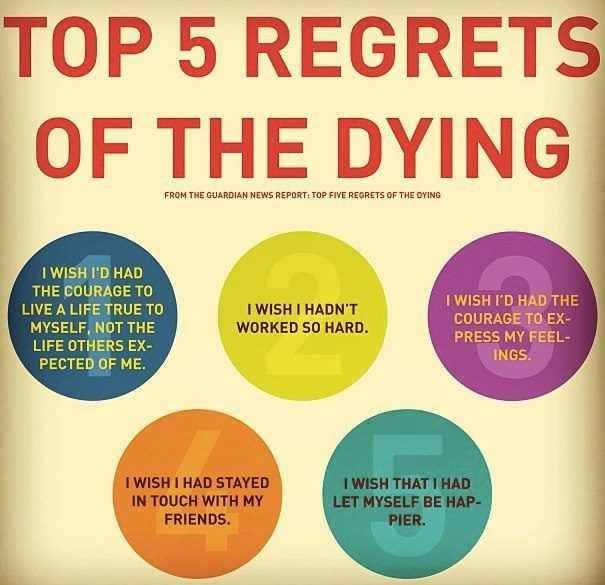
A friend shared this picture from Wake Up World the other day.
I’m not thinking of dying anytime soon and neither is my friend, but this got me thinking. I could say four of those about myself. And two of them would go deeper than that.
So I thought I’d explore each one in more detail, starting with:
And when I thought about this some more, I decided I do live a life true to myself – now and in the big things. In my childhood, there were many things I’d have liked to have done – things I didn’t even ask my parents about because I knew they wouldn’t agree.
But as an adult, I generally do the things I want – the big things, anyway. With the little things, I try to do what’s expected of me, even without knowing what that is. It’s all part of wanting to be normal, whatever that is.
There’s an easy answer to that: Stop doing what’s expected of you and do what you want.
Absolutely. Good advice. Except that I do it automatically. Without thinking. Because that’s how I’m programmed. And it’s not something that’s easy to change.
So this all started when I was reading Seumas Gallacher’s blog and I noticed he’d reblogged something about Alzheimer’s from Chris the Story Reading Ape’s blog, in which he (Chris) had included a moving and personal letter written for World Alzheimer’s Day. The blogs encourage people to reblog and tweet and generally help to raise awareness of the disease.
While that is definitely a worthy cause, it’s not the one I have chosen to champion. So I decided to see if there is a World Social Anxiety Day. There isn’t. But I did discover World Mental Health Day. By chance, it’s today, 10th October. Then I looked around to find out who was talking about World Mental Health Day and whether social anxiety was included.
Stephen Nolan presents a special programme on mental health to coincide with World Mental Health Day. Stephen discusses a range of issues; including depression, stress, post natal depression and dementia.
(The semi-colon is not mine.)
Very good, but what about social anxiety?
I know that the main focus this year is on schizophrenia, but I saw other issues mentioned on various sites. Not social anxiety, though. And yet social anxiety is more common than most of these others. Statistics vary because no one really knows, but they say that between 5% and 13% of people will experience social anxiety in their lifetime.
The main reason why social anxiety isn’t better known is because of its very nature. People with social anxiety prefer not to talk about it. But by keeping it out of the limelight, they are doing a whole community a disservice.
Another problem is that of people claiming to have social anxiety when they probably have a mild fear of public speaking. This downplays the effects of social anxiety disorder.
I don’t know if a World Social Anxiety Day is needed, but somehow the world needs to be aware of it.


 I still don’t meet other women very often, but I’m getting better at it. There’s one I often meet. We write together and talk, too. And two days ago I met up with someone I haven’t seen for many years. I even initiated the meeting and travelled all the way to Haifa for it. Well, for this country it’s a long way. The bus journey from Jerusalem to Haifa takes all of two hours.



 Miriam Drori, Author