

Misunderstandings are often fun… when you look at them from the outside or with hindsight. When they’re actually happening and you’re involved, they can be far from fun. Here’s Joan Livingston, whose third mystery in the Isabel Long series is due out next week (22nd March).
A Dangerous Misunderstanding
Sometimes words get in the way of what people are trying to say. That happens with several of my characters. And because I write mysteries it can get them into trouble.
 Let me tell you about Isabel Long, the protagonist in my mystery series who is a former journalist turned amateur P.I. solving cold cases. In Redneck’s Revenge, the second in this series, Isabel gets herself into a sticky situation while interviewing Gary and Larry Beaumont in their dump of a home. The brothers are notorious drug dealers and suspects in the death of a junkyard dealer. And Isabel is brave enough to dig deeper in her line of questioning.
Ah, but she hits a nerve because she’s dealing with a couple of hotheads who don’t listen very well. They have a tendency to jump to conclusions. And being new to the P.I. game, Isabel is still learning how to deal with people like the Beaumonts.
Here’s part of that scene from Redneck’s Revenge. She is meeting them at their house.
“If I’m hearing correctly, you two don’t have alibis for that night,” I say. “Right?”
I believe I just stepped into it big time because Gary and Larry’s foreheads clamp so hard their brows hang heavy over their bloodshot eyes. Their lips curl.
Larry slaps his brother’s arm.
“What’s she mean?” he asks.
“It means she’s callin’ us liars,” Gary answers.
I speak up.
“I didn’t call you liars.” I try to make my voice as warm as I can muster given how nervous I am. “What I said is that you can’t account for your whereabouts the night Chet Waters was killed.”
Gary’s fist hits the table.
“You bitch, what makes you think we’d have anythin’ to do with that?”
Yes, Isabel manages to get out of there unharmed, but she is rather shaken because she really felt in danger.
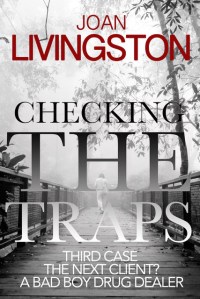 I’m not going to spoil what happens later in this book, but fast forward to the third, Checking the Traps. Yes, the Beaumont brothers return. Gary, the alpha brother, wants Isabel to find out what happened to their half-brother, Cary. Did he jump from a bridge known for suicides, or was he pushed, like Gary thinks?
Isabel takes the case, largely because she is interested in the victim, who was a highway worker by day and a poet at night. But she decides to be upfront with the Beaumonts, particularly, Gary, who is the alpha brother. She wants to avoid any misunderstandings this time.
“He was just a regular guy.”
“Uh, Gary, you gotta do better than that. I’m gonna need as much information as possible. By the way, if we proceed, I might ask some tough questions that’ll make you uncomfortable, and I don’t want you getting all pissed off at me like you did once before. Remember?”
Gary puckers his mouth. He’s thinking about that time at his home when he and his brother scared the bejesus out of me because they thought I called them liars. It was a misunderstanding on their part.
“Okay, okay,” he says finally.
Yes, Isabel is learning.
About Checking the Traps
Isabel Long is a bit banged up from her last case with a broken collarbone and her arm in a sling. But that doesn’t stop her from pouring beer at the Rooster Bar or taking her third case with Gary Beaumont, a local drug dealer who once terrorized her. Gary is convinced his brother didn’t jump off a bridge known for suicides. Somebody pushed him.
Gary’s brother was a boozer who drove for a highway crew. But what interests Isabel and her ‘Watson’ — her 93-year-old mother who lives with her — is that the man wrote poetry.
The chief suspects are one of Gary’s business associates and a famous poet who plagiarized his brother’s poetry for an award-winning book. Yes, he was that good.
As a journalist, Isabel did regular meetups with her sources for stories. She called it checking the traps. She does the same as a private investigator, and this time, she’ll make sure she doesn’t get caught in one.
About Joan Livingston
Joan Livingston is the author of novels for adult and young readers. Checking the Traps, published by Crooked Cat Books, is the third in the mystery series featuring Isabel Long, a longtime journalist who becomes an amateur P.I. The first two are Chasing the Case and Redneck’s Revenge.
An award-winning journalist, she started as a reporter covering the hilltowns of Western Massachusetts. She was an editor, columnist, and the managing editor of The Taos News, which won numerous state and national awards during her tenure. Recently, she was named editor of the Greenfield Recorder.
After living eleven years in New Mexico, she has returned to rural Western Massachusetts, which is the setting of much of her adult fiction, including the Isabel Long Mystery Series.
Links to Joan and her Books
Website, Facebook, Twitter, Instagram, Goodreads
~~~
Is this the last of the series?
There have been some wonderful articles in this series. Some guest posters have opened up on difficult topics. But now, if no one else wants to volunteer, I might close it, either temporarily or permanently. You’re still welcome, however, to suggest a topic for a guest post.
Do you want to write (or talk) about one or more of the SIM topics – Social anxiety, Israel, Misunderstandings? The details are here.



 Thanks so much for inviting me onto your blog to talk about an issue that’s very important to me and one that (fittingly enough!) I’ve kept quiet about for a long time.
 Over the next year, after transferring school and having speech therapy, Abby’s speaking improves although she still feels panicky and tongue-tied in certain situations. She describes her sessions to Philippa in letters – progressing from pointing to words or pictures to express a choice during the first term to the following term making a puppet nod or shake its head. At first her hand freezes even when asked to make the puppet squeak – selective mutism sometimes affects more than the voice, rendering the person immobile as well as non-verbal.
 I learned quite quickly that I could tell a story. But my storytelling needed preparation if I was to be placed on that stage. Put a blank page in front of me and I’ll smash out a short story before the day is out. Replace the page with real faces and the result would not be identical.
 In my new novel
  A similar argument could be made for The Purloined Letter by Edgar Allen Poe. Famous French philosopher Jacques Lacan argued that Poe’s story is based on a misunderstanding of what the letter means, and another equally famous French philosopher, Jacques Derrida, argued that Lacan deliberately misunderstood Poe’s entire story. I’m not sure I understand Lacan or Derrida, but my point remains: a good mystery is based on a clever misunderstanding.
 The first pleasurable aspect is that of surprise. As readers, we have assumptions about the characters and their motivations. A skilled writer gets us looking in one direction, essentially misunderstanding certain aspects of the story. Once the misunderstandings have been revealed, we have a moment of surprise when we find out that we have been wrong about the characters and their motivations.
 It’s such a pleasure to be here on Miriam’s blog today. I was really pleased when she asked me to contribute a post. I was offered the choice of Israel, Misunderstandings or Social Anxiety. As I’ve never been to Israel and I always try to avoid misunderstandings, I’m going to talk about the main character in my London Murder Mystery series, Beth Haldane.
 Beth, on the other hand, has bills to pay, deadlines to meet and, until sudden death throws her together with a certain tall, handsome policeman, in the shape of Detective Inspector Harry York, she is struggling with it all alone, following the death of her husband. She, unlike many of her contemporaries, has real worries. Her anxieties are not just social, she has trouble making ends meet.



 As a child, no one ever said the words social anxiety to me. People called me shy, quiet, mature beyond my years. I knew I spent more time inside my own head than other people, but it didn’t occur me it might be something more. I preferred to be alone, or with one close friend, never a crowd.
  In my first book, The Guilt of a Sparrow, the main character Magnolia Porter suffers from social anxiety. This is evident from page one, when she’s walking through a busy town park to attend an event, hoping to make it to her spot on the sidelines without notice. When she’s approached and needs to make idle conversation, her heart is pounding, hands shaking, mind reeling. She goes blank and wants to escape. This part of Maggie is me – it was easy to pull upon my own experience to write her social anxiety.
  Miriam Drori, Author