Author, editor, attempter of this thing called life. Social anxiety warrior. Re-Connections, a collection of short stories, published with Ocelot Press, 15/10/2025.
I’m so pleased to be awarded with another visit from Nancy Jardine, whom I interviewed last month.
She’s back to tell us about not one but two novels of hers that are about to be published.
Take it away, Nancy!
Hello Miriam. It’s lovely to come back so soon to update on my next book launches. First of all, I’d love to say that I’m absolutely delighted with both of my cover designs – each is perfect for their intended market.
I mentioned during my last visit that I was waiting for my cover design from graphic designer, Neil Saddler, for The Taexali Game, my time travel adventure for middle grade/ early teens. That was revealed recently so I’ve rescheduled its launch to April 2015. I’m so pleased to now be virtually ready to self-publish this adventure novel since it’s been waiting on my writing shelf, in various draft guises, for a long time. Soon my readers will be introduced to the intrepid trio you see on the cover – Aran and the twins, Brian and Fianna. In this first book of the Rubidium Time Travel Series, the adventure takes place in their own Aberdeenshire back yard – except that they are time travelled back to the year AD 210. I hope you can see the Ancient Roman legionaries in the cover design because AD 210 was an era when Roman Emperor Severus and his vile son, Caracalla, invaded northern Britain with multiple legions in a show of Roman strength. My teen protagonists have a set of tasks to fulfil, but how do they work out how to help both the ‘baddies’ and the ‘goodies’ when some of the Celtic chiefs they meet are as foul as Severus and Caracalla? Dicing with death becomes the norm in this Roman/Celtic Britain adventure but my trio need to stay alive! The main reason I’m not self publishing The Taexali Game sooner is… because I’ve another launch to attend first!
My Crooked Cat edition of Monogamy Twist, my contemporary romantic mystery, is launching on March 27th 2015 and I’m absolutely delighted with the quirky cover design for this, too – created by Laurence Patterson of Crooked Cat. Monogamy Twist is a mystery with historical aspects but very different from my Celtic Roman Britain historical novels. The plot for it is based on a recognisable Dickensian theme – that of the bequest of a decaying stately home. Luke Salieri finds himself the recipient of this strange inheritance – except the house can only be his if he fulfils certain weird and quirky conditions. To eventually become the owner Luke needs a woman to help him but not just anyone will do. Rhia Ashton seems perfect for the job since she’s a family history researcher but Luke finds she has a few conditions of her own before she’ll take him on and find out why Luke has been chosen by Amelia Greywood to receive the house. Compromise is the name of the game in Monogamy Twist. It’s a read that will appeal to those who like a bit of history with a few twists in their mystery, or those who like a good solid story in their romantic reading. I extend a warm welcome to the Facebook Launch Party on the 27th March. Goodies can be won and lots of information on my protagonists will be divulged.
Thank you for the update, Nancy. I was in awe of you before; I’m even more in awe of you now.
Nancy Jardine
Nancy Jardine lives in Aberdeenshire, Scotland. She currently shares a home with her husband, daughter, son-in-law, 3 year old granddaughter and 1 year old grandson. It’ll continue to be a busy household till late summer of 2015 when the new build home will be completed for the young ’uns on what was Nancy’s former back garden. The loss of that part of the garden won’t be missed since there should now be more writing time available this spring and summer! Childminding is intermittent over the day and any writing time is precious. (If interested in how a new house is built these days, follow my blog posts named ‘Gonna build a house’ )
All matters historical are a passion; Ancestry research a lovely time-suck. Nancy regularly blogs and loves to have guests visit her blog. Facebooking is a habit she’s trying to keep within reasonable bounds! Any time left in a day is for leisure reading and the occasional historical series on TV.
Yes, it’s finally time to reveal my theme for the A-Z Challenge this year.
In 2011, I didn’t have a theme. I posted mainly on the themes of this blog: writing and social anxiety.
In 2012, I wrote about places in Jerusalem.
In 2013, my theme was memoir writing. I learned a lot that year. One day, I might put that knowledge to use.
In 2014, I highlighted authors, including some of my new friends all published by Crooked Cat.
In 2015, ….
.
Writing Historical Fiction
I will publish 26 posts on the theme of writing historical fiction. I’ve never written historical fiction and don’t know much about it, so I’m hoping all you experts out there will help me by adding comments to my posts. I’m really excited to be doing this and I do have a little idea about where this might lead.
…not golden. Just a fake gold that soon dulls. Like the necklace I bought in Cyprus. They told me it was gold. I knew they were lying, but I bought it anyway. I felt I had to buy something because they gave me tea….
I’ve been keeping silent for most of my life. It’s time to talk.
So tune in again, keep in touch and don’t suffer in silence.
So much has happened since then. Thank you for being part of it.
It’s getting warmer. Warm enough to sit outside in the sun. But not so warm that I search for shade… except on days when it’s extra hot. The weather can’t be trusted at this time of the year, but that gives us variety that vanishes in the summer.
Hyacinth
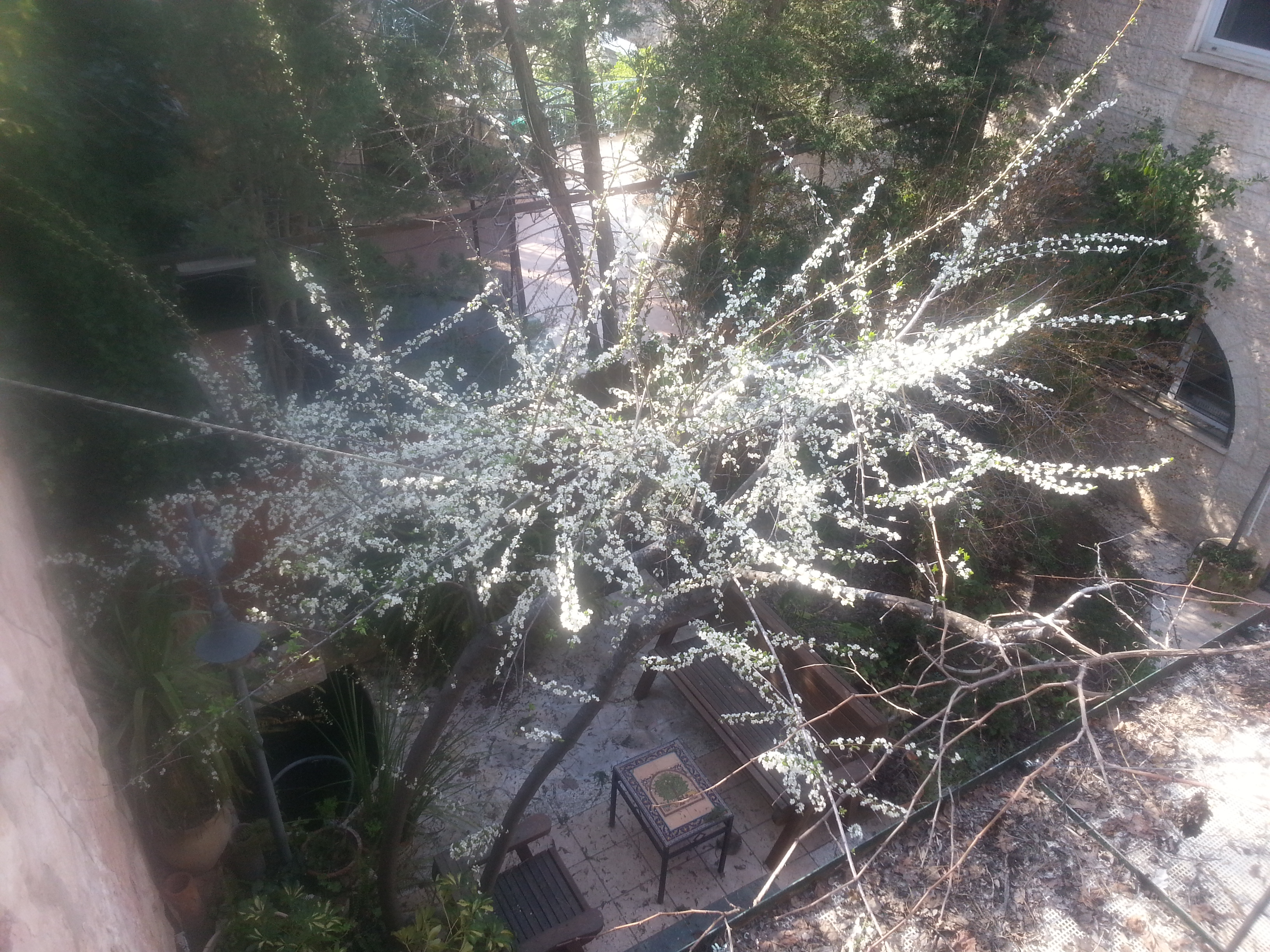
This hyacinth branch was falling off, so it’s now indoors and its fragrance is exquisite. By the way, in Hebrew hyacinth is yakinton, a word that always reminds me of ‘mackintosh’ but actually has the same root as ‘hyacinth.’
I can’t say I’ve started the spring cleaning, but I’ve started thinking about it. Maybe today….
There is one thorn in my rose. Someone I see regularly has decided to stop talking to me and I have no idea why. (It’s OK – she’s very unlikely to see this blog.) I wonder what’s the best response to it. I could write to her and explain how I feel. I could talk to her normally and pretend to ignore her curt behaviour. What do you suggest?
Are you doing the challenge?This April will be my fifth go at the A-Z Challenge. It’s fun but hard work. I didn’t think I’d do it again this year, but then I had an exciting idea for a theme.
In 2011, I didn’t have a theme. I posted mainly on the themes of this blog: writing and social anxiety.
In 2012, I wrote about places in Jerusalem.
In 2013, my theme was memoir writing. I learned a lot that year. One day, I might put that knowledge to use.
In 2014, I highlighted authors, including some of my new friends all published by Crooked Cat.
In 2015, ….
Yes, I have a theme and I’m excited about it, but it’s not quite time to reveal it. However, as well as signing up for the challenge itself, I have also signed up for the A to Z Challenge Theme Reveal on 23rd March. That’s in just two weeks.
As it happens, 23rd March is also a birthday. Six years ago, this blog published its first post. A lot has happened since then!
***
In other news, I have another interview hosted by the lovely Nancy Jardine. Her questions have been giving me ideas.
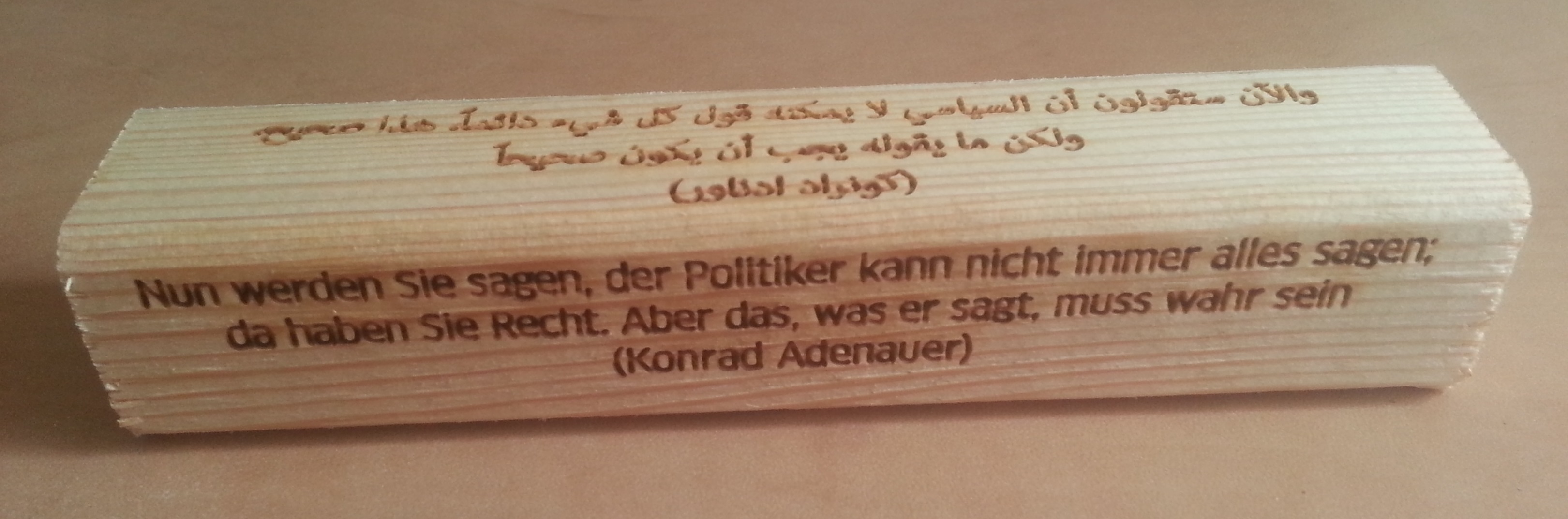
Outside the recent Jerusalem Book Fair – at which my novel was on display, although I doubt it drew much attention – was a tall construction containing many removable blocks of wood, courtesy of the Goethe Institute. I should have photographed it, but I didn’t. Each block had a quotation in the original German translated into Hebrew and Arabic. Each visitor was allowed to take one block and I chose this one from Konrad Adenauer:
.
.
.
.
.
.
.
.
In English:
You are right to say that a politician cannot always say everything. But what he says must be true.
I think modern politicians either don’t believe in that statement or have a warped idea of what truth is. Neverthless, I, along with many Israelis, will shortly be voting for the party I think is the least bad of those available, and many in the UK will be doing the same shortly afterwards. At least we have the privilege of being able to vote.
The video of a Jew walking the streets of Paris wearing a kippa (yarmulke) and tzitzit (tassels) has received a lot of publicity. Zvika Klein, the journalist who did this, has been interviewed all over the world. Youtube is full of copies of the short video. Here is one of them:
In this interview, both interviewer and interviewee said they were “shocked at their shockedness,” meaning that they were surprised that people around the world were shocked at what happened to him.
I’m not shocked. I’m not even surprised.
Firstly, I’m not surprised it happened. The fact is, I’ve never felt comfortable as a Jew in Europe, and that goes a long way to explaining why I’m here in Israel. It’s not that I ever went around displaying my Jewishness. Just the fact that I was afraid to say I was Jewish, because I couldn’t know what people would think. Ordinary people – not Muslims. I don’t think I ever met any Muslims while living in England. Anti-semitism has become more visible in recent years, but it was always there.
Secondly, I’m not surprised that people are shocked. I think most people don’t understand what it’s like to live as a Jew in the diaspora, and if this video goes a little way towards explaining, then I’m glad.
I’m delighted to welcome Nancy Jardine, Scottish author of historical romantic adventures, contemporary mystery thrillers and YA time travel historical adventures. As you’ll see, I’m rather in awe of Nancy and I’m hoping she’s about to provide some useful advice.
Nancy Jardine: author
Nancy, I am amazed and very impressed by all that you manage to do. You have published a number of books in various genres and are working on several more. You post regularly on your blog, thrilling readers with interviews, wonderful scenery and updates about you and your writing. You appear on other blogs in guest posts and interviews. You are active on social media. You do author events. And on top of all that you have babysitting duties. Do you have a secret stash of daily hours that mere mortals like me can’t access? How do you fit everything in?
I don’t feel I do fit everything in. I have ‘things’ I want to achieve in a day but often the domestic side overtakes everything else and the priorities shift. Your readers can read more of my domestic situation in my bio below, so I won’t repeat here. An exciting update would be that…the foundations for the new house were started only yesterday [now a few days ago] and I’m sure you can imagine that there was a lot of celebration in our house after all the red tape issues were finally over. I’m about to begin a BLOG DIARY about ‘My lost back garden’. Anyone interested can follow the progress on my blog – Nancy’s Novels.
Apart from lack of writing time just now, I know that I have too many manuscripts on the go. I want to work on them all – but that is way too fanciful. My writing targeting plans, made in January on my blog, need a lot more effort to be fruitful! The procrastinator’s way (mine) is to do more blogging which makes me feel that I’m still writing – just different writing. I’m weaning myself from Facebook, which is just too enticing sometimes.
Don’t I know it! Can you tell us about the settings of your novels? How important are the locations to the stories? Do you think it’s possible to write about a place you’ve never been to?
Nancy Jardine: Award Finalist at The People’s Book Prize, 2014
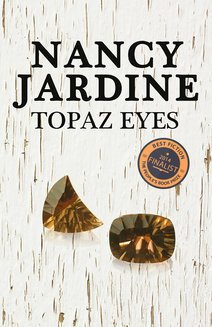
All my settings are carefully chosen for particular reasons that fit with my plots. In Topaz Eyes – my contemporary Award Finalist for The People’s Book Prize 2014 – I used a number of different destinations in the mystery thriller that’s also a treasure hunt with deadly consequences. I’ve been to every place mentioned and I selected them very carefully for use in the novel. When I wrote Topaz Eyes in 2011, it had been some time since I’d visited Vienna and Heidelberg. I used the internet to check that some mentions were still reasonably current. Checking was paramount because the colour of the tram system in Vienna changed in early 2011 from red to yellow. Checking was even more important for Amsterdam, because a place I’d remembered fondly from when I lived there in the early 1980s had been demolished. The Poffertje Stall which sold tiny Dutch pancakes near the centre of Kalverstraat – a main Amsterdam pedestrian street – had gone when I visited in April of 2011. I had a minor panic because I’d included the stall in Topaz Eyes. The manuscript was at first edit stages with Stephanie Patterson of Crooked Cat Publishing but when I got home from my holiday, I emailed and asked to make some changes to the story. Although it wasn’t likely that many readers would have picked up on this, I knew about it and it would have bugged me to leave it. There’s still a scene involving Poffertjes, for a significant reason, but it now fits with contemporary Amsterdam.
Crooked Cat is re-launching two of my other contemporary mysteries – Monogamy Twist and Take Me Now. There are a few locations which feature in these novels that I haven’t been to. I used the internet for information but I also got other handy tips from my daughter, who had visited them during her ‘year-out world trip’ after university. Therefore, I personally believe it’s possible to write about places you’ve not actually been to.
How do you set about writing a historical novel? Do you have the whole story in mind before doing any research, or does the story form itself as you discover details? Do you have any tips for an author planning to explore this genre for the first time?
I think that historical work always needs thorough research. Readers of historical fiction can be very disappointed if they find anachronisms or something that’s just wrong for the era – and I count myself among that readers group. I try very hard to give an accurate portrayal of my chosen era of first century AD Roman Britain in my Celtic Fervour Series of historical romantic adventures, even though historical details for the era are scant and much is gleaned from interpretation of archaeological data. If the epoch is completely new to an author, I’d suggest a good consolidation time of research would be necessary to get a real feel for the times. In my case, my teaching of Celtic/Roman Scotland gave me a great background to feed from. Book 1 of the series evolved from a basic plot and grew and grew. Books 2 and 3 of the Celtic Fervour Series took a lot more research since I knew very little of the Roman military infiltration of Britannia. Once I’d learned about the campaigns of Agricola, Governor of Britannia in AD 78-86, I was able to plot out the movements of my characters. However, I found that using the writings of Tacitus (a Roman historian) was misleading. He is one of the few prime source writings of the era but it’s long been known that his writing is somewhat biased towards a Roman slant, his summation of events not particularly reliable. Tacitus’ dating of events is now seriously flawed by a number of years, according to the latest twenty-first century archaeological findings – recent dendrochronology (wood deposits) findings now dating the construction of Roman forts and fortresses much more accurately. Agricola was credited with making early campaigns into northern Britannia (Scotland) but dendrochronology dating is now putting those first Roman footsteps, in Scotland, back to the times of previous Roman governors, like Cerialis and Frontinus. My tip to an aspiring historical author would be try to keep abreast of recent developments in your chosen era because things can surprise you part way through the writing of a novel and, if you’re like me, you’ll want to make changes for better credibility.
I enjoyed hearing (and seeing) you read from After Whorl: Bran Reborn in this video, although I didn’t understand every word due to the quality of the recording and being unaccustomed to your gorgeous accent. Do you think being a teacher provided good experience for readings and other author events? Was there anything else that prepared you for life as an author?
That’s an interesting question, Miriam. The answer might be perhaps. The funny thing is that during my 25 years of teaching mostly 11-12 year olds, I could stand up in front of them and just get on with whatever I’d planned. The same was not the case when I was in front of adults and my teacher colleagues. For some reason adults made me nervous and doubt myself. I was extremely tense just before my first author talk in 2013, but as it happened the audience was small – I think only about seven people – and I wasn’t nervous once I got started. I’ve not been in front of any more than 15 people so far with author engagements but I’m hoping that a bigger audience won’t make me nervous in the future. At present, I’ve no planned author talks but I’m hoping to arrange some soon for my YA time travel historical novel, The Taexali Game, which I intend to self-publish soon. I’m presently waiting on my cover design and when that’s decided on, I think I’ll be good to start promoting it. However, I’m quite anxious about the self-publishing process – even though I know that thousands of other authors have done it themselves.
What other author events do you take part in? Which events have you found most useful for selling books?
Apart from my author talks at local public libraries, and women’s groups like the Women’s Rural Institute, the only other events I’ve attended have been when selling my books at local craft fairs. My first foray with this ‘public selling’ technique was when a friend agreed that my books are my ‘produce’ and that I could take a stall and sell at our Farmers’ Market in the local county town. These markets happen one Saturday morning every month, under canvas awnings, and are held in almost all weathers. (We are talking north-east Scotland!) At first, I was uneasy about being ‘out there’ and on show as an author. As it happened, I thoroughly enjoyed coming across new people to talk to about my books; potential readers; and people from my teaching past – fellow colleagues and some parents of kids I’d taught. The downside is that wind and rain are NOT good for paperback books or for printed publicity material. After a few of these outside markets, I was very fortunate to be invited to join FOCUS, a local crafters group who have bookings for their Craft Fairs in public Halls across Aberdeenshire, Scotland. (FOCUS means Festival Of Crafts Unique to Scotland.) FOCUS events are all held indoors, so weather isn’t a problem and my table display doesn’t blow away!
Nancy Jardine: Celtic Fervour poster
Between September and December 2014, I sold a total of 140 of my paperback novels at Craft Fairs and Author Talks. That’s not huge sales compared to some authors, but it was a thrilling start for me. I intend to sell at fairs this coming 2015 season which begins in April. The most exciting thing about selling at Craft Fairs, so far, is that I’ve had a few return customers who liked the first book they’d bought and they then bought more of my work. The only minor drawback to selling at these fairs is that I spend around 7 hours on a Saturday that could potentially be new writing time. Nevertheless, as published authors, we all now know that promotional time must be spent and is a huge time suck!
Oh yes!
Thank you for inviting me to your blog, Miriam.
Thank you for coming, Nancy, and for your interesting and helpful responses.
***
Nancy Jardine lives in Aberdeenshire, Scotland – currently with her husband, daughter, son-in-law, 3 year old granddaughter and almost 1 year old grandson. It’ll continue to be a busy household till late summer when the new build home should appear on the back garden for the young ‘uns. The great thing about that is Nancy now has less of her original garden to tend, and any garden jobs that side of the property will soon be someone else’s! Child minding is intermittent over the day, so writing time is precious – the tendency is for it to be between 9 p.m. and 1a.m.
Her published work to date has been two non-fiction history related projects and six novels. Three of the novels are contemporary mysteries, the others historical romantic adventures set in northern Roman Britain, late first century AD – published by Crooked Cat Publishing. By spring 2015, she’ll have published The Taexali Game, the first of her Rubidium Time Travel series for a Middle Grade/ YA market.
All matters historical are a passion; Ancestry research a lovely time-suck. She regularly blogs; loves to have guests visit her blog; and Facebooking is a habit she’s trying to keep within reasonable bounds! Any time left in a day is for reading, though her TBR list of books on her kindle is now huge.
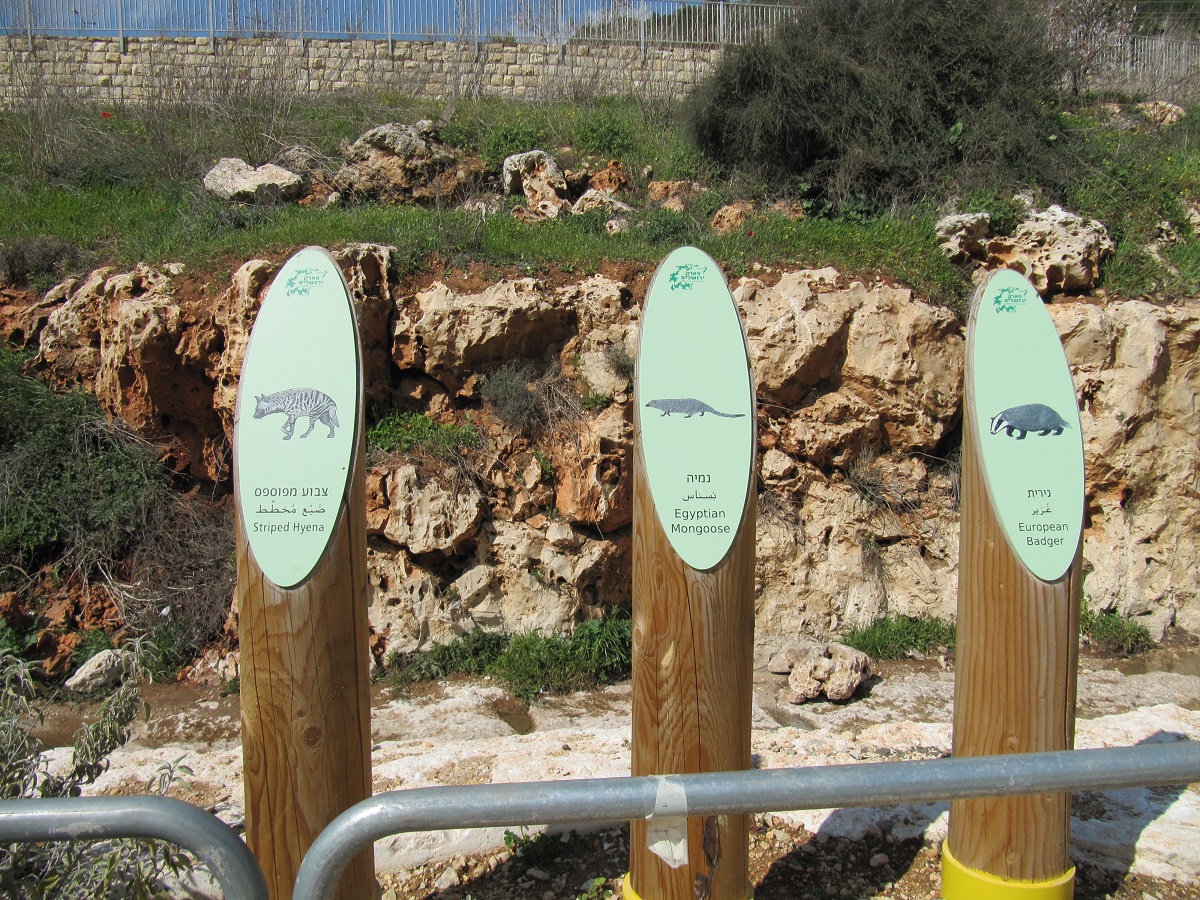
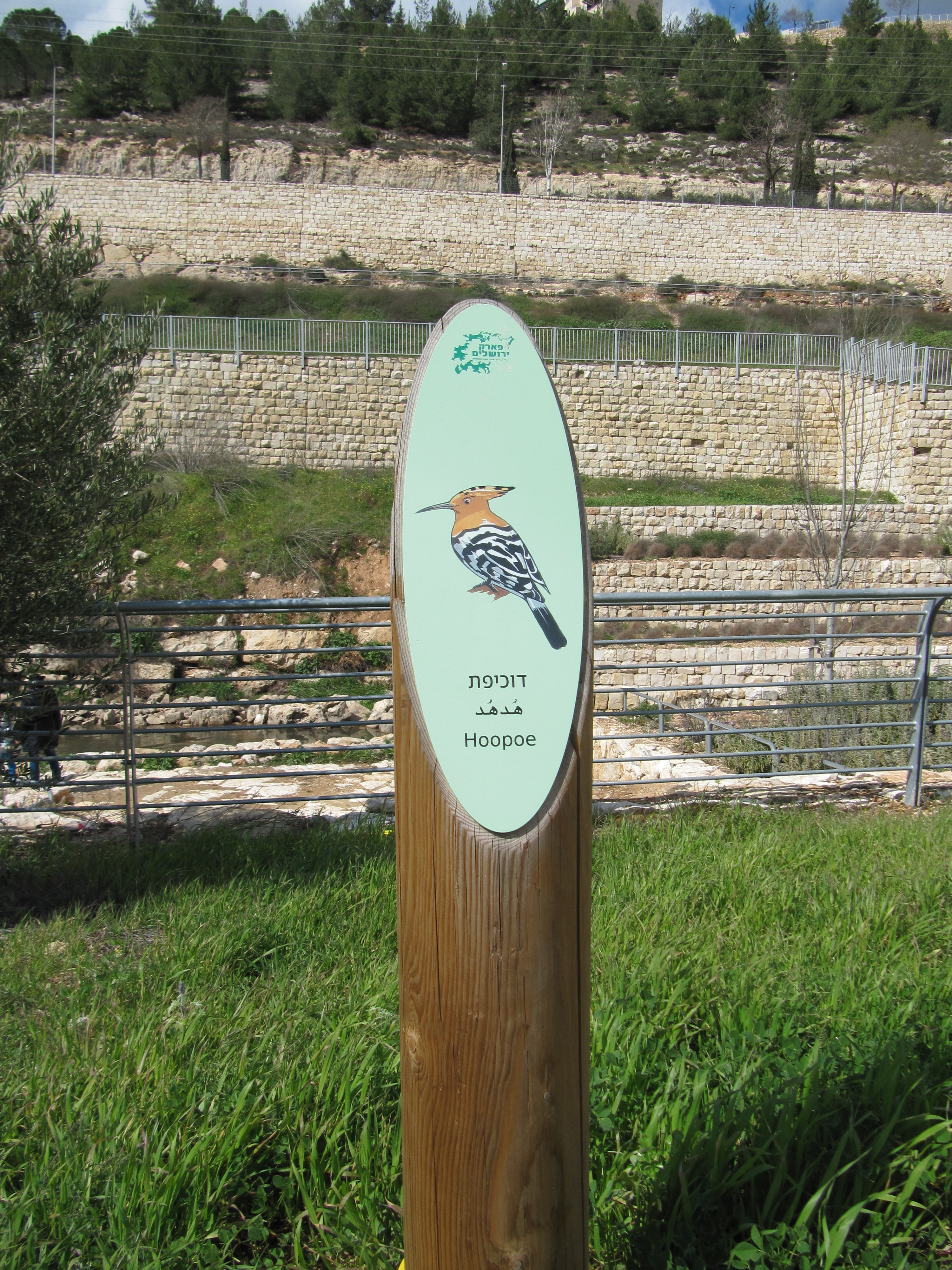
Jerusalem has a new park by the zoo. It’s part of a larger project called The Jerusalem Park. We can walk there from our house and we did the other day. There and back. And we walked all round the park and the zoo. The park is beautiful and so is the zoo. Jerusalem is hilly. We were exhausted when we returned, yet I managed to dance for over three hours (with breaks) that evening.
Jerusalem Park: Canal
The next day we were in Tel-Aviv and did a fair bit of walking there. Fortunately it’s flat.
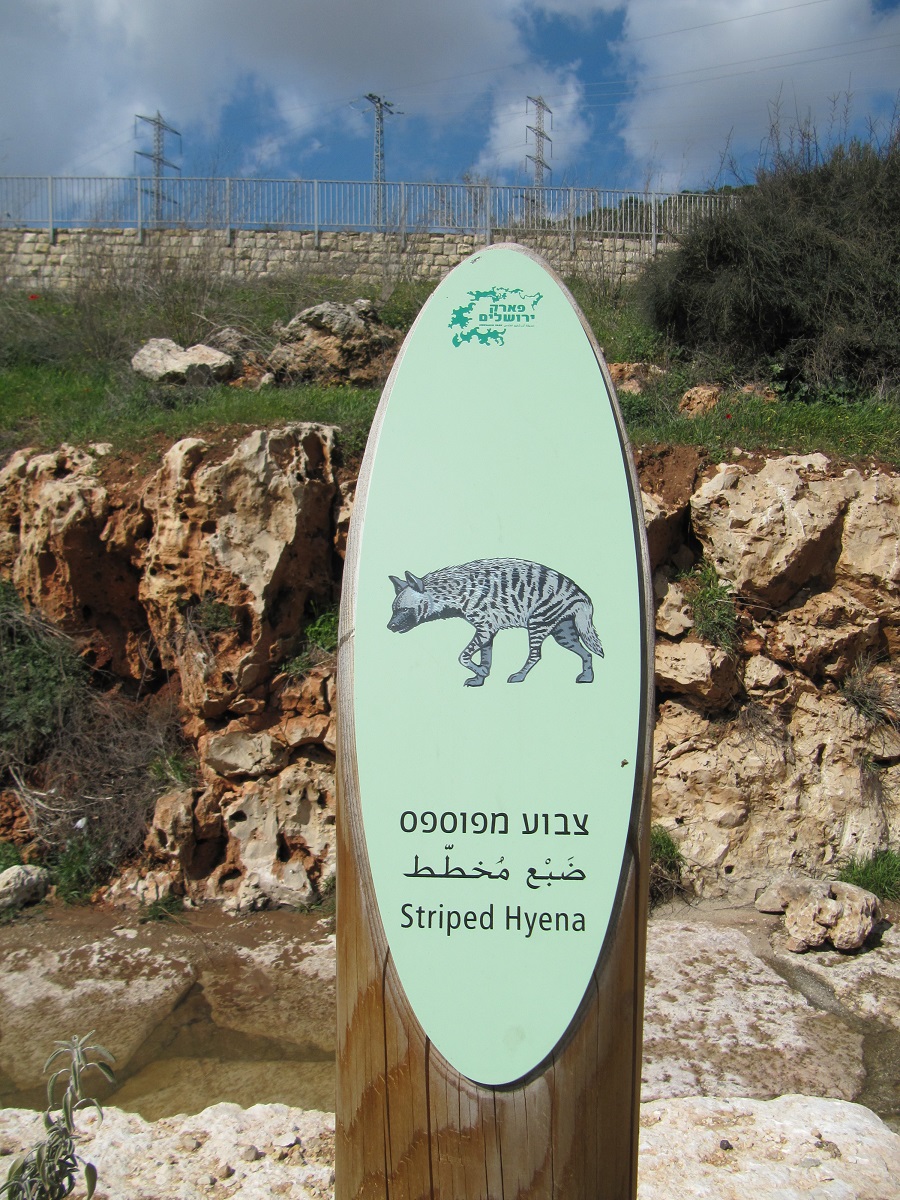
Jerusalem Park: Hopefully not full of …… hyenas!
Then there was a walk to the post office (twenty minutes each way) and more folk dancing. Tomorrow my writing group is meeting at a different location from usual. If the weather is okay, I’ll probably walk there, too (about half an hour each way).
Apart from being good for the body, walking provides more opportunities to see things: scenery, plants, animals, humans. Things to put into stories. The park is now ensconced in the first chapter of the sequel.
My guest today is the Crooked Cat author, Vanessa Couchman, whose debut novel is set in Corsica. In The House at Zaronza, a young woman uncovers the story of a secret romance from the beginning of the twentieth century.
Hello Vanessa and welcome to my blog. Could you start by telling us about the place you live in?
Hi Miriam, and thanks for inviting me. We have lived full time in South West France since 1997. We fell in love with an ancient farmhouse set in glorious countryside. Having a continental climate it can be freezing in winter (no one tells you that before you move!) and roasting in summer. But we love it here. I’m not a city person by temperament and the country life suits me perfectly. Although it’s good to catch up on exhibitions, theatre etc and especially English bookshops whenever I go to London.
People think Israel is always hot, and are surprised when I mention snow in Jerusalem.
How well did you know French before you moved and how good is your French now?
I learned French at school for years but it doesn’t equip you for living here! My grammar was good but I could barely string two words together. (My husband had lived in France before, so his French was reasonable). I went to French classes for 4 years and now I would say my French is fluent but not perfect. Being a perfectionist, I will probably always say that!
Ah, a perfectionist. That fits with my impression – that you’re organised and modest. Organised because of the way you handled your interview of me, down to the exact time when it would be published, and even converted that to my time zone. And modest because when I praised you for being organised you downplayed it.
Does that trait also apply to the way you write? Do you plan everything before you start?
I was brought up not to push myself forward, so the idea of blowing my own trumpet always makes me squirm. Not the best of attributes, perhaps, when it comes to marketing books! I suppose I would describe myself as efficient and can achieve quite a lot if I set my mind to it. I also have a tendency to indolence, so there are bursts of activity with fallow periods in between. When it comes to writing, I do like to plan things – but not too much, since that can stifle creativity. Sometimes, I just like to start writing with an idea in mind and see how a particular scene will work out.
I have the same problem when it comes to marketing books. It doesn’t come naturally, but we twenty-first century authors have no choice.
I recently wrote a blog post about the word ‘passion’ after someone wrote that it has no place outside the bedroom. Having concluded that it does, I wonder what you’re passionate about.
Gosh, hard to know how to answer that one. I’m passionate about women’s rights and passionately against oppression in any form. That all sounds a bit high falutin’, so coming closer to home, I’m passionate about history, which was the subject of my first degree, and that’s why I normally choose to write historical fiction. My interest in history grows as I get older and I’m particularly interested in Corsican history and the history of the area of France where I live.
I’ve never tried or wanted to write historical fiction before, but an event I happened to come across triggered an interest. How should I go about it? Do you have any tips for writing historical fiction?
Gosh! I’m no expert. One of the dilemmas is how much history and how much story to include. Getting the balance right is very hard. Great chunks of historical background will just turn off the reader. Equally, you have to get your facts right and ensure that you have captured the spirit of the age.
Since we’re talking about fiction, my advice is to focus on getting the story right and worry about some of the detail later on. You still have to research the period in question, but the research shouldn’t develop a life of its own. Sometimes you have to adjust the storyline in the light of the history. But navigating a course through these problems is just what fascinates me about historical fiction.
You have written historical fiction. Therefore you’re much more expert than I am, and this looks like excellent advice.
I enjoyed reading The House at Zaronza very much. I particularly liked the superb writing, the settings and being able to lose myself in the story. What have others said about it?
Thank you. I’m pleased you enjoyed it. Well, you know what I said above about squirming! However, I’ve been delighted with readers’ responses to Zaronza. A number of people have mentioned the Corsican setting, which is pleasing, since that was very important for me. People have also mentioned that they felt involved with the characters and kept reading to find out what happened when they should have been doing other things! And lots of people have asked about a sequel, which was not something I considered when I first wrote it, but I am working on one now.
Lastly, I’m interested to hear more about the choirs you sing with. I have belonged to choirs in the past, but only one at a time! How do you have time for several? What sort of music do you sing? Do you give performances?
I love singing, but took it up again only a few years ago, not having been in a choir since university. Until last Christmas I belonged to a big local choir, which gave concerts several times a year, but sadly had to give that up since they changed rehearsal times. I also belong to a small ensemble of 12 people run by a friend and a women’s choir of about 30. And we sing in big a scratch choir twice a year, which comes together to give concerts in aid of a church restoration fund. Fortunately, not all these choirs meet every week. It’s mostly classical music and choral works with the big choirs, but we also sing more modern works and French songs with the smaller ones. But I would never, ever sing a solo in public!
I wouldn’t do that, either. I don’t think I could stop my voice from quivering.
Vanessa, thank you so much for this interview. I’ve enjoyed finding out more about you.
Thank you, Miriam, I’ve enjoyed it too.
Clearly Vanessa is not going to blow her own trumpet, so I shall sing her praises! She is one of those people who manages to fit so much more into their lives than I can. She is an excellent writer, a kind and friendly person and… I’m sure there’s more but that’s all I know.
***
Vanessa Couchman is passionate about French and Corsican history, from which she derives the inspiration for much of her fiction. She has lived in France since 1997, where she runs a copywriting business and also writes magazine articles. Her short stories have won and been placed in creative writing competitions. The House at Zaronza is her debut novel.
I wasn’t going to do it. I didn’t have time. I don’t have time. But I had a brilliant idea for a theme and so I did it. Yes, I signed up again for:
Starting on 1st April with A, I will post about a topic beginning with the next letter in the alphabet. A lot of other bloggers will be doing the same. I am currently number 595 out of 604. By April, there will probably be thousands of bloggers signed up for this. Most have a theme; some choose topics at random. All my posts will be on the theme of…
Sorry, I’ll tell you that nearer the time. I’m excited about it. See you in April! And before.
 I mentioned during my last visit that I was waiting for my cover design from graphic designer, Neil Saddler, for The Taexali Game, my time travel adventure for middle grade/ early teens. That was revealed recently so I’ve rescheduled its launch to April 2015. I’m so pleased to now be virtually ready to self-publish this adventure novel since it’s been waiting on my writing shelf, in various draft guises, for a long time. Soon my readers will be introduced to the intrepid trio you see on the cover – Aran and the twins, Brian and Fianna. In this first book of the Rubidium Time Travel Series, the adventure takes place in their own Aberdeenshire back yard – except that they are time travelled back to the year AD 210. I hope you can see the Ancient Roman legionaries in the cover design because AD 210 was an era when Roman Emperor Severus and his vile son, Caracalla, invaded northern Britain with multiple legions in a show of Roman strength. My teen protagonists have a set of tasks to fulfil, but how do they work out how to help both the ‘baddies’ and the ‘goodies’ when some of the Celtic chiefs they meet are as foul as Severus and Caracalla? Dicing with death becomes the norm in this Roman/Celtic Britain adventure but my trio need to stay alive! The main reason I’m not self publishing The Taexali Game sooner is… because I’ve another launch to attend first!
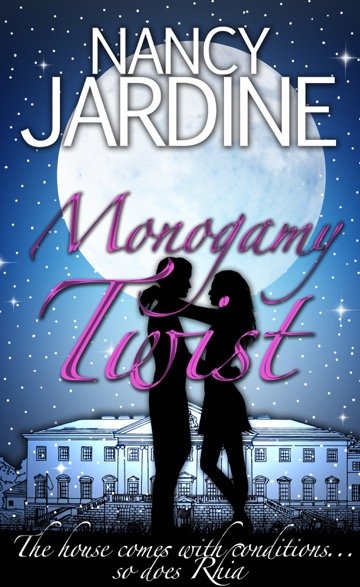 My Crooked Cat edition of Monogamy Twist, my contemporary romantic mystery, is launching on March 27th 2015 and I’m absolutely delighted with the quirky cover design for this, too – created by Laurence Patterson of Crooked Cat. Monogamy Twist is a mystery with historical aspects but very different from my Celtic Roman Britain historical novels. The plot for it is based on a recognisable Dickensian theme – that of the bequest of a decaying stately home. Luke Salieri finds himself the recipient of this strange inheritance – except the house can only be his if he fulfils certain weird and quirky conditions. To eventually become the owner Luke needs a woman to help him but not just anyone will do. Rhia Ashton seems perfect for the job since she’s a family history researcher but Luke finds she has a few conditions of her own before she’ll take him on and find out why Luke has been chosen by Amelia Greywood to receive the house. Compromise is the name of the game in Monogamy Twist. It’s a read that will appeal to those who like a bit of history with a few twists in their mystery, or those who like a good solid story in their romantic reading. I extend a warm welcome to the Facebook Launch Party on the 27th March. Goodies can be won and lots of information on my protagonists will be divulged.





![20150209_122319[1]](https://miriamdrori.com/wp-content/uploads/2015/03/20150209_1223191.jpg)







 Miriam Drori, Author