Categories
Books

2015 A to Z Challenge: L is for LIST OF AUTHORS

I don’t want to compile a list of all authors who write/wrote historical fiction – just those I have read and those I feel I ought to read.

I haven’t actually read a lot of historical fiction.  These are the authors I remember having read:

  • Sue Barnard
  • Tracy Chevalier
  • Vanessa Couchman
  • Philippa Gregory
  • Carol Hedges
  • Gill James
  • Nancy Jardine
  • Pamela Melnikoff
  • David Rory O’Neill
  • D. B. Schaefer
  • Rosemary Sutcliff (It’s not her fault that her book put me off ancient history for decades!)

Which other authors should I read now? Any recommendations?

Categories
Books

2015 A to Z Challenge: K is for KINGS, QUEENS AND OTHER FAMOUS PEOPLE

A-Z Challenge 2015Some writers prefer not to mention famous people. They write about the unknown people. That way, the characters are formed purely by imagination… and knowledge about how people were and how they behaved at that time and in that place.

Others purposely write about famous people. They leave themselves more open to criticism, because they can’t always stick to the truth, but we’d be poorer without their stories.

HenryIVPart1

Categories
Books

2015 A to Z Challenge: J is for JOURNEYS

A-Z Challenge 2015

Two very different sorts of travelling could feature in your story.

The characters will probably need to get to other places at some point – places that are too far to reach on foot. The time and place will determine the mode of transport they use. Obviously they won’t travel by car or bus or train in the sixteenth century. But it’s not enough to plonk your characters in a carriage. You have to know what the carriage looks like, inside and out. You have to know what it feels like to ride on the roads of the time, and how often they stop to give the horses a rest or to leave the horses behind and continue with refreshed horses.

By Sipyardbelize (Own work) [CC BY-SA 3.0 (http://creativecommons.org/licenses/by-sa/3.0)], via Wikimedia Commons
By Sipyardbelize (Own work) [CC BY-SA 3.0 (http://creativecommons.org/licenses/by-sa/3.0)%5D, via Wikimedia Commons
They might ride on horseback. In another part of the world, they might ride on camels or elephants. Have you ridden on those animals? I have. When the camel gets up, it feels as if you’re at a fun fair and about to be turned upside down.

Then there’s the other sort of journey that traverses time. For some reason I haven’t managed to find the answer to this question: in a time-travel novel, who or what does the travelling? Is there one character (or more) who starts off in one year and find herself in another? Or does the story do the travelling by showing two or more different eras in which the characters are connected in some way? Could someone explain, please?

Categories
Books

2015 A to Z Challenge: I is for IDEAS, IMAGES and IMAGINATION

A-Z Challenge 2015You start with ideas. A period in history, a place, an event plants an idea in your mind. How do you make it lead to a novel?

You start to research. Images form in your mind. You see a captain standing on the deck of a ship, his blond beard flying in the wind*. You know what he’s wearing – coat, boots, hat. You know what he has in his pockets. You live most of your life along with him and all the other characters.

Then, when you know all your characters well enough, you use your imagination to weave a story around them.

Story weaving
Weaving a story around the characters

———————————————————————

* http://www.caroclarke.com/historicalfiction.html

Categories
Books

2015 A to Z Challenge: H is for Historical Research

A-Z Challenge 2015We modern day authors are so lucky. Whatever we might wonder, almost any question we want to ask will have been answered on the Internet.

Which songs were popular in England in January, 1922?
What was the world’s first postage stamp?

You can find all the answers at the touch of a button or two.

BUT

Sometimes there are mistakes on the Internet. Sometimes you need more detail than you can find on the Internet. The Internet is not enough. It can be very helpful and it can set you on the right path, but it doesn’t replace detailed and well-researched

BookBOOKS.

Categories
Books

2015 A to Z Challenge: G is for Guessing

A-ZChallenge2015So you’ve done your research, you’ve asked experts and still there are things you don’t know.

Why did Charles Dodgson (Lewis Carroll) fall out with the Liddell family?
How did the cliff dwellers of Montezuma Castle manage their days?

You need to answer these questions, but no one knows the answers. What do you do? You make informed guesses based on the information you have been able to discover. And there’s nothing wrong with doing that, because this is fiction.

I asked Nancy Jardine, whom I interviewed here and who writes – amongst other genres – historical novels set in Celtic/Roman Britain, for one example of when she had to make an informed guess. This is her response:

I’ve had to do a fair bit of that in my Celtic Fervour Series, the reasons being that the only source materials for the times are Greek or Roman – and biased at that. The Celts left no written evidence at all – save what’s found on stone inscriptions. In Book 3 of the series, I have a large battle at a place named Beinn Na Ciche (Gaelic for a hill range that’s nine miles from my home). Bennachie, as it’s currently called on the map, is only one possible site earmarked by historians for a battle between Romans and Celts that the Roman historian Tacitus wrote about. The thing is that Tacitus may only have been attempting to make his father-in-law Agricola seem like a greater general than he really was. None of the other Scottish contender sites – for what was later named the Battle of Mons Graupius by early Victorians – have provided conclusive evidence. I made my ‘informed’ choice and decided that the topographical information given by Tacitus matched the landscape around Bennachie, but even more important for me was that in 2006 local archaeologists decided that the Romans had had some 30,000 soldiers in Durno – a marching camp opposite the fooothills of Bennachie. The number of soldiers (which is drawn from archaeological evidence and not written evidence) was sufficient for me to use the site in my novel. In fact most of what I’ve written as historical facts on Celtic life is drawn from purely archaeological sources and is therefore all interpretative.
Thank you for this, Nancy. It shows a lot about what a historical novelist has to do – research, decision-making and more – before starting to write.
Bennachie
Bennachie
Nancy also sent me this photo, which “was taken from near the Durno camp looking over to the hilltop named ‘The Mither Tap’ – the most distinctive part of Bennachie range.”
Categories
Holidays Israel

Not Passing Over Passover

I’m interrupting the flow of daily A-Z posts for two reasons.

The first is that I have paid a (blog) visit to Ailsa Abraham at Bingergread Cottage. I had so much to say (prompted by her hospitality, or was it something else?) that she divided it into two parts: one and two.

The second reason is to say something about the festival of Passover. I don’t think I’ve ever posted anything about it, because it always comes at the same time as the A-Z challenge. There is so much I could say, but I’ll just tell you about the story behind our Seder plate.
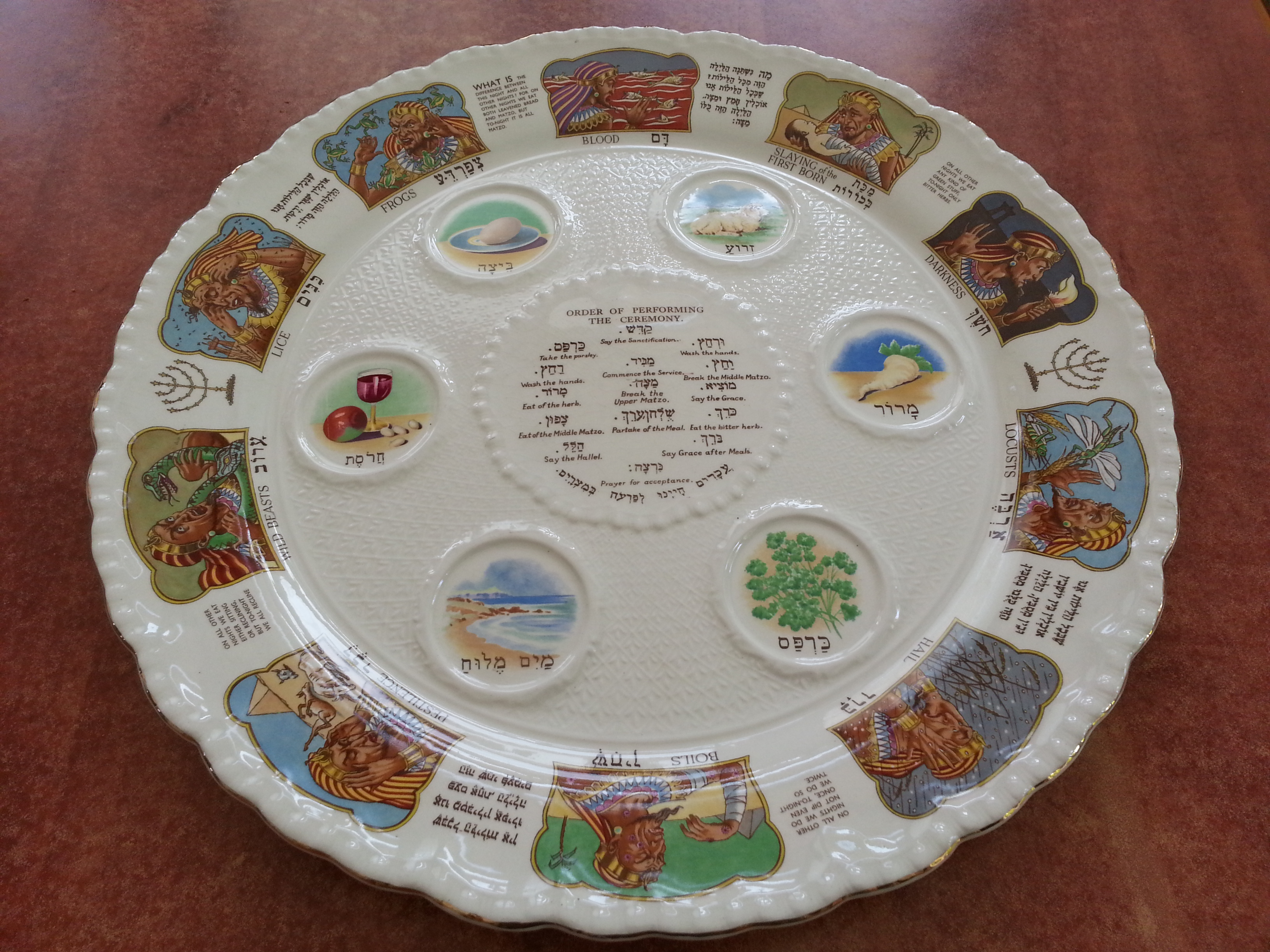
Seder PlateThe word seder means ‘order’ or ‘procedure.’ In this case, it refers  to the ceremony and festive meal observed at the start of the week-long festival. On the Seder plate are six different items of food that symbolise aspects of the Passover story: the exodus from Egypt.

We never had a special plate for this until we inherited this one when my mother died in 2011. But I knew the story of how my parents had acquired it.

They were on holiday in Ilfracombe in Devon one year and happened to spot this beautiful plate adorned with pictures of the ten plagues in the window of an antique shop. It wasn’t expensive, so they went in to enquire. The underside of the plate shows that it was made in England by Royal Cauldon. The shopkeeper had no idea what it was. There were dishes to match the plate. Unfortunately, two of them were broken and had been glued together (or did my mother do the glueing – I’m not sure). Also, some dishes are missing while others are duplicated.

Seder plate with dishesBut they bought the set anyway, and now we use it every year. And each year we comment on the mistake in the Hebrew. One of the food items is salt water. In Hebrew, the word for water is always plural and the adjective (salted) has to agree with the noun. Here it doesn’t.
Categories
Books

2015 A to Z Challenge: F is for FICTION

A-ZChallenge2015Never forget that what you have written is fiction. If people get too serious about how real the story is and suggest things might not have happened that way, remind them they didn’t happen in any way because the story is fictional. However much you tried to be true to history, the fact remains: it’s made up.

InappropriateFight

Categories
Books

2015 A to Z Challenge: E is for EXPERTS

A-ZChallenge2015There is a limit to the amount of research an author can do for a novel. There will always be specialists who know more about the era and the place than you do.

So ask them. Find an expert who is willing to help by answering all your outstanding questions and hopefully providing information that you hadn’t even thought of asking about.

Presentation

Categories
Books

2015 A to Z Challenge: D is for DIALOGUE

A-ZChallenge2015How do you decide on the language to use in dialogue? Clearly modern expressions would be out of place. But the language of the time is also inappropriate because readers wouldn’t understand it, even if you researched it enough to be able to write it.

As with all these dilemmas, you have to find the right balance between these two approaches.

Historical Fiction - Dialogue