Categories
Books

2015 A to Z Challenge: X is for XYLOPHONE

I have invented a theory, with a little help (OK a lot of help) from Vanessa Couchman when I interviewed her here. Its name possibly has something to do with the fact that I struggled to find any connection between the letter X and writing historical fiction. But the advice is serious and probably useful. So with much fanfare I present the first ever airing of…

Miriam’s Xylophone Theory

A xylophone has no use without a mallet (or beater or stick). Similarly, research has no use without a story. At some point you have to relegate all the research to the background and concentrate on the story. And while you’re writing the story, you might get some of the facts wrong. But that’s all right. You can revise the story later to fit the facts.

Xylophone
“Kulintang a Kayo 01“. Licensed under CC BY-SA 2.5 via Wikimedia Commons. Copyright: Philip Dominguez Mercurio
Categories
Books

2015 A to Z Challenge: W is for WOMEN

A-Z Challenge 2015There’s a reason or two why women depicted in nineteenth century novels have only one thing on their minds: marriage. They had nothing else to do and marriage was the most important event in their lives, determining the rest of their future.

As a historical writer, you have to be aware of the restrictions on women during your era and in your place. Could they go out without a chaperone? Were they allowed to study anything?

You can be sure of one thing: restrictions existed. I’m glad I’m alive now and not earlier. I’m glad I live in the country I live in, rather than one in which women are still restricted.

Categories
Books

2015 A to Z Challenge: V is for VISIT

A-Z Challenge 2015If possible, visit the location you’re writing about. Even though it has changed, something remains, if only the wind, the sun, the mountains or lack of them, the sea, the river.

But beware. Even the sea can change. Of the original five south-east England Cinq Ports, members of a confederation formed in the 12th century for military and trade purposes, two are no longer on the sea.

20150419_202118[1] The picture above, which hangs on the wall of my office, is one I bought as a child when we visited the picturesque town of Rye and my mother told me about the Cinq Ports. Rye wasn’t one of the original Cinq Ports, but took over from New Romney which was damaged by storms and silted up. Rye is now two miles from the sea.

Categories
Books

2015 A to Z Challenge: U is for UNKNOWN

A-Z Challenge 2015Writing advice often includes this one:

Write what you know.

Not all writing instructors agree with that. Some even say it can be better to write what you don’t know. “Write what fascinates you,” they say.

Nevertheless, many authors do write what they know. It’s easier to describe places you’ve been to. It’s easier to get inside the head of a character who’s been through experiences that are similar to yours.

History, by its very nature, is unknown. You can’t rely on your experiences or on knowing a place, because they were different then.

Categories
Books

2015 A to Z Challenge: T is for TREES AND PLANTS

A-Z Challenge 2015Even trees and plants need to be researched. Some might not have existed then. Some might not have grown in locations where they are to be found now.

Jerusalem: blossoming tree
Categories
Books

2015 A to Z Challenge: S is for SCENES

A-Z Challenge 2015Readers need to see the scenes. You have to show these scenes without losing sight of the story.

It’s good to depict several different scenes, indoors and outdoors, to give a sense of that other world.

Categories
Books

2015 A to Z Challenge: R is for RELIGION

A-Z Challenge 2015This is where things get complicated (as is often the way with religion). You don’t just have to describe religious practices. You have to get into the characters’ heads and work out why beliefs make them act and talk as they do.

In this article, Amanda McCrina claims that the vast majority of historical fiction mostly ignores religious practices and the pervasiveness of religion in people’s lives, making them more modern in outlook than they really were. This makes life easier for the modern writer and also makes it easier for the modern reader to identify with the characters.

Categories
Books

2015 A to Z Challenge: Q is for QUESTION

A-Z Challenge 2015You want readers to know what life was like then. You want them to understand the character’s situation. But of course you don’t want to TELL them; you want to SHOW them.

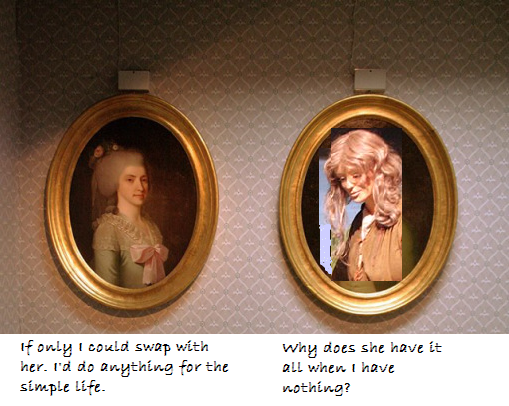
One way of doing this is to have the characters question their place in society.

Questioning

Categories
Books

2015 A to Z Challenge: P is for PERSON

A-Z Challenge 2015Should you write your story in the first person or third person?

As with any narrative, your decision must be based on the type of story you want to produce. Third person lets you (and the readers) see situations from different points of view. With first person, you concentrate on the viewpoint of just one character.

If you choose the first person, you need a credible reason why the character should tell their own story. You also need to be sure you’re able to be the ears, eyes, nose, heart and brain of a character whose experiences of life are necessarily very different from yours.

Being a Character

Categories
Books

2015 A to Z Challenge: O is for OVERWRITING

A-Z Challenge 2015I may have overwritten this point, but it seems to be one of the main facts about writing historical fiction. Information dumping is annoying, yet you need to set the scene and somehow make readers understand what life was like in those days.

So don’t include everything from your research notes, but do include enough for readers to imagine themselves there. Find the right balance.

Put Reader in Scene