I’ve been working on a personal essay with my writing group. At the beginning of the year, I submitted fictional stories for them to critique, but after reading personal essays by other members, I decided to try my hand at one, too.
My essay discusses how I became aware of social anxiety and the effect that awareness has had on me. Naturally, it also describes my childhood, explaining how I caught social anxiety in the first place. So far, I have submitted the essay twice. Each time, the members and the mentor said they wanted to know more. They wanted more examples, more explanations, more dialogue. So I’m still working on it and the essay is growing.
One man asked me a question after the last meeting. “I’ve heard stories about difficult childhoods before,” he said. “I always wonder why the people can’t just forget what happened and move on.”
An elephant never forgets. Should we?
I stood there transfixed, not knowing what to say. I wasn’t hurt by the question; I knew he’d asked it because he wanted to understand. The truth is that there are many answers and someone was waiting to give me a lift home. But even if I’d had all the time in the world, I wouldn’t have been able to respond because… well… I have social anxiety. I don’t know how to think up responses on the spot.
“I suppose it’s easier said than done,” he said.
“Yes,” I replied, escaping with my lift-giver.
While editing my essay, I’ve been thinking about how I should have responded. How I could respond in writing. How I’m going to respond right here on my personal blog.
I tried to do exactly what my fellow writer suggested. When I left school, I tried to put all the nasty experiences behind me and start again as if they had never happened. But they did happen. They shaped the person I became. Ignoring them meant that I had less to talk about, because a big part of me was buried along with them. This was true even on the basic level: when anyone mentioned childhood experiences, I couldn’t join in with mine.
You can’t shut out your own misfortunes because you need to piece together the reasons it happened, in order to communicate that to yourself and others.
says Joe Warnimont in the post.
There are other, less personal reasons why I want to write about these things. But I think I’ve written enough for one blog post. I’ll continue this another time, maybe tomorrow.
I read this post last month. It’s written by “a 30-something working mother living with bipolar disorder.” The post, like all her posts, is beautifully written and explains very clearly all the questions the writer would prefer not to hear from her friends. Once, I would have agreed with it. Now, I’m not sure I go along with its assumptions.
I understand very well what it feels like when people say things that show the gap between them and you. Things that you can’t answer because what they say shows that they and you are on a different wavelength.
Of course I understand it. I wrote something similar a few years ago in a book explaining social anxiety. This is what I wrote:
Don’t Say…
😦 Cheer up it can’t be that bad!
😦 Why don’t you smile? You have such a pretty smile.
😦 Are you ok? You look bored.
😦 Cheer up, love, it might never happen!
😦 Smile, you’re ruining the scenery.
😦 He’s so shy.
😦 You’re QUIET, aren’t you.
😦 It speaks!
😦 What did you do during the weekend?
😦 A penny for them.
😦 This is Susan. She doesn’t like associating with people.
…Or the Sarcastic Ones
😦 You’re full of conversation today.
😦 I can’t get a word in edge ways.
😦 You’re a bundle of laughs.
Don’t draw attention to our symptoms
😦 You’re as red as a beetroot.
😦 What’s up? You look as if you’ve seen a ghost.
Don’t Insist on Details…
…of our weekend/holiday/whatever. If we don’t want to say, it’s probably because we’re embarrassed to say we didn’t do anything.
Don’t Patronise Us
As recently as a couple of months ago, I had someone put on a ‘sympathetic’ face and speak to me in a tone of voice that you would use to address a small child or a pet. I am certain that people think I’m a bit backward, mentally defective, not all there, etc.
Just as people in wheelchairs don’t like it when others address questions about them to other people, we don’t like being treated like small children. I know our external behaviour sometimes resembles that of children, but internally we passed that stage a long time ago.
I don’t think I agree with any of that any more. It’s true that those things are annoying. It’s particularly upsetting to hear sarcasm directed at you, highlighting a feature of your personality that you would dearly love to change.
But ‘don’t say’ statements make a big assumption. They say: you are normal and I’m not. And they say: you can have a normal conversation with me, leaving out these things that annoy me.
Well, I don’t know about you, but if I have a list of things I mustn’t say, my tendency is not to say anything at all, because I’m too afraid of forgetting or getting confused and saying the forbidden words.
So I’m beginning to think that we who banish words are defeating our purpose. We’re repelling the very people we want to come close.
Instead of telling people what not to say, we should accept that these things will occasionally be said, and work out how to respond to them. Even if it’s only to say, “I can’t answer that.” Or to make a joke out of it. Or to explain why the statements are annoying. It all depends on the context and the way we’re feeling. But responses can be worked out in advance, relieving the pressure to react on the spot.
Maybe my next post should list possible responses to the statements above. If you have any ideas about how to espond, I’d love to read them in the comments section.
I am delighted to welcome Jean Davison to my blog today. I have been
Jean Davison
following Jean’s blog for some time, but only recently got round to reading her memoir: The Dark Threads. At the age of 18, Jean, like many intelligent teenagers, was confused about religion and other issues. Feeling the need to discuss these with someone who would listen and offer guidance, she went to see a psychiatrist. The result was five years in the mental health system, including two stays as an in-patient in an antiquated institution. This was the 1960s and ’70s.
I must admit that when I started reading Jean’s memoir, I thought it wouldn’t add anything to what I’d learnt by reading Jean’s blog. But I was wrong. It’s the detail that brings her story to life. The short, unmeaningful conversations that provided no basis to her being diagnosed with schizophrenia. The interaction with other victims of an outdated system.
.
How has the experience changed you?
Initially, very much for the worse. It played havoc with an already shy personality, worsened my depression, triggered long-lasting feelings of anger and bitterness, and perhaps brought on what today might be called post-traumatic stress disorder.
Even now I sometimes wake up screaming (fortunately, rarely) from the nightmare of being in great danger, such as from a white-coated man bending over me ready to interfere with my brain. Recently I was anxious about having to go into hospital for a minor operation under general anaesthetic for a physical condition. I wonder if my memories of ECT (electro-convulsive treatment) and the whole dreadful hospital experiences have made me more fearful and distrustful of hospitals, doctors, general anaesthetics and medical procedures, than what perhaps I would otherwise have been.
On the other hand, maybe in the end, it was the experience, the desire to overcome it, which helped motivate me to change my life and go on to do things I would never have thought I could do. I entered the mental health system as a teenager, not yet fully formed, so I will never know how I would have turned out if I had not seen a psychiatrist. Although I would not, with hindsight, have chosen to go down that road, I do feel I have learnt much of value from my experiences. I hope I have learnt to be a stronger, wiser, more understanding person. Without my experiences, I wonder if I would ever have stumbled upon the reserve of inner strength that enabled me to reach out and achieve the richness of my life today.
High Royds and the other asylums/mental hospitals have now closed. Does that mean that nothing similar to your experiences could happen today?
No doubt a lot has changed for the better. High Royds was a big, Victorian-built institution. When I was there (late 60s and early 70s) there was a strict, authoritarian regime, with many of the staff openly displaying attitudes that would be unacceptable today. As you say, those old type of hospitals have now closed down. With the emphasis on community care, I don’t think a teenager like the ‘18-year-old me’ would be admitted as an in-patient today.
However, it’s important to say that people today are still having similar experiences to mine because many of the same issues do remain. A psychiatrist is trained to look for, and expects to find in a patient, symptoms of ‘illness’, and is, therefore, likely to see them. People accessing the mental health services, past and present, are pathologised with a diagnostic label and treated within a medical framework, often with dangerous mind altering treatments which may not be appropriate for their problems. This can cause a person to become more embroiled within the psychiatric system until they get stuck.
I’m not saying a medical approach is wrong for everyone. But supposing a person’s circumstances need changing, not their brain? I can’t see the sense in bombarding a person’s brain with powerful drugs, and electric shocks (ECT is still used today) to ‘treat’ what might be social problems, ‘human life’ stuff, or ‘normal’ reactions to traumatic experiences? People are still being damaged, as I was, by a system that is supposedly there to help them. Unfortunately, the issues raised in ‘The Dark Threads’ are still very much relevant today.
What you describe in the book as shyness, you’ve since said was probably social anxiety, something I know a little about (!). How do you cope with it today?
It’s not as big a problem as it used to be, but I do sometimes find myself battling with the same feelings of being unable to initiate or join in conversation when with people I don’t know well. In some ways I’ve come along in leaps and bounds, even become able to give talks to large audiences – but then I might revert back to my old uncomfortably quiet self when it comes to chatting at tea breaks.
I do find it frustrating and upsetting to think that, after trying so hard for so long, I still keep feeling and behaving as if I haven’t really overcome this shyness or social anxiety or whatever it is and sometimes just can’t get through a barrier that holds me back. I cope by reminding myself of how far I have come and of all the positive things in my life now. I have a lovely husband, several close friends and a good social life; so much to be thankful for.
And I have to tell you, the part I most identified with in the book was about talking to professionals and thinking, “Is he saying that because he means it or because he wants to see my reaction?” I think the fact that I’m thinking it affects my reaction and causes me to do the thing he expects me to do, and then he holds it up as “proof” of whatever it was he wanted to show. I’m not sure if that makes sense, but if it does, do you agree?
Yes, it does make sense to me and, yes, I do agree. I’m sure that the way we think (rightly or wrongly) that someone might be seeing us does affect our reactions to them and, consequently, often reinforces their thoughts about us.
When I first saw a psychiatrist I thought during the interview that he was prematurely and negatively evaluating me (I was right about this, I learned later). Thinking this made it harder for me to be relaxed and respond spontaneously to him, which, in turn, made him see further ‘proof’ to back up his first impressions of me.
The rest of the questions come from my friend, Gill.
Despite all your achievements and evident abilities, do you still worry about your “treatment” having caused permanent damage?
Yes, to some extent, and I know that might seem an irrational view because of all I’ve achieved since. Obviously the treatment hasn’t made me unable to function at a reasonably high intellectual level or I wouldn’t have been able to obtain a first-class degree, nor did it make me lose the ability to hold down a responsible job and go on to lead a happy, constructive life. I do think there was the danger of this happening if I had stayed in the system longer, and I believe I am very lucky.
But is there still some damage, perhaps more hidden or subtle? It’s hard to say as I don’t know how I would have been if I had not had the treatment. I do have difficulty in finding my way to new places, and it often takes me a while to remember faces so I sometimes forget who is who when watching films (though I can’t remember whether or not this was the same before my treatment!). I sometimes forget what I’d just been thinking about or what I was going to say, but friends my age tell me that so do they. I honestly don’t know if any physical damage remains. [Some of those things can also be symptoms of social anxiety.]
As far as psychological damage is concerned, again it seems to be not much, if any, now. I do still have anger about what happened (to me and to many others) but, hopefully, I am channelling that anger to use constructively, so it’s not altogether a bad thing.
Do you still struggle with the existential questions of your youth?
Yes, I do, but they don’t bother me as much as they used to now that they aren’t mixed up with all the anxieties and confusion of being a teenager. I find it easier to accept the not knowing. I can still get hung up on questions about what a human being is and what I’m here for and what life’s all about, but then I can more easily laugh at myself for tying myself in knots with unanswerable questions. I can put the questions aside to get on with the many enjoyable and interesting things that are going on in my life.
I know now I’m not alone; that many people, today and throughout history, have struggled with these same questions. I might (who knows?) have been less worried about these questions when I was a teenager if they hadn’t been pathologised by the psychiatrist who quoted my words ‘Who am I? What am I?’ in my case notes as an example of ‘thought disorder bizarre in nature’.
Do you think there’s any form of counselling or therapy that might really have helped, had it been available, or any of the newer types of medication now available for depression and anxiety?
A more holistic approach and being given information about options may have been helpful instead of being immediately shunted down the path of the medical model. I remember how I longed for someone understanding to talk to, so I do wonder if counselling could have helped. I think perhaps what is today called ‘person-centred’ counselling might have helped; a non-judgemental, empathic counsellor with qualities of genuineness and warmth.
The newer types of medication, lowest effective dose and only for a short time, would probably have suited me better than the kind of medication I received. However, I do believe it would have been far more helpful for me to have never been prescribed any medication at all in the first place. I wish I could go back to 1968 and change things and see if I am right to think this!
***
Thank you, Jean, for agreeing to come here and for taking the time to answer our questions so clearly and thoughtfully.
If you have any other comments or questions for Jean, you can ask them here in the comments or contact Jean directly.
Life is strange. So is language. Stroppy Author and Catdownunder both blogged recently about the lack of words in English to describe a situation that we tend to feel is too hard to talk about. I thought of a word that’s missing in Hebrew: assassination. Perhaps it’s right that it’s missing. A leader who is murdered is a human being. All murders are equally bad. Then I thought of another missing word: bullying. That’s an oversight, in my opinion.
When you leave your country of birth to live in a country where a different language is spoken, things happen with your native tongue. Sometimes you forget words, because you’re more used to saying them in the new language. Sometimes new concepts appear and you hear them only in the new language. Sometimes people in the old country find new ways of saying things and you don’t know them.
For example, when I left Britain, “Oh right,” meant, “Do you know I’d forgotten all about that. Thank you for reminding me.” Or something like that. At some stage, on a visit back to my former home country, I realised its meaning had changed. Now it means, “Oh really? I never knew that.”
For years I felt cut off from the changing language. Now that I’m able to listen to BBC Radio 4, I’m more in touch. I know that young interviewees will start most sentences with the word, “So.” And I’ve finally learnt the expression, “to raise awareness,” which is what I want to do to social anxiety.
But when I asked recently how I should say I have social anxiety and people replied, “I live with social anxiety,” I thought that sounded strange. I thought I’d never heard that use before, but I think I had really. I just hadn’t taken much notice of it and certainly hadn’t taken it on board. It was part of my passive vocabulary – the parts I understand but don’t think of using.
And what’s the point of all this rambling? So (yes, I’m pretending to be young) the other day on Woman’s Hour, I heard this: “I don’t live with HIV; HIV lives with me.”
I let that sentence revolve several times in my brain. What did it mean? What does it mean? I wonder if it’s this: she doesn’t let HIV rule her life; HIV happens to be there, but she ignores it as much as possible and gets on with her life.
Taking control of SA
.
Can I apply that to social anxiety? I don’t think so. It comes up too often; it’s the cause of too many things that I wish were different. But that’s something I can aim for. It sounds much more possible than aiming to get rid of social anxiety.
I’ve just realised why I have a problem telling people about social anxiety – well, one of the problems.
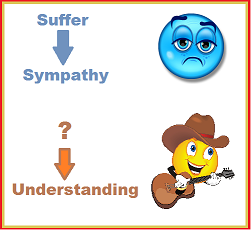
I say, “I suffer from social anxiety.” It’s true – it causes suffering. But I say it because that’s the only way I can think of saying it. It’s not what I really want to say.
When someone says, “I suffer,” it sounds as if they’re asking for sympathy. “Oh you poor thing – I do hope you get better soon.” That kind of thing. But I don’t want sympathy. I’m not some poor, pathetic character who spends her life feeling sorry for herself.
I tell people in the hope that they’ll understand why I am as I am. I tell them so that they’ll know this thing not only exists but is very common, even though it’s seldom mentioned. I want understanding, not sympathy.
And as far as getting rid of it is concerned, I’ve come to the conclusion that no one does that. You can learn to live with it, to do things despite it, to stop letting it restrict you. But it doesn’t go away. It’s always there, somewhere.
Anyway, coming back to the problem – the “suffering” one, how can I explain it without the S-word? Any ideas?
Have you heard the theory that there are countless parallel universes, that at particular moments in your life when one decision was made, another universe began with another you who lived the choice you didn’t make.
In my memory, I made the decision aged six, but really I think I always did this. At the age of six I was more able to rationalise it.
As I saw it, they picked on me. They all chose to tease me. In reality, it probably started as normal childhood behaviour. This is the way young children treat each other. But I didn’t know about that. My response was not to react – never to show that their taunts upset me, because if I did it would be worse.
In the parallel universe, I cried and they stopped teasing. They included me instead of spurning me.
In the parallel universe, this blog doesn’t exist, I don’t write and I’ve never heard of social anxiety.
But I’m married to someone else, have different children and probably still live in Britain.
My life is different in the parallel universe. I can’t say whether it’s better or worse. Where I am now, in this universe, it’s pretty good.
Mapelba says:
What moment in your childhood would change where you are now? Of course, perhaps it the small forgotten decision that made all the difference. You’re alive because you took an extra minute to tie your shoe and so you weren’t on your bike in the intersection when the truck ran the stop sign. But those moments you can never know.
On 3rd March, 2002, I received an email. It began: “Hi, it’s Gill Balbes (as was) here. Was talking to Jane the other night and she was telling me about how she’d been in contact with you and that you remember me (as I do you) so I thought I’d say hello. Schooldays seem a long way off but it would be nice to hear how you’re doing.”
Schooldays certainly were a long way off. It was over thirty years since I’d walked out of the school gates, vowing never to have any connection with any of the girls I’d known over the previous seven years – a few even longer. It was only recently that I’d added my name to the Friends Reunited site, opening up the possibility of contact, although I didn’t expect anyone to write to me.
But Jane did write and I made a decision: that if I was going to correspond with anyone from school, I would make the relationship meaningful by being open about what happened to me there. If they didn’t want to discuss it, there wasn’t much point in reuniting.
Fortunately, Jane did agree to discuss it. She also apologised for what she did to me, although I didn’t hold her or any of the former pupils to blame as adults for their actions as children. I always knew the bullying (which I called teasing then) had had a bad effect on the rest of my life, but never thought the children were mature enough to understand what they were causing.
Jane soon put me in contact with Gill, who had more time to write. Gill and I corresponded almost daily for a long time, and she became a very special friend to me. It was Gill who told me about social anxiety. I didn’t realise the significance of it at first, but gradually two things became clear. I was not alone in being this way and it’s possible to improve. (I don’t think it makes sense to say there’s a cure, and I don’t think there needs to be one.)
Gill has been the catalyst for many changes in my life – for starting to write, for starting a blog, and much more. We have now met several times. After ten years, I still count Gill as a very special friend.
—o—
Do you have a friend story you want to share?
Please note: I have scheduled this post to appear on the right day, but probably won’t be available to comment for a day or two.
That’s me on the left – with Robin, Myriam and Lisa
A common feature of social anxiety involves the person worrying so much about an event beforehand that they do their best to avoid it. Fortunately, or otherwise, I’ve never done that. I’ve explained my behaviour by saying that my desire to be with people is greater than my anxieties. I could also explain it as stupidity. Why else would I keep coming back for more?
That is not to say that I didn’t enjoy the Scavenger Hunt that I attended on Friday in the Jewish Quarter of the Old City of Jerusalem. Most of it was fun and I enjoyed meeting all the other participants. I was also amazed to discover how much there is to see in such a small area, and how much I’ve missed, despite having been there many times before.
What was hard was answering the questions, especially the ones that required opinions, but fortunately the other members of my team made up for my shortfalls.
As I’m sure you won’t have my problems, I can heartily recommend going on a scavenger hunt instead of an ordinary tour. If you’re planning a visit to Jerusalem, here’s the place to find out more information.
Another blog post made me think today. This one came from Catdownunder:
There is a very, very small Indian community in Adelaide. It is so small that the sight of sari or turban causes people to look twice. It is all so very different from the area of London I lived in for seven years. I still miss the cultural diversity of London. It is quite different from the “multicultural” ethic here.
The sight of an Indian face at the checkout in the supermarket is even more unusual. There was a pleasant young girl in the “fast” lane yesterday. As people went ahead of me I could hear her dutifully saying the obligatory “Merry Christmas”. Some people would say “Merry Christmas” back. Others would nod, too busy to care about something said meaninglessly.
When I reached her and she said it to me I asked, “Do you celebrate Christmas?”
She looked surprised by the question and then admitted, “No, not really.”
So I said, “Well it is really much too late but would it be more appropriate for me to say I hope you had a happy Diwali?”
Her face lit up. “You know about that?” I do.
Now, instead of the professional smile there was a genuine one which reached her eyes as she said, “It was wonderful. Thankyou – and I really do hope you enjoy Christmas.”
If I happen to see her next Diwali I will give her good wishes at the appropriate time. I like it when that happens too.
My first thought was: how thoughtful of Cat. So many people seem to think that everyone must celebrate Christmas. Even if they don’t believe, surely they’d have a tree, give presents, gorge themselves. When I lived in Britain, people seemed to regard me as weird because we didn’t.
Then my thoughts moved on. If I’d been behind that checkout counter, Cat wouldn’t have wished me a happy Chanuka. How could she have known? Unless I’d gone out of my way to look different – maybe by hanging a big Star of David on my neck. But that would be rather in your face, like putting up a sign.
Sometimes I think it would be easier if all differences could be seen. That would avoid confusion and embarrassment. There’s another sign I’d like to put up. It would say:
.
I have another three days of gorging ahead – on doughnuts and latkes.





 Miriam Drori, Author