I’ve lived in Tel Aviv for twenty months and I’m still discovering parts of it. I’ll probably continue to do so for a long time.
Independence Park is my latest find. It’s not so far from my home and has existed for decades, so I really should have known about it. It has wonderful views of the sea below. I expect I’ll be returning to it soon.
…I also know little of life in Israel, other than what we see on the news, which I have tried to forget as the real world is a different one to the world this story inhabits. That’s what fiction is for, taking us away from the real world.
I actually wrote this novel more than a year ago, its publication having been delayed for several reasons. But even before the seventh of October 2023, and going back long before independence in 1948, Israel has been plagued by conflict and wars, by enemies who will agree to nothing less than its complete destruction. It has always known terrorist attacks of various sorts.
By the way, despite all that, I believe Israeli cities are among the safest in the world, especially for women.
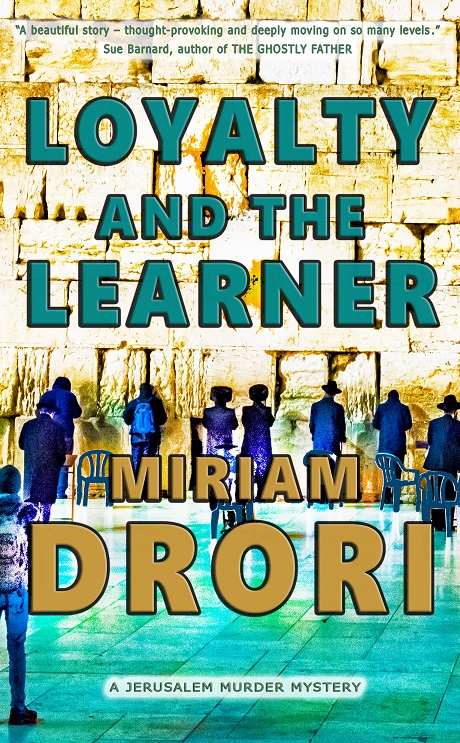
Not one of my novels set in Israel – Neither Here Nor There (not currently available), Style and the Solitary and Loyalty and the Learner – mention wars or attacks, other than Asaf saying of Israel’s problems in Loyalty and the Learner, “One of those is the security situation.”
Why?
There are plenty of novels set in Israel that highlight the security situation and explain it much better than I ever could. I wanted to portray ordinary life here, to show the beautiful and the not so beautiful but without the wars. Does that make the world of my novels fictional?
I don’t think so. The reality is that Israelis live in two parallel worlds simultaneously. We work in offices or building sites or fields. We go shopping in markets and supermarkets and smaller shops. We exercise in the gym or by walking, runnning, cycling, dancing. We love to spend time with our families.
The other world is more frightening. We hear about it on the news and hope it won’t come any closer to us, but of course it does, even if it’s only when we run for shelter. No, it’s never only that, because we all know people who’ve been affected much more, who’ve lost family members and had their worlds changed forever in a single moment.
In normal times, but not during the past year, it’s possible to spend whole days, maybe even a week or two, without thinking about wars or attacks. Unless, of course, you’re in the army, or have a child in the army, or find yourself under attack…
Really, it’s often possible to forget you’re in the Middle East for a while. And so, I suggest the world of my novels is not as fictional as you might think.
Loyalty and the Learner is published through Ocelot Press and can be purchased via Amazon and other online stores.
Holocaust Remembrance Day started off fittingly dark.
This year we remember the Holocaust in the aftermath of the 7th October massacre, the worst tragedy that has befallen the Jewish people since the Holocaust. There are some who want to call that day another Holocaust, but most disagree. During those awful years, while a few brave individuals risked their lives to save others, most Jews had nowhere to turn. Today, we have a state and an army.
In recent years, when the siren went off, I’ve stood on the balcony facing Jerusalem’s Yad Vashem, the Holocaust Museum. This year, in Tel Aviv, I took a short walk ending at Jerusalem Beach.
There I stood on the raised platform, watching the movement around me. On one side, the waves constantly rose and fell on this windy day. On the other side, people walked or ran past and traffic came in waves, often halting at the traffic light. In the distance, four young men kicked and headed a ball to each other.
At ten o’clock, the siren went off and everything stopped. Traffic came to a standstill, walkers and runners stood still, the young men let the ball roll to a stop as they, too, stood still. Only the waves continued to roll, oblivious to the occasion. Two minutes later the siren stopped, traffic started up, people continued their activities and I walked home.
I’m thinking of the six million who died in the Holocaust. I’m thinking of the one thousand two hundred who died on 7th October. I’m thinking of all the hostages still in Gaza after seven months, who didn’t hear the siren and probably don’t know that today is Holocaust Remembrance Day. I’m thinking please, bring them home.
“A memoir-in-miniature” says the front cover, the words hovering over a cardboard box, its flaps raised, inviting me to unpack it. Written on the side of the box is the author’s name, leaving me in no doubt about the contents within.
But I’m wrong, not about the overall goal of this book but about the way it’s presented. The chapters are short, flash-fiction style, and all the words have been chosen with care and precision, clearly requiring several rewrites. And not only that. The formatting is also special. There are words crossed out, tables and diagrams, short lines, indented lines, framed lines, columns, blank spaces.
I have to admit that, as a person who struggles with visual clues, I don’t always understand the reasons for all these unusual formats. But I’m certain there are reasons as I read the book, and even more so at the end when I read the book-club-type questions. “What do you think is the difference between her [Jennifer’s] use of strikethroughs vs parentheses?” For me, the answer doesn’t matter; what’s important is that reasons exist, proving that everything in this book was carefully thought out.
And yet, none of this interfered with my enjoyment of the memoir, my wish to discover how the story would continue and end. I wasn’t disappointed.
Rereading my review of a few days ago, I notice I didn’t even mention the love story the memoir tells, the differences of opinion between the two players in the story, caused by their different backgrounds and attitudes towards religion. It made me keep thinking: surely this is the part when they agree to separate.
Although the love story formed the whole plot, it was the telling of it that made this book special.
Places We Left Behind
“For anyone who has ever loved deeply and been willing to take risks for the sake of love.” Rachel Barenbaum author of Atomic Anna
When American-born Jennifer falls in love with French-born Philippe during the First Intifada in Israel, she understands their relationship isn’t perfect.
Both 23, both Jewish, they lead very different lives: she’s a secular tourist, he’s an observant immigrant. Despite their opposing outlooks on two fundamental issues—country and religion—they are determined to make it work. For the next 20 years, they root and uproot their growing family, each longing for a singular place to call home.
In Places We Left Behind, Jennifer puts her marriage under a microscope, examining commitment and compromise, faith and family while moving between prose and poetry, playing with language and form, daring the reader to read between the lines.
Jennifer Lang
American-French-Israeli hybrid; obsessed with identity, language, home, belonging
1995-today: Stories in BabyCenter, Parenting, Parents, Natural Solutions, Woman’s Day, Real Simple, Baltimore Review, Under the Sun, Barren Magazine, Quarter After Eight, Citron Review and on NPR
MFA in Writing from Vermont College of Fine Arts; an Assistant Editor at Brevity Journal
Yogini, practicing since 1995, teaching since 2003
IG: jenlangwrites FB: jenlangwrites
AWARDS for Places We Left Behind: *Finalist in Multicultural Nonfiction in American Book Fest’s 20th Annual Best Book Awards *Finalist in Multicultural Nonfiction in the IAN Book of the Year Awards 2024 *Gold Book Award Winner of Literary Titan
I can think of several options that I’d better not repeat here. But the event that brought about this post is that I was thrown off Facebook, with no reason given or any route to appeal the decision.
I have been on Facebook since 2009, if not earlier. (I have no way of knowing any more.) All my history, memories, friendships, groups, photos have vanished in one fell swoop. That’s a huge part of my life.
But, you know, it’s not the end of the world. I can think of many things that could have happened to me that are much worse than this. I could have:
suffered an accident and been rendered unable to walk or dance
suffered a robbery
suffered a loss* (That happened six months ago; I certainly wouldn’t want a repeat.)
suffered many other events I don’t want to dwell on
The worst thing I can think of at the moment is that I could have been kidnapped by terrorists and held for over five months (so far), suffering hunger, torture, rape and more.
One happier piece of news is that I’m moving from Jerusalem to Tel Aviv. I’ll have to change the tagline of this blog. I will post more about this after the move.
* On the subject of loss, I have an essay in this new anthology of poems, stories and essays:
The author Joan Livingston called my contibution a “Great piece of writing!”
Here’s a shout-out for Lisa’s wonderful and informative blog, in which she describes nature trails and historic ruins, gorgeous birds and flowers. If you want to see a beautiful side of Israel, one that you won’t see on the news, this is the place to go. We’ve all been through hell, but Lisa’s hell began long before 7th October. It’s lovely to see her back.
Over the past two months, I’ve watched many more videos, seen more pictures, and read more comments than is good for me. Some of them I saved to refer back to and maybe share later. Like this one:
He was released in a prisoner exchange: 1027 prisoners for one Israeli soldier.
I think that shows so much about Israel. For instance:
We value life.
We look after prisoners.
Our doctors treat all patients equally.
What it shows about Hamas is obvious.
And that’s why there is no comparison and can never be one between Israel and Hamas.
We have heard, but generally not watched (because it’s too harrowing) what they did on 7th October. We’re only starting to hear how they mistreated the people they kidnapped. And that’s from those they chose to release. Who knows what they’re doing to the ones still being held?
Israelis don’t always see eye to eye. But when disaster strikes, that’s when we’re the most united. While the world continues to chant meaningless slogans and repeat lies, we’ll get on with the war we didn’t choose and don’t want. Why? I think Golda Meir, prime minister of Israel from 1969 to 1974, explained it well:
Take care, wherever you are in this dangerous world.
As some of you know, my husband of forty-five years died suddenly just over a week ago. I will write a post about his life, but first I want to tell you about the tradition called shiva, and how it works in Israel.
This was actually my first full shiva and the first in Israel. The one for my father was curtailed because of a festival. My mother didn’t have any friends left when she died at ninety-eight, and I also didn’t have any friends in England who’d be able to visit.
What is a shiva?
In Judaism, the shiva is the period of seven days (shiva means seven) during which the mourners sit at one of their homes and people come to pay their respects, give condolences and provide comfort. Those who knew the deceased add their memories.
The count of seven days begins on the day of the funeral and includes the Sabbath, even though the mourners don’t “sit shiva” on that day. In our case, the funeral was on Sunday and so the shiva lasted until Friday without a break.
The last photo of us together, taken at the celebration of my 70th birthday.
Who was present every day?
My three children; my brother-in-law, who hopped on a plane in London and arrived in good time for the funeral, which took place the day after the death; my daughter’s husband and me.
Who was present most days?
My son’s wife, who helped a lot, even though she had to care for their little daughter and also to work.
Where did the food come from?
So many people brought food – from cakes, sweet and savoury bites, and fruit to complete meals. We sat and indulged and wondered whether people tend to put on weight during a shiva. When it was over, I stuffed everything into cupboards and the fridge and didn’t want to eat anything. I still don’t want much.
Who came to visit?
There were several groups:
Close friends, who knew all of us well.
Family members, some close, others more distant.
Friends of each of us, who didn’t know my husband.
Work colleagues, who knew only him.
What did we learn?
What it was like to work with him.
Anecdotes.
The secret to living a long and healthy life. (One of my dancing partners is 95!)
What a lot of friends he had.
What a lot of friends I have.
What did we think of the shiva?
We were sceptical at the beginning, none of us having experienced this before. By the end, we all agreed that it works very well and provides the best possible transition between life before and after.
Today is Holocaust Remembrance Day in Israel. Since 1951, this day in the Hebrew calendar (one week after the end of Passover and one week before Memorial Day and Independence Day) has been set aside to remember the Holocaust.
At ten o’clock today, I stood on the roof and turned towards Yad Vashem, the Holocaust museum, as the siren sounded and the country stopped for two minutes.
I didn’t want this day to pass without posting something, so I’m going to list three excellent stories that I’ve read, all books containing horrific events but also optimism. After all, Holocaust memories come from those who survived.
I am definitely not the right person to explain about Mimouna. Wikipedia has a much better explanation than I could give, starting with:
Mimouna … is a traditional Maghrebi Jewish celebration dinner, that currently takes place in Morocco, Israel, France, Canada, and other places around the world where Jews of Maghrebi heritage live. It is held the day after Passover, marking the return to eating hametz (leavened bread, etc.), which is forbidden throughout the week of Passover.
Unfortunately, the celebration in Jerusalem’s Sacher Park was rather a washout, this year, as thunderstorms lasted for most of the day. However, we were invited to the dry quarters of our next-door neighbours, who served muflettas and all sorts of sweet things, and also dressed up for the occasion.
Years ago, some visitors to this blog asked me to write more about living in Israel. This worried me. I thought there would be aspects of living here that would be hard to explain. But I decided there must be a few “normal” parts that I could expand on.
So, under the category of Israel, I created a sub-category called Everyday life. I posted a few things I thought would be universally understood. Then, one day, I wanted to post about an unusual occurrence. So I created another sub-category called Extraordinary events. We’ve had many of those, over the years, although I usually don’t mention them here.
Fast forward to the present. I tend to post more on Facebook than on the blog. What have I posted about recently?
A video of folk dancing taken ten years ago
Holiday greetings to all
Cake and other food I made for Pesach – Passover
A memory from my sadly defunct writing group
A video from last year’s trip to South Africa
The discovery that Google translate can now read out text in Hebrew
Finally, as I scroll down, I get to something more serious: my one and only share about the current wave of protests in Israel. The current government is trying to bring in a law that would give less power to the Supreme Court and more to the politicians. In one of the photos in the post, author Etgar Keret holds a sign that reads: “Once I wrote books; today I write signs.”
It’s sad to realise how split this country is – not that we didn’t know before, but now the situation seems worse than ever.
However, one thing that’s guaranteed to bring the Jews together is when terror strikes, as it has done several times recently. When two sisters, aged sixteen and twenty, are murdered and their mother is fighting for her life in hospital, it feels as if this is our family. Yes, we still go out for trips in nature, or to dance, or do whatever else we enjoy, but part of us is grieving for those girls and for the other victims.
95 and still dancing!Dressed up for Purim
Sometimes, we’re split as a country. Other times, we’re split inside. That’s what living in Israel is like, and always has been. Hopefully, it won’t always be like this.
Update: Sadly, the mother of the two girls succumbed to her wounds.




 Miriam Drori, Author