The familiar characters are back in Hunter’s Rules, the sixth in the series of DI Hunter Wilson Crime Thrillers by Val Penny. I loved spending time with them again, albeit not a lot of time as I whipped through another page turner from this prolific author.
I also enjoyed meeting new characters, especially Eileen, who remains strong and positive, despite having suffered horrific injuries. Naturally, not all the characters are nice, and some turn out to be thoroughly bad. Will Hunter see to it that they get their just deserts?
Like all the other books in this series, the setting is Edinburgh, and I was happy to be introduced to new parts of this varied and colourful city.
Topics in the novel include drugs, blackmail, prison life, science, medicine and relationships. But a clue to the main theme is on the cover: “FOLLOW HUNTER’S RULES AND THE EYES HAVE IT…” I’ll say no more.
I received a free copy of this book for the Reading Between the Lines blog tour in return for an honest review.
Val Penny: BIO
Val Penny has an Llb degree from the University of Edinburgh and her MSc from Napier University. She has had many jobs including hairdresser, waitress, banker, azalea farmer and lecturer but has not yet achieved either of her childhood dreams of being a ballerina or owning a candy store.
Until those dreams come true, she has turned her hand to writing poetry, short stories, nonfiction books, and novels. Her novels are published by SpellBound Books Ltd.
Val is an American author living in SW Scotland. She has two adult daughters of whom she is justly proud and lives with her husband and their cat.
“A memoir-in-miniature” says the front cover, the words hovering over a cardboard box, its flaps raised, inviting me to unpack it. Written on the side of the box is the author’s name, leaving me in no doubt about the contents within.
But I’m wrong, not about the overall goal of this book but about the way it’s presented. The chapters are short, flash-fiction style, and all the words have been chosen with care and precision, clearly requiring several rewrites. And not only that. The formatting is also special. There are words crossed out, tables and diagrams, short lines, indented lines, framed lines, columns, blank spaces.
I have to admit that, as a person who struggles with visual clues, I don’t always understand the reasons for all these unusual formats. But I’m certain there are reasons as I read the book, and even more so at the end when I read the book-club-type questions. “What do you think is the difference between her [Jennifer’s] use of strikethroughs vs parentheses?” For me, the answer doesn’t matter; what’s important is that reasons exist, proving that everything in this book was carefully thought out.
And yet, none of this interfered with my enjoyment of the memoir, my wish to discover how the story would continue and end. I wasn’t disappointed.
Rereading my review of a few days ago, I notice I didn’t even mention the love story the memoir tells, the differences of opinion between the two players in the story, caused by their different backgrounds and attitudes towards religion. It made me keep thinking: surely this is the part when they agree to separate.
Although the love story formed the whole plot, it was the telling of it that made this book special.
Places We Left Behind
“For anyone who has ever loved deeply and been willing to take risks for the sake of love.” Rachel Barenbaum author of Atomic Anna
When American-born Jennifer falls in love with French-born Philippe during the First Intifada in Israel, she understands their relationship isn’t perfect.
Both 23, both Jewish, they lead very different lives: she’s a secular tourist, he’s an observant immigrant. Despite their opposing outlooks on two fundamental issues—country and religion—they are determined to make it work. For the next 20 years, they root and uproot their growing family, each longing for a singular place to call home.
In Places We Left Behind, Jennifer puts her marriage under a microscope, examining commitment and compromise, faith and family while moving between prose and poetry, playing with language and form, daring the reader to read between the lines.
Jennifer Lang
American-French-Israeli hybrid; obsessed with identity, language, home, belonging
1995-today: Stories in BabyCenter, Parenting, Parents, Natural Solutions, Woman’s Day, Real Simple, Baltimore Review, Under the Sun, Barren Magazine, Quarter After Eight, Citron Review and on NPR
MFA in Writing from Vermont College of Fine Arts; an Assistant Editor at Brevity Journal
Yogini, practicing since 1995, teaching since 2003
IG: jenlangwrites FB: jenlangwrites
AWARDS for Places We Left Behind: *Finalist in Multicultural Nonfiction in American Book Fest’s 20th Annual Best Book Awards *Finalist in Multicultural Nonfiction in the IAN Book of the Year Awards 2024 *Gold Book Award Winner of Literary Titan
The blog tour is organised by the lovely Lynsey Adams of Reading Between the Lines.
About the Book
Stories to soothe your soul.
In a world drowning in negativity and dark events, we all need a little light and hope. With a little adventure, romance and even music, these short stories will give your hopes and dreams a nudge as they draw a smile.
A Gentle Nudge by Mason Bushell wraps you in calm.
Author Mason Bushell, is a naturalist, chef and writer from Norfolk in the UK. He loves nothing more than to write among the trees, near his home. He is an avid short story writer and is always working with his characters unless Lucy Dog steals his laptop for a walkies!
I’m sure many people have occasional days when they feel overwhelmed by events and only want to escape the real world with a book. What sort of book do you read in those circumstances? I’ve found romances to be eminently suitable for the purpose. But having read this book of short stories, I think they are just as good. The advantage of short stories over a novel is that the reader can dig into a story whenever they have a few minutes free, and never lose the thread or forget which character is which.
The stories in this collection are sweet. Some include romance; others involve children and animals. Sometimes disaster strikes, but I hope I’m not giving anything away when I say all the stories have happy endings.
The characters in these tales are kind. They often go beyond all expectations to help people in need of support. When bad characters appear, they always get their just deserts. The stories provide satisfaction.
The real world, as we know, is not always like this. It would probably be correct to say it’s not usually like this. But the world of these stories is one we should aspire to. If the real world were like this, we wouldn’t need these stories. As it is not, we very much do.
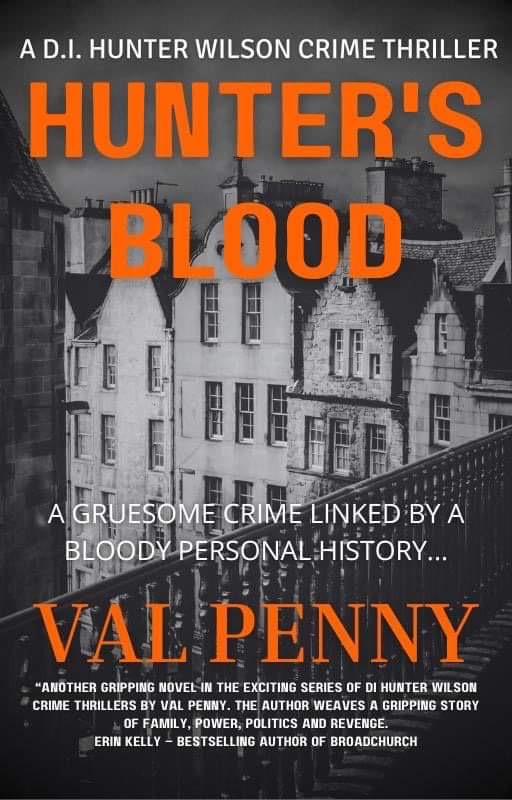
I’m delighted to be able to participate in the blog tour for Hunter’s Blood, the 4th in a series of crime novels set in Edinburgh by friend and author, Val Penny.
The blog tour is organised by the fabulous Lynsey Adams of Reading Between the Lines.
About the Book
DI Hunter Wilson never has just one problem to solve.
Three elderly women he knows have died in mysterious circumstances. Hunter appears to be the only link.
A little girl goes missing on a cold winter’s night. When his team discovers cocaine hidden at the farm where she was living, the search becomes even more urgent.
Why did the women die? And what did the child witness?
Hunter must find the answers to these questions to ensure his family and his city are safe.
Val Penny has an Llb degree from the University of Edinburgh and her MSc from Napier University. She has had many jobs including hairdresser, waitress, banker, azalea farmer and lecturer but has not yet achieved either of her childhood dreams of being a ballerina or owning a candy store.
Until those dreams come true, she has turned her hand to writing poetry, short stories, nonfiction books, and novels. Her novels are published by SpellBound Books Ltd.
Val is an American author living in SW Scotland. She has two adult daughters of whom she is justly proud and lives with her husband and their cat.
This is a great series. Like all the other novels in the series, this one is easy to read, and even I sped through it. Val Penny has some great ideas and weaves them together into a believable and exciting story, while introducing new characters and bringing back familiar ones. I had no idea ‘who done it’ until the very end, and yet the resolution fitted the plot perfectly.
By the way, Val Penny has appeared on this blog several times and I’m sure she’ll be back soon. She has also been kind enough to host me on her blog.
Hello again, all you lovely readers. It’s been a while. In the meantime, I took part in various activities, the most important being our daughter’s amazing and unique wedding.
Recently, I’ve been posting short excerpts from the wonderful reviews for Cultivating a Fuji on social media – Twitter and Instagram. This has caused me to reflect on each sentence. Here’s the one I posted today:
“This is Martin’s story but there are multiple POVs to show not everyone thinks badly or only wants to ridicule him. People want to help… they just don’t know how.”
When I thought about it, I realised this is the whole point. Most people are kind. Most people want to help. But they need guidance, especially when faced with someone like Martin. He will never provide that guidance himself. He’s much too locked up inside himself.
That’s why I became passionate about raising awareness of social anxiety. It’s why I wrote my non-fiction book, Social Anxiety Revealed. It’s why I’ll continue to bang on about social anxiety.
Because the world is full of people like Martin who need help. It’s also full of people who want to help. But help will never be forthcoming unless those kind people find out how to provide it.
Social Anxiety Revealed is one source of useful tips. You can find this book at Smashwords, Barnes & Noble, Kobo and elsewhere.
Thank you for reading this post. One day, the world will understand better.
Now that Cultivating a Fuji (new edition with Ocelot Press) is well and truly out in the world and I have time to breathe, I’m posting the review excerpts from my last post in a better way, so that they can be seen on any device.
There are other reviews, which I will post soon. I’m so proud of the reactions to Cultivating a Fuji so far, and hope the novel will be read by many more readers.
You can find Cultivating a Fujihere. The paperback is on its way.
This is a very moving story. There are many other characters and the author does an amazing job of developing them all. It is an intriguing and thought-provoking story, a very different read with a dramatic twist at the end that had me rethinking assumptions I’d made when reading the earlier part of the book.
[I] found it to be a moving description of social anxiety and just how traumatic a simple meeting can be for sufferers….yes there’s humour, but I found this to be a sad, poignant and thought provoking tale.
This is a book that is guaranteed to stay with you long after you read it, it is a book that really makes you think with a few surprises along the way.
Cultivating a Fuji is a very touching story about how hard it can be to fit in the crowd. Martin’s character is well-developed and even the minor personalities have their own past and problems in this wonderful story.
What a beautiful book! This is a novel I will reflect on time and time again. This isn’t a ‘preachy’ read; rather it is one of understanding and compassion, and it has brought another excellent author into my world. Extremely enjoyable, providing much food for thought and, in my humble opinion, no less than five stars will do it justice!
These scenes were deeply uncomfortable for me, as someone who experienced bullying, so I’d be mindful of how you feel, but it’s written sensitively and in a beautifully validating way. The thing I appreciated most about this novel was the way the author constructed a novel elevating social anxiety as a real, difficult thing. She either experiences the illness herself or has done her work. Where the Curious Incident with The Dog in the Night-time is a beautiful novel explaining autism, this, for me, is the work to explain social anxiety.
Even when I wasn’t reading the book I found I was thinking about it and counting down to when I could pick it up again. This is an extremely important book for helping people gain an understanding of social anxiety, and just how deeply it can affect the entire lives of sufferers.
Author Miriam Drori has written a compelling, heart-warming and thought-provoking UpLit exploration of loneliness and social anxiety. It was impossible not to be gripped by Martin’s journey, which begins with a business trip to Japan. And, then there’s a whammy of an ending that’ll leave you gasping…
This is Martin’s story but there are multiple POVs to show not everyone thinks badly or only want to ridicule him. People want to help… they just don’t know how. Cultivating a Fuji is a good read lovers of contemporary and literary fiction will enjoy, and the twisty conclusion will linger long after the story’s end.
Not everyone is without sympathy for Martin either but sometimes, as the book shows, people willing to help him (such as his boss, John) don’t know the best way to go about it or may inadvertently choose the wrong way. There were some great scenes full of humour… I really enjoyed the second part of the book in which we learn of Martin’s life following his return from Japan. Cultivating a Fuji does a great job of highlighting the experiences of those with social anxiety disorder and the challenges they face using the medium of fiction.
I think the resilience Martin inadvertently learned from his school years, sets him on the path he takes, and propels the story forward into a new chapter in his life. There are plenty of moments of contrition in this book, and the feel is generally cathartic. I did find certain aspects troubling, as I think we are meant to.
Miriam Drori has sensitively exposed the reality of living with social anxiety and the impact it has on all involved while creating a character I love in an uplifting, memorable novel.
Miriam Drori, the author, is a marvellous storyteller, especially in her ability to create real and relatable characters. You will be charmed by the story of Martin and all the people he meets. In this book, even the minor walk-on characters are fully developed with fascinating back stories.
It’s such a beautiful and thought provoking story. The first half of this book completely and utterly broke my heart then tenderly pieced it back together, filling it with so much joy. This is really an uplifting novel.
I thought the choice to tell the story from both Martin’s perspective and the perspective of those around him added depth to the emotional landscape. The author seems to understand the challenges faced by those of us with social anxiety as well as the troubles that exist for others who try to interact with us.
This is a very cleverly constructed novel and beautifully written. There’s no preaching or wallowing. The author presents the issue of social anxiety and gives us a view from both sides: from those who experience it and those who feel that it’s OK to put others down and induce such misery. There’s hope and despair, love and disappointment, achievement and failure, happiness and missed opportunities in this richly textured book that’s rewarding and poignantly enjoyable to read.
Release. What an amazing feeling. To be free to walk, on his own, out of the police station. Free to go in any direction, do whatever he liked. No one pushed him or shoved him or shouted commands at him. He took deep breaths and released them into the cold, welcoming air.
Finally, it’s the end of his incerceration, or so Asaf believes. In the Liberty Bell Park, his elation is boosted:
The path was almost deserted on this dull, wet day, but the bell welcomed him with its message of liberty.
Sadly, these feelings are short-lived. And so it is with the novel itself.
Yes, Style and the Solitary, published by Darkstroke Books, is free to download for a short period only, so get it while you can, no strings attached.
I do, however, have a little request. If you enjoy reading it, I would very much appreciate a review. It doesn’t have to be long and detailed. “Loved it” is fine – really.
Review
Here’s the latest review on Amazon.com: “I loved this innocent young woman who stood by her social phobic coworker when he was accused of murder. Her compassion and tenacity for finding the actual killer puts her in danger but demonstrates how much Nathalie cares for Asaf. The help she gets from her roommates is funny and caring as they bumble their way toward freeing Asaf. Will they survive this investigation, or will the murderer lead them off the deep end. Great story. Nice setting.”
Thank you, Sandy.
About the Novel
An unexpected murder. A suspect with a reason. The power of unwavering belief.
A murder has been committed in an office in Jerusalem. That’s for sure. The rest is not as clear-cut as it might seem.
Asaf languishes in his cell, unable to tell his story even to himself. How can he tell it to someone who elicits such fear within him?
His colleague, Nathalie, has studied Beauty and the Beast. She understands its moral. Maybe that’s why she’s the only one who believes in Asaf, the suspect. But she’s new in the company – and in the country. Would anyone take her opinion seriously?
She coerces her flatmates, Yarden and Tehila, into helping her investigate. As they uncover new trails, will they be able to reverse popular opinion?
In the end, will Beauty’s belief be strong enough to waken the Beast? Or, in this case, can Style waken the Solitary?
This post is part of the blog tour organised by Reading Between the Lines. It’s a post I’m pleased to have been invited to write, and one that I now tackle with enthusiasm and, well… embarrassment, but only a little. Read on…
The blog tour is for the book Creativity Matters: Find your Passion for Writing, which is compiled by Wendy H. Jones.
The Blurb
Have you always thought about writing a book but don’t know where to start? Are you an experienced author and want to spread your wings? Are you looking for inspiration for every step in your writing journey? This is a book for everyone who wants to write, whether history or contemporary, science fiction or humour, local fiction or set in a made-up world, fiction, non-fiction, memoir, there’s something here for you. Join thirteen authors as they share their passion for why you should write in their genre and find your own passion as you read.
It’s time for you to spread your wings, follow your dreams and find your passion for writing.
My Review
Here begins the embarrassing part.
You see, when I was asked to take part, I was away, hiking in the Bernese Oberland and other parts of Switzerland. I know, I haven’t blogged about that yet, but I plan to. I digress.
Since returning home, my time hasn’t been my own. I’ve had to attend to family matters and in particular to culinary matters, and the result is that I didn’t spend much time on creative matters and I Didn’t finish reading the book.
However, I did warn the organiser in advance, and I’ve read enough of the book to have something to say about it, which is this:
I love it and am looking forward to reading the rest. All the participating authors are clearly passionate about writing in their particuar genres, and their enthusiasm is catching. Each one answers the question ‘why write?’ rather than ‘how to write?’ and yet the ‘how to’ question is answered in a ‘show don’t tell’ sort of way – by example.
The chapter on writing drama particularly appealed to me because it was written as a drama. I’ve never even considered writing drama before, but this might even get me started. All I need is time!
If you have time and want to write in any genre or to switch genres, this book will spur you on.
As soon as I saw this title, I thought of this song:
and I couldn’t help singing it as I read the novel.
Beautiful as it is, I’m not here to talk about the song or Rod Stewart, but about the novel, The First Cut by Val Penny, published by Darkstroke Books and officially launched today. Like all Val’s novels, it’s crime fiction and this is the first of a new series. Jane Renwick has appeared in previous novels, but she now has her own series and we discover her roots.
Jane’s unfortunate early years are related so poignantly that the reader can’t help being drawn in and touched by the story. On top of that, there’s a dangerous killer at loose, and the police are working hard to find out who the killer is, but sometimes they’re misled.
There are stages in the process of writing a novel:
Formulate ideas.
Plot the story.
Write the first draft.
Write more drafts.
Edit.
Each of those stages contains various steps. Clearly, the author put a lot of laborious work into most of them. That’s what made the novel so easy and quick to read. And enjoyable, too. There must have been a lot of thought about how much information to reveal and when to reveal it. The hints at facts unknown to the police make this story a thrilling one to read, as the reader watches the police following the wrong paths.
There’s a lot involved in editing, too, and unfortunately it feels as if, for this novel, that stage was rushed. In particular, I was bothered by one sentence I didn’t understand. I’m not sure whether that was because of a typo, but I didn’t follow why it caused Jane to burst out crying and then decide she had to explain her tears by relating part of her childhood. Very possibly, I’m to blame for that. Also, there were places where I didn’t understand the use of italics, first/third person, tense and repetition.
But I want to stress that most of the novel is excellent, and probably other readers wouldn’t notice these small things. So do read it; it is what it promises: “fast-paced, gripping police procedural…set in Edinburgh and Glasgow, Scotland.”
About the Book
Sometimes it’s hard to escape a brutal past. That’s the case for DS Jane Renwick, who learns via DNA a serial killer could be a family member.
This gripping police procedural is set in Edinburgh and Glasgow. A vicious killer is on the loose and victims include an academic and members of Edinburgh’s high society. But Jane is banished to the side-lines of the case and forced to look on impotently when the hunt for the killer ramps up, because the Murder Investigation Team believes the killer is related to her.
Has someone from Jane’s estranged birth family returned to haunt her? Could one of her relatives be involved? Where will the killer strike next?
This exciting novel is the first in Val Penny’s new series of Scottish thrillers.
About the Author
This is the first in the new series of novels, The Jane Renwick Thrillers. Val Penny’s other crime novels, Hunter’s Chase Hunter’s Revenge, Hunter’s ForceHunter’s Blood and Hunter’s Secret form the bestselling series The Edinburgh Crime Mysteries. They are set in Edinburgh, Scotland, published by darkstroke Her first non-fiction book Let’s Get Published is also available now and she has most recently contributed her short story, Cats and Dogs to a charity anthology, Dark Scotland.
Val is an American author living in SW Scotland with her husband and their cat.