Categories
Books

Easter Eggs

I have to admit, I’ve never heard of this meaning of “Easter eggs” before, but it’s a great term for an interesting topic. I’ll let Rumer Haven explain.


Thanks so much for hosting me, Miriam!
As the oft-repeated saying goes, “Write what you know.” And so writers often do, me certainly included. As I’ve related time and again when people ask, yes, What the Clocks Know is inspired in part by real life. The protagonist’s move to London parallels my own, as does her emotional response to the life changes she undertakes.
But that’s the bigger stuff that helps drive the plot and underlies the themes. There are a lot of little things writers will include from their own experiences, too, and I’m no exception. In fact, no one loves an inside joke more than I do, so I deliberately plant these personal “Easter eggs” in my stories to give myself and people who know me a chuckle. Here are just a few that appear in What the Clocks Know:

1. Chapter One alone is pretty loaded with ’em. I’m ridiculously nostalgic for my childhood and past pop culture, so I drew from that to initially ground Margot in the ordinary world she lives in during the present before she enters a rather extraordinary one of the past.

  • High school friends will remember the way I put dimes in my black loafers instead of pennies.
  • College friends might recall the “squirty bird” I purchased at the Meijer store off campus–a big, bright plastic parrot that squirted water out of its beak. One of my rooms at the sorority house had a flat roof just outside the window, so at night, I liked to climb out and wait (unseen) for unsuspecting friends to pop in and chat with my roommate, then douse them through the window screen.
  • Speaking of the sorority, yes, I was in one, and yes, we had a traditional symbol that we’d form with our index fingers and thumbs when posing for group photos. Unfortunately, many sisters had the tendency to position this diamond-shaped symbol below waist-level, which made me laugh hysterically–Really? Did they not see the innuendo there? But apparently I wasn’t the only one to catch it, as the alumni magazine now bans this pose from all its photos.

2. In Chapter Two, while Margot is still at her childhood home, she finds an old grade school journal akin to one I kept in sixth grade. Reading through some of the entries reminds her of a classmate who lived off a dirt road that I based on my actual school bus route. Though now paved over, this road has forever creeped out locals and become an urban legend, as depicted in the eponymous film Munger Road. I was shocked when the movie came out after I’d already incorporated this reference into my first draft–just goes to show the mark that road makes on locals!

3. The once nameless waiter at the Troubadour cafe in Chapter Five only first became “Hal” during the late stages of editing–named for the actual Troubadour employee who gave me permission to reference the independent cafe by name. He was so pleasant and enthusiastic about the book that when he jokingly suggested I name a character after him, I decided to do just that.
4. Speaking of cafes, though not mentioned by name, the Chicago coffee house that Margot describes to Chloe at the Troubadour is the very same Bourgeois Pig Cafe featured in my last novel, Seven for a Secret. I frequented that place when I lived in Chicago’s Lincoln Park, loving and missing it so much that I held my Seven for a Secret launch party there as well in 2014.
5. There are occasional references to the French Revolution and, more specifically, Bastille Day–which is my birthday.
I could go on and on with these little hidden eggs, I’m sure, but I’ll leave the challenge to you as you read What the Clocks Know. Happy hunting! I mean, reading!
~ * ~

About What the Clocks Know:
Finding a ghost isn’t what Margot had in mind when she went ‘soul searching’, but somehow her future may depend on Charlotte’s past.

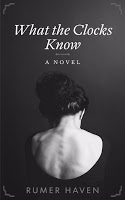
Woven between 21st-century and Victorian London, What the Clocks Know is a haunting story of love and identity. A paranormal women’s fiction, this title is available as of March 18, 2016 from Crooked Cat Publishing.

“A unique tale of the paranormal – as beautiful as it is haunting.”
~ Shani Struthers, author of Jessamine and the Psychic Surveys series

** Add it! **
http://www.goodreads.com/book/show/29368003-what-the-clocks-know
** Read it! **
Amazon US – http://amzn.to/21DZoCw
Amazon UK – http://amzn.to/1QsiFfr
~ * ~

Author Bio:

Rumer Haven is probably the most social recluse you could ever meet. When she’s not babbling her fool head off among friends and family, she’s pacified with a good story that she’s reading, writing, or revising—or binge-watching something on Netflix. A former teacher hailing from Chicago, she presently lives in London with her husband and probably a ghost or two. Rumer has always had a penchant for the past and paranormal, which inspires her writing to explore dimensions of time, love, and the soul. She debuted in 2014 with Seven for a Secret (in which a Jazz Age tragedy haunts a modern woman’s love life), and her award-winning short story “Four Somethings & a Sixpence” (about a bride who gets a little something she didn’t register for) was released in 2015. What the Clocks Know is her second novel.

Learn more about Rumer at:
Website – http://www.rumerhaven.com
Facebook – http://www.facebook.com/rumerhaven
Twitter – @RumerHaven

Thank you for coming, Rumer, and for revealing all those Easter eggs.

As for the novel, What the Clocks Know,  I can attest to its excellence because I helped with the final editing, so am privileged to have read it.

Categories
Books Letters from Elsewhere

Letters from Elsewhere: Dougal

Letters from Elsewhere

Today’s visitor is one of a kind. He’s called Dougal and he’s decided to write one of those letters to his younger self.

Dear little one,

You hated the thought of leaving the shores of Kent, the land of honey, Sky TV, siblings and mother’s milk for the unknown crime-ridden Metropolis, brim full to bursting with rules, vicious dogs and air pollution.  

Have I loved and protected you, the puppy in me? Kept alive your aspirations, quelled your fears and led you sensibly down the passage of time, helping to curb your excesses, fulfil your dreams and discover your role in life? How to be a man’s best friend: helping him through the trials of life, be it flu, sad times or a self-induced hangover.    

How have you fared? Has keeping a diary helped?

This particular date is forever etched in my memory.
16th May  (A quote from your diary at 5 months old)
Stonkingly good day! Terrified an entire nursery school and left muddy paws on the most elegantly-suited woman in the park. Once home I ate two brown socks, the tacks off the telephone wires, hacked through the skirting board, burst two footballs, was half-way through eating one of them and it wasn’t even lunchtime.

By 5 pm I’d eaten my lead, dug three large holes in the garden, chased next-door’s cat and chewed the leg off a chair. I’d call that, success.

Well, the good news is: you’ve stopped eating socks. A relief to the vet, your boss and dog minder, who had the pleasure of extracting a sock or three from out of your nether region…I need not continue, you get the picture? The details are too foul to go into. Maybe this is the moment to tell you more about you.

When you swapped Sky TV for the radio, you became less informed on Wildlife Programmes, but gained a greater knowledge about politics. And the big question now, is IN or OUT. Which for you, as a French speaker and Francophile, Paris and Brittany (Cité Europe is not on your wish list nor one of the 100 places you want to visit before you die) means you’re in. One of the very few to have actually made up their mind.

You didn’t die under the knife when your testicles were removed (the vet’s fault) nor did you gain the high notes of a counter tenor, but mercifully retained a deep baritone bark.

As you are aware, you survived a cliff-hanging incident (your fault) on the Thames. (Another diary entry, at 9 months of age.)

14th Oct

We were meeting Hannah in Barnes, not for the Boat Race – that we missed months ago. It was a blisteringly hot day and the tow path was heaving with families making the most of the weather. Next month London will be battening down the hatches, jumping into thermals and vegetating for the winter – a human habit caught from squirrels.

We sped along the path, river to one side, trees and back gardens on the other, dodging bikes, pushchairs and runners. They did, I didn’t.

‘Dougal, mind the baby. Oh, sorry, so sorry!  Dougal!’ I was high as a kite, charging through the dried leaves, my tail going like the clappers, as I sniffed dogs, chased cats and greeted every toddler going. Then, from the other side of the wall came the sounds of oars dipping in and out of the water, male voices, cries and laughter. The river was brimming with fun. I had to join in. With one Olympian leap, I was over.

Bonkers Dougal! Never underestimate the consequences of your actions. The water was only twelve metres below. Did I shimmy down the walls? No way. I dropped, one furry bundle of panic in free fall, my life vanishing behind me, the Thames looming ever closer, when a ledge, barely large enough to house a seagull, interrupted my descent. By some miracle I was able to grip. Thank the Lord I’d never had my nails cut.

Here, writing a diary helped you retain your sanity.

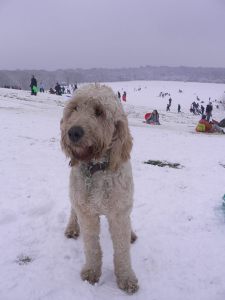
DougalInSnowNow, what about me, the older you? I keep in shape and young at heart by chasing non-existent foxes in the garden, jumping higher than a kangaroo when catching balls and treats. And I love, really adore nicking ice-creams out of  babies’ prams. But as for my obsessions with balls and health, I’d prefer to leave them for another time.

So, back to you, young Dougal! What of your dreams of starring in a West End Show, of travelling the world on Virgin Atlantic, or cocking your leg without falling over? Did any of them ever come true? 

Some of them, yes.

Always remember life is fun and you, my puppy, are well, truly alive and living in me.

From the almost grown-up Dougal xxx

The letter was headed:

A letter from my basket.
Written from the older, wised up but never wise or streetwise, Dougal to his younger self.

Dougal is the star of the novel Dougal’s Diary by Sarah Stevenson, published by Crooked Cat.

SarahStephensonAbout Sarah

Joining the Bristol School of Dancing aged seven, Sarah spent most of her childhood dancing in prisons, theatres, old people’s homes and the Grand Palais in Paris. Later she trained as an actress, working with Mike Leigh and other distinguished directors. When the children arrived, she trained as a chef, and when they’d finally flown the nest, catered in Europe, Britain and the States, giving private dinner parties. Sarah still works as a cook and writes.

.

 About Dougal

About Dougal’s Diary

DougalHas he chosen his owner well and landed on his paws? Dougal the Labradoodle puppy, a complete hypochondriac and Boris Johnson’s No 1 fan, arrives in Greenwich with great expectations.

He longs to travel the world on Virgin Atlantic, dine at royal banquets and either become a superstar and party the night away or work as a doorman at the Savoy.

Behaviour classes were never on his wish-list, neither were cliff-hanging experiences on the Thames, booze cruises to Calais or obsessions for eating socks.

Can he survive life with a chaotic owner and her eccentric friends? Can he deal with his jealousy when a foster puppy comes to stay? And as for his dreams, will they ever come true?

Dougal’s Diary on Amazon

Categories
Books Letters from Elsewhere

Letters from Elsewhere: Luke

Letters from ElsewhereI haven’t quite “landed” following the twelve-and-a-half-hour flight back from Hong Kong and I have a visitor. He’s a boy called Luke. He sounds quite sensible really. And brave.

Dear Mum and Dad

Sorry about the incident at school. I was stupid and have no real excuse. Sometimes I do things without thinking.

I know I’ve been a bit strange and distant recently, but I find it hard to tell you exactly what’s going on. In fact, there are some things you just would not believe – I hardly believe them myself.

You wanted me to be friends with Guy didn’t you? At first I kept thinking, why him? He’s so… weird. I know he has ‘special needs’ or whatever they’re called, but everyone else at school laughs at him. He gets bullied, but I promised to look out for him. And I did. I am.

I was right about him being weird. He is. He has this incredible ability to attract animals – wild animals that he handles without them hurting him or being scared. Birds, mammals, reptiles, insects, you name it. He seems to have special powers, like some kind of ‘Nature Boy’.

So we’ve become friends, which is kind of good because it’s what you wanted me to do. But it’s bad too, because now my mates at school think I’m a weirdo as well. They make stupid comments about us being ‘gayboys’. Just jealous I suppose.

Guy has shown me awesome things I never knew existed. He talks about the ancient magic of the natural world. When he talks like this he sounds like an old man, or some kind of wise guru. I told you he was weird. He uses words like ‘Gaia’ and ‘numen’, which I don’t fully understand.

He seems a bit obsessed with environmental issues. I think he’s one of those hippy tree-hugger types. He keeps going on about how we’re killing planet Earth with stuff like pollution, deforestation and over-fishing the oceans. If the planet’s dying then it needs some large-scale changes – and quickly.

The other day Guy said he wanted me to help him look for his mother. I know he lives with foster parents, so it’s normal to want to find your biological parents, but aren’t there agencies that can help you trace family? He said his mum is dying but he doesn’t know where she is. I wasn’t sure how to help him, but maybe you could have a chat with his foster parents.

I just wanted you to know that I’m fine. I really am sorry about the trouble I’ve caused, and that I’m not always the easiest person to be with. But being with Guy has taught me a great deal. I wish I could tell you about the really amazing stuff… about the magpie that was tapping on my window… about being in the middle of a storm… and what really happened to Frisky…

When the time comes, I promise to tell you everything. At the moment I just need you to trust me that I’m fine and that I mean it when I say I’m sorry for all the hassle I’ve caused you.

Thanks for being there.

Lots of love

Luke x

PicaNewRel

About PICA by Jeff Gardiner

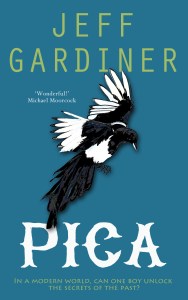
PicaFrontCoverPica explores a world of ancient magic, when people and nature shared secret powers.

Luke hates nature, preferring the excitement of computer games to dull walks in the countryside, but his view of the world around him drastically begins to change when enigmatic loner, Guy, for whom Luke is reluctantly made to feel responsible, shows him some of the secrets that the very planet itself appears to be hiding from modern society.

Set in a very recognisable world of school and the realities of family-life, Luke tumbles into a fascinating world of magic and fantasy where transformations and shifting identities become an escape from the world. Luke gets caught up in an inescapable path that affects his very existence, as the view of the world around him drastically begins to change.

JeffGardinerAndPicaWhere to find Jeff and Pica

Categories
Books

While I’m away…

I’m taking a short break from the blog. While I’m away:

  • There will be no Letters from Elsewhere this Friday, but the popular series will be back the following Friday.
  • I have a post coming up on Angela Wren’s blog today and other guest posts are planned for a month or so hence.
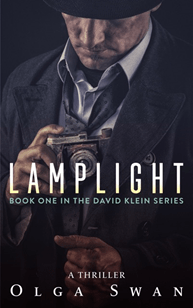
  • OlgaSwan - LamplightLamplight by Olga Swan is being published by Crooked Cat this Thursday. Lamplight is a thriller – book 1 in the David Klein series. David Klein is eighteen when he runs away from the poverty and orthodoxy of his Jewish home in Birmingham, England, for the bright lights and opportunities of New York. But trouble is in store.

    From the anguish and terror of nearly drowning at sea, the story moves between New York, Birmingham and eventually to Breslau in Germany where, when working as a war reporter, he meets Karin. Together, they live through the burgeoning terror of Nazi Germany in 1938.

    You’re invited to join the launch party on Facebook. And the ebook is available now for pre-order on Amazon UK and Amazon US.

Baby with rattlePlay nicely while I’m away and I’ll reveal all on my return.

Categories
Books

News of a Book Sale

Sale1

Reduced for one week only from 19.02.2016

What would you give for a world free of war, dependence on fossil fuels, pollution and terrorism? That is the premise for the Alchemy series.

An accidental discovery solving the problem of fossil fuel brings this Utopian vision closer but at what cost? Could there be unforeseen consequences and how dire would they be? Who could fight demons if all established religion had been abolished?

Put aside demons and add two people more doomed than Romeo and Juliet who are forced to fight alongside each other. Mix in some very energetic Goths and an undercover Christian Granny for an explosive result as the stories move at breakneck speed into the near-future blending magical realism with pizza, ritual with slang, deepest hatred with impossible love, shape-shifting with public transport.

Sale2.

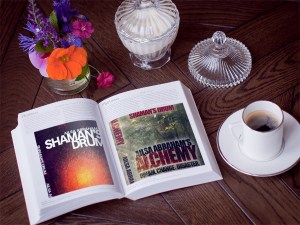
Book 1 Alchemy

Book 2 Shaman’s Drum

You can find Ailsa Abraham on TwitterFacebook and on her Web page.

Categories
Books Letters from Elsewhere

Letters from Elsewhere: Tana Standish

Letters from Elsewhere

It seems special abilities are as much a handicap as good fortune. Just as well I don’t have any! I’m fascinated by the history of today’s visitor, especially as it relates to the novel I’m currently working on.

Tana Standish operated as a British secret agent for Interprises, a secret adjunct of MI6, through the 1960s to the 1980s. She had a photographic memory and possessed psychic abilities, not all of them capable of being called upon at will. After four missions (Singapore, Naples, Izmir and Odessa), and prior to her next mission to Pilsen (1968), she was evaluated by the new psychologist, Dr James Fisk. In an effort at catharsis, he asked her to write a number of letters to him about her early memories. This is one of those letters:

Dear James

 I ‘celebrated’ my fifth birthday [in 1942] stumbling through the sewers of Warsaw, my hand in twelve-year-old brother Ishmael’s. We’d survived hunger and disease and managed to avoid the deportation of the children to Treblinka in July but everyone knew they would not live through the oncoming German onslaught.

Our elder brother Mordechai had told us we must escape, promising, “Jews will live to settle scores. Jews have lived and will endure for all eternity.” He would continue the Jewish resistance. As we slunk through the subterranean tunnels, I looked back, and Mordechai was singing a popular song of the starved ghetto: “When we had nothing to eat, they gave us a turnip, or a beet, here, take food, take fleas, have some typhus, die of disease!”

Ishmael, with hollow cheeks, pallid skin and all the signs of starvation, constantly deprived himself of our meagre contraband food in order to keep my strength up. Ishmael limped; he’d fractured his heel escaping a German raider whilst stealing outside the wall in the Aryan section of the city.

For two days, we munched sparingly on the scraps of coarse bread and stale cheese and stolen sugar.

On the third day when the food ran out, we surfaced from the rank sewers in the Christian part of the city. The outskirts of Warsaw were a great deal more repellent than below. We’d long-since grown accustomed to the dark and the vermin; even the smell had lost its pungency. But here, above ground, we were easy prey to demented thieves and homicidal Nazis.

Our most treasured possessions, however, were forged papers, created by a small commune of talented men and women: a travel-pass each, testifying that we were young Poles of pure race.

Constantly hiding, we followed the river Wkra north for most of the way, towards the Baltic, and our forged papers helped. When we could, we prayed. Ishmael told me about our eternal souls and how good people went to Olam Haba. “People who have done good but need to be purified, they go to Gehenom.”

“What about the Nazis?” I asked.

“Oh, they are too evil for Gehenom. They will be punished for all eternity.”

“Good,” I said.

We subsisted on vegetable refuse in farms and on the occasional rabbit.

The nights were still very cold and there were few haystacks to insulate us. The sky was filled with stars and my young mind wondered if there was any truth in the fable that when people died a star came into existence. A lot of people had died, I thought, gazing aloft, trying not to think of Mordechai.

Fortunately, I remembered a map from school in Karmelicka Street; it showed the area up to the Baltic; it hadn’t been up-to-date, but it proved invaluable. With an effort, I projected a mental image of it before my eyes and picked out salient landmarks as we travelled. All my family members took my memory gift for granted, hoping I would make use of it at university – but that was before the war, when hopes for a sane future flickered briefly.

Mere scarecrows, we often robbed farms. With my feet blistered and rib cage visible through translucent skin, I weakly, stubbornly clung to Ishmael’s bony hand.

Our journey took almost three months, and on numerous occasions, it was my sixth sense that saved us from capture. I seemed able to see through other people’s eyes sometimes – usually at moments of heightened tension. Ishmael didn’t even pretend to understand what powers I possessed, but was grateful for them.

As we approached the port of Gdynia, Ishmael explained in a faint whisper what we must do. “We’ll stow away on a ship. Wherever it docks, we can hide. It may even go across to Norway. Just think, Tana – Norway!”

Sneaking through the seaport wasn’t easy. The field-grey-clad sentries, gasmask canisters clinking, were there in force and on the alert for saboteurs. But our small size helped us melt into the shadows of warehouses and railway wagons. Miraculously, we avoided detection.

The dockside was swarming with threat and shadows. I was fearful of unfamiliar shapes and seemed to be trembling all the time. Framed in a narrow alleyway, the crosstree and derrick of a freighter’s mainmast were outlined against the night skyline. Then the black hull loomed and Ishmael whispered, “This one. We’ll get aboard this one.” He’d chosen well; whoever docked the ship hadn’t bothered to fit rat-guards on the cables.

Weak as we were, we managed to shin painstakingly slowly up the hawser. My hands were almost raw with the roughness of the cable. Tense minutes later, we squeezed through the gap and quietly lowered ourselves onto the dew-damp forecastle.

I cautiously followed Ishmael and scaled down a ladder onto the well deck. He partially lifted the cargo hatch tarpaulin cover and we both slid into the for’ard hold, where it was pitch-black at first. But after a while, our eyes became accustomed to the darkness; it was not unlike the sewers, I supposed, though smelled less rank.

The hold was stacked with crates but no food. Rats scurried to the forepeak, in deep shadow, but neither of us was particularly alarmed. Even the prospect of eating these vermin as a last resort held no horrors.

My stomach rumbled emptily at the memory of the last food scraps to pass my lips two days ago.

Ishmael chuckled and I imagined that he was smiling; he told me I was to make myself comfortable, while he went ‘up top’ to steal some food.

Fearful for his safety, I pleaded with him not to go. He kissed my forehead. “We’ll starve here if I don’t find something, little Tana. I promised Mordechai I’d look after you. I keep my promises.”

He was gone for ages. I had no way of knowing how long. It could have been an hour, perhaps much longer. The waiting seemed endless.

Deep in the creaking, dank-smelling hold, I was a little afraid. I would much rather have stayed in the sewers of Warsaw. Known terrors seemed preferable to those unknown. Besides, I had too much imagination.

Then my heart lightened, as I recognised Ishmael’s limping stride across the deck above. He sounded in a hurry. Intuitively, I knew something was wrong.

Anxiously, I scrambled up, knees grazing on the metal ladder. I peeked over the coaming.

Silhouetted in the searchlight beam that lanced down from the ship’s bridge, Ishmael attempted to run for cover, heading towards me, dodging around winches and the cowls of ventilators. Under his arm was a brown paper parcel that was spewing apples and he left a trail of broken eggs behind him.

A German voice shrieked: “Halt!”

Ishmael faltered. He turned to face the bridge.

Running out of the wheelhouse, a black-clad sailor leaned over the Navigation Bridge. In his arms was a sub-machine gun. I recognised the weapon and my heart froze.

Ishmael’s face was unnaturally pale in the pinioning light. He seemed resigned. His youthful cracked mouth twisted in a breathless agonised grimace. Suddenly, he jack-knifed backwards, six inches in the air to the staccato sound of the Schmeisser MP40 weapon. His out-flung arms violently discarded the stolen food; most of it splashed overboard as he crumpled almost on top of me, inches away from my face. A solitary apple rolled past his staring eyes and unthinkingly I snatched the fruit.

Ishmael’s head was on one side, his right cheek squashed against the metal deck and his eyes stared at me. His lips trembled but he was unable to speak. Yet I caught his words, faintly echoing in my mind. “I hope Mordechai won’t be too annoyed with me when I see him…” What little light there was went out of him and a thin gasp of air passed his lips and I felt it, like a kiss, on my cheek.

In shock, I slid back into the shadows under the tarpaulin. I knelt in the dark. My mind was completely numb, but I gripped onto the apple – my brother’s last gift to me.

It seemed an age. The agony of waiting, fearing discovery, was almost too much. At one low point, I even wanted to declare myself – anything to be rid of the heart-stopping suspense.

Then I heard voices talking overhead. And laughter.

My hearing was finely tuned now. But my mind was still numb – unable to snatch any thoughts from the nearby sailors or soldiers. Then they dragged the body of my brother away, laughing as they did so.

I heard a heavy splash and more hilarity.

But no tears came.

Alone now, I hunched tighter into the hold, amidst the bulky crates, and held the apple till it was bruised.

Even at that early age, my hatred was under an iron control. I had learned quickly enough through listening to other Jews who’d escaped from Treblinka that I must be circumspect when dealing with the enemy. I had cause to grow up quickly..

Finally, the sirens sounded. The freighter cast its moorings; the propellers pulsed and the ship throbbed into life.

Bow-waves caressed the hull. The lapping of water and the heaving motion signified we were finally at sea.

If only I could stay hidden until the ship pulled into some port.

Hunger drove me reluctantly to bite into the apple. It was moist and sent my pulse racing. So delicious! Thinking of Ishmael, tears at last flowed. I ate every scrap, the dry-textured bruised bits, core and all.

Like my young friends, I’d had to scavenge in Warsaw, sneaking into the Aryan quarter. The German policy had been simple and brutally logical – better to starve the inhabitants of the ghetto and save the bullets for the Front.

So, many hours after eating the apple, as the hunger-pangs returned with redoubled force, twisting my stomach into knots, I decided I’d have to forage onboard. At worst, if no food could be found, I’d have to risk serious infection and kill and eat a rat. It presented the least physical risk, obviously – the less food-hunting trips I made, less chance of discovery. But as far as I was concerned it would have to be the last resort.

The freighter was edging out of the choppy Gulf of Danzig and steaming into the Baltic when I emerged into the starlit night. The well deck beneath my feet vibrated to the beat of the massive engines. My nostrils snatched the heady, salty cold air that made me want to retch.

A yellow halo surrounded the moon.

I reached the foremast.

“Halt!”

But this time no searchlight stabbed out. Allied submarines prowled out here, after all.

Praying for invisibility, I stood immobile, ears attuned, detecting feet on a ladder’s metal rungs. Any moment I expected the bullets to punch into me, to rip me open as they had so many of our neighbours; as they had poor Ishmael.

But in an instant I’d regained control and dived behind some winch machinery, hurting knees and shins. Here, the smell of grease and oil mingled with the salt-spray. My senses were at fever pitch. I seemed to hear my pursuer’s every step.

More shouting.

I heard the heavy thud of sea-boots getting closer.

The seaman was a couple of metres away. I glimpsed his black angular shape slinking between the lifeboat davits.

Frustration seethed inside me. It didn’t seem fair, to get so far only to fail!

A sudden deafening explosion rocked the vessel from stem to stern and the night instantly transformed into stark red-yellow daylight. I felt the force of it through the deck, vibrating through my body.

Amidst a raucous hissing and dozens of men’s screams, the ship canted sharply.

The drunken angle of the vessel worsened and I lost my footing on the slippery brine-covered deck.

I hit the metal guardrails and tried grabbing at anything I could get my hands on.

A falling lifeboat barely missed caving-in my skull; it splashed, floated.

Gasping with the shock of the cold sea, I snatched and held onto a rope that dangled from the lifeboat.

The strength in my arms was ebbing fast when I saw a shimmering dark dreamlike shape directly ahead, blocking out the myriad stars. I blinked frantically, distressed at not being able to see the Ishmael and Mordechai stars.


James, I’m sorry, but that will have to be enough for now. The curse of a photographic memory means that I don’t forget.  

Thanks, Tana.

Tana books1 and 2Nik Morton explains

Tana’s eleventh mission (but the first to be published) is The Prague Papers, which takes place in Czechoslovakia in 1975; it explains how she obtained the surname Standish. The details were given to me as a dog-eared manuscript in a Southsea hotel with the proviso that I should write it as fiction. Agent Swann was emphatic on that point. A follow-up mission, also based on information provided by certain contacts, has been published, The Tehran Text, relating events in Iran in 1978-1979. Both are e-books published by Crooked Cat.

Bio

NikMorton.

Nik Morton has been writing for over 50 years. He has sold over 120 short stories, even more articles, and had 21 books published in several genres. His latest books are the second and third novels in the ‘Avenging Cat’ series, Catacomb and Cataclysm from Crooked Cat. The third Tana Standish mission, The Khyber Chronicle should be released later this year.

Nik’s Links
Categories
Books Letters from Elsewhere

Letters from Elsewhere: Rosamund Davis

Letters from Elsewhere

Since beginning this series of posts, I’ve been visited by people from the near and distant past, people from the present and the future, people from real and made-up places, and someone who appears to have been visited by ghosts. But today’s visitor gives a new meaning to “elsewhere” since she has come from beyond to write to her (living) great-granddaughter. As you’ll see, Rosamund has some important advice to impart.

Dear Ruby,

Shani-EveHow I wish I had known you in life, that I could have walked with you, talked with you. There is so much I want you to know… and much that I hope you never know. My daughter, Sarah, your grandmother, has done a wonderful job in raising you, ensuring, just like I did with her, that you realise how strong the light is, how pure, that the roles we undertake to live are just that: roles. We are players on a stage, some of us in the guise of villains, some of us far less colourful than that! She has taught you that we come from source and go back to source, no matter what deeds we’ve carried out on this earth, that there is rehabilitation but not condemnation, we are part of a whole and must therefore return no matter how meandering our route. That is the human journey.

But what of beings that were never human? Beings that your mother, Jessica, conjured, that almost destroyed her, destroyed you too. Creatures so base that the light cannot touch them. Ruby, these are what I’ve spent a lifetime studying: how they can affect us, how they are waiting, always waiting, to taint our very souls, to drag us deep into the darkness with them. The things I’ve seen, Ruby, oh, the things I’ve seen… The darkness is tempting. I know that. I’ve stared into the very depths of it. It promises us so much whilst delivering nothing. And if we’re frightened of it, it can feed on that fear, devour us. How insidious the darkness is! It creeps in and takes us over bit by bit; it destroys what we really are. But what you are is good, Ruby, remember that, your gift is great, far greater than my gift or your grandmother’s or your mother’s, which is also what makes it dangerous. The darkness has marked you, ever since you were a little girl, and I know how you struggle against it – still struggle, despite having faced it. You suspect it’s not over. And you’re right. Some things are never over. Don’t relax your guard, and keep those you love close – Theo, Ness, Corinna, Cash and Jed – they are your strongest allies and you will need them, all of them.

How I wish I could stand by your side, lend you whatever strength and wisdom I possess. But this is your path and all I can do is watch as you walk down it. But I will keep watch. I promise. And I will pray that you make the right choices, that the darkness doesn’t overwhelm you. Stay safe, darling.

Your loving great-grandmother,

Rosamund

Thank you, Shani Struthers, for letting Rosamund make this brief appearance in our life.

Shani’s Links

ShaniPsychic Surveys Book One: The Haunting of Highdown Hall (Global Link) 

Psychic Surveys Book Two: Rise to Me (Global Link)

Psychic Surveys Prequel: Eve – A Christmas Ghost Story (Global Link)


Facebook Author Page    Twitter    Blog    Goodreads

Shani-RTMAbout Shani

Brighton-based author of paranormal fiction, including UK Amazon Bestseller, Psychic Surveys Book One: The Haunting of Highdown Hall. Psychic Surveys Book Two: Rise to Me is also available as is Eve: A Christmas Ghost Story – the prequel to the Psychic Surveys series. She is also the author of Jessamine, an atmospheric psychological romance set in the Highlands of Scotland and described as a “Wuthering Heights for the 21st century.”

Psychic Surveys Book Three: 44 Gilmore Street is in progress.

All events in her books are inspired by true life…

Catch up with Shani via her website or on Facebook.

Shani-HHH


Categories
Books Letters from Elsewhere

Letters from Elsewhere: Auntie Jane and Iamo

Letters from ElsewhereOh my, are you in for a treat this week. Just sit back and get ready to be entertained by the one and only Ailsa Abraham.

Jane_Austen_coloured_versionDear Auntie Jane…

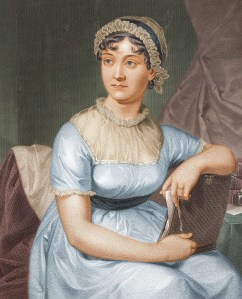
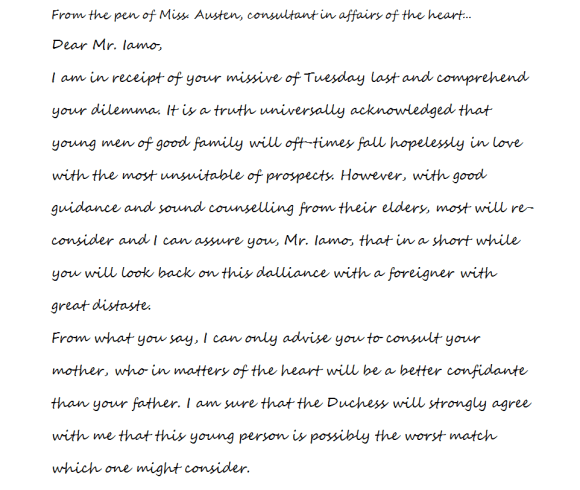
It is a little-known fact that Jane Austen, during the time she was waiting for her novels to become successful, worked as an Agony Aunt on the “Journal for Refined Gentlewomen”. In a recently-discovered trunk of papers the following correspondence was found. I can only assume that one of my characters indulged in a little time-travel to hide his distress and identity.

Ailsa1

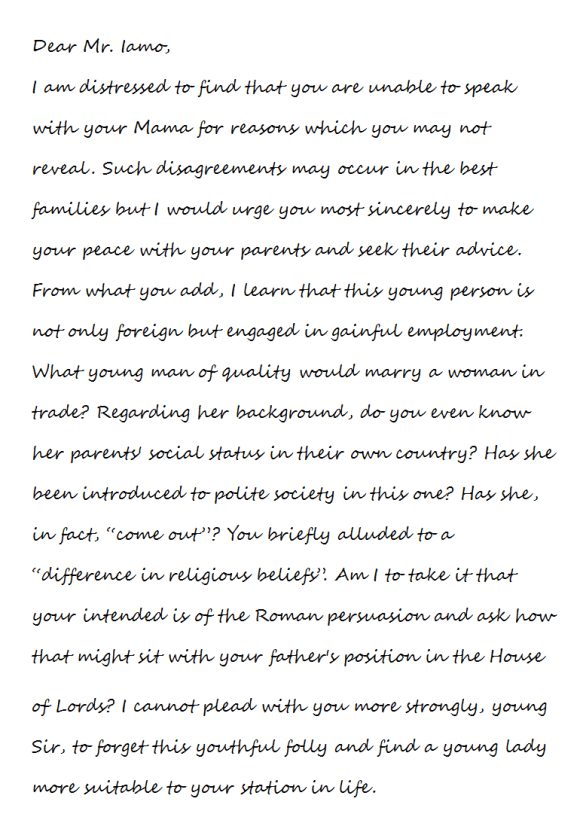
It would seem that Iamo continued because her next letter does not change tone.

Ailsa2

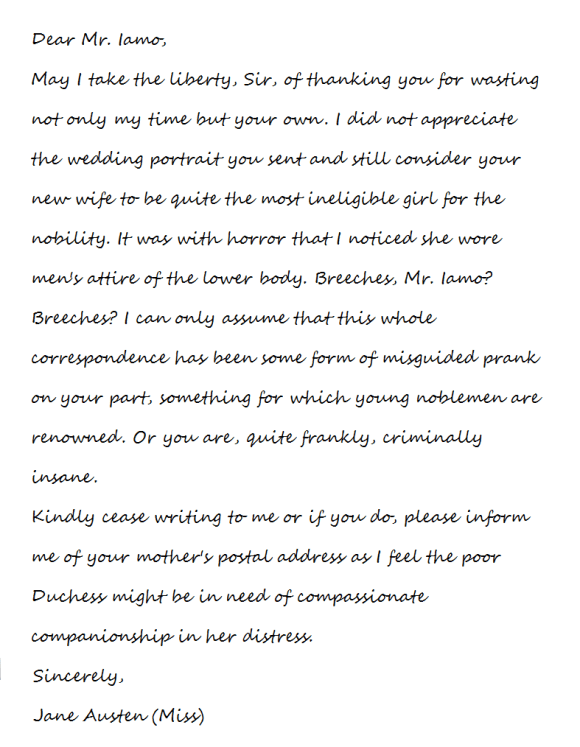
We can assume that there was a long gap in communication because the final letter pertaining to this question is as follows.

Ailsa3

goth wedding

BIO – Ailsa Abraham retired early from a string of jobs, ending up with teaching English to adults. She has lived in France since 1990 and is married with no children but six grandchildren. Her passion is motorbikes which have taken the place of horses in her life now that ill-health prevents her riding. She copes with Bipolar Condition, a twisted spine and increasing deafness with her usual wry humour – “well if I didn’t have all those, I’d have to work for a living, instead of being an author, which is much more fun.”. Her ambition in life is to keep breathing. She has no intention of stopping writing.

both with teaAs Ailsa Abraham:


  • Four Go Mad in Catalonia – self-published, available from Smashwords

Twitter – @ailsaabraham

Facebook – Ailsa Abraham

Web page

As Cameron Lawton

Categories
Books

This Week

JenniferCWilliams Kindred Spirits-Tower of LondonKindred Spirits: Tower of London by Jennifer C. Wilson spawned a very odd letter, which appeared in my series, Letters from Elsewhere in October. This week Jennifer’s novel is one of those featured by my publisher, Crooked Cat.

The other novel featured is The Haunting of Highdown Hall by Shani Struthers.

CrookedCatLogo

If it’s Crooked Cat, it must be good.

In other news, the sun is shining (unlike last week), temperatures are rising and my spirits are, too. No, not the sort of spirits in those novels up there!

Categories
Books Letters from Elsewhere

Letters from Elsewhere: Rivka

Letters from ElsewhereMy visitor today is Rivka, mother of Esty, the heroine of my novel, Neither Here Nor There. Rivka was called Rose in her previous life. I’ll let her tell you more.

BS”D

Dear Readers,

At first, I was pleased to receive this opportunity to explain myself and my actions to you. I thought I’d write it all down and then it would make sense. But when I sat down with a pen and a blank sheet of paper, doubts filled my mind. I’m not sure I can explain it logically to myself. How can it make any sense to anyone who hasn’t experienced what I experienced? How can such people comprehend the decisions I made?

Don’t get me wrong. I have plenty to thank G-d for. I love my husband and my children – all of them. I have much joy from watching and helping them to grow up and take their places in the world. I take pride in trying to steer them in the right direction – in the path of good and righteousness, but I know that eventually I will have no influence over them.

Mea Shearim 2014 Street
A street in Mea Shearim, Jerusalem, where Rivka lives.

Esty, my first-born, has chosen a different life for herself, away from the fold. I miss her so much, even though I see her occasionally. She was such a good girl, always ready to help me with the housework and the little ones. That’s not why I miss her. It’s because she’s one of mine, but she’s no longer one of us. Also, it’s possible I’m a bit jealous, because a part of me wants to be out there with her, although I do my best to suppress those feelings.

It’s easier for people who’ve always lived this life. My husband, for instance. It’s all he’s ever known. He’s never considered any other lifestyle. But I grew up with no religion at all. I could have stayed in London, studied at university, worked and settled down there. And kept in touch with my parents. I do regret making that break. And it wasn’t necessary. I suppose I worried they’d try and influence me to return to their way of life. I suppose I doubted my ability to stand up for what I’d chosen.

How can I explain why I gave it all up? How, at eighteen, I thought I was grown up enough to make my own decisions without any help from anyone. How I thought I’d found everything that was missing in my life – the spiritual stuff – and was happy to give up all the rest, even seeing my parents. I didn’t miss them then. It was only when the babies started arriving that I realised how much I missed my parents and how much they must miss me. Only then, when it was too late, did I realise what an awful thing I’d done to them. Their only child. How could I have left them like that?

No, I don’t expect you to understand. I don’t expect you to empathise with my situation now. I will endeavour to concentrate on being a good and pious woman and thank G-d for everything He has bestowed on me.

Yes, that’s a message I can leave you with – one that can be understood whatever culture you live in. Be thankful for what you have.

Rivka

Thank you, Rivka, for sharing your worries with us. I’m sure you didn’t envision all these difficulties when you decided to join the haredi community. Readers may remember the letter from Leah, Esty’s ex-friend, who has none of these doubts, having been born into the community.

Neither Here Nor There

Neither Here Nor There CoverSo much more than a romance, this is a tale of transformation in an exotic setting. Esty’s life was laid out for her from birth. She would marry one of a handful of young men suggested to her and settle down to raise a large family in a tiny space within the closed community of her parents, near to and yet far from the modern world. But Esty has decided to risk all by escaping while she still can. Will she make it to the other side? Mark, who is struggling with his own life changes, hopes that Esty will find a way through her troubles. He is fast falling in love with her. Separately and together, in Jerusalem and London, Esty and Mark need to overcome many obstacles in their endeavour to achieve their dream.

Neither Here Nor There is available from Amazon, Smashwords and elsewhere.

Miriam Drori

Me with Neither Here Nor ThereMiriam Drori was born and brought up in London and now lives with her husband and two of her grown up children in Jerusalem.

With a degree in Maths and following careers in computer programming and technical writing, Miriam has been writing novels and short stories for eleven years. Two of her short stories have been published in anthologies and others have been published online. Neither Here Nor There is her first novel.

Miriam began writing in order to help raise awareness of social anxiety. Since then, the scope of her writing has widened, but she hasn’t lost sight of her original goal.