Categories
Israel

Train Talk

The first thing I noticed was the youngish man who stood up and said, “I’ll tell the driver.”

Tell the driver? Was he crazy? He sounded like the old woman the other day who called out “Rega!” as she made for the open door, causing me to smile. Rega, literally moment, is what an Israeli passenger calls to the bus driver to warn him not to close the door because the passenger wants to get off. Despite eighteen months of living with the light railway, Jerusalemites are still not completely used to this mode of transport. Some of them, for instance, still think they should be able to buy the ticket on the train.

But this man, it turned out, wasn’t crazy. He knocked on the glass that separated our front carriage from the driver’s compartment. When the driver turned round, the man spoke to him.

“Someone’s dropped a Rav Kav between the train and the platform. I’ll try and get it. Don’t move the train.” A Rav Kav, I should explain, is Jerusalem’s version of London’s Oyster card. You can fill it up and use it to travel on trains and buses within the city.

The man reached down, retrieved the card and handed it to the grateful old man who had dropped it. The younger man returned to his seat and the older man touched his card on the machine and sat down, too. The train doors closed and the train pulled away from the station. I glanced at my watch. Almost one o’clock. A popular time for old people to travel, I thought, looking around.

Suddenly an old man with a knitted yarmulke stood up. There is a dress code here as far as men’s headgear goes. A knitted yarmulke means orthodox. A black one means more orthodox. A black hat  means ultra-orthodox. The old man with the knitted yarmulke said, “I lost my Rav Kav.” He took a pile of papers out of his pocket and started to go through them.

Another old man, with white curly hair and no yarmulke, said, “So it’s yours?”

There followed a convoluted conversation between Knitted Yarmulke and No Yarmulke, during which each tried to make sense of the other’s words. All the while Knitted Yarmulke went through the same pile of papers over and over, opening and refolding pages of newspaper and searching inside a wallet.

“Was it a Rav Kav?”

“What?”

“What sort of card did you lose?”

“A card for the train.”

“A single ticket or a whole card?”

“A card – a Rav Kav.”

“Someone over there found a Rav Kav. Maybe it’s yours.”

Knitted Yarmulke went to ask. “I heard someone found a Rav Kav and I just lost one. Maybe it’s mine.”

“No,” said the lucky old man whose Rav Kav had been retrieved for him by the younger man. “I dropped my Rav Kav and this man picked it up for me. But it’s mine, I promise.”

“I believe you. I’m not accusing you.”

They parted amicably and Knitted Yarmulke returned to his seat minus a Rav Kav.

“You can get another one,” said No Yarmulke.

“I know, I’ve lost it before,” said Knitted Yarmulke. “But I’m going home now, in the other direction.”

“Right, but another time you can buy a single ticket and go to get a new Rav Kav.”

“Right.”

I was glad that was all finally cleared up.

Categories
Blogging

Why do you Like?

I’m… like… confused about why… like…  people… like… like, if you… like… know what I mean.

Facebook is the mother of likes, I think. It has many objects you can like. Posts, comments, pages, photos. In WordPress, you can like blog posts.

But why? Why does anyone like anything? Possibly you:

  • Just want to show you like the object.
  • Want to show you agree with the object.
  • Don’t have anything particular to say about the obect.
  • Are to lazy to say anything about the object.
  • Don’t particularly like the object but want to encourage the person who created or posted it. Saying, “This is awesome!” would be going too far, but one click of a like… well, that’s OK if it makes someone feel good.

While these can all be valid reasons, surely when you click that four-letter word you’re aware that you’ve made yourself  visible to a lot of people, some of whom might know you or know of you, but most of whom will not. Surely you’re aware of the possibility that some people might want to know more about this person who clicked this button.

In WordPress, in order to like a post you need to have defined a gravatar. I have no idea why it works in this way, but it does. A gravatar is a sort of profile. It tells people things about you. In particular, when you define your gravatar, or when you edit it, you can add links to it. You can direct people to your blog, Facebook page, Twitter profile or whatever you like.

And this leads to the reason why I’m confused.

Confused

Of the (currently) five people who liked my last post, only one has any link at all on their gravatar. And that one contains two links that no longer exist and no link to the author’s blog, although I know he has one.

And I ask myself

WhySurely most people who press like, especially on a blog post that is usually viewed by other bloggers, are interested in publicity. Surely they want new followers and are keen for others to find them.

So why don’t they all update their gravatars and include links to their blogs/websites/social media profiles? Perhaps they:

  • Don’t know how to.
  • Can’t remember their password.
  • Can’t be bothered.
  • Other (please state).

Those problems can be solved. I think it’s important to solve them. Don’t you?

Categories
Uncategorized

It’s a Fake!

Or not.

What a powerful video this is. I love the message:

Don’t fake it ’til you make it.

Fake it ’til you become it.

With thanks to David Allen for brightening up my Thursday.

Categories
Books Israel

Not such a backwater

I’d always thought not much happens in my home town as far as literary events go, but this month has been quite a revelation.

First, there was the excellent two-day seminar I wrote about here.

Then there was the Kisufim Writers’ Conference, of which I attended one session, a discussion about memory in literature.

And now, there’s the biennial International Book Fair, which I attended yesterday and where I heard three interesting talks/discussions. The first was a discussion of the works of the Israeli author, Leah Goldberg. The second was a talk by an Israeli author whose name I didn’t catch. I enjoyed hearing about his path to becoming an author and why he writes what he writes. “I don’t know why,” he said several times, but that didn’t stop him from saying plenty on the subject.

Thirdly, in a large, packed hall that I was lucky to get into as many were turned away, I heard the Chief Rabbi of Britain, Lord Jonathan Sacks. He is an excellent speaker. He kept the audience enthralled with anecdotes, while holding on to his message: not assimilation and not segregation. We have something to give to the world and can do it proudly.

What did this have to do with literature? Lord Sacks has written fifteen books. At least, I think that’s what they said, although here I see he’s written twenty-four. That’s quite an achievement!

So it seems Jerusalem isn’t such a literary backwater after all.

Categories
100-word stories

100 Word Challenge – Week #76

100 Word Challenge
Click to join in the fun

The challenge: 103 words including:

…beneath the surface

The Party

I watch her face as I endeavour to keep up the conversation, trying to salvage the right thoughts and words from the depths of my mind. From her facial movements and body language, I know what she’s thinking. She thinks I’m stupid and boring. The more she thinks it, the more I’m drawn to play into her view of me. She nods at my remark, but her mind is elsewhere, developing an escape strategy.

“Well, lovely meeting you,” she says. “Must move on.”

I hope my smile and raised shoulders portray the inevitableness of her action.

“Good riddance,” I say, beneath the surface.

Categories
Blogging Books

Appreciation

It feels good to be appreciated. I don’t think I get a lot of appreciation at home. Generally, I’m taken for granted.

Yesterday, I received two signs of appreciation online.

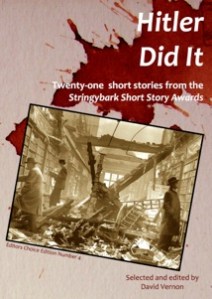
The first was about a new short story anthology, which includes a story of mine: Reflections in Watercolour. It’s published by Stringybark Publishing and is called: Hitler Did It, a title I’m not too enamoured with, although the story with that title is a beautiful tale set in wartime London.

If you’re interested in reading the anthology, it’s available here as an ebook and there might be a print version soon.

Hitler Did It

The other sign was a blogging award:

Very Inspiring Blogger Award

which I received from Rachael of Honest Speaks. Thank you, Rachael!

So I’m supposed to list 7 things about me and 15 inspiring blogs.

  1. I have worked with computers all my working life. That doesn’t stop my son from telling me I know nothing about computers.
  2. There isn’t a lot of food I adore. Eggs, potatoes, white chocolate. I think that’s it.
  3. My favourite drink is cold borscht.
  4. I love the weather in Jerusalem. Cold, rain, sun, heat, snow, I love it all.
  5. I’ve never been to the Far East, but hope to rectify that soon.
  6. I’m not good at pronouncing Rs, which is unfortunate since there are three in my name.
  7. I love most classical music and pop, but not jazz.

Now for the blogs:

  1. http://jeandavisonwriter.wordpress.com/blog/
  2. http://bottledworder.wordpress.com/
  3. http://susanwritesprecise.com/
  4. http://davidrory.com/
  5. http://mythoughtsonthesubjectareasfollows.wordpress.com/
  6. http://fortyoneteen.wordpress.com/
  7. http://victoria-writes.com/

I think seven is enough.

This blog post has added 247 words to my word count for today. No – 256… 257…

Categories
Blogging

A to Z Challenge

So I seem to have signed up for the A to Z Challenge for the third time running.

BUT I don’t have a theme yet.

Two years ago I wrote about writing and social anxiety.
Last year I wrote about Jerusalem.This year?

Following my post from yesterday, I’m thinking of doing some research on memoir writing and organising the fruits of my labour alphabetically.

Do you think that could make an interesting topic?
Is there any other topic you’d like me write about?

I’m open to suggestions at this stage.

Categories
Books

Writing Seminar and Memories

I spent the last two days at a memoir writing seminar led by the author Ilana Blumberg.

I haven’t attended many such activities, so I can’t compare, but this one was excellent. It covered many topics, let the participants participate and included writing exercises. Sharing our hastily written pieces showed up the similarities and differences in our lives.

It came as no surprise to me, in a seminar held in Israel and conducted in English, that all the participants had moved to Israel from other, mostly English-speaking, countries. None of us was forced to leave our native countries and for all but one the move was intended to be permanent.

But, as I listened to the tale of one woman who’d moved with her husband, ten children and twenty-four suitcases, I realised how different the emigration/immigration process can be. I came on my own with one case. I hopped on a plane and landed less than five hours later to join a year-long programme. My stay in Israel could be temporary or permanent. I didn’t have to decide at that point.

That’s not to say that my immigration process was all plain sailing. But I didn’t have the difficulties of arriving with a large family.

The seminar has made me think again about memoir. I did write one once, but when I reached the end, I decided I needed to start again and change the structure of it. I thought of a new way of organising it, began again and stopped. How could I be sure that way was any better? Maybe the best way, in the end, is to write it chronologically, because that shows the sequence of events and the affect each event had in shaping the personality of the author… me.

The seminar included a discussion of what Vivian Gornick in “The Situation and the Story” calls… well… the situation and the story. The situation is what happened. It shows the events – the descriptions, the conversations, the actions. The story is the emotional journey caused by the situation. The story is what we need to tell, but it’s not clear what the story is. This is something the writer has to work out. Without a story, the memoir is a jumble of events. The story tells the author which events to tell and how to tell them. It tells the author how to create order from chaos.

I suppose that’s why I don’t have a structure. I haven’t yet worked out what my story is.

The seminar was held in the picturesque neighbourhood of Yemin Moshe. It’s a neighbourhood of alleys and cobblestones. Of several stairways leading down to the Old City of Jerusalem. The view is magnificent.

Arriving early, as I often do, I decided to take a short walk around the area. My feet led me to the house we lived in for about fourteen years until we moved out seven years ago, and I realised how much I miss this place. I remember how lovely it was to be able to step from the house into this area of history and beauty, away from the noises and smells of modern day life, yet within easy walking distance of the town centre and the Old City.

Yemin Moshe - view along Malki Street

I’ve never missed a home before. Certainly not the one I grew up in. I was eager to leave the place with memories that were mostly sad. In one of my writing exercises in the seminar, which I read out loud, someone noted that, when writing about visiting my former house and school, I’d mentioned looking at both from the outside. That does reflect how I feel now about my former life. I’m outside it now and pleased to be so.

Categories
Israel

It’s a holiday!

Yes, today is a public holiday. No, it’s not Purim yet – our day for dressing up. And Tu B’shvat, the new year for trees, had not been brought forward. (Besides, neither of those are public holidays.)

Today is election day. After all these years of living here, the reason why  it is a public holiday still eludes me. Still, it’s warm and sunny today, so why not let people relax and enjoy themselves.

In Britain, today would be called a bank holiday; no doubt that has historical significance. In Israel, it’s called a shabbaton, which comes from the word for sabbath: day of rest. It certainly seems like a day of rest today.

As we walked round to our local voting station, we couldn’t fail to notice the lack of traffic on the roads and the unusual calmness of the people we saw. In the station itself, usually a school, the same calm atmosphere was apparent, as you can see.

Voting

There was no queue, no problem. We voted and left.

Afterwards, in hot sunshine, I sat on a bench in the little park opposite the voting station. Some election leaflets littered the grass. Occasionally one or two of them got up and moved to a position nearby, helped by a breeze. I watched two men quietly putting up yet another election poster, fixing one side to a sign indicating disabled parking and the other to a branch. People ambled by on their way to vote, one talking to a mobile phone. Children rode bikes. A woman held a dog on a leash while her partner went to vote.

Ordinary people exercising their right to vote. When I lived in Britain, I took that right for granted. Here in Israel, it means more, knowing that not one of our neighbours really has that right.

Categories
100-word stories Israel

100 Word Challenge – Week #74

100 Word Challenge
Click to join in the fun

The challenge: 104 words including:

the extreme weather meant

I’m throwing fiction to the elements this week. We had our extreme weather about a week before most of you.

So near and yet so different

In Tel-Aviv, the extreme weather meant flooding, road closures and terrible traffic jams.

In Modi’in, a shopping centre was flooded, giving rise to the picture of a restaurant, the diners with their feet in water, that appeared on Facebook. Another interesting picture compared the shopping mall to Venice. They did look rather similar.

In Jerusalem, the extreme weather meant a traffic shutdown, a welcome holiday, snowmen, snowballs and beautiful, silent whiteness. What a difference a few kilometres and a few hundred metres make!

A week later, we sat lazing on the grass in warm sunshine, not a trace of extreme weather in sight.

Frozen pond
Frozen pond