Categories
Books

I Am Fearless!

Jodie Llewellyn asks this question today:

As a writer, what do you fear the most?

Fifty-three writers, so far, have responded with their fears. Clearly writers fear a lot and want to express those fears.

I could have responded, too. But I don’t want to. I don’t want to talk about fears and I don’t want to think about them.

It’s not that I think I’m a perfect writer. Far from it. I know I have plenty to learn; probably always will.

But if I concentrate on fears, I will never succeed. If I don’t believe in my ability to reach my goals, then I won’t reach them.

I felt this way even before I knew I was going to be published. I saw all those posts by writers in the Insecure Writer’s Support Group!, in which they list all their insecurities, every month. And I thought, surely by doing this they are perpetuating the fears. Because no one replies, “You’re doing fine; don’t worry about it.” The respondents write, “Me, too.”

And I still feel that way. I know that getting published is only a first step and I need to stay positive if I want to advance along the writing path. Which I do.

So I’m not going to join that support group or think about fears. I’m going to plod on, because I’m determined to get there.

Hands up those who want to banish fears and believe in themselves.

HandUp

Categories
Israel

Exterminate!

No, this post is not about daleks. It’s about something real and serious. It’s about what the Israeli government is doing to a part of its population.

There. I said it. All those things you heard on the news are true.

NO!

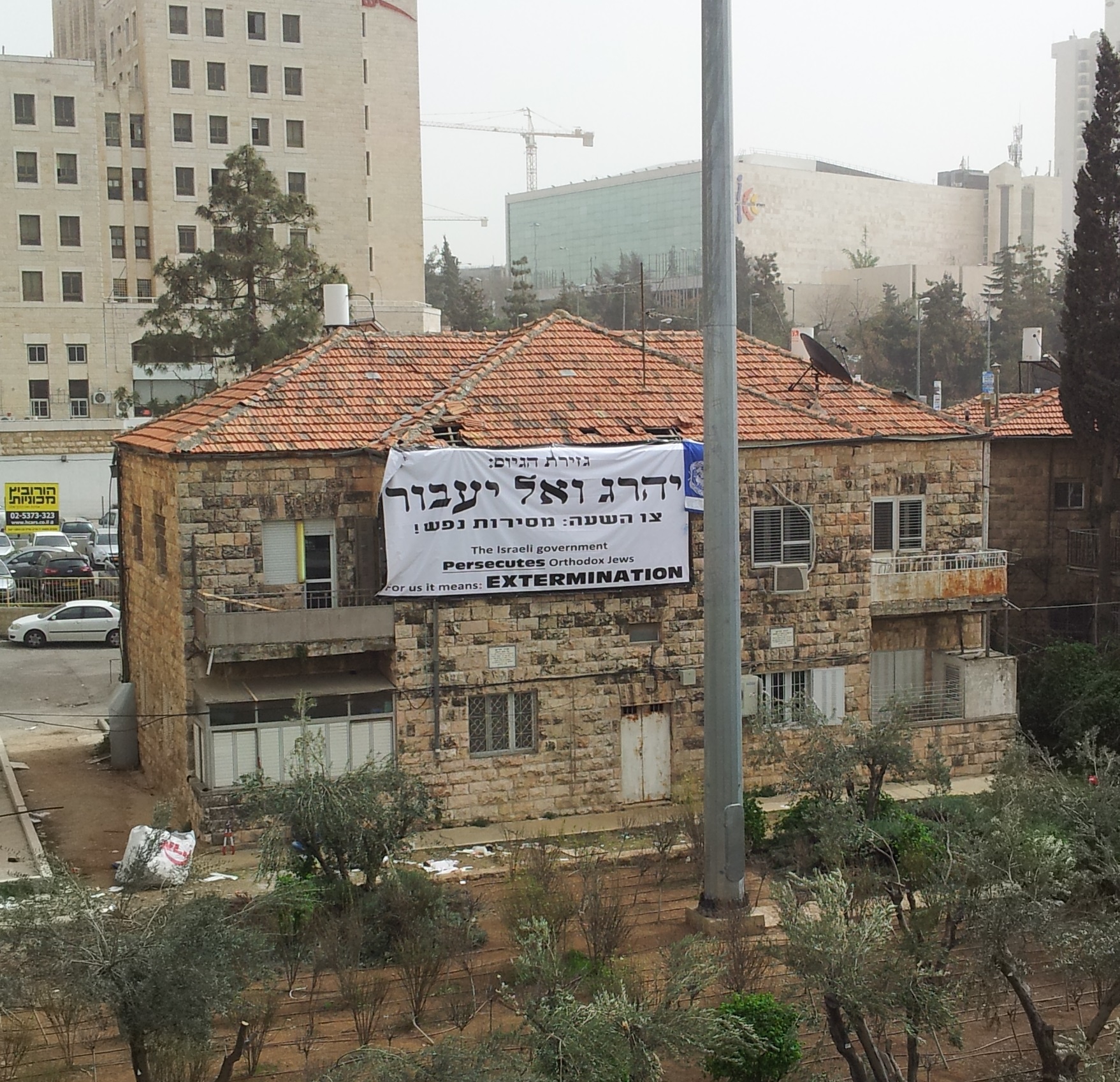
But that’s what the sign said. I read it. I needed to walk along the String Bridge on my way from one errand to the next, this morning. I looked down at the area where yesterday a sea of black hats swayed in prayer and demonstration and there it was: EXTERMINATION.

20140303_122305

OK, so they don’t actually mean they’re being exterminated. They mean that what the government is planning to do to them will cause them to cease to exist as they do now.

And what is this evil government plan? The government wants to conscript all young people, including those who belong to the Haredi community. That doesn’t necessarily mean conscription to the army. It can also be for what’s called here National Service or what you might call Community Service. All the government is saying is that one law should apply to all. All young people should give two years of their time to serve the community or the country.

And probably, if those young people from the Haredi community are conscripted in this way, it will change the whole community in certain ways. I’m not sure that’s such a bad thing.

Categories
Books Bullying

Igboland

I have another visitor, today. Jeff Gardiner has dropped in while on his blog tour. It’s just as well you didn’t arrive in Jerusalem yesterday, Jeff, or you might have found yourself drowning in a sea of black hats!

I’ve just started reading Jeff’s previous novel, Myopia. I was attracted to that one, of course, because the main character is a boy who is bullied.
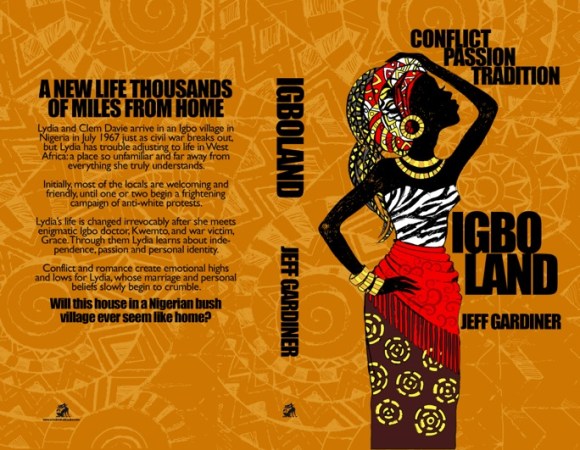
Igboland cover5

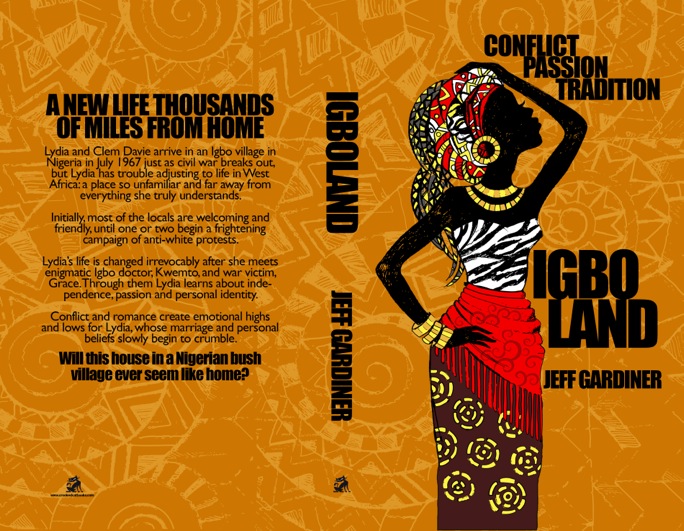
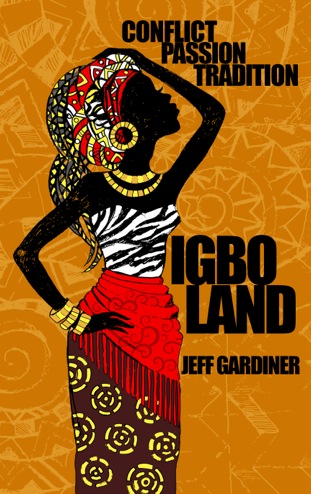
Igboland is a very different sort of novel, as Jeff’s description shows.

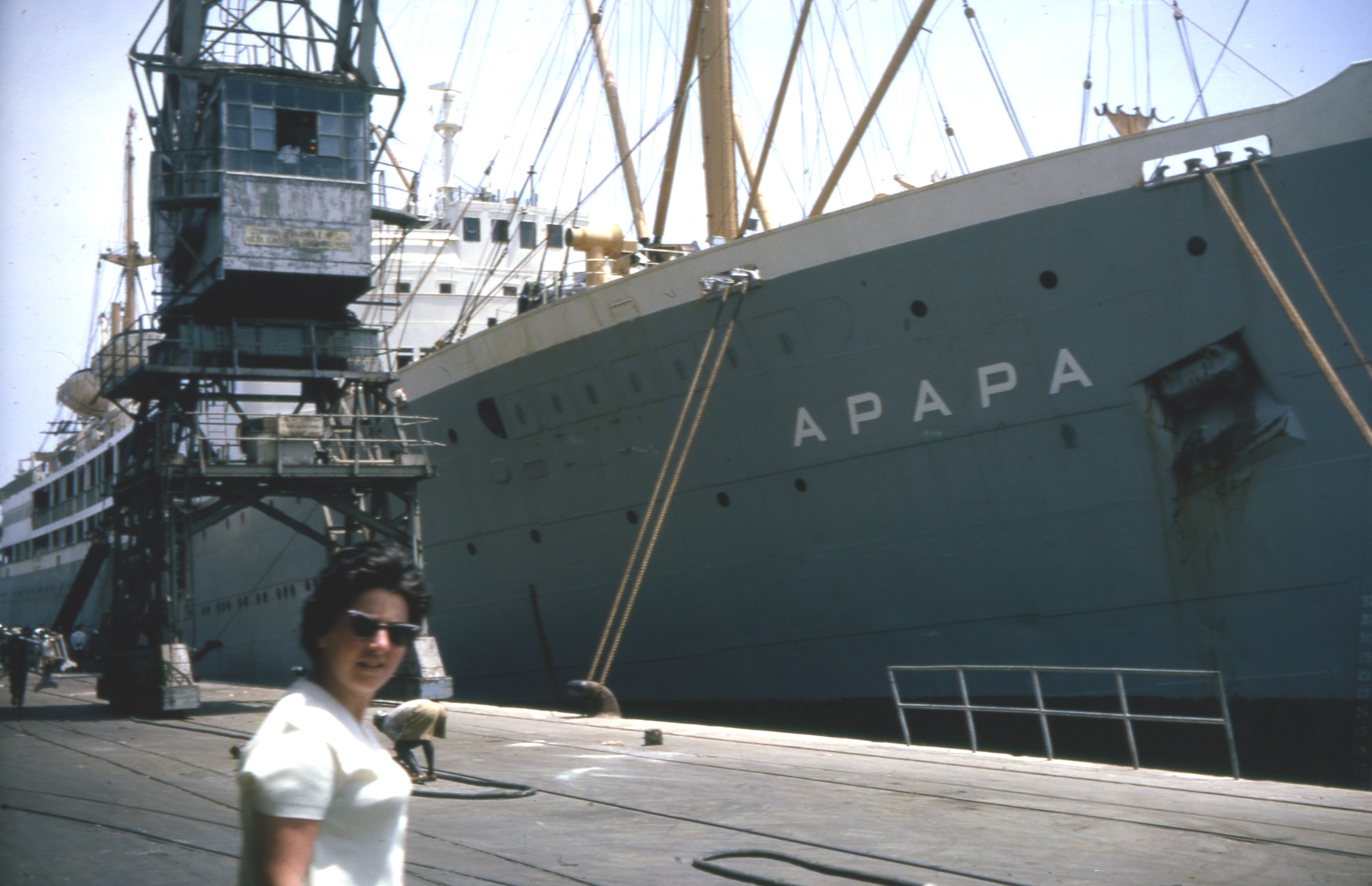
Igboland is a novel of passion and conflict set in Nigeria during the late 1960s Biafran War. Lydia is a young English girl, recently married to Clem, a Methodist Missionary. Their first home together as a couple is in the West African bush, thousands of miles away from her beloved family. Lydia and Clem arrive in Nigeria just as civil war breaks out and the extract below is of their first sight of their new home. The novel is inspired by the diaries and photos of my own parents, who lived out in West Africa for six years. They travelled to Nigeria on a ship, The Apapa, and then travelled hundreds of miles on a train into the foreign bushland.
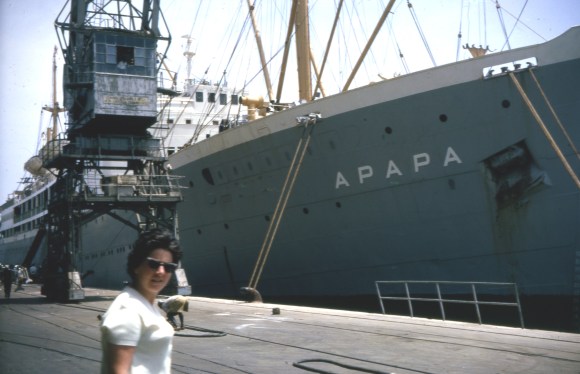
Box 1001 Apapa

Here is an extract from Chapter 2 of Igboland:

***

That evening the train came to a sudden, jerking halt.

‘Here we are, my love,’ Clem said with a nudge. ‘This must be Enugu. Look lively.’

‘Sorry,’ I mumbled. ‘I’m so tired. I don’t feel very well.’

With little sympathy, Clem pulled me up and tucked his arm into mine. We stopped by the door and I wondered why he didn’t open it straight away. Instead, he stepped back and I heard a harsh but muffled voice shout from below us.

‘Why’s there no platform?’ Clem asked aloud. ‘What’s going on?’

I looked out the window and noticed a soldier outside on a raised hillock, waving two hands above his head at us. In one hand he held a gun.

‘Stay behind me,’ Clem ordered.

The soldier was gesticulating for us to exit the train.

Clem opened the train door and stood in front of me with his hands up.

‘Come down from the train!’ the soldier beckoned furiously again; his face impenetrably dark under his peaked cap. I had no idea which side he was on – or even which side might show us the greater sympathy. Thus my ignorance enhanced my fear.
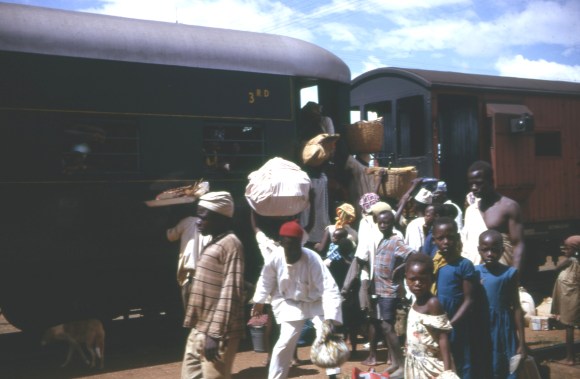
box 1066 Zonkwa station

The soldier came closer, placing his gun in his holster.

‘Quickly. The line ahead has been bombed. Enemy soldiers are patrolling and all ways into the city are blocked.’ His English was excellent; clearly the product of a good education. With there being no platform, the drop down to the floor was considerable. Clem jumped for it but tumbled over and turned his ankle. The soldier reached up and signalled for me to jump onto him. He easily caught me. I wrapped my arms round his neck and my legs round his waist, and then he lowered me gently to the ground.

Behind me, I became aware of the other passengers jumping down, the driver and stewards amongst them. They stood in large groups chattering excitedly amongst themselves.

‘You must turn back. Go back North. Perhaps we could drive you north to a safer place like Jos.’

Clem shook his head. ‘We’re going to Ngkaluku.’

‘This is not a good idea.’

But Clem insisted and nearly came to blows with the soldier.

He asked to see our passports.

‘Mr and Mrs Davie.’ He enunciated each sound very deliberately.

‘Reverend Davie,’ Clem replied pedantically.

When he saw he was getting nowhere with my stubborn husband, the soldier whistled behind him and a group of about a dozen similarly dressed soldiers appeared. They talked to each other in their own tongue. A few of them gave us dirty looks and began to argue amongst themselves. Eventually the first soldier, presumably their leader, returned accompanied by another.

‘Corporal Nwoko here will drive you to your destination and leave you there. Are you sure this is what you want?’

Clem stood firm and the soldier in charge shook his head. He obviously had a more important mission to complete and was keen to get us out of the way. Giving up on us as a lost cause, he went to talk sense into the other passengers.

Corporal Nwoko pulled the limping Clem towards a clump of trees away from the stationary train and I followed behind like a puppy. It occurred to me just then that he might be preparing to shoot us and a rising sense of panic struck me. The relief was palpable when I saw an open-top Jeep parked under a mahogany tree.

‘I will drive you now,’ said Corporal Nwoko, leaping into the driver’s seat and jerking his thumb behind him.

Clem got in the back with me and we sped off down a red dirt track pocked with potholes. The bumps only worsened my headache.

‘You come here at very bad time,’ our driver shouted over his shoulder, ominously.

For the rest of the car journey I phased in and out of the intermittent conversation. I remember very little about the last part of our long and tortuous trek. My only recollections are short flashes of being bumped around, with my head on Clem’s lap; having flushes of being freezing cold and then sweating profusely; the voices of the two men chatting between long silences as I drifted in and out in waves, feeling horribly claustrophobic. A new warmth embraced me as I allowed my entire being to be engulfed by the looming jaws of darkness.
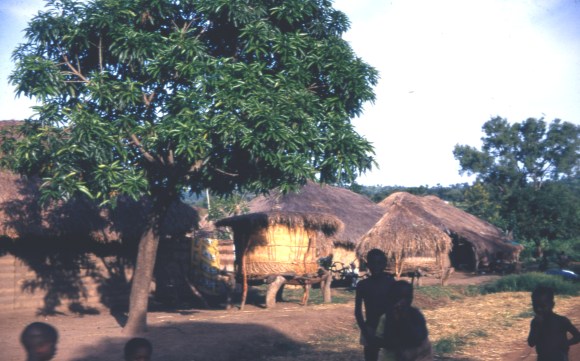
box 1015 Iga village

‘Lydia? We’re here!’

‘What, home?’ I said, filled with happiness.

I was going to see Mum’s dimpled smile and her mischievous eyes; Dad’s strong arms would welcome me back and Oliver would proudly call me his ‘favourite sister’. I even saw Frisky bouncing up on his back paws, tongue out, tail wagging–—

‘Welcome to Ngkaluku.’

The dream crumbled.

My life crashed about me as my head swam in a panic. I wanted to scream and thrash about but my whole body felt drained of all energy. All my limbs were paralysed.

This wasn’t home. Home was thousands of miles away.

Clem helped me out. We stood alone in the West African bush.

Corporal Nwoko revved his engine noisily and turned his vehicle round. On the way past he slowed down and leaned over towards us.

‘We try to warn you,’ he sneered in a chilling tone, before accelerating away.

The sight awaiting us was horrific.

Ngkaluku had been recently bombed.

The devastation shocked us. Bodies and limbs lay piled up. Dead faces stared out with eyes burnt from their sockets. Many of the corpses had been smashed beyond recognition, or possessed gashes of bloodless open flesh exposing rotten innards. Swarms of flies flickered around the heaps. Dogs and other small scavengers made dashes past the children instructed to keep them off. Vultures hopped about sullenly only a short distance away. Grotesque as it was, the sight continued to entice me to look. After a while, I could no longer return the gaze of these death masks. Without a second thought, Clem went to help the locals in their search under debris for further bodies, which were then carried over to a hut now designated a makeshift medical centre. A local doctor had already assembled a team of helpers and was doing what he could with very few resources.

***

Wow – exciting stuff! Thank you for that excerpt, Jeff, and good luck with your new novel.

Igboland is available as a paperback or e-book (Kindle, Epub or PDF) from Amazon US, Amazon UK or Crooked Cat Books.

You can visit Jeff Gardiner at his website or his blog.
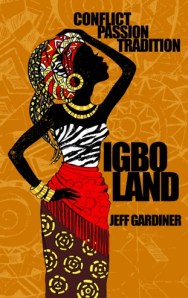
Igboland cover6

Categories
Books

Writing the Book You Want to Read

I’m delighted to welcome Sue Barnard to my blog today. Sue and I first met about two years ago at an online workshop run by Sally Quilford. Since then we have met twice face-to-face and helped each other with our writing.

Sue4Sue’s recently published debut novel was not one of those I saw in the draft stage, and so I was able to read it simply for enjoyment, and enjoyment describes my reading experience very well. The appealing idea of changing the most famous of love stories is very cleverly handled in The Ghostly Father. Sue doesn’t say that Shakespeare’s version was wrong. She makes both versions right, depending on who is telling the story. And she writes it all so well.

But that’s enough from me. I’ll let Sue take over now.

I love books.  My house is full of them, my Kindle is full of them, and I’m irresistibly drawn to places which sell them.  So much so, in fact, that I spent more than twenty years of my adult life working in a bookshop.  The sheer diversity of subjects, genres and content of books still never fails to amaze me.

Sue1Those who claim to know about such things reckon that everyone has at least one book in them.  Be that as it may, until a few years ago I never imagined that I had a book in me, much less that this book, if it even existed, would ever get any further than the concept stage.  The point at which that situation changed was when, a few years ago, I came across one of those lists of Things You Must Do Before You Die.  The one which leapt off the page and grabbed me by the throat was Write the book you want to read

Fast-rewind thirty-odd years, to when I first saw Franco Zeffirelli’s wonderful film of Romeo & Juliet.  At the end there wasn’t a dry eye in the house, and I came away from the cinema thinking: “Why does the world’s greatest love story have to end in such appalling tragedy?”  Ever since then, that question has lurked, dozing, at the back of my mind.  The exhortation to Write the book you want to read woke up that question, kicked it out of bed, opened the shutters and forced it out into the blinding light of day.  This was when it finally dawned on me that the book I’ve always wanted to read was the version of Romeo & Juliet which has a satisfactory outcome.  If, at any time during those decades of browsing in bookshops, I had ever come across such a book, I would have snapped it up, rushed home and read it in one sitting.

Why, I asked myself, shouldn’t there be such a book? 

And the answer came straight back: Why not indeed? And if that book doesn’t exist, you need to write it yourself.

Even then, it took me a while to get going.  Although I’d dabbled with Creative Writing in the past, and had taken a few courses on the subject, I’d never attempted anything longer than poems or short stories.  The thought of tackling a full-length novel, even one on a subject about which I felt so strongly, was, to say the least of it, a daunting prospect.  I’d been mulling over the idea for a while, but without any concrete results, when fate took a hand.  Back in 2010, whilst on holiday in France, I was (yes, you’ve guessed) browsing in a bookshop, when I chanced upon a novel in the style of the lost diary of a woman who had been the secret lover of Count Dracula.  This, I realised, was the format I needed: a lost manuscript which tells a previously-unknown story.

Back at home, I powered up the laptop and started writing.  Because this was the book I’ve always wanted to read, I was, at that point, writing it mainly for myself.  I wanted to be able to read this version of the story in private, and think, “Well, perhaps this, rather than the ‘lamentable tragedy’ as told by Shakespeare, is what might have happened.”  At this stage, going public with it couldn’t have been further from my thoughts.

After I’d finished the first draft (which took about six months), I mentioned it to a couple of close friends who are both avid readers.  They both asked to see it.  On handing it back, one of them said, “I know what I like, and I like this.”  The other said, “You really ought to take it further.  I think it could even be a best-seller.”

Sue3Even so, despite these votes of confidence, it was another year or two (during which time the manuscript underwent several revisions) before I plucked up the courage to send the manuscript to Crooked Cat Publishing, an independent publisher whom I’d found on Facebook, and for whom I’d recently started doing editing work.  I wasn’t very hopeful, so when I received the email from them telling me they wanted to publish it, I had to print it out and re-read it four times before I was able to convince myself that I hadn’t imagined the whole thing.

The book’s title, The Ghostly Father, is based on a quotation from the play (it’s how Romeo addresses the character of Friar Lawrence), and the story (which is a sort of part-prequel, part-sequel to the original tale) is told from the Friar’s point of view.  I’ve often wondered why, in the play, he behaved as he did – and by giving him what I hope is an interesting and thought-provoking backstory, I’ve tried to offer some possible answers.  Plus, of course, I wanted to reduce the overall body-count, and give the lovers themselves a rather less tragic ending.  I hope I’ve succeeded.

The book which re-tells the world’s most famous love story was officially released, very appropriately, on St Valentine’s Day 2014.  If the early sales figures are anything to go by, it looks as though I’m not by any means the only person who wants to read it.  And for that, I am very grateful.

Sue Barnard, February 2014

In the UK, The Ghostly Father is available from Amazon as a paperback or ebook.

Outside the UK, it’s also available from Amazon as a paperback or ebook.

Thank you, Sue, for visiting me and for writing about this interesting topic.

The novel I’m working on now hasn’t been evolving for quite that long, but it’s one I wish I’d read a long time ago, and one I’ve wanted to write it for several years. Only now have I found a way to do it that I believe works.

I know, I promised a different post this time. Maybe next time… no promises….

Categories
Israel

I’m No Botanist

Last month, when I wrote this post, I made two mistakes. I said we have no almond tree in our garden and I said almond trees always blossom on the festival of Tu B’Shvat and there didn’t appear to be any near our house.

Wrong!

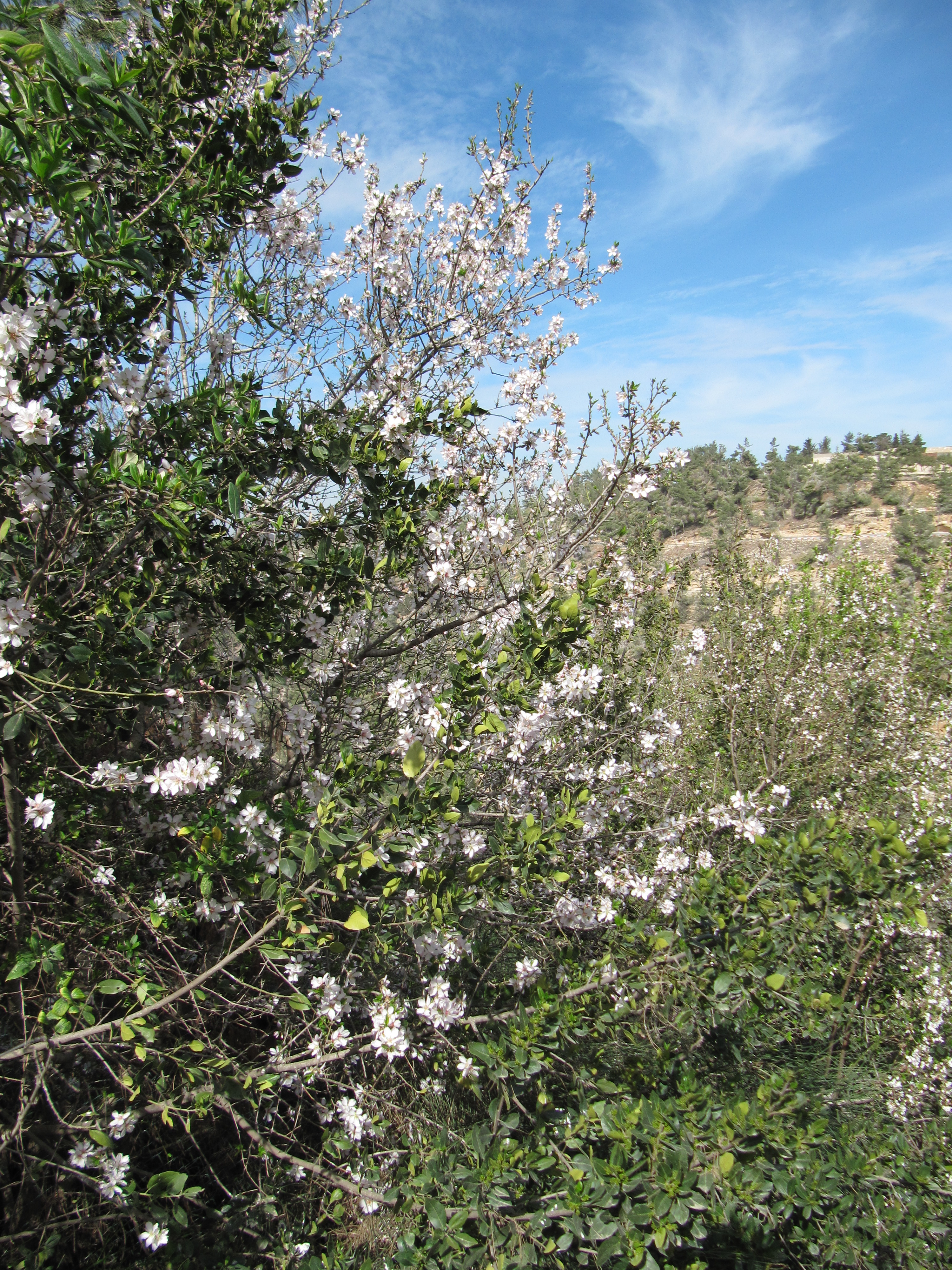
The almond trees blossomed late this year, or Tu B’Shvat was early, or both. There has been plenty of almond blossom around here for the past couple of weeks.

There is an almond tree in our garden, it turns out, and now that the blossom has nearly all gone, I’ve got round to taking a photo.

Plum blossomNo, not that. That’s part of a plum tree.

Almond blossomYes, that. At least, I think that’s an almond tree. So much for my foray into botany!

In my next post, I’ll tell you about the excellent writing workshop I attended yesterday, when I’ve worked out what I want to say about it. At least writing is something I know a little bit about.

Categories
100-word stories Books

100 Word Challenge – Week #122

Click on the image to join the challenge

The challenge: 105 words including:

… the blackness just enveloped me…

A New Reality

I woke to total darkness. The blackness just enveloped me. I checked that my eyes were really open. They were. Only one explanation then. I must have gone blind overnight. I would have to get used to a new reality without sight.

I thought of all the things I would never see again except in my mind’s eye. The view from the window. The sunset over the sea. My children’s changing faces as they grew up. Then I heard something. At least my hearing was all right.

First whispering, then giggling. I reached up and pulled something down.

“Who put this blackout sheet over me?”

Categories
Books Israel

Places in NHNT

My novel, Neither Here Nor There, due to be published later this year, describes several places in Jerusalem that I’ve mentioned before on this blog. Like the market, Machane Yehuda.

Machane Yehuda market

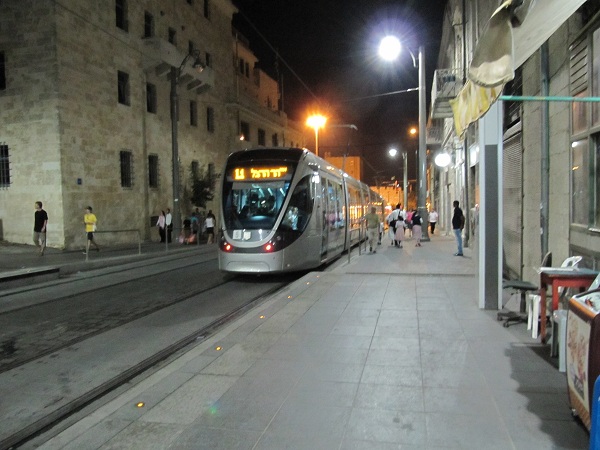
Jaffa Road and the light railway (which has been going for two and a half years).

Jerusalem Light Railway at night

The German Colony, which I mentioned here.

House in German Colony

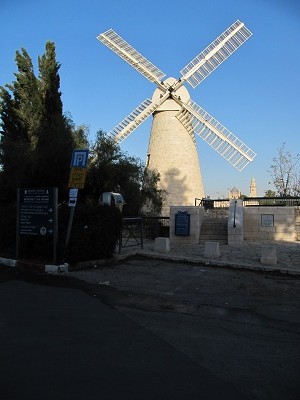
Yemin Moshe, where I used to live, and which I described here and here and here.

Yemin Moshe windmill

There are some other places in Jerusalem that get a mention in the novel. I’ll have to photograph them, too.

There are also places in London that feature in the novel. I haven’t taken photos of them and they’re a bit far away from me for a quick snapping session.

Place can often drive a novel. It certainly drives mine.

A lane in Yemin Moshe

Nothing can happen nowhere. The locale of the happening always colours the happening, and often, to a degree, shapes it.

~ Elizabeth Bowen

Categories
Books

I’m an author – I think

In the past, when people asked me what I did, I’d say, “Well, for a long time I was a computer programmer, and then I was a technical writer.” If they looked confused at that – and most did – I’d say, “I wrote manuals explaining how to use software,” and they’d nod, whether they understood or not.

WhatDoYouDo

Then they’d ask, or I’d feel I had to add, “Now I’m at home and I write.” With raised eyebrows they’d ask, “What sort of thing do you write?” and I’d mumble, “Oh, different things.” Then came the inevitable question: “Have you had anything published?” to which I’d mumble, “A couple of short stories in anthologies,” as if they don’t really count – not because I think that’s true, but because they probably do. Their question probably meant, “Have you had a whole book published?”

Suddenly, everything has changed. Now when people ask me what I do, I say, “Ani soferet” – I’m an author. They look at me with wide eyes. “Wow!” And I smile and nod.

But something bothers me about all this. Was it the signing of a contract that turned me into an author? Surely I’ve been an author since I started writing. Why couldn’t I ever say that before?

On the other hand, I suppose I couldn’t say it because I’d have felt I didn’t deserve the “Wow!” that followed.

Anyway, it’s happened now and I’ve taken a big leap and landed in a bed of Cats – Crooked Cats. There is even a catalogue.

Categories
Uncategorized

Revelation Number 2

This is my second piece of exciting news.

On Thursday night / Friday morning, I met Natalie Portman.

Well, I didn’t exactly talk to her and she probably didn’t notice me at all, but….

I was an extra in a film that she’s directing and starring in. I got into it through my folk dancing group. They said they wanted dancers, but in the end there were too many people to be able to dance properly.

We were there – outdoors – from 5 pm to 5 am (except while we were eating). I had to wear a thin skirt, tights and open shoes, and I was freezing. We took part in two scenes, which were filmed several times.

It was quite an experience, although not one I’d like go through very often!

Categories
Books

Revelation Number 1

In my last post, I hinted at two more exciting things that I couldn’t yet divulge.

I am now able to tell you one of them.

For those of you who haven’t seen any of the posts on Facebook and Twitter:

My novel, Neither Here Nor There, is going to be published later this year by Crooked Cat Publishing.

As you can imagine, I’m very excited and looking forward to being a published author.