Please note: I wrote this post before a large band of terrorists infiltrated our country and commited heinous war crimes. I’m not sure I’d be able to write such a post in my current mood.
Today’s guest in the series That’s Not Me! is not a guest at all. It’s me, Miriam Drori, author, editor, blogger and much more. What do I have to say on the topic?
That’s Not Me! examines how much of our fiction is autobiographical and why some authors try to insist there’s no link between their fictional characters and themselves. If you want to take part, have a look here and get in touch. You don’t have to be a writer. Readers also have views!
An Admission
Of all the characters I’ve written so far, the one who’s closest to me is Martin in Cultivating a Fuji. This is how I described the connection in About the Author on Amazon:
Miriam Drori was born and brought up in London at about the same time as Martin. Like Martin, she studied Maths and went on to work as a computer programmer. Like Martin, she was bullied at school and, as a result, social anxiety paid a visit and refused to leave.
There, the similarities end. Miriam also studied Music. She emigrated, married and had three children. Her career path veered onto technical writing and then took a sharp turn, landing in the field of creative writing. Now, she enjoys reading, hiking, dancing, touring and public speaking. And writing, of course.
Although most of the current and past events in the story are completely imagined, some are taken from my life. I am now going to admit, for the first time, that I did something out of spite, because, in a way, I’m still angry about the way I was treated all those years ago. What was the spiteful thing I did?
I used someone’s real name.
And while that person, if she’s still alive, will probably never know what I did, it was not very nice of me. Here’s the excerpt:
February 1962
Miss Spector surveyed the classroom. All the children were writing except for Martin. She walked over to him and in a loud voice said, “Martin, why aren’t you writing?”
Martin looked up at her. “Because I don’t know what I want to be when I grow up.”
“There must be something you’d like to be. A doctor? An astronaut? A teacher?”
Someone said, “Martin wants to be a dustman,” and everyone laughed, including Miss Spector. Everyone except for Martin.
Martin looked down at the empty page of his exercise book.
“Well, think about it, Martin, and write your composition at home. I want to see it tomorrow.”
The next day, Miss Spector made Martin read out his composition to the class. It went:
I want to be an engineer, because an engineer works with machines and not with people. With people, you never know what they’re going to do, but machines do exactly what you tell them to do. Every time you press a button, the machine always does the same thing.
“Martin,” said Miss Spector. “How do you know about engineers?”
“My daddy told me about engineers yesterday. We talked about lots of different jobs I could do, and I chose that one.”
Someone said, “Martin said that because he doesn’t like us.”
Someone else said, “Yeah, because he’s funny and we laugh at him.”
The children laughed. Miss Spector laughed. Only Martin didn’t laugh.
I tweaked that story to better fit Martin but the essence of it is the same and Miss Spector was the teacher’s name. She was only eighteen at the time, so can be forgiven for not knowing better, but I still blame her for taking the side of the popular kids against me, and for not understanding the effect such treatment could have on a vulnerable eight-year-old.
I don’t have to put a bio, blurb or links here, because you can find those by clicking on the headings up at the top .
Next week, I intend to post a summary of all the posts so far. Remember to let me know if you want to take part in this series.
Today, there’s a letter and two announcements for you.
The letter comes from John, who is Martin’s boss in Bournemouth, UK. John has popped over from the pages of my novel, Cultivating a Fuji. It’s 1976, shortly before the start of the novel.
The announcements follow the letter.
Dear Martin,
I’m at my wits’ end. I’ve tried other ways to no avail, and now I’m resorting to a letter. At the very least, I can now be sure you’ll understand how I feel about this matter. But I’m hoping for much more. I’m hoping you’ll write back with an explanation, and that you’ll give me hope to believe things will gradually change. I promise I won’t show your reply to anyone, if you don’t want me to.
You know, I’m sure, how much I appreciate your work – how much we all do. We all know you do the work of ten other programmers, and we’re always confident you’ll complete all your tasks on time and with extreme efficiency.
But employment in an office doesn’t end with producing output. There is always a social aspect to it. We expect all employees to interact sometimes, as this adds to the convivial atmosphere in the office.
I would have thought that you, too, would welcome more interaction. No one can work all the time without a break. Instead of spending your breaks hunched over your desk, you could be having a word with your colleagues. It doesn’t have to be anything deep – just a little something to break the ice and ease the tension.
I don’t know anything about your past life. Exam results don’t tell me much. I suspect something happened to make you so quiet. Maybe a lot of things happened. If you want to tell me about them, I’m here to listen. You can do it by letter, if you prefer. I repeat my promise: I won’t tell anyone what you confide in me.
But please, please do respond in some fashion. I’ve tried many different paths to reach you – not because I’m nosy, but because I really, really want to help. Because I’m sure you’d be much happier if you opened up a bit. If this doesn’t work, I don’t know what else to try. I genuinely want to help you, but I can’t think of any other way.
Yours, John
More information about Cultivating a Fuji and about its author (me) is available by clicking the tabs at the top, as well as at the Amazon link in Announcement 1 below.
Announcement 1
Cultivating a Fuji (the Kindle version) is completely free this weekend. Do download it from Amazon while you can. I hope you enjoy reading it. That was my main intention in writing the story. I also hoped you’d think about the story after reading it – not so that you feel uncomfortable, but so that you’d consider changing your behaviour in the future. Because, probably, everyone knows someone like Martin.
Announcement 2
I’ve been waiting for a long time to be able to make this announcement. I have a short story in the two-volume anthology, Dark London, that will be published by Darkstroke this summer. All royalties from this anthology will go to London-focused charities. I’m very excited about this, delighted to find myself in this amazing lineup of authors and looking forward to the publication.
Q: Hello, Miriam. I’m delighted you could join me today.
A: I’m delighted to be here. Thank you for inviting me, Miriam.
Q: Tell me about your novel, Neither Here Nor There.
A: It’s a light romance, set mostly in my home town of Jerusalem and partly in my former home town of London.
Q: Oh come on, it can’t be that light with such a background. It must involve terrorist attacks and killing and all those scary things that go on all over the Middle East.
A: No, there’s none of that in my novel.
Q: So it’s a utopian sort of novel – the way you’d like your country to be.
A: No, it depicts everyday life in present times, just as it is. The fact is, there’s so much more to life in Israel than those troubles you hear about on the news. We follow the news, of course, and we’re so very sad about the lives that are lost. But most people go about their lives without encountering any danger at all. And so the story of Esty and Mark and all the characters in my novel is perfectly realistic.
Q: So you’re saying this is just another romance.
A: No. While it can be read as a simple romance, it also brings up some complicated issues – issues most readers will recognise in some form or other.
Q: What sort of issues?
A: Arranged marriage, living in a closed community, escaping from a closed community, emigration, life-changing decisions.
Q: Yes, some serious issues there. Tell me about the closed community in your novel.
A: The haredi community. I call it that for simplicity, although within that group are several sects, some very much opposed to others. They live in various parts of the world. Many of your readers will have noticed their distinctive dress. The men wear black hats, black suits and white shirts, with tassels hanging over their trousers, and they have beards and sidelocks. There are some who wear stranger garb. The women always wear long sleeves and long skirts, and married women cover their hair with scarves or wigs. Some people even think that all Jews or all Israelis dress like that.
In Jerusalem, they used to live only in specific districts like Mea She’arim, but they’ve expanded to other areas due to lack of space. The men often don’t work, spending their time studying the holy books. That leaves the women to support their large families, as well as caring for children and doing the housework.
Q: The women must feel very bitter about that.
A: I don’t think so. Most of them believe that’s how they’re supposed to live and never question it. They’re proud to have husbands who are able to study for long hours.
Q: What about arranged marriage? How does that work?
A: I want to stress that their marriages are arranged and not forced. They’re allowed to choose their marriage partners, but their choice is limited. They’re expected to choose one out of the few they’re introduced to.
Q: Do you think that works?
A: It seems to work as much as our system of random meetings does. The divorce statistics show that. I think a couple can grow to love each other after marriage, although I don’t have first-hand experience of such a relationship.
Q: How do other Israelis regard the haredi community?
A: There’s a lot of resentment. They generally don’t have to serve in the army, and they get grants for studying, which many view as a complete waste of time. On the other hand, they do jobs that no one else wants to do. There are at least four major associations run by people from the haredi community and serving the population at large. There’s one that deals with everything surrounding burials. One that provides all sorts of medical equipment. One that provides food for hospital visitors. And one that picks up and identifies all body parts following an explosion.
I saw an accident once at a junction in Jerusalem. I looked down from the top of a hill and saw a man lying on the road, having been thrown off his motorcycle. Immediately, someone got out of a car and started redirecting the traffic. Someone probably phoned for an ambulance. Two minutes after the accident, a haredi man who happened to be passing stopped his car, took a first-aid kit out of the boot and rushed over to the victim.
Q: Well I think we’ll leave it there. Thank you for coming, Miriam.
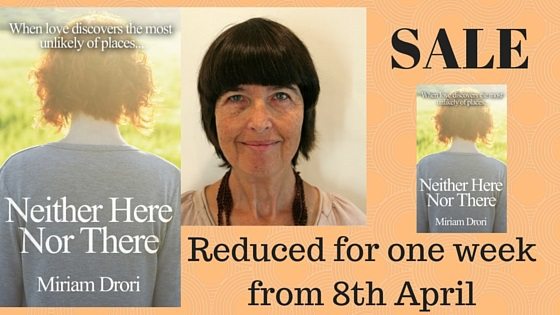
Stop press: Neither Here Nor There is on sale for a few days on Amazon. In honour of that, several bloggers will be featuring the novel. I’ll update this post as those posts appear.
My visitor today is Rivka, mother of Esty, the heroine of my novel, Neither Here Nor There. Rivka was called Rose in her previous life. I’ll let her tell you more.
BS”D
Dear Readers,
At first, I was pleased to receive this opportunity to explain myself and my actions to you. I thought I’d write it all down and then it would make sense. But when I sat down with a pen and a blank sheet of paper, doubts filled my mind. I’m not sure I can explain it logically to myself. How can it make any sense to anyone who hasn’t experienced what I experienced? How can such people comprehend the decisions I made?
Don’t get me wrong. I have plenty to thank G-d for. I love my husband and my children – all of them. I have much joy from watching and helping them to grow up and take their places in the world. I take pride in trying to steer them in the right direction – in the path of good and righteousness, but I know that eventually I will have no influence over them.
A street in Mea Shearim, Jerusalem, where Rivka lives.
Esty, my first-born, has chosen a different life for herself, away from the fold. I miss her so much, even though I see her occasionally. She was such a good girl, always ready to help me with the housework and the little ones. That’s not why I miss her. It’s because she’s one of mine, but she’s no longer one of us. Also, it’s possible I’m a bit jealous, because a part of me wants to be out there with her, although I do my best to suppress those feelings.
It’s easier for people who’ve always lived this life. My husband, for instance. It’s all he’s ever known. He’s never considered any other lifestyle. But I grew up with no religion at all. I could have stayed in London, studied at university, worked and settled down there. And kept in touch with my parents. I do regret making that break. And it wasn’t necessary. I suppose I worried they’d try and influence me to return to their way of life. I suppose I doubted my ability to stand up for what I’d chosen.
How can I explain why I gave it all up? How, at eighteen, I thought I was grown up enough to make my own decisions without any help from anyone. How I thought I’d found everything that was missing in my life – the spiritual stuff – and was happy to give up all the rest, even seeing my parents. I didn’t miss them then. It was only when the babies started arriving that I realised how much I missed my parents and how much they must miss me. Only then, when it was too late, did I realise what an awful thing I’d done to them. Their only child. How could I have left them like that?
No, I don’t expect you to understand. I don’t expect you to empathise with my situation now. I will endeavour to concentrate on being a good and pious woman and thank G-d for everything He has bestowed on me.
Yes, that’s a message I can leave you with – one that can be understood whatever culture you live in. Be thankful for what you have.
Rivka
Thank you, Rivka, for sharing your worries with us. I’m sure you didn’t envision all these difficulties when you decided to join the haredi community. Readers may remember the letter from Leah, Esty’s ex-friend, who has none of these doubts, having been born into the community.
Neither Here Nor There
So much more than a romance, this is a tale of transformation in an exotic setting. Esty’s life was laid out for her from birth. She would marry one of a handful of young men suggested to her and settle down to raise a large family in a tiny space within the closed community of her parents, near to and yet far from the modern world. But Esty has decided to risk all by escaping while she still can. Will she make it to the other side? Mark, who is struggling with his own life changes, hopes that Esty will find a way through her troubles. He is fast falling in love with her. Separately and together, in Jerusalem and London, Esty and Mark need to overcome many obstacles in their endeavour to achieve their dream.
Neither Here Nor There is available from Amazon, Smashwords and elsewhere.
Miriam Drori
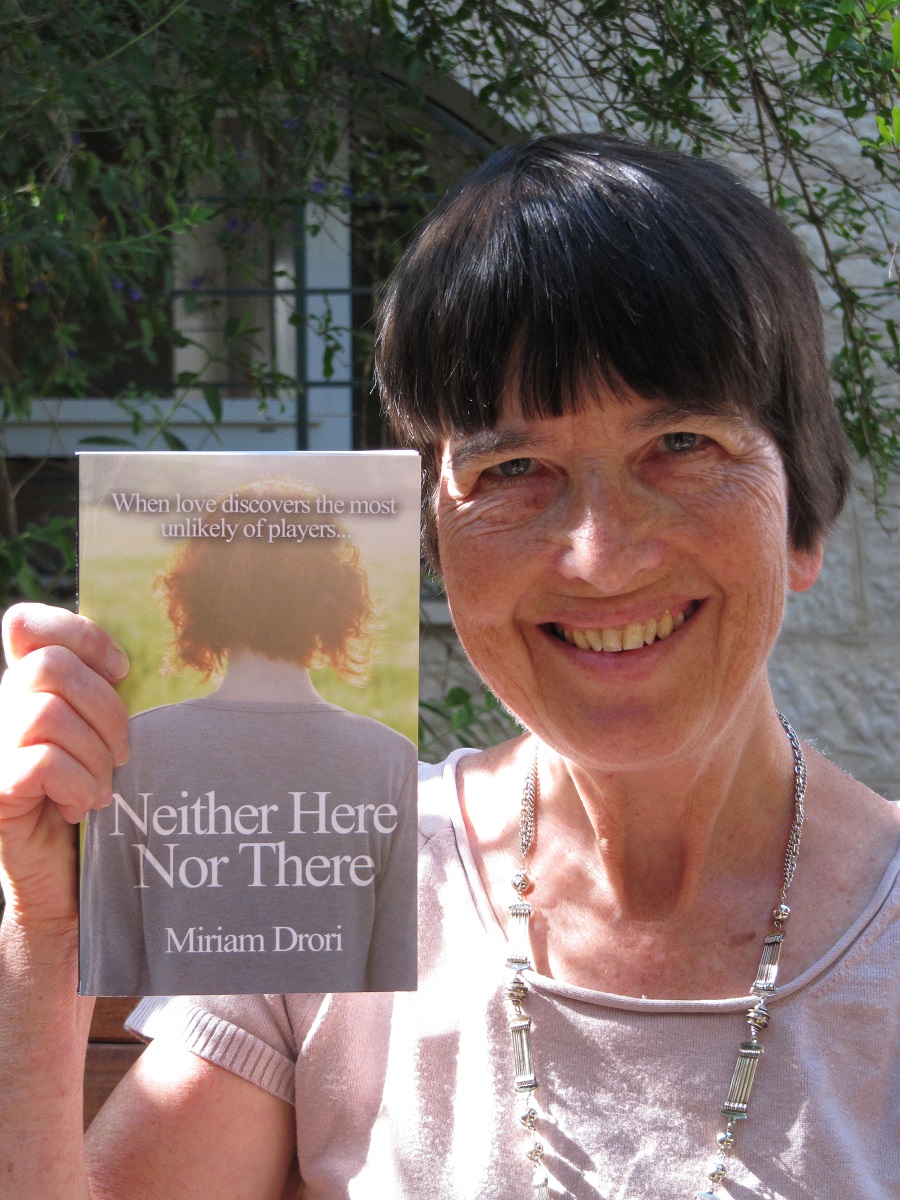
Miriam Drori was born and brought up in London and now lives with her husband and two of her grown up children in Jerusalem.
With a degree in Maths and following careers in computer programming and technical writing, Miriam has been writing novels and short stories for eleven years. Two of her short stories have been published in anthologies and others have been published online. Neither Here Nor There is her first novel.
Miriam began writing in order to help raise awareness of social anxiety. Since then, the scope of her writing has widened, but she hasn’t lost sight of her original goal.
Fictional characters sometimes do uncharacteristic things when their authors pull the right strings. That’s how I can bring you Leah today. Take it away, Leah. Ah, that means… let’s hear from you.
BS″D
Dear Readers,
It feels very strange for me to be writing this letter. Usually, we keep ourselves apart from all the infidels who haven’t yet learned how to live as G-d wants us to. I feel blessed to have been born into a righteous, G-d-fearing family, who brought me up to fulfil all six hundred and thirteen of G-d’s commandments – or rather, those that apply to women.
Now I have a family of my own. I was lucky enough to marry at sixteen. My husband is a good, studious and pious man. He gets up very early every morning to lay tefillin and pray before going to study in the yeshiva, where he spends long hours. I get up early, too, of course. When I’ve said my prayers, I have to tend to the children and the flat and help my mother in her grocery store.
Bli ayin hara, I have three wonderful children and with G-d’s help I will have many more. I feel so proud to be able to fulfil the commandment: Be fruitful and multiply. My eldest is a boy. He has beautiful long flowing hair, which I comb every morning and tie in a ponytail. I will be sorry when he reaches the age of three and has to have it cut short, but I’ll also be proud to see him become a real boy with peyot, and wearing a kipah and tzitzit, a boy who is old enough to do good deeds. The other two are girls; I love them all.
My life has changed so much and so quickly. Not so long ago I was a young girl, playing, studying and helping my mother with the chores. Truth be told, I never did study much. It was hard for me to concentrate. I was never like my friend, Esty, who thought deeply about the things we learned. I remember her trying to discuss them with me, but I wasn’t really interested.
May G-d forgive me for mentioning Esty’s name. I can’t help thinking about her sometimes and wondering why. She was so pretty and clever. How could she have done such a stupid thing?
I saw her the other day in the Interior Ministry office. I’d gone to register the birth of my little one. I was just wheeling out the babies, my son holding onto the pram, when she called my name and I instinctively turned round. I was shocked at what I saw. She stood there, in the hallway, wearing a man’s clothing – trousers and short sleeves. She knows what a sin it is to do that, but she did it anyway.
I just stood there, transfixed. I couldn’t talk to her, of course, but I should never have turned when she called my name. Fortunately, my son called to me and I turned back to him and we continued to the lift. I don’t know what I’d have done otherwise. She could have become a light to the women of our community, I know she could. She was clever and wise, but she threw it all away. I’ll never understand why.
Well, I must go. The baby needs a feed and I have plenty of chores to do before the Sabbath. Life is good, thanks to G-d.
A peaceful Sabbath, Leah
Neither Here Nor There
So much more than a romance, this is a tale of transformation in an exotic setting. Esty’s life was laid out for her from birth. She would marry one of a handful of young men suggested to her and settle down to raise a large family in a tiny space within the closed community of her parents, near to and yet far from the modern world. But Esty has decided to risk all by escaping while she still can. Will she make it to the other side? Mark, who is struggling with his own life changes, hopes that Esty will find a way through her troubles. He is fast falling in love with her. Separately and together, in Jerusalem and London, Esty and Mark need to overcome many obstacles in their endeavour to achieve their dream.
Neither Here Nor There is available from Amazon, Smashwords and elsewhere.
Miriam Drori
Miriam Drori was born and brought up in London and now lives with her husband and two of her grown up children in Jerusalem.
With a degree in Maths and following careers in computer programming and technical writing, Miriam has been writing novels and short stories for eleven years. Two of her short stories have been published in anthologies and others have been published online. Neither Here Nor There is her first novel.
Miriam began writing in order to help raise awareness of social anxiety. Since then, the scope of her writing has widened, but she hasn’t lost sight of her original goal.
Emma Darcy is the pseudonym used by the Australian husband–wife writing team of Wendy Brennan (b. 28 November) and Frank Brennan (died 1995); they wrote in collaboration over 45 romance novels. In 1993, on the Emma Darcy pseudonym’s 10th anniversary, they created the “Emma Darcy Award Contest” to encourage authors to finish their manuscripts. Following the death of Frank Brennan in 1995, Wendy now writes the books on her own. Wendy lives in New South Wales, Australia.
Darcy sold 60 million books from 1983 to 2001, and averages six new books per year.
In 2002, Darcy’s first crime novel Who Killed Angelique? won the Ned Kelly Award for best first novel. In 2003, the next novel, Who Killed Bianca, was a finalist for the Ned Kelly Award for best novel.
Born and raised in London, Miriam graduated in Maths. She worked as a computer programmer for several years and later as a technical writer. She began writing creatively in order to raise awareness of social anxiety. Since then the scope of her writing has widened, but she hasn’t lost sight of her original goal.
Miriam has had short stories published in the anthologies 100 Stories for Queensland and Hitler Did It.
Neither Here nor There will be her first published novel.
The Link
Wendy Brennan, real name of Emma Darcy, used to be a computer programmer before taking up writing. I also used to work as a computer programmer.





 Announcement 1

 My visitor today is Rivka, mother of Esty, the heroine of my novel, Neither Here Nor There. Rivka was called Rose in her previous life. I’ll let her tell you more.



 Born and raised in London, Miriam graduated in Maths. She worked as a computer programmer for several years and later as a technical writer. She began writing creatively in order to raise awareness of social anxiety. Since then the scope of her writing has widened, but she hasn’t lost sight of her original goal.
 Miriam Drori, Author