
 I’m a bit worried about today’s visitor. I think she’s supposed to be in a lunatic asylum and I’m not sure how she got here. If you don’t hear from me again, expect the worst.
Dear Patrick,
It is worse than we ever imagined it would be. The first few days were the worst: the shock of my new surroundings, those abhorrent acts of brutality, the threat of which lingers in the shadows, leaps out at the merest look of defiance. But – and this has come as a shock to me – I have quickly grown used to the place and seem to be able to block out all but the most severe cruelties. I have lost track already of how many days I have been here – very few though, perhaps eight or nine. It feels like so much longer; I miss you and Fleur terribly. Maybe it is best not to dwell on it, after all, I must remember my purpose here. My motives are good; I just hope nobody will judge me too harshly for them.
There is no harm in any of the women. Indeed, there is one I believe I can even count on as a friend. She is a brave soul, Minette Dolan, only about eighteen or nineteen years old. She is very protective of the more vulnerable patients and has shown me the way to survive in this place. When I asked her how long she had been here, she said she didn’t know. She knows the date she came in here, she says, but does not know what date it is now, or even which day of the week, for we are not allowed a clock or calendar. When I asked what had brought her to Saint Anne’s, she looked me dead in the eye and said, “Moral insanity.”
She would not be drawn on it any further, and I have considered it for some time: moral insanity, what could that possibly mean? Dolan believes she can communicate with the spirit world; she gives comfort to some of the women here, women who have lost children or loved ones. I don’t believe there is any malice in her; she is misguided, that’s all. What harm could it do, to offer solace by bringing messages from the other side?
And yet women like Dolan are ten a penny in this Godforsaken city. We have met women like Dolan before, have we not? Since coming here I have thought about Soubrette often, the charlatan in her red room, with her ringed fingers and china figurines all rattling on her shelves.
In the end, I believe you nearly fell for her, but I think perhaps you wanted to. You had more at stake than me. One could be forgiven for being deceived.
It is time you let go, Patrick, let go of the past and start living again. Pictures of Magdalen are dotted all over the house; the portrait of her standing at the top of a horseshoe-shaped staircase with a flower garden behind her, another taken after she died. That one sits in a frame on your dresser in our bedroom. It is hard to live up to the memory of a ghost.
Ghosts – our house is full of them. There is Zeus, also, who you had prepared and stuffed, sitting always at our fireside, menacing me with his glassy stare. He never liked me; he was Magdalen’s dog, forever slobbering on me and pinning me against walls with his docile weight. Magdalen’s dog, Magdalen’s husband, Magdalen’s bed and her wardrobe full of clothes. There is only Fleur who is really mine.
I know you will never forget Magdalen – I wouldn’t want you to – but it’s time to let her rest in peace. We can talk about it more when I come home. It won’t be long now. I only say this because I love you. I love you and Fleur more than anything in this world, and can’t wait to see you both, just as soon as my work here is done.
Yours, always,
Cicely
Thanks for that, Cicely. And to the rest of you: you don’t really have to worry about me because Cicely comes from the pages of (soon to be released) Delirium by the very talented Emma Rose Millar.
 About Delirium
1881
Saint Anne’s Lunatic Asylum, London
One woman whose secret has brought her to the brink of insanity; another who claims she can tell fortunes and communicate with the dead. With seemingly no way out – and everything at stake – only one of them has the tenacity to survive.
Lies, murder, obsession… Delirium.
About the Author
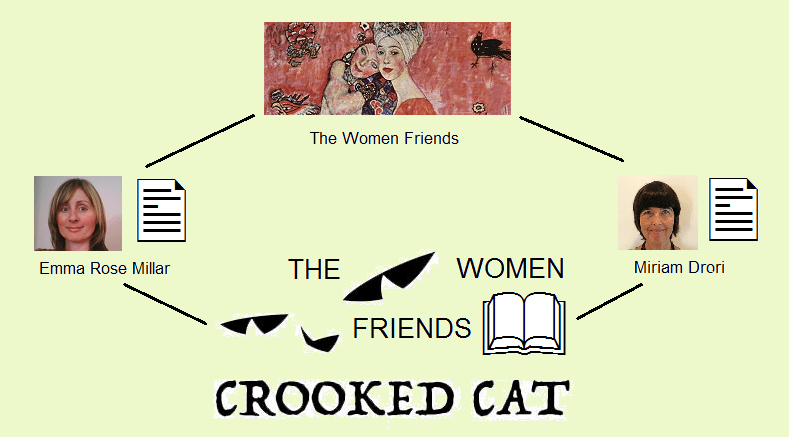
 Emma Rose Millar is a single mum from Birmingham who works part-time as a sign language interpreter. She writes historical fiction for adults and poetry for children. Her first novel, Five Guns Blazing, won the Chaucer Award, (Legend Category) in 2016. Her novella, The Women Friends: Selina, co-written with Miriam Drori, was shortlisted for the Goethe Award for Late Historical Fiction in 2016. Delirium is her third novel and was shortlisted for the Chanticleer Paranormal Book Awards in 2017. Some of Emma’s children’s poems will be published in 2019 by The Emma Press.
In her spare time, Emma enjoys swimming, yoga and ice-skating, and makes delicious chocolates.
 So why am I telling you that
 “Perhaps influenced by the 1907 performance of Richard Strauss’s opera, Salome, Klimt returned to the subject of the femme fatale in 1909, when he painted Judith II. Here again, critics mistakenly identified the subject as Salome. Indeed, this Judith appears threatening and monstrous: her face and claw-like fingers instil fear, and her dress engulfs Holofernes’ head, symbolising his loss of identity. As in Judith I, the artist’s counter-decapitation of Judith is suggested by the two white stripes cutting across her neck.
 Except that it wasn’t as easy as it sounds!
 I still don’t meet other women very often, but I’m getting better at it. There’s one I often meet. We write together and talk, too. And two days ago I met up with someone I haven’t seen for many years. I even initiated the meeting and travelled all the way to Haifa for it. Well, for this country it’s a long way. The bus journey from Jerusalem to Haifa takes all of two hours.


 But what of the real men, women and children who were sent to the colonies during the eighteenth century? Most surviving accounts of transported convicts focus on notorious criminals or scandalous circumstances. The overwhelming majority, ordinary men and women, convicted of petty offences, have been forgotten. After being handed down their sentences they promptly disappeared from the history books. However, a few of these records still survive.
 On December 1st, 1722, Margaret Hayes went into a shop and began to barter with the owner, Elizabeth Reynolds over the price of a pair of stockings. In the middle of their discussion, she grabbed the stockings, which were on display and ran out into the street. Alerted by Elizabeth’s cries, Margaret was pursued by a number of people and dropped the stockings to the ground just before she was apprehended. At the trial she denied ever having gone into the shop but was found guilty of theft. As the goods were priced at the princely sum of two shillings, Margaret faced a penalty of death by hanging. Often in these cases the jury would take pity on the felon and devalue the stolen goods. Mercifully, this was exactly what happened to Margaret; the jury devalued the stockings to ten pence and she was transported to the American colonies for a period of seven years.
 complexion. When I was writing Five Guns Blazing, this unknown woman caught my interest. I wondered how desperate a person must have been to have risked going to the noose all for a pair of stockings. I wondered whether Margaret had children, and if so, what happened to them, how she would have felt being torn from those children and having to leave them behind. I tried to build a character around one of these unfortunate, petty criminals and through her, show the plight of women transported to the colonies during the eighteenth century.
 Miriam Drori, Author