I’m interrupting the flow of daily A-Z posts for two reasons.
The first is that I have paid a (blog) visit to Ailsa Abraham at Bingergread Cottage. I had so much to say (prompted by her hospitality, or was it something else?) that she divided it into two parts: one and two.
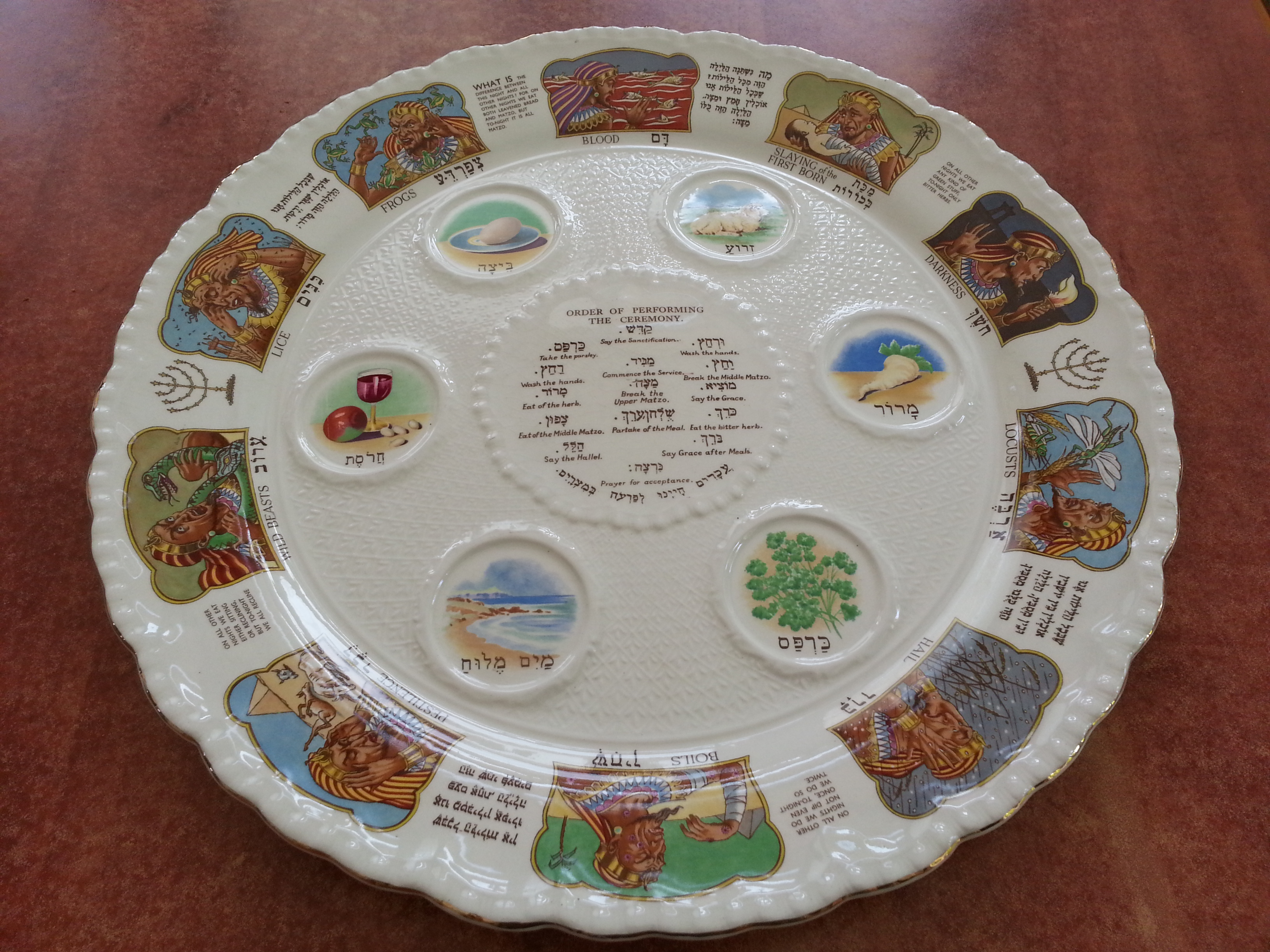
The second reason is to say something about the festival of Passover. I don’t think I’ve ever posted anything about it, because it always comes at the same time as the A-Z challenge. There is so much I could say, but I’ll just tell you about the story behind our Seder plate.
The word seder means ‘order’ or ‘procedure.’ In this case, it refers to the ceremony and festive meal observed at the start of the week-long festival. On the Seder plate are six different items of food that symbolise aspects of the Passover story: the exodus from Egypt.
We never had a special plate for this until we inherited this one when my mother died in 2011. But I knew the story of how my parents had acquired it.
They were on holiday in Ilfracombe in Devon one year and happened to spot this beautiful plate adorned with pictures of the ten plagues in the window of an antique shop. It wasn’t expensive, so they went in to enquire. The underside of the plate shows that it was made in England by Royal Cauldon. The shopkeeper had no idea what it was. There were dishes to match the plate. Unfortunately, two of them were broken and had been glued together (or did my mother do the glueing – I’m not sure). Also, some dishes are missing while others are duplicated.
But they bought the set anyway, and now we use it every year. And each year we comment on the mistake in the Hebrew. One of the food items is salt water. In Hebrew, the word for water is always plural and the adjective (salted) has to agree with the noun. Here it doesn’t.
It’s getting warmer. Warm enough to sit outside in the sun. But not so warm that I search for shade… except on days when it’s extra hot. The weather can’t be trusted at this time of the year, but that gives us variety that vanishes in the summer.
Hyacinth
This hyacinth branch was falling off, so it’s now indoors and its fragrance is exquisite. By the way, in Hebrew hyacinth is yakinton, a word that always reminds me of ‘mackintosh’ but actually has the same root as ‘hyacinth.’
I can’t say I’ve started the spring cleaning, but I’ve started thinking about it. Maybe today….
There is one thorn in my rose. Someone I see regularly has decided to stop talking to me and I have no idea why. (It’s OK – she’s very unlikely to see this blog.) I wonder what’s the best response to it. I could write to her and explain how I feel. I could talk to her normally and pretend to ignore her curt behaviour. What do you suggest?
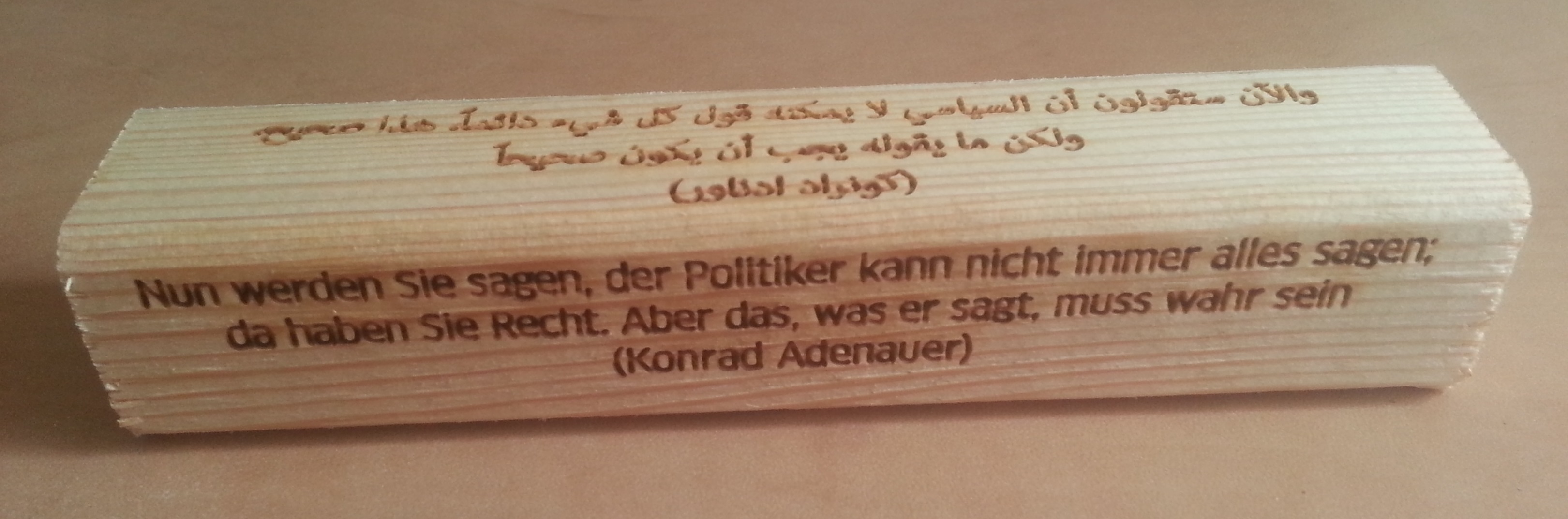
Outside the recent Jerusalem Book Fair – at which my novel was on display, although I doubt it drew much attention – was a tall construction containing many removable blocks of wood, courtesy of the Goethe Institute. I should have photographed it, but I didn’t. Each block had a quotation in the original German translated into Hebrew and Arabic. Each visitor was allowed to take one block and I chose this one from Konrad Adenauer:
.
.
.
.
.
.
.
.
In English:
You are right to say that a politician cannot always say everything. But what he says must be true.
I think modern politicians either don’t believe in that statement or have a warped idea of what truth is. Neverthless, I, along with many Israelis, will shortly be voting for the party I think is the least bad of those available, and many in the UK will be doing the same shortly afterwards. At least we have the privilege of being able to vote.
The video of a Jew walking the streets of Paris wearing a kippa (yarmulke) and tzitzit (tassels) has received a lot of publicity. Zvika Klein, the journalist who did this, has been interviewed all over the world. Youtube is full of copies of the short video. Here is one of them:
In this interview, both interviewer and interviewee said they were “shocked at their shockedness,” meaning that they were surprised that people around the world were shocked at what happened to him.
I’m not shocked. I’m not even surprised.
Firstly, I’m not surprised it happened. The fact is, I’ve never felt comfortable as a Jew in Europe, and that goes a long way to explaining why I’m here in Israel. It’s not that I ever went around displaying my Jewishness. Just the fact that I was afraid to say I was Jewish, because I couldn’t know what people would think. Ordinary people – not Muslims. I don’t think I ever met any Muslims while living in England. Anti-semitism has become more visible in recent years, but it was always there.
Secondly, I’m not surprised that people are shocked. I think most people don’t understand what it’s like to live as a Jew in the diaspora, and if this video goes a little way towards explaining, then I’m glad.
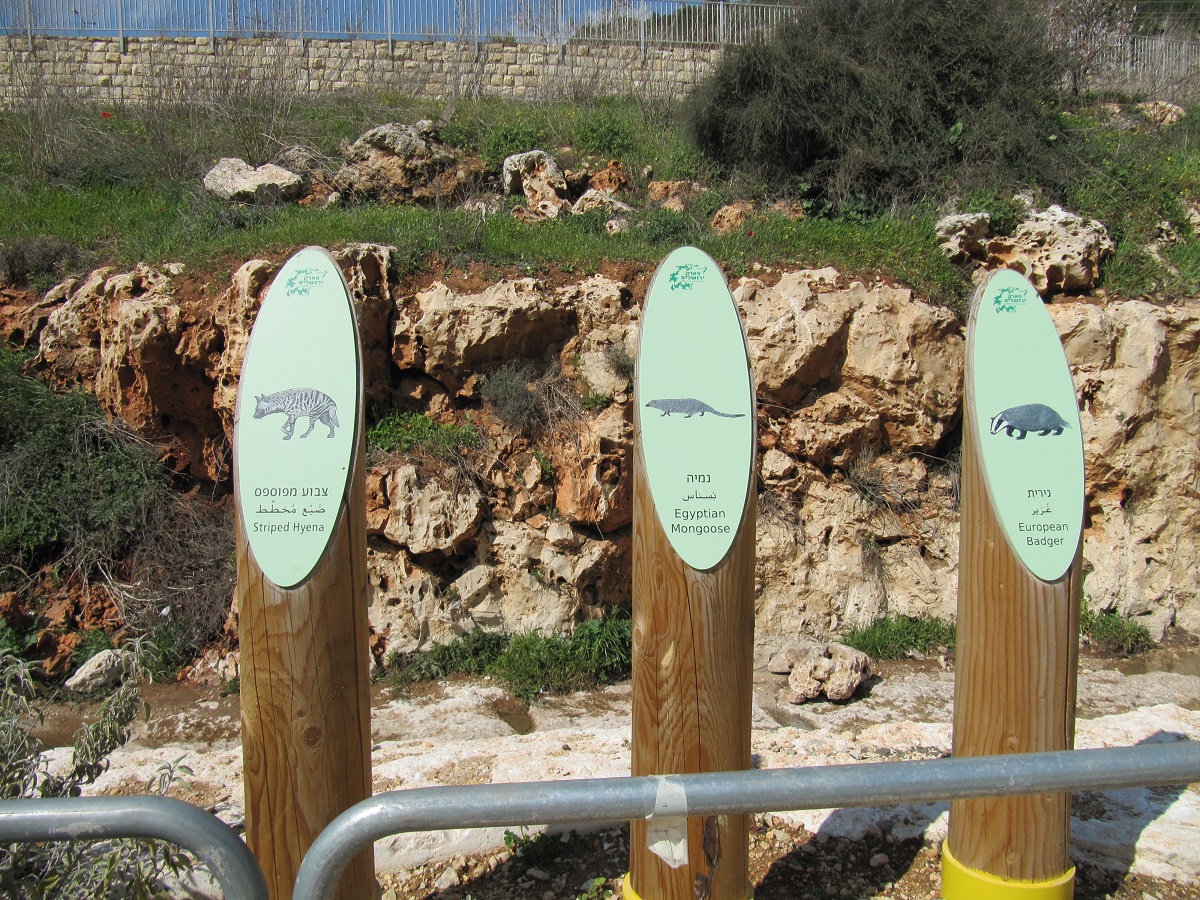
Jerusalem has a new park by the zoo. It’s part of a larger project called The Jerusalem Park. We can walk there from our house and we did the other day. There and back. And we walked all round the park and the zoo. The park is beautiful and so is the zoo. Jerusalem is hilly. We were exhausted when we returned, yet I managed to dance for over three hours (with breaks) that evening.
Jerusalem Park: Canal
The next day we were in Tel-Aviv and did a fair bit of walking there. Fortunately it’s flat.
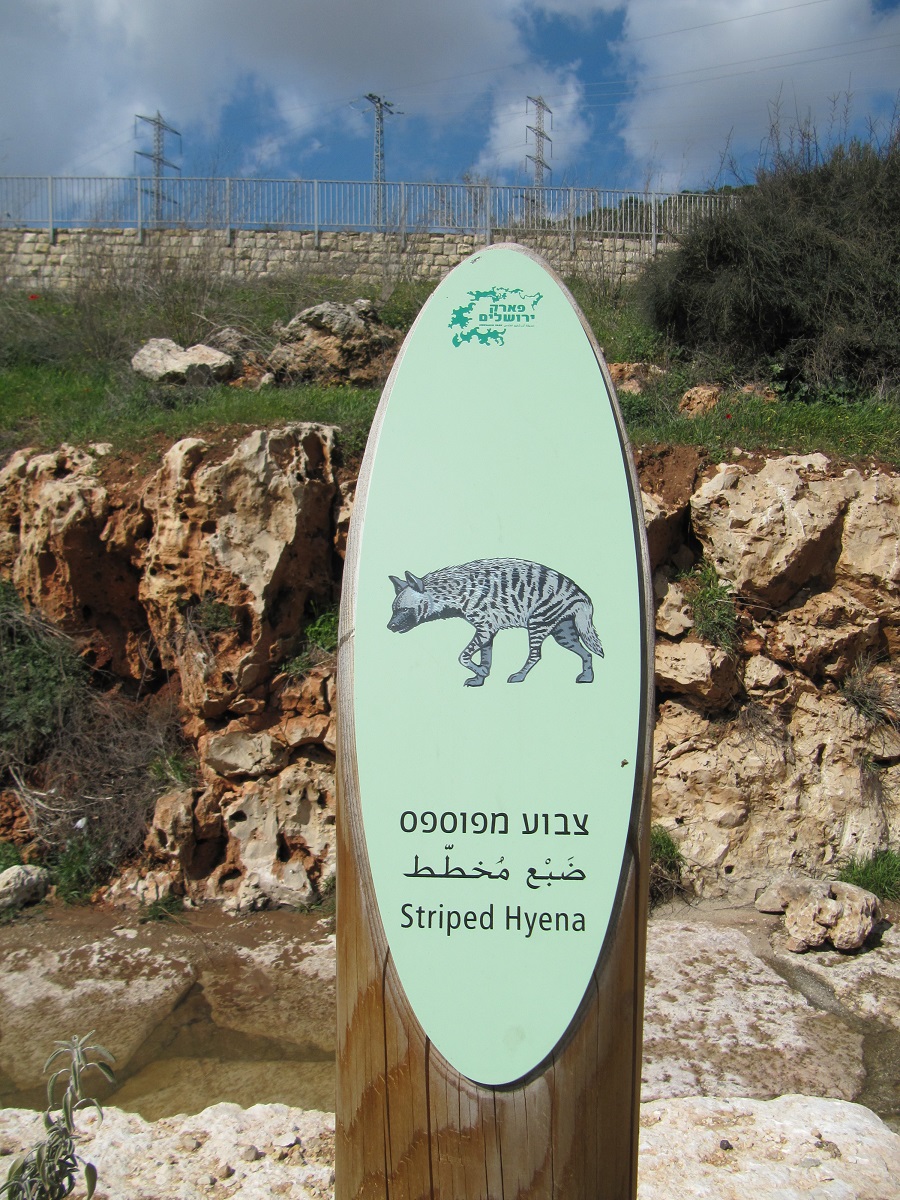
Jerusalem Park: Hopefully not full of …… hyenas!
Then there was a walk to the post office (twenty minutes each way) and more folk dancing. Tomorrow my writing group is meeting at a different location from usual. If the weather is okay, I’ll probably walk there, too (about half an hour each way).
Apart from being good for the body, walking provides more opportunities to see things: scenery, plants, animals, humans. Things to put into stories. The park is now ensconced in the first chapter of the sequel.
It is said that all Jewish festivals can be described in the same way:
They tried to get rid of us.
We survived.
Let’s eat.
Chanuka is one of those. It’s not the most important festival, but it’s fairly well known because it comes at about the same time as Christmas.
I looked for a short explanation of Chanuka, and found one on Lisa’s beautiful blog(Blogger wouldn’t link to the post itself):
Chanukah commemorates two miracles which occurred on behalf of the people of Israel. The first miracle was the military victory of a handful of Jewish warriors against the mighty armed forces of the Syrian-Greek army. The second miracle was that while going through the ruins of the destroyed holy temple only sufficient oil to light the menorah for one day was found, yet the oil miraculously burned for eight continuous days. That is why Chanukah lasts eight nights.
There are three main traditions for Chanuka:
To light candles – one, two… up to eight on each night of the festival and sing Maoz Tzur.
To play with a sevivon/dreidel/spinning top.
To eat foodstuffs fried in oil.
The sevivon has four letters on it. One of the letters is different in Israel from sevivonim found in the rest of the world. There, the letters stand for (A) Great Miracle Happened There. Here, they stand for (A) Great Miracle Happened Here.
The candelabra (I see the correct word is: candelabrum) used to light the candles is called a chanukiya. In other countries it is often called a menorah. This is incorrect. The menorah has six branches and was used in the Temple. The chanukiya has eight branches (or nine). The extra one is for the shamash, the candle used to light all the others.
Food. We Ashkenazi Jews, who migrated via Europe, eat levivot (potato pancakes) and sufganiyot (doughnuts). Sephardi Jews, who migrated via Arab lands, and some via Spain and Portugal, eat other fried foods. Bimuelo, ma’akouda and mofleta are some of the names I found.
In London, where I grew up, I attended a Jewish primary school and a “secular” secondary school. In those days, secular secondary schools celebrated Christmas and it was impossible to opt out altogether.
I loved the tunes of the Christmas carols, but didn’t feel comfortable with all the words. When I had to sing one, solo, that fact caused me to sing it quietly, and the teacher probably thought I was nervous or didn’t have a good singing voice. I was never chosen to be in the choir.
In an art lesson in the first year, we were told to draw something for Christmas. There was an option for drawing Chanuka objects, but it wasn’t encouraged and I, of course, was always trying not to stand out. However, I had no idea what one drew for Christmas. So I looked over someone’s shoulder and tried to copy her work.
We gave each other presents and cards. That was all right, although I was always aware that it wasn’t really my festival.
My children don’t know about any of these feelings, and I’m glad of that. They missed out on the Christmas carols, but they got Chanuka songs instead.
Happy holidays!
To see all the other Crooked Cat stories, poems, giveaways and more during the six-week event, join our Facebook group.
I was wondering what to write about the New Year that is almost upon us, but I decided others have written enough, and all I have to do is to point you to their posts.
Lisa explained what Rosh Hashana is about and even threw in examples of her art and a new recipe. And if you scroll down on her blog, you can read about her wonderful summer in Scotland.
These are the comments that halted me in my perusal of the Internet this morning and made me decide to pour out part of my inner world. Sorry if it makes a stain on your day.
…writing helps us cope with our ‘inside world’ in a therapeutic way. It allows us to explore our innermost feelings, fears hopes etc, in a safe environment, safe because we can stop writing at any time we want.
Sometimes internal and external worlds blend, like knitting, and writing can help with the unravelling.
Some time ago, readers of my blog asked me to write about every day life in Israel – about ordinary life that doesn’t make its way to your newspapers. I created a new category and called it, “Everyday life in Israel.” I had no intention of ever writing about politics or to take sides in any conflict. There are plenty of blogs that do that. They are written by people who are much more knowledgeable than I and hold much stronger views.
Me and Jerusalem
That said, the very fact that I live here, and chose to live here, says something about my opinions. I’m always amazed at the surprise shown in the media at the fact that general opinion in Israel is so much at odds with general opinion around the world. The reasons for that are clear to me.
We’re fighting for survival. Ever since the State of Israel was created in 1948, we have fought those trying to destroy us. We continue to do that now no less than previously. Yes, the means we have to protect ourselves have increased over the years, but so have those of all the other sides. I realise the rest of the world doesn’t see this as a fight for survival, but we who live here do, and that makes us think in a different way.
And we know the media lies. We have husbands and sons who serve in the army, who risk their lives to protect us, who risk their lives in an attempt to protect the lives of the citizens caught up in the place – Gaza – that has become such a mess. Clearly the thoughts and opinions coming from this knowledge will be different from those who believe those reports in the media.
So what is life like in a time of war/conflict? I can’t tell you what it’s like for those living in the south of the country where there are constant rocket attacks. I can’t tell you what it’s like for people who have to carry sleeping babies out to relative safety in fifteen seconds, although I do remember a previous war when we did have babies. I can’t tell you what it’s like to lose a son or husband or other family member. I can only tell you what it’s like for me, in one of the safest parts of the country.
I went to folk dancing twice this week in two different places and run by two different people. In the first, we danced to the usual songs but the atmosphere was not as usual. During a break, I sat with a group of people and the conversation was all about the situation. Did we know about the tunnels? How much did we know? Did we know about the mega-attack planned for the eve of the New Year holiday? And someone mentioned something I remember, too. During the ’80s, people who lived in Ashkelon often used to visit nearby Gaza City. They especially liked to buy the furniture sold there. I remember going there too, once, along with friends who lived in Ashkelon. No one felt afraid of going there. Times change.
At the other folk dancing group, the instructor managed to create a lighter mood. I welcomed those few hours when my mind didn’t dwell so much on all this.
Wars and conflicts have changed for me over the years. In the past, we watched the news in the evenings and went to work during the day, where we naturally discussed what was happening but otherwise got on with work.
Now I’m at home, and now there’s social media. I see a lot more of what’s being said around the world and a lot of what I see makes me sad. I’ve often been upset by being misunderstood (which happens often) and I’m similarly upset when my country is misunderstood.
I’ve never written a story that involves this conflict. My romance, Neither Here Nor There, doesn’t mention it. I’ve always thought I wanted to keep away from it, but now I’m not so sure. Anyway, I’ve exposed a bit of my inner world here. It’s not everyday life in Israel, but everyday life in Israel in times of war.
There’s plenty more that I could say and probably some that I wouldn’t say. I’m not about to give out my phone number, for instance, or talk about those closest to me. If you want to ask anything, please do. If you want to pick a fight with me, please don’t. This is not the place for it. You can write your own blog post. You can comment elsewhere. Attacks here will be deleted.
You have to laugh to stop yourself from creating a poem by mistake!
Whatever the reason, you have to laugh sometimes.
So I was reading through my Facebook feed the other day. Missiles landing here. Missiles being deflected there. Buildings destroyed by falling missiles. Then I saw this:
It’s raining. The wet sort.
And I thought: good thing he qualified that.
We went to the Jerusalem Theatre to see a play that took place around the time of the Yom Kippur War. A notice went up before the play started:
During the performance, sounds of explosions and sirens will be heard.
To my friends around the word: thank you so much for your concern. We are hanging in there. It’s not easy but we know what we’re doing. We’ve been through this before and we know it will pass soon. All we can do is say a prayer that someday, Tel Aviv will not be so humid.
Benji is a comedian who has been doing a lot to keep us laughing. And sane.
So this is my Facebook home page at 9:30 this morning:
1. Pictures of people in Tel-Aviv trying to shelter from a falling missile.
2. Pictures of people in Tel-Aviv trying to shelter from a falling missile.
3. Something about a car alarm that sounds like a siren.
4. An article about break-ups in the orthodox world.
5. A link to a blog post about the “situation”.
6. A link to a blog post by an Israeli comedian who manages to continue laughing despite everything.
7. Someone who asks, “How do you fight with people who have no regard for human life but plat the humanitarian card with social media?”
8. A link to a blog post about using Twitter.
9. A link to a blog post about a wedding held under the threat of missiles.
10. Something about security and rockets.
11. What Israeli schoolchildren sing to deal with rockets.
12. Breast cancer awareness: some people with the worst pasts end up creating the best futures.
13. Tel-Aviv is a target….
14. Posts about Corsica.
15. About sirens in Tel-Aviv.
16. About sirens in Binyamina.
17. Football.
18. Kids playing chess, despite everything.
19. George R. R. Martin, whoever he is.
20. What high school stereotype are you?
9:30 is only 7:30 in the UK. Later the posts will be more even. Pictures of pets and babies, posts about writing between talk of missiles.
I know that life continues as normal in other parts of the world, but I feel torn apart – wanting to keep in touch with what’s going on in my country, wanting to react to light comments with light answers and needing to keep up to date with writing colleagues. It’s hard to continue like that for days on end.
So if you “see” a bit less of me on social media, I hope you’ll understand why.
 The word seder means ‘order’ or ‘procedure.’ In this case, it refers to the ceremony and festive meal observed at the start of the week-long festival. On the Seder plate are six different items of food that symbolise aspects of the Passover story: the exodus from Egypt.
 But they bought the set anyway, and now we use it every year. And each year we comment on the mistake in the Hebrew. One of the food items is salt water. In Hebrew, the word for water is always plural and the adjective (salted) has to agree with the noun. Here it doesn’t.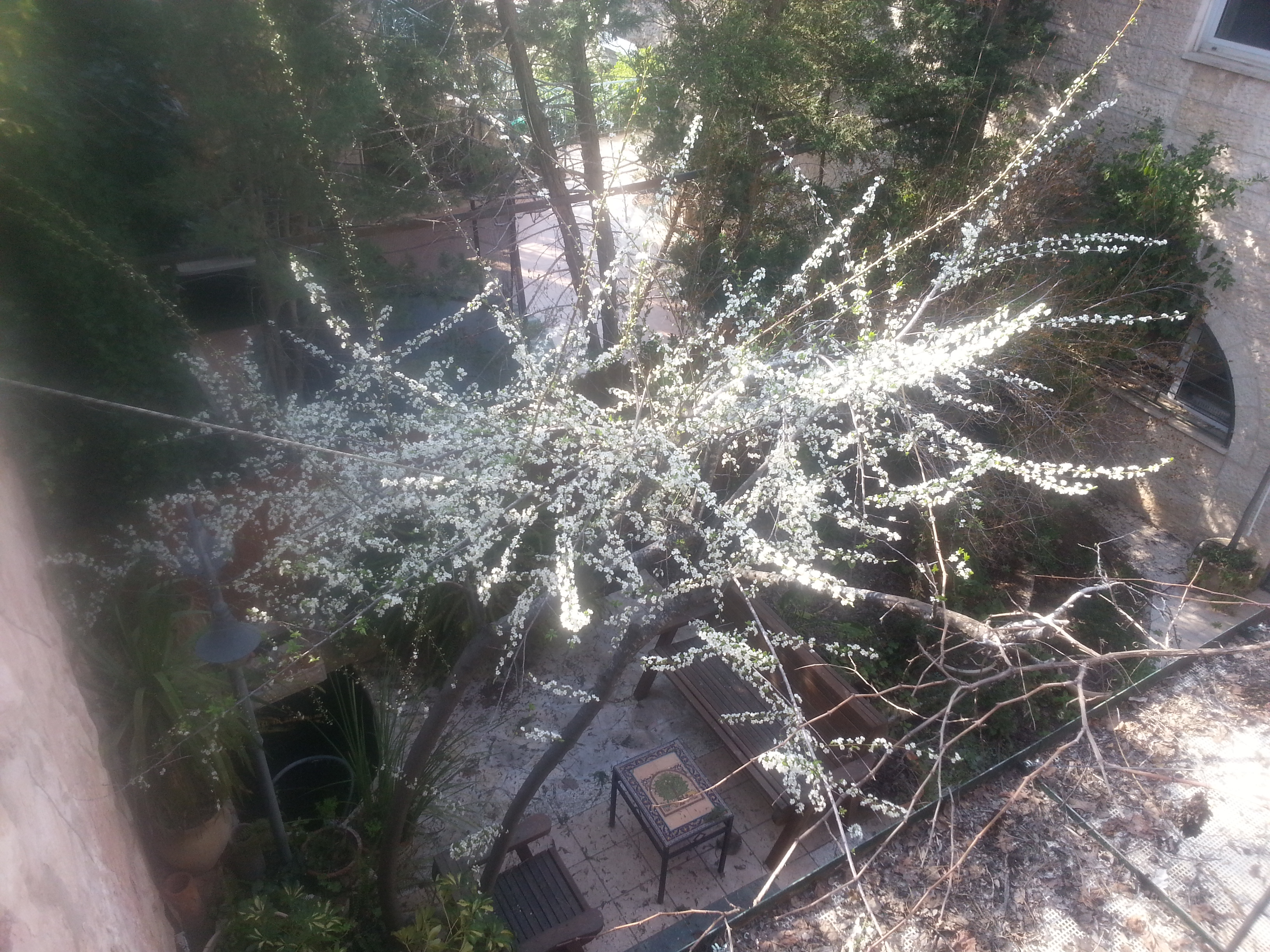


![20150209_122319[1]](https://miriamdrori.com/wp-content/uploads/2015/03/20150209_1223191.jpg)








 Miriam Drori, Author