Categories
Books Israel

Booths and Tales

If you wandered around towns in Israel this past week, you will have seen strange constructions dotted around, fitted into every possible space – on the ground and on balconies. They’re temporary dwellings to remind us of similar dwellings in which the Children of Israel lived during the forty years that they wandered through the desert.

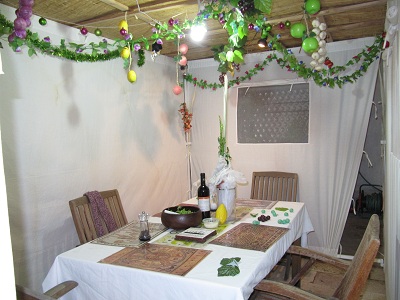
Yes, it was the festival of Succoth, during which Israelis, religious and secular, honour the tradition of building, eating in and sometimes sleeping in booths. I was lucky enough to be invited to eat in the Sukkah of David and Ruth:

In this wonderfully-decorated sukkah, I was treated to a delicious vegetarian meal and delightful company.

***

In other news, the Society of Authors has now made a recording of the Twitter story, for which I contributed the last line – read by a real actor. Here it is:

Categories
Books Israel

Yesterday was a good day

Yesterday morning, I read Nicola Morgan’s blog post about  a tweetathon being organised by the Society of Authors as a protest against BBC Radio 4’s plan to cut the number of short stories it broadcasts. It seemed like a worthy idea and a fun activity, so at one o’clock my time I read the first line of the story and composed and tweeted my suggestion for the second line. At two o-clock I read the chosen second line and tried for the third line. Then the fourth. At four o’clock I tweeted my suggestion for the last line and took my laptop down to the kitchen to listen while I cleared up. Soon after five I thought I’d better check to make sure I hadn’t won  and discovered that I had. My last line was chosen to conclude the story.

Here’s the completed story. I’m thrilled.

Later on, I played Scrabble with my husband and my son, both good players, and I won easily.

Good things always come in threes, right? But there was no more time left yesterday. So, early this morning, I met my friend Marallyn and we sat outside in a quiet little cafe and discussed writing. We’ve often done this before, but not recently as Marallyn was away all summer. I’m looking forward to writing with her next week.

Categories
Israel

Two for One

You’ll be able to read two blogs about a single event. Erika and I met on Thursday for an evening out and decided we’d both blog about it and compare our views. Which parts made enough of an impression to be included? What did each of us enjoy?

So, I took the light railway again. Well, why not? It’s free (still), comfortable and takes a reasonable amount of time to arrive. Entering the bus station (I’m so used to this, I don’t usually think about it), I walked through an xray machine and then put my backpack through another machine. I’m not crazy about the way the bus station is designed. For me, it’s a bus station and not a shopping centre, and I don’t enjoy pushing my way past shoppers to reach the buses, two floors up.

Some things can be confusing for those who don’t know. The two bus stations in Tel-Aviv are known as central and north, but the north station is also the central railway station. At least they’re both also called Arlozorov, so if you use that name, you can’t go wrong. Although the station is also called Savidor.

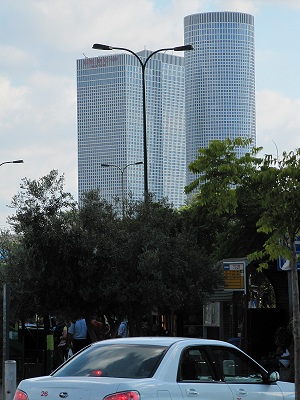
The journey to Tel-Aviv was fast, comfortable and cold. I tried to keep my bare arms under my backpack to protect them from the cold air from the air conditioning. I hadn’t taken a bus along this route for some time and was pleased to note that the new(ish) bus lane saves a lot of time. Just to show I was in the big city, I took this picture, although it doesn’t really prove anything:

Erika picked me up at the station and drove me to the sea. (No, I didn’t say into the sea.) Then we walked to Jaffa’s famous Clock Tower.

On the way, we passed a large number of people and realised they must be celebrating Eid-Ul-Fitr (the end of Ramadan). They were spread out all over the grass and busy grilling meat or just hanging around. Erika hadn’t realised this was going to happen and apologised to me for the commotion around us, but I didn’t mind. I’ve done this walk before when it’s been quieter.

As we walked, we caught up with each other’s news, in particular we talked about her recent trip to Latvia and mine to Italy.

Our destination was the flea market. We wandered along its streets, which were quiet as the shops were about to close, looking at the shops with their mixture of old and antique. We entered one shop where the goods were expensive and interesting. Unusual plates, a lamp shade with a wooden base, mirrors with ornate frames.

Then we looked around for somewhere to eat and settled on a small café, where we sat outside during a quiet period between the day and the evening. I ordered a sandwich with aubergine and other vegetables. It came with salad. The lemon drink with mint had an unusual, not-so-pleasant taste. Afterwards, on Erika’s recommendation, I bought kurtosh, a sweet Hungarian pastry. Later, my family and I enjoyed eating it. It tastes very much like yeast cake, but it’s shaped like a tower and hollow in the middle.

We walked back by the sea and I returned from whence I came. A very pleasant evening. Thank you, Erika!

Categories
Books Israel

Improvement

It’s not often I get a chance to attend talks by authors, so I was happy to be able to go to one yesterday evening. I heard readings by Evan Fallenberg (from his new book, When We Danced on Water) and Abby Frucht (who is in Israel to teach creative writing), followed by a discussion on writing. A very pleasant evening.

And it was made more pleasant by the journey there and back. Despite my previous experience, I decided to brave the light railway again. What a difference! I left the house at 6:00 and arrived in the centre of town at 6:30. I couldn’t have done that by bus. I got a seat both ways and we didn’t stop for long at stations.

Now all I need is a sticker:

Categories
Israel

How I celebrated my birthday

Four of us walked the whole length of Jaffa Road, from the bus station to Jaffa Gate. On the way, we were overtaken about every two minutes by a light railway train. Jerusalem has finally reached the twenty-first century. Well, not quite. Because it was the same train that kept passing us. I need to go back in time to explain.

As it was my birthday, I got to choose. I wanted to see the Mamilla shopping centre, which has been open for a few years but which I only saw once and not in the evening. So I chose a restaurant in the area that was recommended. We could have gone by car, but I decided it was time to try out the light railway. We’ve been suffering the building of this single railway line for eight years. The opening has been postponed four times. Last week, it started operation and for the first few weeks it’s free!

I wonder whether the powers that be will decide they made a mistake, opening it up as free transport during the summer holidays. We got on at the first station. When the train arrived, the seats were all taken in a second and we had to stand. As the train filled up, people jostled us – not just at stations but during the ride. The large number of prams and children didn’t help.

Jerusalemites aren’t used to trains. They’re used to buses, on which there is one door to enter and another to leave. When the train stops, no one thinks to tell them to let people off first. They push their way on, and then those getting off have to push, too. There are problems with doors. People stand in the way of the doors so that they don’t close. Over the loudspeaker, they say, “Boy in the green shirt, keep away from the emergency button. What you’re doing is dangerous.” That’s why the train stopped for about five minutes at each station.

When we reached the bus station, we’d had enough. We got out and walked, arriving at exactly the same time as the train.

The shopping centre was quite full. We found the restaurant and waited less than five minutes for a table. We sat outside, which might have been a mistake because it was rather noisy. The food was excellent. I had mushroom quiche with salad, followed by a rather large but tasty apple pie.

Walking back to the train stop, I took a photo of a sign that has been there for many years. What do you think it means? (Answer at the end of this post.)

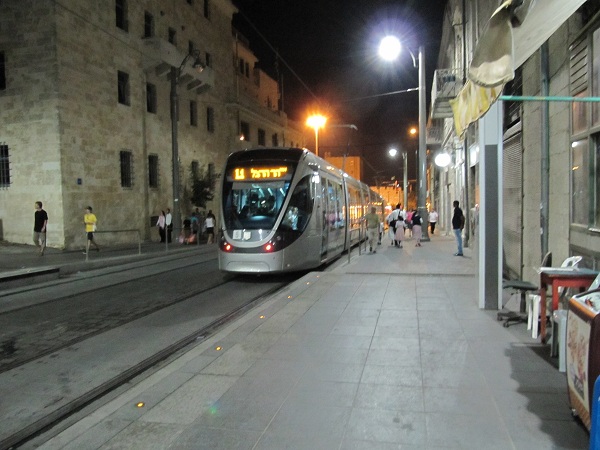
While in a snapping mood, and because we had to wait nearly an hour for our train, I photographed one going the other way:

The return journey was also slow, noisy and uncomfortable. Hopefully, the teething problems will be sorted out and we really will have a convenient transport system in Jerusalem. We haven’t got there yet.

The sign? “REHOV PRATI” is a transliteration of the Hebrew. It means “private road,” but of course you knew that, didn’t you?

Categories
Israel

A quiet place

I have a feeling not many people know about our local library. It takes up a large room in the community centre and is not well-advertised. I discovered it via an article in a local newspaper.

Yesterday, the temperature a little too high for comfort but bearable,  I followed my usual path to it, along a little road, across a main road, along a footpath, and past the Monster. Inside the building, I continued round two corners to the stairs, which I climbed to reach the quiet place. It’s hard to get away from noise in this country. This is one place where you can – on Tuesday mornings, anyway.

The library is small but well-stocked. There is even an English section and I always find something in it to interest me.

This time, I chose Barack Obama’s memoir, Dreams from my Father. My choice has nothing to do with my political views. I chose the book because I wanted to know where he came from, to read about the issues he encountered and to read something “Thoughtful, moving and brilliantly written” (The Times). I haven’t been disappointed with it yet.

The library is free. You leave a hundred-shekel cheque with them for each book you want to take out in one go. I decided one at a time is enough. Going to the library gives me an excuse for a walk, and I do read many other books.

On the way back, I stopped in a small park to read the preface – not the park with the Monster, where children on holiday were scrambling all over it and running around, but a quieter one off the path.

Walking along the road, I remembered I needed to look around more in order to have something to write on the blog, so I stopped where there is a lovely view of the Jerusalem Forest. The other day, I saw an amazing sunset from this place. Sunsets are fast here, and in a minute or two, the deep red ball disappeared behind the horizon. Turning back, I noticed the wall of a block of flats decorated with different-coloured flowers. I’ve walked past this place so many times, looking without seeing.

Flowers decorate block of flats (the real thing looks much better)

Categories
Israel

Food, glorious food

Right, let’s try this. There’s nothing more everyday than buying food, so I’m going to guide you through an Israeli supermarket. Obviously they’re not all the same and I haven’t been to all of them, so this is mostly about the one I usually go to. It’s medium-sized. I go there because it’s fairly cheap, convenient and only ten minutes’ drive from my house. There’s a supermarket just down the road, but it’s smaller and annoying. The most annoying thing about it is the loud advertisements over the loudspeaker for certain products at “x shekels, ninety-nine.” They make it hard to concentrate on deciding what I want to buy.

So you drive your car into the underground carpark, stopping to take a ticket, an action that opens the barrier. The guard will probably just watch while you do this, although presumably he checks inside some of the cars. Park the car, remembering to take the ticket with you. If there are trolleys down there, you can take one. (I hope you remembered to have a five-shekel coin ready for the purpose.) Otherwise, after going up in the lift, you have to exit the supermarket to take a trolley.

You don’t have a car? No problem. They do deliveries.

If you brought bottles back, put them in the trolley provided and tell the head cashier. They might give you cash; usually they’ll tell you to mention them at checkout.

Right, fill up the trolley. Fruit, vegetables and the rest, it’s all there – mostly. Sometimes the specific things the children ask for are missing. Too bad. There’s a counter for cheeses and salads, another for meat and another for borekas and other baked/fried goods. Hopefully, you won’t have to wait too long at each one.

Now the fun starts. There might be only two people in front of you in the queue, but each one takes an age. When it’s your turn, you’ll know why. Just hope no one pushes in front of you saying, “I’ve only got two things and the queue for the quick checkout is very long,” because that’s the one who will take the longest when it comes to paying.

Finally it’s your turn. You’re beginning to worry because if it goes over two hours, you’ll have to pay extra for parking.

The woman asks you if you have a club card. Usually, she does it in a Russian accent, so that moadon comes out as moadworn. If you’re unlucky, while she puts your card through the machine, she says, “Why don’t you have our credit card? You could save money. It’s worth it.” My answer to that has become, “My husband decided against it.” She continues to talk about the wonder card (because she gets commission on sales), but soon realises that I’m not going to give in against my husband’s wishes.

It takes you longer to put the food in bags than it takes her to check them through, so she has plenty of time to gossip with her neighbouring workers, read your newspaper, talk on the phone, etc. Sometimes, she talks to you. One of them, I discovered, used to be a piano teacher in Russia. Now she has to do this boring job. Sometimes, there are problems. An item is missing the price code, so the customer has to run round the shop looking for another, while those waiting behind get impatient. A cheque needs to be checked. When you tell her about your bottles, she has to get permission before taking the money off your bill.

She might ask you if you want any of the items on discount and if you want to donate money to the current charity. You pay with your credit card and then sign. Those machines on which you enter your PIN haven’t arrived here yet.

That’s about it. Don’t forget to have your parking ticket validated on the way out. If you hurry loading the car, you won’t have to pay for parking. B’tayavon (bon appetite)!

Categories
Israel

A question for you

Catdownunder has made a suggestion for this blog. She wrote, “Lots of us would just like to know about everyday life in Israel instead of all the usual news stories. Is it really so very different from life Downunder. I wonder about that.”

My question is: is she right? Do you want to know?

Categories
Israel

A Walk in my City

I look down on the conglomeration that is my city. Men in suits and black hats in the burning sun, women in short skirts and sleeveless tops – along with women more suited to the above-mentioned men and men suited to the above-mentioned women. Lorries, buses, cars, taxis, motorbikes. Buildings, old and new:

Buildings - old and new

The bridge on which I’m standing has been open for three years and yet this is the first time I’m walking along it. I need to get out more before I stop recognising my city.

My problem is to decide what to call it in English. In Hebrew, it’s called Gesher Hameitarim – The String Bridge. But that’s string as in a violin string. Online, I find two options: The Bridge of Strings or The Chord Bridge. I like the way “chord” combines music and geometry.

As I stand at the top of the bridge watching the changing view, people pass me, alone or in couples, quiet or chatting, on foot or on cycle. They don’t seem to notice the view. They’re probably used to it.

Eventually I leave the bridge and follow the tramlines along Jaffa Road. There are plenty of stops for the tram or light railway, all empty because the opening of the light railway has been postponed yet again. Ghost trams pass by, their seats still covered with plastic, their destinations flashing alternately in Hebrew, English and Arabic.

I sit down at one of the stops, providing it with some company for a few minutes. Buses have been rerouted away from here and it would be quiet if it weren’t for the drilling across the road. An old man approaches. “Is this hat yours?” He fishes a sun hat from under my seat with his walking stick and takes it with him.

The market is crowded, even though it’s only Tuesday. People are busy rushing everywhere. In the middle of it all, an old woman is standing in stained clothes and a straw hat. Next to her is an old shopping trolley filled with plastic bags. A bag lady, I think, until I go round to the other side of her and see what she’s up to.

Artist in Machane Yehuda Market *

Yes, I definitely need to get out more.

( * Apologies for the rubbish bin in the photo. There was no other way to take it.)

Categories
Books Israel

Book Fair

Nearly two years have passed since I started this blog. In all that time, I’ve hardly mentioned my home town. Not here, anyway. I did write a bit about why I’m here in a guest post on Tania Hershman’s blog.

Why not? I’m not ashamed of it. On the contrary. I am proud of it. Of the whole country and this town in particular. So much has been accomplished, despite attempts to block all achievements – from without and within.

I haven’t written about it, because where I live is not one of the two themes of this blog: writing and social anxiety. And because it’s not a neutral place, to put it mildly. It’s a place that arouses emotions. In the present climate, those emotions are often hostile and I don’t want to deal with them. My main reasons for being here are personal, and I’m not equipped to take on the rest of the world.

One of the things I’m proud of is the biennial Jerusalem International Book Fair, which has been held since 1963. This year, I did something there I haven’t done before: I attended some author interviews. They were fascinating. I don’t know why I haven’t done that before. These are the ones I heard:

  • Aaron Appelfeld: an Israeli author who survived the Holocaust as a young boy, separated from his parents. What I took away from the interview is what literature is not. I can’t remember all the list, but I remember the last item: literature is not politics. That doesn’t mean you can’t write about politics, he said, but you can’t use it as an outlet for your political views.
  • Robert Cohen, from Canada. He spoke very well and held my interest all the time. As I listened to all these authors, I wondered whether I could ever become an author in modern times. I can see myself doing readings and presentations. But interviews?
  • Marina Nemat: a Canadian originally from Iran. Wow! That was some interview.  The audience was riveted by her story and the way she told it, starting at the end: certain people used strong language to try to dissuade her from attending the book fair, but she came anyway. She doesn’t do boycotts.
  • Guy-Philippe Goldstein, from France, discussed cyber warfare. Software put Iran’s nuclear programme back by five years. What if organisations with sinister motives could do this? I suppose we have to read his book, Babel Minute Zéro, to discover his prediction.
  • Oren Nahari, an expert in Japan, told us a lot about Japan and the Japanese, starting with his meeting with the emperor of Japan.
  • Dr Yohanan Grinshpon, told some stories from India – stories in which abstract ideas become physical objects and real objects and people can be made from thoughts. I found the stories fascinating, as a person and as a writer.