Categories
Israel

A-Z Challenge: G is for German Colony

House in German Colony

The German Colony is a suburb of Jerusalem. The area was first settled in 1873 by members of the Templar sect from Württemberg, Germany. They lived there until the Second World War, when they were deported by the British Mandatory government as enemy citizens.

I didn’t take this photo, due to a lack of time.

Categories
Israel

A-Z Challenge: F is for Folk Dancing

Not a site, this time, but an activity that takes place all over the country, including Jerusalem.

I dance, too

What’s special about Israeli folk dancing is that new dances are constantly being created. You have to keep attending, otherwise you fall behind. Folk dancing is fun and healthy, and it brings together, in a friendly atmosphere, all sorts of people who wouldn’t normally meet. I love it – especially with my dancing instructor, Boaz.

Happy Easter/Passover, everyone!

Categories
Israel

A-Z Challenge: E is for Ein Karem

Churches in Ein Karem

.

.

Ein Karem (literally “Spring of the Vineyard”) is an ancient village, and now a suburb of Jerusalem. John the Baptist is believed to have been born there, and that is the reason for the many churches and monasteries around the village. The photograph, taken by my other half, shows… I’m not quite sure what. The steeple in the middle looks as if it belongs to the Church of St John the Baptist. The others…. I’d better go there again soon.


Commenters: the comment button is at the top of the post.

Categories
Israel

A-Z Challenge: D is for Dormition Abbey

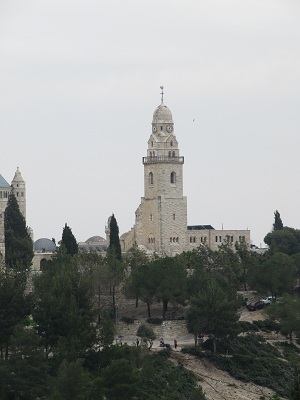
Dormition Abbey
Dormition Abbey Clock Tower

.

.

The Dormition Abbey is a German Benedictine church completed in 1910. It has a conical roof (described as blue although it looks grey to me), four ornamental turrets and a clock tower. When we lived close to a view of the clock tower, we used to watch its “face” appear as it got dark.

(If I’d had any sense, I’d have photographed the two buildings together.)

Categories
Israel

A-Z Challenge: C is for Chord/Cord/String Bridge

Chord/Cord/String Bridge

.

.

I’m a bit confused about what it’s supposed to be called in English, but it stands at the main entrance to Jerusalem, was inaugurated in 2008 and is now used by pedestrians and the light railway. I’m not sure it suits the character of Jerusalem, but it is impressive and was apparently the only suitable option for the light railway.

Categories
Israel

A-Z Challenge: B is for Bikur Cholim Hospital

All the photos in these posts were taken by a very unprofessional photographer – me. You can easily find much better ph0tos of this hospital.

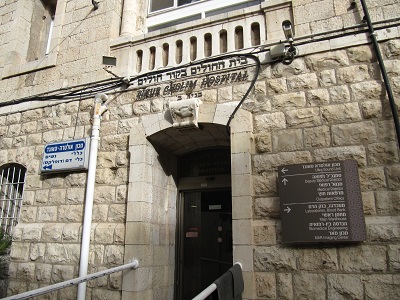
Bikur Cholim Hospital

Bikur Cholim (literally “Visiting the Sick”) Hospital dates from 1826. The current building was completed in 1925 and was one of the first to be erected in what is now the city centre. It still functions as a hospital, having survived artillery fire and severe financial problems.

Categories
Israel

A-Z Challenge: A is for Al Aqsa Mosque

As I mentioned before, I’m going to be blogging about Jerusalem this month – one letter per day. With such a subject, I’m rather spoilt for choice and can only show you a small part of the amazing number and variety of sites in this relatively small town.

Al Aqsa Mosque and the Dome of the Rock

.

.

.

.

The Al Aqsa Mosque is the third holiest site in Sunni Islam. Its name means “the Farthest Mosque” and it originates from the year 705, although the building has been rebuilt and renovated several times since then.

Categories
Israel Social anxiety

Scavenger Hunt

That’s me on the left – with Robin, Myriam and Lisa

A common feature of social anxiety involves the person worrying so much about an event beforehand that they do their best to avoid it. Fortunately, or otherwise, I’ve never done that. I’ve explained my behaviour by saying that my desire to be with people is greater than my anxieties. I could also explain it as stupidity. Why else would I keep coming back for more?

That is not to say that I didn’t enjoy the Scavenger Hunt that I attended on Friday in the Jewish Quarter of the Old City of Jerusalem. Most of it was fun and I enjoyed meeting all the other participants. I was also amazed to discover how much there is to see in such a small area, and how much I’ve missed, despite having been there many times before.

What was hard was answering the questions, especially the ones that required opinions, but fortunately the other members of my team made up for my shortfalls.

I won’t go into detail about what we saw, because that has been done excellently by Lisa and Amit and Hadassah and Sharon.

As I’m sure you won’t have my problems, I can heartily recommend going on a scavenger hunt instead of an ordinary tour. If you’re planning a visit to Jerusalem, here’s the place to find out more information.

Categories
Books Israel

Foreign or Familiar? Does it matter?

I’ve read two recent blog posts about foreign settings in books – one by Rachelle Gardner, the other by Nicola Morgan.

In my son’s English class, when he was about nine, the pupils were made to read an American book written totally in a dialect I found hard to follow. My son didn’t understand it at all. When the same book was suggested for my younger son’s class, I complained and the book was changed.

There’s no point in reading a book you can’t understand, but as long as you can, does setting matter? Personally, I like to read about places I’ve never seen. I also like to read about places that are familiar.

What about other readers? Are they usually interested in books set in foreign places? Apparently, Americans are less willing to read books with foreign settings than readers in other countries.

I have another question about setting. I generally set my stories in England, where I used to live. I would like to write stories set in Israel, where I live now. But I think readers generally expect specific topics to appear in any book set in Israel: war, political conflict, etc. I think they believe Israel is one of those countries where it’s impossible to lead an ordinary life. Am I wrong?

Categories
Israel

Do you know which festival is coming up?

That’s right, it’s Chanuka.

Or Hanukka, or Chanukah, or….

There are about twenty ways of spelling it in Latin letters, but only one in Hebrew: חנוכה

Like the festival of Sukkoth, it’s celebrated in Israel by religious and secular people alike. On each of the eight nights, we light candles (one on the first night, two on the second, and so on) in memory of the time the oil in the Temple lasted for eight days although there was only enough for one. And we eat doughnuts and other items made with oil. And we might play with a sevivon or dreidel or spinning top that will land on one of its four sides, which have letters standing for the words: (a) big miracle happened here.

And we sing songs. Young children love singing all the songs that go with the festival. So do I, but unfortunately I no longer have young children to sing them with.

Anyway, Chanuka is a fun festival, loved by all.

As for that other festival, here where it all happened is one place where you could fail to notice it. Unless you go to the Old City of Jerusalem, where it’s celebrated on three different dates by the different communities.