You start with ideas. A period in history, a place, an event plants an idea in your mind. How do you make it lead to a novel?
You start to research. Images form in your mind. You see a captain standing on the deck of a ship, his blond beard flying in the wind*. You know what he’s wearing – coat, boots, hat. You know what he has in his pockets. You live most of your life along with him and all the other characters.
Then, when you know all your characters well enough, you use your imagination to weave a story around them.
We modern day authors are so lucky. Whatever we might wonder, almost any question we want to ask will have been answered on the Internet.
Which songs were popular in England in January, 1922?
What was the world’s first postage stamp?
You can find all the answers at the touch of a button or two.
BUT
Sometimes there are mistakes on the Internet. Sometimes you need more detail than you can find on the Internet. The Internet is not enough. It can be very helpful and it can set you on the right path, but it doesn’t replace detailed and well-researched
So you’ve done your research, you’ve asked experts and still there are things you don’t know.
Why did Charles Dodgson (Lewis Carroll) fall out with the Liddell family?
How did the cliff dwellers of Montezuma Castle manage their days?
You need to answer these questions, but no one knows the answers. What do you do? You make informed guesses based on the information you have been able to discover. And there’s nothing wrong with doing that, because this is fiction.
I asked Nancy Jardine, whom I interviewed here and who writes – amongst other genres – historical novels set in Celtic/Roman Britain, for one example of when she had to make an informed guess. This is her response:
I’ve had to do a fair bit of that in my Celtic Fervour Series, the reasons being that the only source materials for the times are Greek or Roman – and biased at that. The Celts left no written evidence at all – save what’s found on stone inscriptions. In Book 3 of the series, I have a large battle at a place named Beinn Na Ciche (Gaelic for a hill range that’s nine miles from my home). Bennachie, as it’s currently called on the map, is only one possible site earmarked by historians for a battle between Romans and Celts that the Roman historian Tacitus wrote about. The thing is that Tacitus may only have been attempting to make his father-in-law Agricola seem like a greater general than he really was. None of the other Scottish contender sites – for what was later named the Battle of Mons Graupius by early Victorians – have provided conclusive evidence. I made my ‘informed’ choice and decided that the topographical information given by Tacitus matched the landscape around Bennachie, but even more important for me was that in 2006 local archaeologists decided that the Romans had had some 30,000 soldiers in Durno – a marching camp opposite the fooothills of Bennachie. The number of soldiers (which is drawn from archaeological evidence and not written evidence) was sufficient for me to use the site in my novel. In fact most of what I’ve written as historical facts on Celtic life is drawn from purely archaeological sources and is therefore all interpretative.
Thank you for this, Nancy. It shows a lot about what a historical novelist has to do – research, decision-making and more – before starting to write.
Bennachie
Nancy also sent me this photo, which “was taken from near the Durno camp looking over to the hilltop named ‘The Mither Tap’ – the most distinctive part of Bennachie range.”
Never forget that what you have written is fiction. If people get too serious about how real the story is and suggest things might not have happened that way, remind them they didn’t happen in any way because the story is fictional. However much you tried to be true to history, the fact remains: it’s made up.
There is a limit to the amount of research an author can do for a novel. There will always be specialists who know more about the era and the place than you do.
So ask them. Find an expert who is willing to help by answering all your outstanding questions and hopefully providing information that you hadn’t even thought of asking about.
How do you decide on the language to use in dialogue? Clearly modern expressions would be out of place. But the language of the time is also inappropriate because readers wouldn’t understand it, even if you researched it enough to be able to write it.
As with all these dilemmas, you have to find the right balance between these two approaches.
What does the craft of writing a historical novel involve?
Creating an absorbing story set in the past, yet satisfying for modern readers. I think you have to constantly balance those two seemingly opposing requirements. Sometimes it’s necessary to make characters more “modern” than they really are, to have them make decisions based on currently logic rather than steeping them in religion and superstition. Otherwise readers will have a hard job understanding their motives.
Bringing the era to life. You have to set readers in the period and place of the novel and then move them forward, so that they feel as if they are really there.
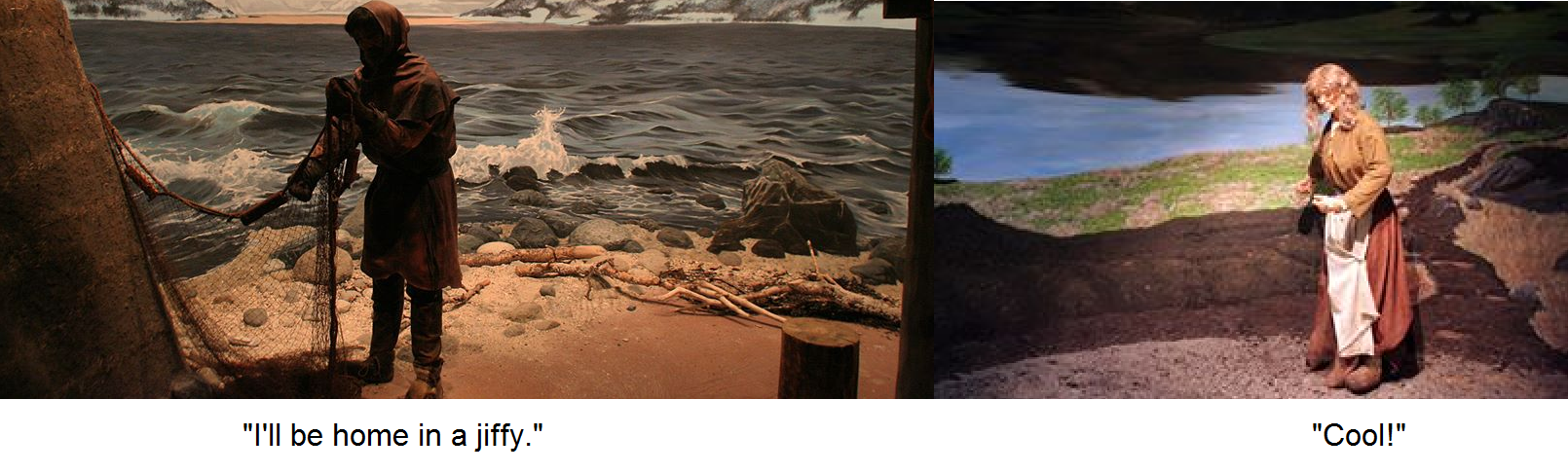
Norway: Trondenes Museum
P.S. I will reply to your comments, but it might take a couple of days.
In any novel there will be some back story. Most characters haven’t just been born. They had a life before the novel began. And even one who has just been born has parents with back stories that will impact on the newborn. Some of that previous life will be relevant to the current story and needs to be told. It is also important to set the scene, whether indoors or out, to give readers a feeling for the setting (or settings) of the novel in place and time.
Even more so for a historical novel. Most readers will be unaware of the norms, limitations and customs that shaped everyday life in the specific time period. They won’t know what places looked like before the advent of cars, fridges and electricity wires.
Somewhere in India
It is the job of the writer to tell them what life was like in those days.
BUT
Readers don’t want information dumped on them. The backdrop doesn’t have to be described at once and the back story, however interesting, doesn’t move the current story along. Whatever can be shown during the story shouldn’t be told upfront. This is true of all fiction; in historical fiction there are more unknowns, making the avoidance of infomation dumping more difficult.
P.S. I’m looking forward to reading your comments. It might take me three days to reply, but reply I will.
An anachronism is before its time – usually in a bad way. It’s a thing that belongs to a period other than the one in which it exists or is attribed to. Usually we think of anachronisms as being misplaced. We think the author hasn’t done their homework. Unless they have been placed there on purpose for comic effect.
The Flinstones, for example, brought twentieth century issues into the lives of a Stone Age family.
But anachronisms are not suitable for serious historical novels.
Not all anachronisms are obvious. I don’t think anyone would make the mistake of having a character switch on a light in the Middle Ages. But would you know not to put a xylophone in an orchestra before 1874?
Anachronisms are not only wrong as actual things before their time, but also in similes and metaphors. As Chuck Sambuchino writes: “A fierce windstorm in a novel set in ancient Rome should not sound like an onrushing train.”
This is one reason why research is essential. And editing.
I’m so pleased to be awarded with another visit from Nancy Jardine, whom I interviewed last month.
She’s back to tell us about not one but two novels of hers that are about to be published.
Take it away, Nancy!
Hello Miriam. It’s lovely to come back so soon to update on my next book launches. First of all, I’d love to say that I’m absolutely delighted with both of my cover designs – each is perfect for their intended market.
I mentioned during my last visit that I was waiting for my cover design from graphic designer, Neil Saddler, for The Taexali Game, my time travel adventure for middle grade/ early teens. That was revealed recently so I’ve rescheduled its launch to April 2015. I’m so pleased to now be virtually ready to self-publish this adventure novel since it’s been waiting on my writing shelf, in various draft guises, for a long time. Soon my readers will be introduced to the intrepid trio you see on the cover – Aran and the twins, Brian and Fianna. In this first book of the Rubidium Time Travel Series, the adventure takes place in their own Aberdeenshire back yard – except that they are time travelled back to the year AD 210. I hope you can see the Ancient Roman legionaries in the cover design because AD 210 was an era when Roman Emperor Severus and his vile son, Caracalla, invaded northern Britain with multiple legions in a show of Roman strength. My teen protagonists have a set of tasks to fulfil, but how do they work out how to help both the ‘baddies’ and the ‘goodies’ when some of the Celtic chiefs they meet are as foul as Severus and Caracalla? Dicing with death becomes the norm in this Roman/Celtic Britain adventure but my trio need to stay alive! The main reason I’m not self publishing The Taexali Game sooner is… because I’ve another launch to attend first!
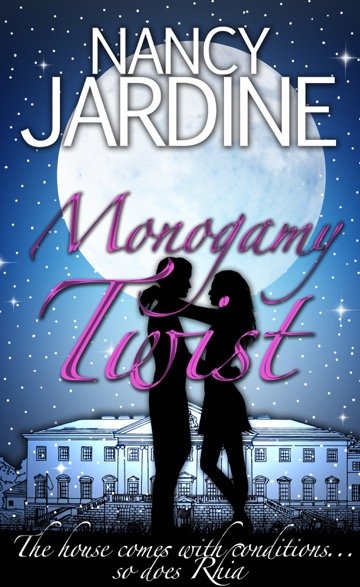
My Crooked Cat edition of Monogamy Twist, my contemporary romantic mystery, is launching on March 27th 2015 and I’m absolutely delighted with the quirky cover design for this, too – created by Laurence Patterson of Crooked Cat. Monogamy Twist is a mystery with historical aspects but very different from my Celtic Roman Britain historical novels. The plot for it is based on a recognisable Dickensian theme – that of the bequest of a decaying stately home. Luke Salieri finds himself the recipient of this strange inheritance – except the house can only be his if he fulfils certain weird and quirky conditions. To eventually become the owner Luke needs a woman to help him but not just anyone will do. Rhia Ashton seems perfect for the job since she’s a family history researcher but Luke finds she has a few conditions of her own before she’ll take him on and find out why Luke has been chosen by Amelia Greywood to receive the house. Compromise is the name of the game in Monogamy Twist. It’s a read that will appeal to those who like a bit of history with a few twists in their mystery, or those who like a good solid story in their romantic reading. I extend a warm welcome to the Facebook Launch Party on the 27th March. Goodies can be won and lots of information on my protagonists will be divulged.
Thank you for the update, Nancy. I was in awe of you before; I’m even more in awe of you now.
Nancy Jardine
Nancy Jardine lives in Aberdeenshire, Scotland. She currently shares a home with her husband, daughter, son-in-law, 3 year old granddaughter and 1 year old grandson. It’ll continue to be a busy household till late summer of 2015 when the new build home will be completed for the young ’uns on what was Nancy’s former back garden. The loss of that part of the garden won’t be missed since there should now be more writing time available this spring and summer! Childminding is intermittent over the day and any writing time is precious. (If interested in how a new house is built these days, follow my blog posts named ‘Gonna build a house’ )
All matters historical are a passion; Ancestry research a lovely time-suck. Nancy regularly blogs and loves to have guests visit her blog. Facebooking is a habit she’s trying to keep within reasonable bounds! Any time left in a day is for leisure reading and the occasional historical series on TV.
 You start with ideas. A period in history, a place, an event plants an idea in your mind. How do you make it lead to a novel?






 Miriam Drori, Author