Quaver felt peeved, as he always seemed to get the short end of the stick amongst his friends. Quite determined was he to rectify this situation when he went out to eat with Crotchet, Minim and Breve. Quaver, adhering to his plan for retribution, suggested the fast food place, and they all trooped in. Quickness wasn’t one of breve’s attributes, and this unfortunate fact caused him to lose his place in the queue. Queue-place-losing also applied to Minim and Crotchet, although their hesitation length was progressively shorter. Quaver, naturally, dallied for the shortest of time and was able to order.
Quivering, however, took place in Quaver’s shoes under the stern gaze of the other three, until he doled out his food in unequal proportions, giving the longest chips to Breve.
Quiet followed, during which Quaver made a secret vow to drop Crotchet, Minim and Breve and instead befriend Semi-quaver, Demi-semi-quaver and Hemi-demi-semi-quaver.
“Private, those are. Personal and private,” my master exclaimed.
“Pray, sir, what distresses you so?” I enquired.
“Papers in this cabinet are not to be disturbed, in accordance with my express wishes.”
“Precisely, sir. Papers in that cabinet have not been disturbed by me.”
Pursing his lips, but opening them slightly, he struggled to keep his voice from exploding. “Please, then, inform me of the whereabouts of my teddy bear.”
Placing my hands behind my back, I stood to attention. “Perhaps it has escaped your notice, sir, but a teddy bear is not a paper.”
“Possibly so,” said my master, still looking grim. “Perhaps, nevertheless, you could inform me of the location of my poor teddy.”
“Poor teddy,” I said, “is in the arms of my granddaughter. Possibly I could retrieve it, although a limb or two might be lacking.”
“Please bring my teddy in one piece, for otherwise I shall have to consider harsher measures.”
“Promise, do I, that your teddy bear will be returned to you in pristine condition.”
Pristine condition, I reflected, remembering the chaos rendered by the little girl, could only be achieved if I paid a sum of money for a new teddy bear. Procurement of such a sum could be achieved by channelling off a very small fraction of the treasure I discovered sewn inside the old teddy bear.
Miss Carson surveyed the class as she made her entrance. Most of the kids, she was pleased to notice, were standing to attention and joining in the chorus of, “Good morning, Miss Carson.” Mandy and Martin were the only ones seated. Miss Carson’s response was followed by a scraping of chairs as the kids sat down.
“Mandy, why didn’t you stand up like everyone else?”
“My attention was diverted at that moment, Miss, so I failed to notice when you entered,” said Mandy.
“Make sure you pay attention in future, Mandy,” said Miss Carson. “Martin, why didn’t you stand up?”
Martin looked down at his desk, his lips firmly closed, his red cheeks clearly showing complicity in something or other.
“Martin, you’d better stay for a detention after school.”
Martin contemplated the unfairness of school. Miss Carson couldn’t know what happened before she came in and Martin couldn’t tell her – not in front of the whole class. Mandy, with the help of a few others, had tied Martin to his chair so that he couldn’t stand up. Mandy hadn’t stood up as she’d hurriedly untied the string after Miss Carson entered. Martin hadn’t wanted to be branded a tell-tale on top of everything else. Mandy had been counting on that.
My visitor today is… well… I think I’ll leave it to Jennifer Young to introduce him.
Dear Reader
How strange it is to be writing a letter. We don’t do that any more.
We do all sorts of things instead. We use texts and we use Facebook messenger. If we’re feeling particularly in-your-face we might go public with our communications. (Twitter works particularly effectively in getting a prompt response from customer service, and even government, departments, or so I’ve learned.) But for all that buzz of digital information, digital communication and digital tracking, there’s still a place for letters.
You’ll be thinking love letters, or I imagine you will. And indeed, there’s little more moving than a thoughtfully-written note to cry out that it’s for your eyes only (perhaps with a few judicious crossings-out, with like changed to love). After all, nobody ties up their texts with ribbon and keeps them in a shoebox with a pressed flower for future generations to discover.
But there’s another type of communication that only really resonates by letter. My book, Looking For Charlotte, begins with one such — and ends with one, too. It’s the antithesis of a love letter. It’s a suicide note — and a confession.
Dear Suzanne
I’m sorry. I couldn’t help it. I know why I did it though – I did it because of all the things you did to me and the way you ruined my life. I did it because you never trusted me and you never tried to understand, because everything was black and I couldn’t see anything – light, hope, luck.
I don’t hate you now.
She didn’t suffer. She was asleep and she never knew. I took her out into the sunshine and I buried her where she can be in peace, with the birds and the moors and the wide wide sky. She’s at home in Scotland. And if she’s lonely she can see people, there are a couple of houses. There’s a big glass house and one with a rusty old car and there’s lots and lots of blue. She loved blue. You do too, don’t you?
I never realised that revenge makes you cold and dead inside.
Suzanne, I’m sorry. I know it’s too late now. Poor little Charlie. But I’m sorry. I’m sorry. I’m sorry.
Ally
Looking For Charlotte is a mystery-cum-romance based upon a true story. It combines love and loss and redemption as my heroine, Flora, sets out to find the body of little Charlotte Anderson so that Charlotte’s mother, Suzanne, can begin to pick up her life and start again. She has no connection with Charlotte or her family — she’s motivated by a desire to do good. And it begins with a letter.
It ends with a letter, too — a note from Suzanne to her late husband. Because there are some things that can only be communicated via pen and paper, even when we’re talking to the dead.
I love letters. Long may they drop through your letterbox
Jennifer
About Looking For Charlotte
Divorced and lonely, Flora Wilson is distraught when she hears news of the death of little Charlotte Anderson.
Charlotte’s father killed her and then himself, and although he left a letter with clues to the whereabouts of her grave, his two-year-old daughter still hasn’t been found.
Flora embarks on a quest to find Charlotte’s body to give the child’s mother closure, believing that by doing so she can somehow atone for her own failings as a mother.
As she hunts in winter through the remote moors of the Scottish Highlands, her obsession comes to threaten everything that’s important to her — her job, her friendship with her colleague Philip Metcalfe and her relationships with her three grown up children.
Jennifer Young is an Edinburgh-based writer and copywriter. She is interested in a wide range of subjects and writing media, perhaps reflecting the fact that she has both arts and science degrees. Jennifer has been writing fiction, including romantic fiction, for a number of years with several short stories already published. Looking For Charlotte, her third published novel, is inspired by a true story of loss and goodness, and is set in the beautiful but bleak Scottish highlands.
Love was all around the lake. Lovers’ Lake, they called it for miles around. Lazing on its banks on this warm, sunny afternoon were at least fifty couples, each oblivious to the others. Levelling their eyes, each at one person only, they revelled in this bliss, oblivious to the rest of the world.
Lots of people in the village didn’t have partners, so they stayed away from Lovers’ Lake and waited for the day they would finally find a lover and be able to visit Lovers’ Lake. Legends of its beauty fired their longing. Lucifer, however, refused to stay away. Lucifer was the village idiot.
Laughter rang out when Lucifer arrived to sit alone by the lake. “Lucifer, go home. Lover have you none. Leave us lovers alone.”
“Lucifer won’t go home,” said Lucifer. “Lucifer is in love.”
Laughter again.
“Life is what Lucifer is in love with. Life in the form of birds and trees and everything that’s alive.”
Lucifer took his place by the lake and gazed at life, his true love.
Level-headed village people stopped calling Lucifer an idiot.
Jay entered the room and stopped dead. “Jerry! What do you think you’re doing?”
“Just doing my homework, Mum.”
Jay surveyed the scene, while attempting to banish thoughts of extra work from her mind. Jam neatly spread all over a jumper laid out on the bedspread. Juice in a glass jug standing on the jam at a precarious angle. Jelly wobbling on top.
Jutting out from the mess was a sheet of paper. Jay picked it up and read the typed words. “Join disparate items together to make an abstract sculpture.”
Jay turned back to the mess. “Just one thing; they’re not disparate – they all begin with J.”
“Is it my job?” she asked, her voice hesitant and controlled, as if trying not to break into a whine. “Is it because of the crazy hours I have to work?”
“It isn’t that.” Isaac shook his head, wishing he could escape from this place, knowing he owed Irene this final meeting.
“Is it my untidiness? I could work on that.”
Isaac again shook his head. “It’s not that either – although untidiness is a trait that’s also not in your favour.”
“Is it the music I play? I can turn the sound down or listen on earphones.”
“It’s not the music.”
“I don’t know what else it could be. Is it not possible you could give me a hint?”
Isaac let out a painful sigh. “It’s your insistence that I begin every bloody sentence with an I. It started as a joke. It’s no longer a joke. It’s too much for me to bear. I can’t stand it any longer.” Isaac raised his voice, causing all the people in the restaurant to look in his direction. “I simply can’t stand it.” Isaac stood up.
“Isaac, I… I… I…”
Isaac turned and left the restaurant.
Inside still, and with nothing better to do, all the onlookers turned back to their companions. Interestingly, they all found themselves beginning every sentence with…
“Hello. How do you do?” He extended a hand towards me.
“Hello,” I said, backing away from the offending hand.
“Have no fear,” he said. “Habits, in our culture, include shaking hands when meeting.”
“Ha-ha.” However I tried not to show my nervousness just didn’t work. “How silly of me.” Having said that, I determined to show my courage. Hooking the wrist of the extended hand with both of mine, I gave a mighty shake.
“Hey, what are you doing?” He seemed surprised; I couldn’t think why. Had he not told me to shake his hand?
“Hand… shaking,” I blurted out.
He’d previously had the corners of his mouth turned upwards. Happy, I’d learnt that meant. Had he stopped being happy now? Had I made him sad?
Holding his shaken hand in the other, he said, “I’m afraid I don’t think you’ll be suitable for the position of spokesperson for the Prime Minister. Have you considered applying to be in slapstick comedy?”
Q: Hello, Miriam. I’m delighted you could join me today.
A: I’m delighted to be here. Thank you for inviting me, Miriam.
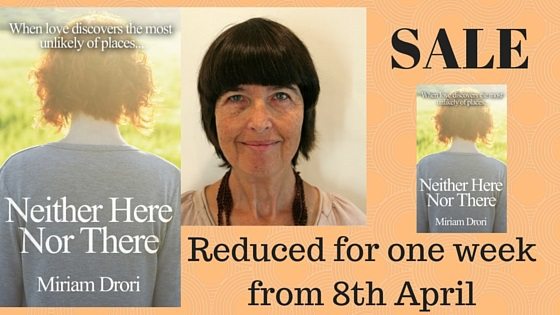
Q: Tell me about your novel, Neither Here Nor There.
A: It’s a light romance, set mostly in my home town of Jerusalem and partly in my former home town of London.
Q: Oh come on, it can’t be that light with such a background. It must involve terrorist attacks and killing and all those scary things that go on all over the Middle East.
A: No, there’s none of that in my novel.
Q: So it’s a utopian sort of novel – the way you’d like your country to be.
A: No, it depicts everyday life in present times, just as it is. The fact is, there’s so much more to life in Israel than those troubles you hear about on the news. We follow the news, of course, and we’re so very sad about the lives that are lost. But most people go about their lives without encountering any danger at all. And so the story of Esty and Mark and all the characters in my novel is perfectly realistic.
Q: So you’re saying this is just another romance.
A: No. While it can be read as a simple romance, it also brings up some complicated issues – issues most readers will recognise in some form or other.
Q: What sort of issues?
A: Arranged marriage, living in a closed community, escaping from a closed community, emigration, life-changing decisions.
Q: Yes, some serious issues there. Tell me about the closed community in your novel.
A: The haredi community. I call it that for simplicity, although within that group are several sects, some very much opposed to others. They live in various parts of the world. Many of your readers will have noticed their distinctive dress. The men wear black hats, black suits and white shirts, with tassels hanging over their trousers, and they have beards and sidelocks. There are some who wear stranger garb. The women always wear long sleeves and long skirts, and married women cover their hair with scarves or wigs. Some people even think that all Jews or all Israelis dress like that.
In Jerusalem, they used to live only in specific districts like Mea She’arim, but they’ve expanded to other areas due to lack of space. The men often don’t work, spending their time studying the holy books. That leaves the women to support their large families, as well as caring for children and doing the housework.
Q: The women must feel very bitter about that.
A: I don’t think so. Most of them believe that’s how they’re supposed to live and never question it. They’re proud to have husbands who are able to study for long hours.
Q: What about arranged marriage? How does that work?
A: I want to stress that their marriages are arranged and not forced. They’re allowed to choose their marriage partners, but their choice is limited. They’re expected to choose one out of the few they’re introduced to.
Q: Do you think that works?
A: It seems to work as much as our system of random meetings does. The divorce statistics show that. I think a couple can grow to love each other after marriage, although I don’t have first-hand experience of such a relationship.
Q: How do other Israelis regard the haredi community?
A: There’s a lot of resentment. They generally don’t have to serve in the army, and they get grants for studying, which many view as a complete waste of time. On the other hand, they do jobs that no one else wants to do. There are at least four major associations run by people from the haredi community and serving the population at large. There’s one that deals with everything surrounding burials. One that provides all sorts of medical equipment. One that provides food for hospital visitors. And one that picks up and identifies all body parts following an explosion.
I saw an accident once at a junction in Jerusalem. I looked down from the top of a hill and saw a man lying on the road, having been thrown off his motorcycle. Immediately, someone got out of a car and started redirecting the traffic. Someone probably phoned for an ambulance. Two minutes after the accident, a haredi man who happened to be passing stopped his car, took a first-aid kit out of the boot and rushed over to the victim.
Q: Well I think we’ll leave it there. Thank you for coming, Miriam.
Stop press: Neither Here Nor There is on sale for a few days on Amazon. In honour of that, several bloggers will be featuring the novel. I’ll update this post as those posts appear.








 Divorced and lonely, Flora Wilson is distraught when she hears news of the death of little Charlotte Anderson.
 Jennifer Young is an Edinburgh-based writer and copywriter. She is interested in a wide range of subjects and writing media, perhaps reflecting the fact that she has both arts and science degrees. Jennifer has been writing fiction, including romantic fiction, for a number of years with several short stories already published. Looking For Charlotte, her third published novel, is inspired by a true story of loss and goodness, and is set in the beautiful but bleak Scottish highlands.