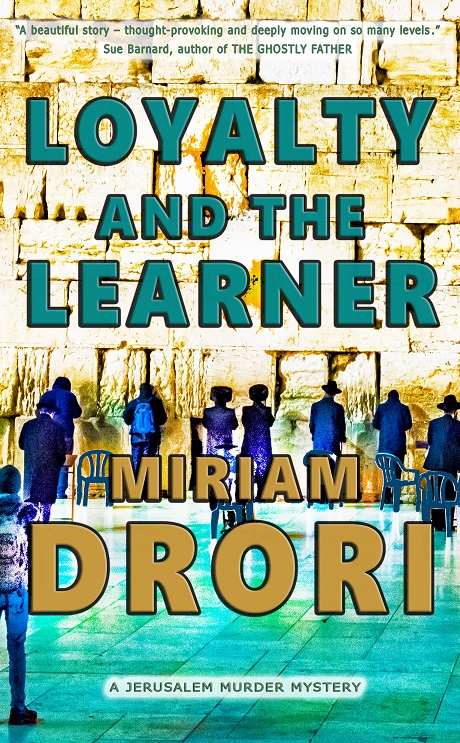
Before I begin this update, I must tell you that today is publication day for Loyalty and the Learner, my second Jerusalem Murder Mystery.
You can find the ebook on Amazon and the paperbook on Amazon and on several other online bookshops.
Back to the crow…
I’m ashamed to say that I’m still reading The Way the Crow Flies, which I blogged about on 21st July. My excuse is that it’s 720 pages long, I’ve been extraordinarily busy and I read slowly.
In the previous post, I was stopped by something I quoted from page 187. This time, I was stopped by this on page 632 (I have advanced):
Why do grown-ups insist on childhood “innocence”? It’s a static quality, but children are in flux, they grow, they change. The grown-ups want them to carry that precious thing they believe they too once had. And the children do carry it, because they are very strong. The problem is, they know. And they will do anything to protect the grown-ups from knowledge. The child knows that the grown-up values innocence, and the child assumes that this is because the grown-up is innocent and therefore must be protected from the truth. And if the ignorant grown-up is innocent, then the knowing child must be guilty.
Wow. Thank you for that, Ann-Marie MacDonald. It explains a lot.
I’m back at last and ready to fill in some of the spaces since my last post, six weeks ago, if not earlier.
The first event hasn’t happened yet, but it will happen in just five days. Loyalty and the Learner will be published on 9th September.
Hints on the contents of Loyalty and the Learner.
Loyalty and the Learner is the second in the series of Jerusalem murder mysteries. The first was Style and the Solitary.
In Style and the Solitary, the murder took place in an office. This time, it takes place in an apartment. Next time, … that’s a secret for now. Nathalie, Asaf and a few other characters are back, and there are several new ones, some friendly and others not so much.
You don’t have to have read Style and the Solitary to understand Loyalty and the Learner. Just click on the link for the ebook, which can be pre-ordered now. The paperback will be available from various online bookshops.
Here’s another project I’ve been involved in and haven’t had a chance to announce:
WE ARE THE BULLIES is a collection of stories written from the point of view of a bully. I have one story in it, called Owning Your Space, and I also edited the collection. For me, it was interesting to put myself in a position I’ve never been in.
The book is available from various sites. I suggest searching for ‘we are the bullies miriam drori’.
What I did on holiday
In the middle of July, I attended a fun-filled and exhausting five-day festival of Israeli folk dancing in the Czech Republic.
Then I spent three weeks in the UK, visiting friends and family and attending an action-filled writers’ summer school known as Swanwick.
We were once with the same publisher.
I recently joined a fascinating tour of the new National Library in Jerusalem, but I could never write a post about it as good as this one.
Monday marked a year since I lost my husband. This is what I wrote on Facebook:
“Today is the second of September, exactly a year since the sudden, although expected, death of my husband, David, after 45 wonderful years of marriage. I feel as if I had exactly five weeks to grieve before that event was superseded by one that changed the lives of everyone in Israel and has repercussions for the whole world. I’m coping with my loss, smiling at the memories, and am aware that people all around me are suffering much more.”
We’re planning to hold an exhibition of David’s art shortly.
The familiar characters are back in Hunter’s Rules, the sixth in the series of DI Hunter Wilson Crime Thrillers by Val Penny. I loved spending time with them again, albeit not a lot of time as I whipped through another page turner from this prolific author.
I also enjoyed meeting new characters, especially Eileen, who remains strong and positive, despite having suffered horrific injuries. Naturally, not all the characters are nice, and some turn out to be thoroughly bad. Will Hunter see to it that they get their just deserts?
Like all the other books in this series, the setting is Edinburgh, and I was happy to be introduced to new parts of this varied and colourful city.
Topics in the novel include drugs, blackmail, prison life, science, medicine and relationships. But a clue to the main theme is on the cover: “FOLLOW HUNTER’S RULES AND THE EYES HAVE IT…” I’ll say no more.
I received a free copy of this book for the Reading Between the Lines blog tour in return for an honest review.
Val Penny: BIO
Val Penny has an Llb degree from the University of Edinburgh and her MSc from Napier University. She has had many jobs including hairdresser, waitress, banker, azalea farmer and lecturer but has not yet achieved either of her childhood dreams of being a ballerina or owning a candy store.
Until those dreams come true, she has turned her hand to writing poetry, short stories, nonfiction books, and novels. Her novels are published by SpellBound Books Ltd.
Val is an American author living in SW Scotland. She has two adult daughters of whom she is justly proud and lives with her husband and their cat.
I’m reading a 720-page book by an author I didn’t know: Ann-Marie MacDonald. It’s one of the few books I saved from the large pile I gave away before moving, and I’m so glad I did. The book is called
The Way the Crow Flies
One of the things I love about this book is the way the author comes up with thoughts that make me think
Wow, I never thought of it that way before!
or
Wow, that’s so true!
So far, I’ve only read up to page 187 and this author has managed to do this to me several times. But this time, on page 187, I had to stop reading for some extra reflection.
It’s 1962 on an air force base in Canada, and Jack, one of the main characters has just realised that one of his neighbours, who comes from Germany, is Jewish. In fact, from his eight-year-old daughter, although he hasn’t revealed to her the meaning of the tattoo on his arm, he knows that the neighbour was in a concentration camp.
Jack finds himself replaying conversations with Henry Froelich. Einstein is a Jew. It had sounded anti-Semitic from Froelich’s lips last summer. Of course there is nothing wrong with the word “Jew” – especially if you are one – but there is something about the single syllable, it sounds less polite than “Jewish”. Perhaps the noun sounds anti-Semitic because Jack has rarely heard it pronounced by people other than anti-Semites.
It’s so true. It was true in 1962, and in 2003 when the book was first published, and it’s just as true now. But I’ve never thought about it before. It makes me think of Shakespeare’s The Merchant of Venice, but that was written a long time ago and many words have had their meanings changed since then:
I am a Jew. Hath not a Jew eyes? Hath not a Jew hands, organs, dimensions, senses, affections, passions; fed with the same food, hurt with the same weapons, subject to the same diseases, healed by the same means, warmed and cooled by the same winter and summer as a Christian is? If you prick us do we not bleed? If you tickle us do we not laugh? If you poison us do we not die? And if you wrong us shall we not revenge?
Coming back to Ann-Marie MacDonald, I think this is an important job of authors: to point out truths that readers have glossed over and not considered properly before. Of course, not all novels do this, nor do they have to, but I love it when they do.
It’s taken me a long time to reach page 187. I hope I can find more time for this book and the rest goes more quickly. It’s so well-written.
I do enjoy creating a max. 500-word story each month for the Furious Fiction competition from the Australian Writers’ Centre. I warm to the themes and criteria they choose, and look forward to spending what I can of the weekend (because that’s all they allow) being as imaginative as I can.
Here were the rules for this month:
Each story had to strongly feature a relationship between TWO characters.
Each story had to include someone whispering.
Each story had to include the words JAR, UNIFORM, NEEDLE and EDGE. (Certain variations were allowed)
I decided to take a dull story and polish it to a shine. I did that by adding something new to the ending and greatly exaggerating something in the middle, but otherwise only by the way I wrote it.
My story wasn’t featured, but the fact that it was longlisted is, I think, a testament to the fact that a lot of what makes a story stand out lies simply in the writing. I could probably have improved my story, and maybe it could have been featured.
Here it is:
A Bedtime If Story
If this were pure fantasy, you’d say the numbers were unrealistic. But it’s true; their relationship lasted for fifty years, from age twenty to age seventy.
If this were pure fantasy, you’d say it needs more conflict. But it’s true; there really wasn’t much, or at least nothing worth mentioning.
If this were pure fantasy, you’d say it needs detail. I can provide that. I can talk of raising children, of delightful trips to near and far places, of long walks in various natural and unnatural settings, of together visits to museums, castles, plays, musicals, concerts, weddings, friends. I can mention how he fixed things in the house while she sewed buttons on his uniform and other clothes. How, in later years, it became increasingly difficult to thread the needle, a fact she never mentioned. How they quickly learned to avoid friction by avoiding topics because staying together was much more important, and maybe that’s why no significant conflict appears in this story.
If this were pure fantasy, you’d say the relationship is still too smooth, even though cracks are starting to appear. You’d say it jars with anything you’ve ever heard. That if you’d been sitting on the edge of your seat, waiting for the climax, you’d have fallen off it by now as sleep conquered your senses.
If this were pure fantasy, you’d have given up on the story by now. You’d have expected the end to be an accident in which they died together holding hands. Or a long, drawn-out illness, one partner caring for the other with love and tenderness. In reality, long and drawn-out was expected. Both feared that outcome. He didn’t relish the prospect of becoming gradually incapacitated; she wondered about her caring abilities, in particular about whether she possessed any. Pure fantasy would have put those fears to the test. Reality followed a shorter and easier trajectory. He fell and hit his head. No one knew why he fell.
While you suppress another yawn, I’ll leave you with a fact to dwell on. If I let you into a secret and whispered their names, tossing and turning would be the outcome. In fact, even if I didn’t…
“A memoir-in-miniature” says the front cover, the words hovering over a cardboard box, its flaps raised, inviting me to unpack it. Written on the side of the box is the author’s name, leaving me in no doubt about the contents within.
But I’m wrong, not about the overall goal of this book but about the way it’s presented. The chapters are short, flash-fiction style, and all the words have been chosen with care and precision, clearly requiring several rewrites. And not only that. The formatting is also special. There are words crossed out, tables and diagrams, short lines, indented lines, framed lines, columns, blank spaces.
I have to admit that, as a person who struggles with visual clues, I don’t always understand the reasons for all these unusual formats. But I’m certain there are reasons as I read the book, and even more so at the end when I read the book-club-type questions. “What do you think is the difference between her [Jennifer’s] use of strikethroughs vs parentheses?” For me, the answer doesn’t matter; what’s important is that reasons exist, proving that everything in this book was carefully thought out.
And yet, none of this interfered with my enjoyment of the memoir, my wish to discover how the story would continue and end. I wasn’t disappointed.
Rereading my review of a few days ago, I notice I didn’t even mention the love story the memoir tells, the differences of opinion between the two players in the story, caused by their different backgrounds and attitudes towards religion. It made me keep thinking: surely this is the part when they agree to separate.
Although the love story formed the whole plot, it was the telling of it that made this book special.
Places We Left Behind
“For anyone who has ever loved deeply and been willing to take risks for the sake of love.” Rachel Barenbaum author of Atomic Anna
When American-born Jennifer falls in love with French-born Philippe during the First Intifada in Israel, she understands their relationship isn’t perfect.
Both 23, both Jewish, they lead very different lives: she’s a secular tourist, he’s an observant immigrant. Despite their opposing outlooks on two fundamental issues—country and religion—they are determined to make it work. For the next 20 years, they root and uproot their growing family, each longing for a singular place to call home.
In Places We Left Behind, Jennifer puts her marriage under a microscope, examining commitment and compromise, faith and family while moving between prose and poetry, playing with language and form, daring the reader to read between the lines.
Jennifer Lang
American-French-Israeli hybrid; obsessed with identity, language, home, belonging
1995-today: Stories in BabyCenter, Parenting, Parents, Natural Solutions, Woman’s Day, Real Simple, Baltimore Review, Under the Sun, Barren Magazine, Quarter After Eight, Citron Review and on NPR
MFA in Writing from Vermont College of Fine Arts; an Assistant Editor at Brevity Journal
Yogini, practicing since 1995, teaching since 2003
IG: jenlangwrites FB: jenlangwrites
AWARDS for Places We Left Behind: *Finalist in Multicultural Nonfiction in American Book Fest’s 20th Annual Best Book Awards *Finalist in Multicultural Nonfiction in the IAN Book of the Year Awards 2024 *Gold Book Award Winner of Literary Titan
Last week, on the 11th April, I attended a wonderful workshop facilitated by Judy Lev. At the beginning of the workshop, we had to write a first draft about anything we wanted. Then we learned how to work on our drafts. Then we tried to put the tips into practice. I ended up with this:
Today, I commemorate the eleventh of April, the day of my marriage to David nearly five decades ago. This is the first year I celebrate that date alone.
Yes, celebrate. Because no one can take away the memories of forty-five sunny years, and reflecting on them makes me happy. Now, I live in a new place, I see my family often, the sun still shines and I can be happy in other ways.
When I post memories with David on social media, people say, “I see it’s hard for you.” But I don’t feel that way; the memories make me smile. When I explain that, they shake their heads in disbelief. But it’s true, honestly.
No doubt, the piece could be improved further, but it’ll do for now.
Following on from my previous post, I have created a new Facebook account, which is only for friend friends. When I’ve created an author page, I’ll post the link here.
I can think of several options that I’d better not repeat here. But the event that brought about this post is that I was thrown off Facebook, with no reason given or any route to appeal the decision.
I have been on Facebook since 2009, if not earlier. (I have no way of knowing any more.) All my history, memories, friendships, groups, photos have vanished in one fell swoop. That’s a huge part of my life.
But, you know, it’s not the end of the world. I can think of many things that could have happened to me that are much worse than this. I could have:
suffered an accident and been rendered unable to walk or dance
suffered a robbery
suffered a loss* (That happened six months ago; I certainly wouldn’t want a repeat.)
suffered many other events I don’t want to dwell on
The worst thing I can think of at the moment is that I could have been kidnapped by terrorists and held for over five months (so far), suffering hunger, torture, rape and more.
One happier piece of news is that I’m moving from Jerusalem to Tel Aviv. I’ll have to change the tagline of this blog. I will post more about this after the move.
* On the subject of loss, I have an essay in this new anthology of poems, stories and essays:
The author Joan Livingston called my contibution a “Great piece of writing!”