Author, editor, attempter of this thing called life. Social anxiety warrior. Re-Connections, a collection of short stories, published with Ocelot Press, 15/10/2025.
Before I deal with the topic of this post, here’s a reminder of a competition to win a signed copy of Neither Here Nor There. More information on my Facebook page. You have a bit more than a day to enter the competition.
Edit: Actually it was 2 days. Now it’s one. Until midnight GMT on Thursday night.
***
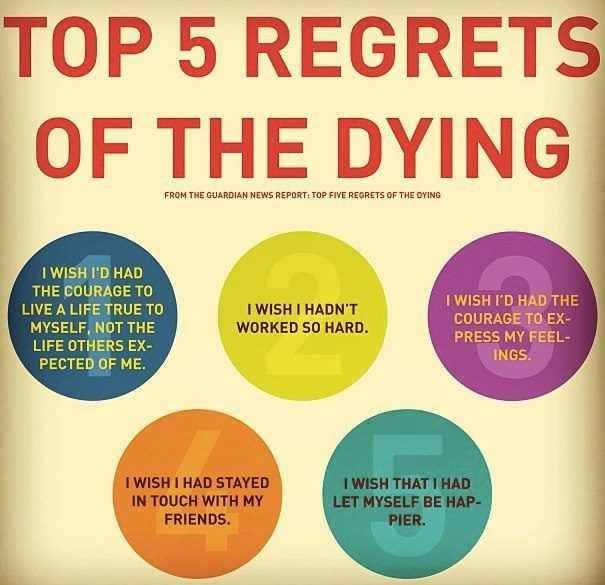
A friend shared this picture from Wake Up World the other day.
I’m not thinking of dying anytime soon and neither is my friend, but this got me thinking. I could say four of those about myself. And two of them would go deeper than that.
So I thought I’d explore each one in more detail, starting with:
And when I thought about this some more, I decided I do live a life true to myself – now and in the big things. In my childhood, there were many things I’d have liked to have done – things I didn’t even ask my parents about because I knew they wouldn’t agree.
But as an adult, I generally do the things I want – the big things, anyway. With the little things, I try to do what’s expected of me, even without knowing what that is. It’s all part of wanting to be normal, whatever that is.
There’s an easy answer to that: Stop doing what’s expected of you and do what you want.
Absolutely. Good advice. Except that I do it automatically. Without thinking. Because that’s how I’m programmed. And it’s not something that’s easy to change.
They stood, she and he, embracing in the centre of a perfect garden. Flowers all around. Pinks, reds, yellows, purples, whites. Water cascading down the rocks into the pool. Maturing plums and kumquats nested by sun-frolicked green leaves. Sweet, juicy fruit waiting to be gathered and consumed.
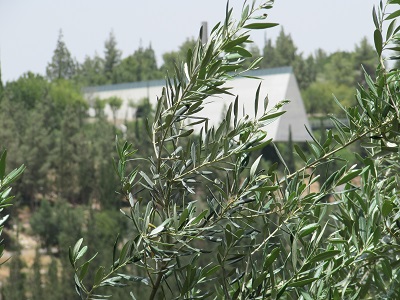
Over there, on the same level, stood a large bald prism. One triangular end thrust out through needle-sharp pine leaves. Acute angles pointed and menaced. Inside the prism, as clear as if its walls had been transparent and its position much closer, people wandered in a daze, struggling to grasp the horrifying enormity exhaled by tragic reminders.
“It looks quite near,” she said. “Could we walk there, down into the valley and up the other side?”
“Do you want to?” he replied in question.
“How long would it take?”
“Oh, about seventy years, going backwards.”
She glanced at him with a frowning half-smile. “We’d die before we got there.”
“Just as well,” he said, without smiling.
.
Explanation: The beautiful view from our beautiful garden includes the prism-shaped building that is part of Yad Vashem, Jerusalem’s Holocaust museum.
***
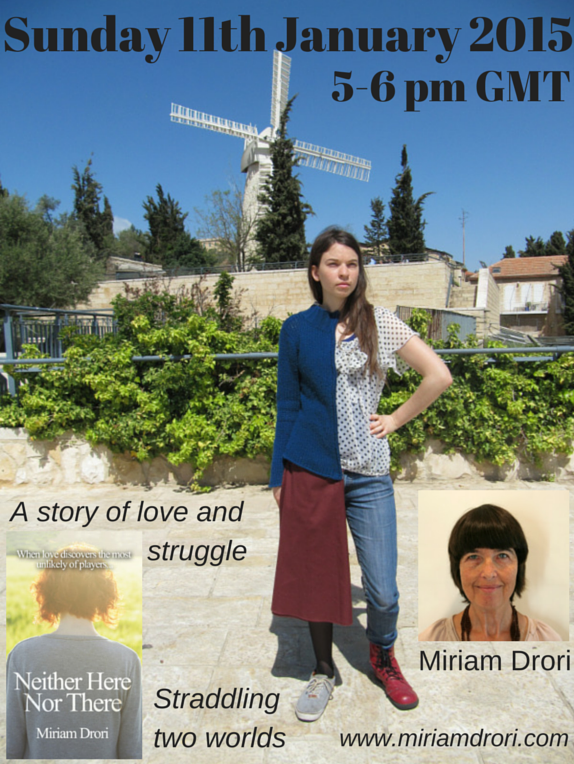
My spot in Indie Authors Appreciation Week is at 5pm GMT today (Sunday). Do join me there if you can.
I will also be running a competition, which you can find on the event page during my spot and also on my Facebook author page. The prize is a signed copy of Neither Here Nor There, which I will send anywhere in the world.
The wonderful Carmilla Voiez has done an amazing thing. She’s set up a whole week for you to get to know 60 authors and their books. Each author has an hour’s spot, during which they will tell you about themselves and their books, post excerpts, run competitions, answer questions and much more.
On top of that, Carmilla has arranged sponsors for the event, enabling her to offer bigger prizes.
I would never have been able to organise such an event, but I’m delighted to be able to take part. The event starts tomorrow (Friday). My spot is on Sunday at 5:00pm GMT and I’d love you to be there. You can sign up for the whole event at https://www.facebook.com/events/393175627502030/permalink/409764545843138/.
I want to tell you about a few of the people we met in India, starting with Sarat Acharya of Discover Tours, who made our stay in India so pleasant. He arranged our three-week tour of Orissa and Chhattisgahr perfectly. We travelled in comfortable cars with excellent drivers and stayed in some special places, including three palaces. Sarat accompanied us for the whole trip, sharing with us his extensive knowledge. He also brought along two other excellent guides for different parts of the trip.
On top of that, he knew how to handle the noisy members of the group. He did his best to accomodate all requests, but was able to stand up to those whose requests were impossible to meet.
Sarat told stories. No, he didn’t just tell the stories. He acted them out, using volunteers. The story for which I volunteered involved Sarat pulling my hair hard. It hurt! But I’ve got over it now. All in all, Sarat provided a wonderful tour and gave me a taste for more. (But I might not volunteer again so readily!)
In the many tribal villages we visited, we were introduced to the residents, who seemed content and happy.
Surprise! This isn’t about India. I forgot I’d promised to post this little rhyme I wrote for Crooked Cat’s Christmas extravaganza (see below).
Three Years a Year
I pity the people with only one year, Who end it all merry, never shedding a tear. They have to say so many things in one go, To one year goodbye, to another hello.
They try to reflect on the year that has passed, While also looking forward to the one that is fast Approaching… nearly… almost… it’s here! Resolutions transferred from yesteryear.
In Israel, you see, we celebrate three And each, in its character, is solitary. Different, special and unique, They make us happy, thankful and… meek?
Rosh Hashana is one of those. With all its rules, it keeps us on our toes, Requesting forgiveness for our sins. That’s “our” for humanity; not just kins.
Then we join with the world and celebrate, too, Although some disagree and think it’s taboo. Sylvester, it’s called, I used to know why. It matters not when I’m feeling high.
What, you may ask, is number three? It’s the one that marks the year of the tree. Goes under the name of Tu B’Shvat. We plant more trees, sing songs. That’s that?
Well no, we give presents of nuts and fruit, And we eat same with much relish to boot. So whatever New Year is appropriate for you, I hope it is happy and fulfilling, too!
To see all the other Crooked Cat stories, poems, giveaways and more during the six-week event, join our Facebook group.
I have a guest post on the lovely and unique blog of Seumas Gallacher. It may be humorous, but it also poses a serious question: do I need a brand? Any answers?
My next post will, I think, be about the good things of India. Because I prefer to remember them, and I also need to think about these for a forthcoming speech (see below). The less good things will appear in a later post.
That speech. Oh dear. When I agreed to do it, I expected to have more time to prepare. I expected to write it at least a week ahead, giving me plenty of time to practise it. It’s now Friday and it’s due to be given on Tuesday evening, and I haven’t started writing it. I’m getting worried. If I leave it any later, the only thing that can save me is if the snow forecast for Wednesday comes a bit earlier. Any chance of that, powers that be?
The WordPress.com stats helper monkeys prepared a 2014 annual report for this blog.
Here’s an excerpt:
A New York City subway train holds 1,200 people. This blog was viewed about 4,300 times in 2014. If it were a NYC subway train, it would take about 4 trips to carry that many people.
A big THANK YOU to everyone who commented in 2014, especially the winner: Angela Brown. I… don’t know what she’s won apart from my gratitude and hope that she and all the other commenters will continue to comment in 2015. Do let me know if there’s anything you want to read about on this blog. And most of all, have a great 2015!
I haven’t done this challenge for ages, due to a lack of time, but couldn’t resist this one: the good parts of 2014. Actually, on rereading the instructions, I see this wasn’t exactly what Julia meant. Sorry. I couldn’t leave anything out.
.
.
.
2014 in 100 Words
On 1st January, I had my hair cut short, hoping this would herald an even better year. It did. Three wonderful holidays, short stories published online and podcasted, two speeches accomplished at Toastmasters, lots of folk dancing, a successful book reading, finding myself in the safest part of the country when things went pear-shaped, the forest fire stopping just short of our house, lots of sunshine and much-needed rain, family healthy and doing well. But the best thing of all: my romance, Neither Here Nor There, published by Crooked Cat Publishing on 17th June. All in all, a fantastic year.
PS My book, like many other Crooked Cat books, is currently on sale on Amazon for a short time only. Here.
Welcome back to my blog, all you wonderful readers! I hope you’ve been having fun without me. I have been away on a very special trip – my third to India.
Our three-week trip was packed full of experiences and included no time for reflection. Now that I’m back – despite my time here being limited, too – I want to go over my notes and photos carefully, and try to make sense of all that I saw, heard, smelled, tasted and felt.
The one point I will mention now is about photos. As always, we visitors took photos. We photographed places and people (with their agreement). As before, children asked to have their photos taken, because they wanted to see their faces on our screens. That cheeky-looking boy in the middle requested several photos.
But this time there was a new phenomenon. People approached us to ask if they could take pictures of them together with us. More than ever, we became attractions. Probably we seemed more strange to them than they did to us.
This change came about, of course, because there are now so many mobile phones. In the old days, even those who had cameras wouldn’t have carried them around with them. Nowadays, anyone can whip out a mobile phone and snap away. Even in remote villages that have never had telephone lines, mobile phones are coming into use.
Dancing together.
The world is changing. Some of the changes are good.
It is said that all Jewish festivals can be described in the same way:
They tried to get rid of us.
We survived.
Let’s eat.
Chanuka is one of those. It’s not the most important festival, but it’s fairly well known because it comes at about the same time as Christmas.
I looked for a short explanation of Chanuka, and found one on Lisa’s beautiful blog(Blogger wouldn’t link to the post itself):
Chanukah commemorates two miracles which occurred on behalf of the people of Israel. The first miracle was the military victory of a handful of Jewish warriors against the mighty armed forces of the Syrian-Greek army. The second miracle was that while going through the ruins of the destroyed holy temple only sufficient oil to light the menorah for one day was found, yet the oil miraculously burned for eight continuous days. That is why Chanukah lasts eight nights.
There are three main traditions for Chanuka:
To light candles – one, two… up to eight on each night of the festival and sing Maoz Tzur.
To play with a sevivon/dreidel/spinning top.
To eat foodstuffs fried in oil.
The sevivon has four letters on it. One of the letters is different in Israel from sevivonim found in the rest of the world. There, the letters stand for (A) Great Miracle Happened There. Here, they stand for (A) Great Miracle Happened Here.
The candelabra (I see the correct word is: candelabrum) used to light the candles is called a chanukiya. In other countries it is often called a menorah. This is incorrect. The menorah has six branches and was used in the Temple. The chanukiya has eight branches (or nine). The extra one is for the shamash, the candle used to light all the others.
Food. We Ashkenazi Jews, who migrated via Europe, eat levivot (potato pancakes) and sufganiyot (doughnuts). Sephardi Jews, who migrated via Arab lands, and some via Spain and Portugal, eat other fried foods. Bimuelo, ma’akouda and mofleta are some of the names I found.
In London, where I grew up, I attended a Jewish primary school and a “secular” secondary school. In those days, secular secondary schools celebrated Christmas and it was impossible to opt out altogether.
I loved the tunes of the Christmas carols, but didn’t feel comfortable with all the words. When I had to sing one, solo, that fact caused me to sing it quietly, and the teacher probably thought I was nervous or didn’t have a good singing voice. I was never chosen to be in the choir.
In an art lesson in the first year, we were told to draw something for Christmas. There was an option for drawing Chanuka objects, but it wasn’t encouraged and I, of course, was always trying not to stand out. However, I had no idea what one drew for Christmas. So I looked over someone’s shoulder and tried to copy her work.
We gave each other presents and cards. That was all right, although I was always aware that it wasn’t really my festival.
My children don’t know about any of these feelings, and I’m glad of that. They missed out on the Christmas carols, but they got Chanuka songs instead.
Happy holidays!
To see all the other Crooked Cat stories, poems, giveaways and more during the six-week event, join our Facebook group.