Categories
Interviews

Taking a Camel to Rome

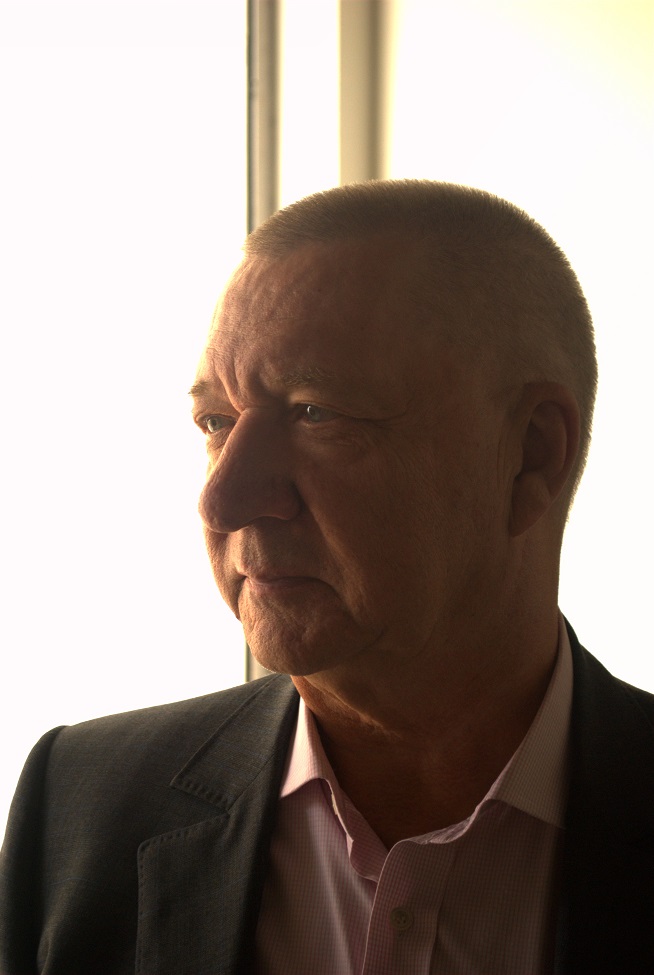
Seumas GallacherI’m delighted to be joined by Seumas Gallacher today. Seumas is a prolific writer of crime thrillers. He has had phenomenal success as a self-published author and has now partnered with Crooked Cat, who are republishing his novels, starting with Savage Payback. (If you want to know why he decided to do this, the answer is here in the post from 2nd February.) Seumas has also written a very helpful guide to self-publishing called Self-Publishing Steps To Successful Sales. Unsurprisingly, Seumas comes from Scotland. If you thought Ireland, as I did at first, look at the spellings again. And if you need any further proof, one look at his blog is all you need! A more surprising fact is that he lives in Abu Dhabi.

Hello Seumas and welcome to my blog. I thought about conducting the interview face to face. I looked up Google’s driving instructions from Jerusalem to Abu Dhabi and got the message: “Sorry, your search appears to be outside our current coverage area for transit.” Still from the map it looks to be quite a straight road. I’m just wondering whether to go that way, taking in the wildlife sanctuary and Riyadh on the way, or to travel to Eilat and take a leisurely cruise round the coast. In the meantime, I’ll make do with this long distance chat.

Hi, Miriam, pity, that. I could have got you some nice discounted camel passes from a guy I know… and anyway, I’m told that all roads lead to Rome, so p’raps we’ll end up in Italy ……

That’s an idea! I read that you went to Abu Dhabi for a short job and ended up staying. What drew you to that place?

My profession is that of (whisper it) a banker, but by vocation that has segued over the years into being a corporate troubleshooter… on one of those engagements I went to Abu Dhabi ten years ago, for one month… I’m still here …

I was offered terms to stay longer and did so because I like the pace of Abu Dhabi …it’s less frenetic than its partner down the road, Dubai, which is more of a marketing man’s dream… currently I shuttle between Abu Dhabi and Bahrain on business… I like the style of the locals whom I’ve been privileged to do business with…

Do you speak Arabic?

I took six months of Arabic lessons, but hardly made as much of an indent as I would like …it’s a very difficult language, as I’ve discovered there are very few algorithms to follow in terms of tenses and so on.

I empathise with you. I’ve never tried to learn Arabic. I got put off by the script, which looks hard to decipher, and the fact that the spoken and written languages are different. But can you manage there without Arabic? Do most people speak English?

Most people do speak English very well in the Middle East, but I’ve always tried to learn the lingua franca wherever I’ve been… it’s respected locally as an effort to ‘come across the bridge’… I speak varying proficiencies of English, Gaelic, French, Tagalog, Cantonese and Arabic… some may say I’m best at talking rubbish…

That sounds impressive! I had to look up Tagalog and it turns out 57 million people speak it.

Ah, sorry, Tagalog is the mainstream language of the Philippines, which actually has more than 75 various dialects.

Do you miss Scotland?

In all honesty, as regards Scotland, I’ve been away for more than 40 years, so I’ve become very much an ’international’ citizen… fond memories I have in spades, of course, but there’s very little attraction to return…

I’m not tempted to return to England, but I miss little things like wide open spaces, country pubs, salt ’n’ vinegar crisps and shortbread. Is there anything you dream of that’s in another country?

I dream very little of other countries’ attractions, having been blessed with travelling so much already in a life and career around the planet… however, there are places I certainly enjoyed being in: Vienna as a tourist, Hong Kong as a businessman, and San Francisco as a mixture of both.

Of those three, I’ve only been to Hong Kong so far, and enjoyed it immensely.

So where are your novels set?

International range..on purpose… based from their London offices, the proponents travel through the books to many parts of Europe, Hong Kong, Turkey, North Africa, the Balkans and South America.

What else do you want to tell us about them?
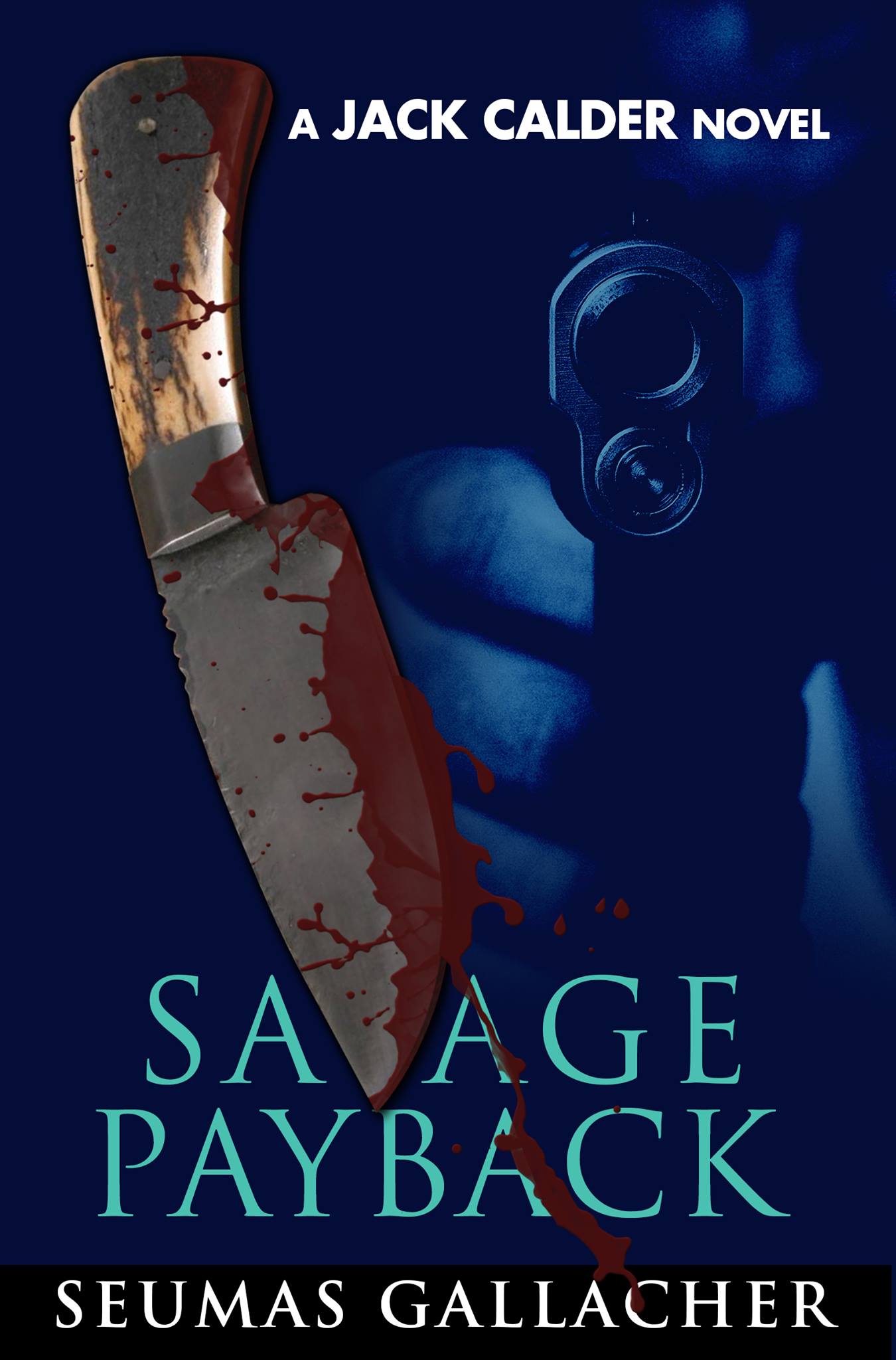
Savage Payback - Seumas GallacherBasic story line is of 3 former SAS commando officers who create their own specialist security firm protecting high value clients and their merchandise. They encounter several bad guys in the form of international crime lords, drug kingpins, people trafficked, money launderers. They use their black operations skills to bring justice where needed, away from the eyes of the normal law enforcement methods.

I read that you left home at the age of 15. How does a 15-year-old boy manage in the big wide world?

As the Beatles put it so well ‘I’ll get by with a little help from my friends’… I’ve had some terrific people come in and out of my life at pivotal moments …each a hero in their own way… also being able to use my own fists where necessary has been useful… I loathe bullies, and have always had a kinda reckless attitude toward not backing off from bullying when I meet it…got me into trouble some times, but trouble that I welcomed, strangely enough.

I wish I’d known how to do that! I suppose it all comes down to self-confidence, which is also what you assumed when you wrote, “I go along with the adage that if you believe you can achieve something, or if you believe you cannot achieve something, you’re probably right.”

What if someone doesn’t have the self-confidence to believe they can achieve something?

Tough one… revert to the saying if they don’t believe it, they’re probably right..sadly.. so many people never try , never step out of the comfort zone… it’s okay to be scared sometimes when you do things…

Hmm, I’ll think about that.

I loved this quote from the interview with you at Smorgasbord: “Thus began my growing tolerance for all people who once seemed on the surface to be different to me… we are all the same.” Would the world be a better place if everyone realised that?

For sure.

We’d better get the word out then!

Seumas, thank you so much for coming onto my blog. I don’t suppose you’ll be surprised to learn that I don’t get many visitors from your part of the world. I wish you even more success with your novels now that you’ve partnered with Crooked Cat.

***

SEUMAS GALLACHER escaped from the world of finance five years ago, after a career spanning three continents and five decades.

As the self-professed ‘oldest computer Jurassic on the planet’ his headlong immersion into the dizzy world of eBook publishing opened his eyes, mind, and pleasure to the joys of self-publishing. As a former businessman, he rapidly understood the concept of a writer’s need to ‘build the platform’, and from a standing start began to develop a social networking outreach, which now tops 18,000 direct contacts.

His ‘Jack Calder’ crime-thrillers series, THE VIOLIN MAN’S LEGACY, VENGEANCE WEARS BLACK and SAVAGE PAYBACK blew his mind with more than 80,000 e-link downloads to date.

He started a humorous, informative, self-publishers blog three years ago, never having heard of a ‘blog’ prior to that, was voted ‘Blogger of the Year 2013’ and now has a loyal blog following on his networks. He says the novels contain his ‘Author’s Voice’, while the blog carries his ‘Author’s Brand’. And he’s LUVVIN IT!

***

You can find Seumas on his blog as well as on Twitter, Facebook and email (seumasgallacher@yahoo.com).

Savage Payback is available on Amazon UK, Amazon US, Amazon Canada, Amazon Australia and Smashwords.

Categories
Books

Interactive Interview: Adam S. Leslie

Yes, I know I just said I was taking a break, but it’s not quite November yet and I have a special guest here today: Crooked Cat author, Adam S. Leslie.

AdamSLeslie

Hello Adam and welcome to my blog. Since joining the Crooked Cat clan, I have been introduced to several genres I hadn’t read before. Your novels sound like a genre of their own – a mixture of several others. After reading the descriptions, I’m teetering on the brink, wondering if I dare to delve into them, hoping this interview will help me decide.

Could you begin by telling us something about the books?

Hi Miriam, and thank you! That’s a good way of putting it – I’m a bit of a restless soul, and I do like to mix the genres up over the course of a full-length novel. I see genres as being like cocktail ingredients: individually, they’re all quite familiar, but if you combine them in just the right quantities, you get a new and unique flavour.

Kaleidoscope, on the surface, is a dystopian satire in the mould of 1984, Brave New World or THX-1138; but it also sometimes acts as a spoof of that genre, and it’s an adventure romp too, a surrealist nightmare and at times a pitch-black comedy. So it’s quite familiar on one hand, but takes the formula to brand new and hopefully unexpected places along the way.

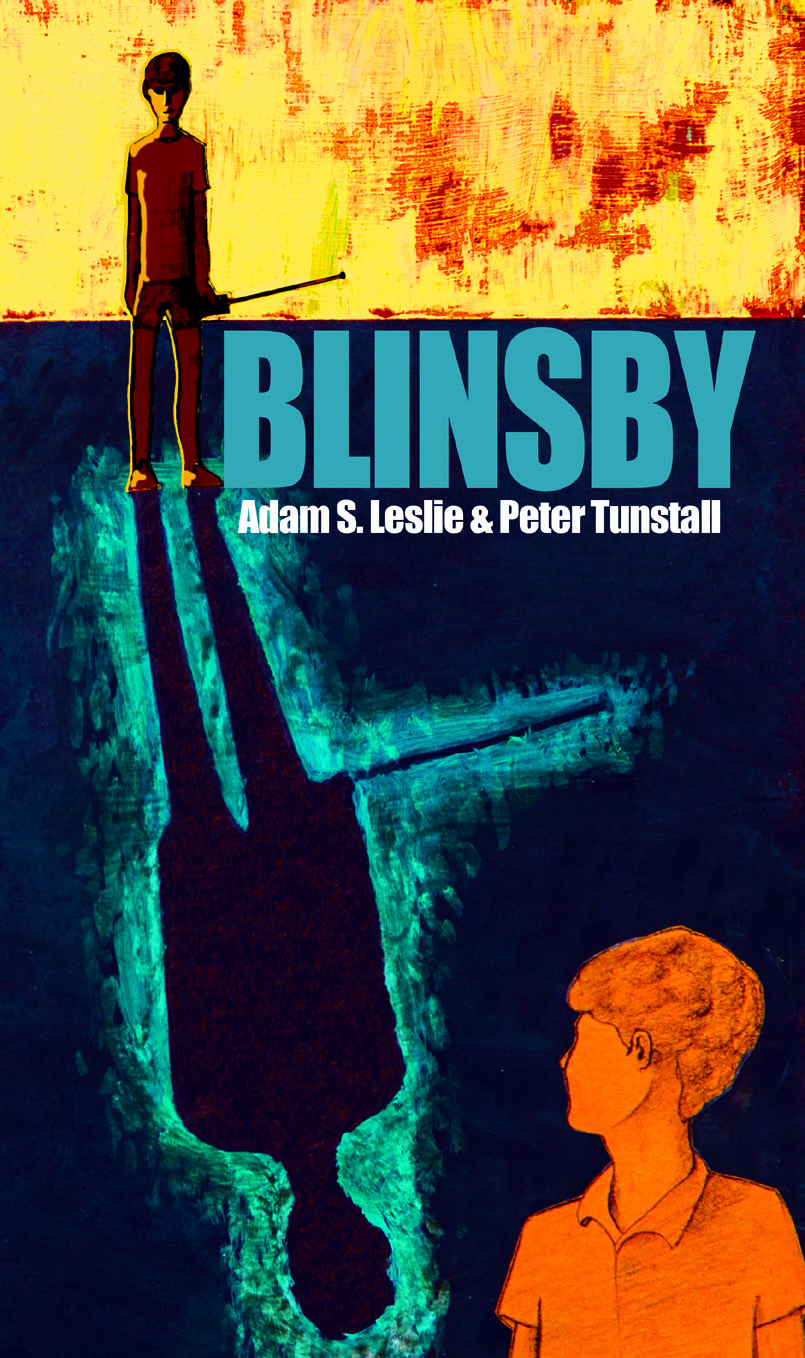
Blinsby, though, is a very personal book – quite different from Kaleidoscope, but I think is the more interesting of the two. I wrote Blinsby with a chap called Peter Tunstall, who I’ve known since we were about five years old. We grew up together in Lincolnshire, in one of the remotest parts of rural England. The book is a fictionalised account of our time at primary school as a pair of 10-year-olds during the mid-1980s, how it felt growing up at that time and how we saw the world.

But, of course, it’s not as straightforward as that. There’s also a conspiracy thriller plot about the disappearance of a new boy in class – who might be good or might be evil – and the way the school authorities are potentially implicated. The whole thing has a sort of hallucinatory feel, but it’s also an adventure yarn on top of that, and there are hopefully a lot of laughs along the way too.

That sounds like an unusual cocktail. Thriller, hallucinations, adventure and humour. I wonder how you combine all that. I suppose there’s only one way of finding out.

I’m interested in hearing how you and Peter worked together. How did you divide up the writing? Were there any arguments? Are you still friends? Would you do it again?

I think the fact that the story is told from a children’s eye view really helps bind the disparate elements together. That’s not to say that it’s all happening in their heads, or that what’s happening isn’t real; but we are very much in their world, and it’s as chaotic and colourful and undefined by adult rules as any 10-year-olds’.

I often pitch it as ‘Calvin & Hobbes meets Catch-22 meets Gormenghast’. Like Calvin (or Scottish comic strip icon Oor Wullie, one of my heroes growing up), our characters think like children but articulate like adults, which helps put the reader on their level and identify more with them, than if they spoke like authentic children. We as adults don’t feel that disconnect, which we might if we spent time with a real class of pre-teens.

Blinsby - AdamSLeslie

The book is structured like a school day. Apart from the opening chapter (which takes place during the summer holidays), it begins with morning assembly and runs through each of the lessons and playtimes – a chapter for each – until hometime. We really wanted to make the reader feel like they’d spent a day back at primary school.

So when Peter and I write together, we sort of treat each chapter as a short story in its own right. We spend hours and hours on the phone brainstorming the overall plot, and then go off and write whichever bit we feel like. And we do redraft each other’s material quite a lot too. Luckily, we have very a similar writing style, so it’s almost impossible to tell which bits are Peter’s, which bits are mine, and which bits we’ve both worked on!

Yes, I’m afraid there were lots of arguments. Rarely about the big stuff, it was almost always silly little details – a particular wording, or a particular way a character was acting. Peter has quite an experimental ethos, whereas I’m more rigorous about the rules we’ve established for the Blinsby universe. Luckily, we always found a way to make it work in the end.

We’d definitely do it again, and are planning to explore this world and these characters more in the future.

I suppose if you managed to agree in the end, that’s the main thing.

Do you still live in rural Lincolnshire? I ask with reference to writing about place. Some authors say they have to get away from a place in order to write about it. How do you feel about that?

I moved away during the late 1980s, not long after the book is set; Peter lived there during the writing of Blinsby, but has since married and now lives in the USA. Exotic stuff!

I can’t speak for Peter, but I certainly think having a certain nostalgia for the place helped me fictionalise it and turn it into something ‘other’, a sort of dream space where magic can happen. It’s tied to that period in my life; whereas for Peter, until very recently, it was a place he’s always lived.

It would be interesting to get Peter’s take on that as well, then.

I don’t think I’ve ever seen Peter interviewed, but I reckon it’d be a fascinating experience for all concerned.

Can you tell me anything about your next book?

I’m mainly concentrating on writing for film and television at the moment, but I would love to have the opportunity to explore the Blinsby characters and universe again sometime soon.

I just read your very interesting interview with Fiona Mcvie, and was surprised when I read your reply to the question about making changes to Blinsby if you could: “Only a couple of typos we’ve noticed since publication, but other than that we’re exceedingly happy with it, which is a bit sickening.” To me, being so satisfied with something you did sounds fantastic. Why do you feel you have to make a sort of apology for it?

Some of my awkward British modesty at play I think!

Yes, perhaps I notice it more, living away from Britain. Coming back to the setting, why did you make it fictional? What were the advantages of doing that? Were there any disadvantages?

It’s funny, we never really considered otherwise. We started writing the book 20 years ago, when we were around 19, and had previously written other adventure yarns based around ourselves and our environment. The sub-Tolkien stories we wrote as children, which I mention in Fiona’s interview, were a retelling of our own real-life adventures, but with added lopping off of orc heads and suchlike. And in those we renamed all the places and all the people. Peter was Vorogond and I was Culfindol, and our brothers were in there too. So we already had a bit of a history of our egomaniacal writing style!

But I think fictionalising the setting of Blinsby has really helped cut our imaginations loose from the geography and feel of Caythorpe – that’s the starting point, but Caythorpe is not really Blinsby. Blinsby is its own unique place. And so we could make Blinsby as surreal or as different as we liked.

Same with the characters. Writing for Erasmus and Frank, rather than Peter and Adam, gave us the freedom to diverge from ourselves wherever we needed to. They’re based on us, but they’re not really us. They both say and do some things which neither of us ever would, especially Erasmus I think. Erasmus goes on the biggest journey and has the biggest arc of any of the characters, by going through life-changing events Peter never had the chance to experience.

When it comes to the supporting characters, we also wanted to be quite sensitive about not saying “this character is based on this person”. So we played with archetypes a lot; and even when real people may have acted as a starting point for some of the characters, everyone is very heavily fictionalised by the time they reach the page. I think this is why readers have responded with such familiarity and positivity to the characters – no matter what your school environment, or where or when you went to school, everyone knew these people. Everyone remembers an Anastasia Krum or a Posy Flatfist or a Benedict Hornbeam or a Luke Carpenter.

Thank you so much for joining me on my blog, Adam, and for your thoughtful and comprehensive replies. I am now intrigued about Blinsby and looking forward to reading it.

Thank you for having me, it’s been fun!

~

Blinsby is available from Amazon, Crooked Cat Books and elsewhere.

Categories
Books Reviews

Me and Ancient History

What’s the point of school? Why are children sent to school? What do we hope they’ll get from it?

I think a good school should show children what’s available to learn and encourage them to discover as much as they can. It should make them excited about all the possibilities and hungry for knowledge.

My school did the opposite for me. Looking back now, I can recognise that some of the teaching was less than inspiring. But I think the main problem was that I was made to learn things I wasn’t ready for.

I received a mark of 29% for my first History exam. Although I worked at it and revised before the exam, that was all I managed, and later on I came to the conclusion that history before the 17th century  is just too boring to remember. But my poor grade was also the result of not being used to thinking and writing fast, because that’s what you have to do in a History exam.

And then, in English, we had to read a book called Eagle of the Ninth by Rosemary Sutcliff. This historical adventure novel is set in Roman Britain in the 2nd century and I hated it. Looking back, that could be because I didn’t understand it, because I wasn’t ready for it. Maybe if I read it now I’d enjoy it. All it told me then was that ancient history was boring. I was happy to be able to leave ancient history and move on to times that made more sense to me. Whether that was because those times were closer to modern times or because I’d matured in the meantime and was more able to follow, I don’t know, but I haven’t returned to ancient history since then.

The Beltane ChoiceUntil now. I won an ecopy of Nancy Jardine’s novel, The Beltane Choice, which is set in Celtic/Roman Britain in the year 71. I started reading it with some apprehension and I did find it a little slow at the beginning. But the writing was good enough for me to keep going and soon I became involved in the story of the two main characters, really hoping they would be able to overcome all the odds.

This is such a beautifully told story that even I could put my preconceived notions aside and immerse myself in the lives of the Celtic warriors. Even the sex scenes, as I mentioned in a previous post, are described with passion and sensitivity and just the right amount of detail.

Maybe, one day, I’ll have another go at art – another subject I hated at school. But I can’t see myself ever playing hockey again!

Categories
Books

Blog Hop, Stage 4

I’ve hopped again – so quickly I’m not even sure where I am, but I’m sure it’s somewhere in the UK.

Geff Gardiner is an author who is hard to categorise. Each of his novels is very different, and as his website says, his “short work and long fiction spans and explores genre boundaries.”

Many thanks to Jeff for letting me land on his blog and babble about life-changing decisions.

The schedule:

18 June Catriona King My Route to Publication
20 June Cathie Dunn The Background to my Novel
22 June Sarah Louise Smith Arranged Marriage
22 June Jeff Gardiner Life-Changing Decisions
Categories
Books

Blog Hop, Stage 2

I’ve jumped from Northern Ireland to Scotland. Today I’m visiting Cathie Dunn, author of historical fiction and romantic adventure.

You can find out more about the background to my novel here.

Here’s my schedule so far:

18 June Catriona King My Route to Publication
20 June Cathie Dunn The Background to my Novel
22 June Sarah Louise Smith Arranged Marriage

Watch this space for updates.

Categories
Books

Crooked Cats’ Tales

The people at Crooked Cat (who are going to publish my novel, NEITHER HERE NOR THERE, in 20 days’ time) have produced an anthology of 20 short stories written by 20 Crooked Cat authors.

The wonderful thing about anthologies is the way they are so varied. Each story is written by a different author in a different genre with a different theme and set in a different place. And all of these are interesting, well-crafted stories.

I came to a decision about short stories: they need to be read in one go. Fortunately this is not hard, because each story takes only a few minutes to read. But it’s no good starting a story last thing at night when sleep will probably take over before I’ve reached the end. When I pick it up again in the morning, or later, it’s hard to remember what went before. Short stories are great for bus or train rides, as long as you’re going further than one stop.

Anyway, this anthology is free from Crooked Cat Books and Smashwords, and definitely worth a download.