Categories
Books That's Not Me

That’s Not Me: Ritu Bhathal

Here’s an author who is new to me. What she has to say is fascinating. Also, the spark for her writing is something I can relate to.
That’s Not Me! examines how much of our fiction is autobiographical and why some authors try to insist there’s no link between their fictional characters and themselves. If you want to take part, have a look here and get in touch. You don’t have to be a writer. Readers also have views!


That’s Not Me!

When I started out writing short stories, the ones that garnered the most positive responses were ones that centred around my cultural heritage.

For clarity, I am a British-born Indian, Sikh to be precise, born to Kenyan-born Indian parents. Quite a colourful mish mash there to keep my inspiration wells filled with all sorts of ideas.

I have always been an avid reader, and one thing I found was that there was a gaping hole in the book world. Sure, there are plenty of lauded Indian writers, but there were very few books I could read where I related to the characters.

As a Brit, there were plenty of contemporary choices to relate to. As an Indian, I could find umpteen books set in the Motherland.

But there was a gap.

Very few characters looked like me. There were a handful of authors (if that) dealing with British Asians as the protagonists of their stories.

And so, I embarked upon a mission to write a story about someone who looked a little like me.

Not literally, of course.

I mean a book with a British Indian family at the heart, dealing with the crossover issues I lived with all my life; not being fully Western, and not all that Eastern, either.

It took a while to write. But I poured everything into that first book, Marriage Unarranged, and when I first announced I was self-publishing it, I was met with so much encouragement from my blogging community, the social media following I had gathered, and friends and
family close to me.

What I hadn’t expected was the volume of questions I got, from people I knew, as well as other readers, about whether this story was my story.

Well, yes, it is my story, in that I made it up and wrote it. But it isn’t my story if you know what I mean.

This was when it hit home that because there weren’t as many authors in my genre, from my background, it almost felt as if readers out there thought we only had our own stories to tell.

Sure, there were a lot of books out there that were partially autobiographical, sometimes with tragic backgrounds, but we, as POC writers, also have imaginations and people who looked like us could also have romances and first world problems, as they say, that could form the basis of stories.

My main character, Aashi was a young woman, of a similar age to me, born in Birmingham, where I grew up. Those were the similarities. And that’s where they ended.

Life is your biggest source of inspiration, or so I believe, and there may have been certain real-life interactions that ignited a spark of an idea for scenes in the story, or quite possibly the shadow of a person would be built upon to create a minor character, but the whys and the wherefores were all made up.

It was fiction, after all. The amount of time I had to field questions about whether this was based on my life was unreal.

My second book, Straight As A Jalebi, was a lot easier to defend, though I should never have had to, in the first place, as the main character, Sunny, is a gay guy. I am not male, and not gay!

But I have to say, the third book, In God’s Hands, which I am writing, might be tougher to explain away, since the main theme is infertility through the eyes of a British Asian couple, and I have been down that road.

Maybe that is why it is the hardest story I have had to write, as I recall my own experiences, but try to ensure they are not what I am basing my plot around. Because this isn’t my story, it’s Kiran’s. This is where I have dug deep to use my feelings and reached out to others in similar situations to do my research, to give a rounded, realistic account of her fertility journey that doesn’t mirror mine.

But, just to reiterate, characters and stories I write? That’s Not Me!

Author Bio

Ritu Bhathal was born in Birmingham in the mid-1970s to migrant parents, hailing from Kenya but with Indian origin. This colourful background has been a constant source of inspiration to her.

From childhood, Ritu always enjoyed reading. This love of books is credited to her mother. The joy of reading spurred her on to become creative in her writing, from fiction to poetry. Winning little writing competitions at school and locally encouraged her to continue writing.

As a wife, mother, daughter, sister, and teacher, she has drawn on inspiration from many avenues to create the poems and stories that she writes.

A qualified teacher, having studied at Kingston University, she now deals with classes of children and managing a team of staff as a side-line to her writing!

She also writes a blog, www.butismileanyway.com, a mixture of life and creativity, thoughts and opinions, which was awarded first place in the Best Overall Blog category at the 2017 Annual Bloggers Bash Awards, and Best Book Blog in 2019.

Ritu has two novels, Marriage Unarranged and Straight As A Jalebi, published by Spellbound Books, and a third in the series, In God’s Hands, coming out soon.

Ritu is happily married and living in Kent, with her Hubby Dearest, and two teenaged children, not forgetting the fur baby Sonu Singh.

Social Media Links

All Ritu’s links

Book Links

Categories
Books That's Not Me

That’s Not Me: Summary 1

There have been eleven fascinating and enlightening posts so far in the series That’s Not Me! What can they teach us?

That’s Not Me! examines how much of our fiction is autobiographical and why some authors try to insist there’s no link between their fictional characters and themselves. If you want to take part, have a look here and get in touch. You don’t have to be a writer. Readers also have views!


Joan Livingston says, “My motto in writing fiction is that I take what I know and have my way with it.” Nowhere is that more apparent than in her Isabel Long Mystery Series, which I know well through having edited it – so much so that I sometimes have a hard time remembering that Joan doesn’t actually investigate long-unsolved crimes!

Vanessa Couchman doesn’t deliberately put herself into her characters, but says, “it’s inevitable that I share certain traits with some of my protagonists.”

Jennifer C. Wilson says, “It would be pointless to pretend for even a second that there’s no hint of me in Kate, the leading character in The Last Plantagenet?

Val Penny hasn’t based a character on herself, but she did unconsciously create a main character who turned out to have a lot in common with one of her uncles.

Mary Grand often uses characteristics of herself as a starting point, but then develops the character so that she becomes her own person.

Angela Wren’s characters are completely made up. She uses her experience as an actor to create them. But she does occasionally use overheard or experienced parts of conversations in her fiction.

Nancy Jardine doesn’t use personal experiences for her historical fiction, but did embellish some remembered events for a contemporary novel.

Tim Taylor discusses the use of real life in poetry, including his own.

Sue Barnard has used her own experiences in her more contemporary novels, as well as letting a character express some of her own views.

Jennifer C. Wilson (yes, she and her delightful humour returned for another guest post) describes how another character unintentionally ended up being very similar to herself.

Miriam Drori (yes, that’s me) used several of her traits for a character, and admits that she not only used a story remembered from childhood, but even kept the real name of a teacher who behaved badly.


What can we learn from these posts?

Overwhelmingly, they say that authors use parts of themselves and their experiences when writing fiction, although they generally embellish or tweak the real stories to fit their fictional novels (or poems).

What do you think? You’re welcome to comment or, better still, to join in the discussion with a guest post, starting off here.

Categories
Books That's Not Me

That’s Not Me: Miriam Drori

Today’s guest in the series That’s Not Me! is not a guest at all. It’s me, Miriam Drori, author, editor, blogger and much more. What do I have to say on the topic?

That’s Not Me! examines how much of our fiction is autobiographical and why some authors try to insist there’s no link between their fictional characters and themselves. If you want to take part, have a look here and get in touch. You don’t have to be a writer. Readers also have views!


An Admission

Of all the characters I’ve written so far, the one who’s closest to me is Martin in Cultivating a Fuji. This is how I described the connection in About the Author on Amazon:

Miriam Drori was born and brought up in London at about the same time as Martin. Like Martin, she studied Maths and went on to work as a computer programmer. Like Martin, she was bullied at school and, as a result, social anxiety paid a visit and refused to leave.

There, the similarities end. Miriam also studied Music. She emigrated, married and had three children. Her career path veered onto technical writing and then took a sharp turn, landing in the field of creative writing. Now, she enjoys reading, hiking, dancing, touring and public speaking. And writing, of course.

Although most of the current and past events in the story are completely imagined, some are taken from my life. I am now going to admit, for the first time, that I did something out of spite, because, in a way, I’m still angry about the way I was treated all those years ago. What was the spiteful thing I did?

I used someone’s real name.

And while that person, if she’s still alive, will probably never know what I did, it was not very nice of me. Here’s the excerpt:

February 1962

Miss Spector surveyed the classroom. All the children were writing except for Martin. She walked over to him and in a loud voice said, “Martin, why aren’t you writing?”

Martin looked up at her. “Because I don’t know what I want to be when I grow up.”

“There must be something you’d like to be. A doctor? An astronaut? A teacher?”

Someone said, “Martin wants to be a dustman,” and everyone laughed, including Miss Spector. Everyone except for Martin.

Martin looked down at the empty page of his exercise book.

“Well, think about it, Martin, and write your composition at home. I want to see it tomorrow.”

The next day, Miss Spector made Martin read out his composition to the class. It went:

I want to be an engineer, because an engineer works with machines and not with people. With people, you never know what they’re going to do, but machines do exactly what you tell them to do. Every time you press a button, the machine always does the same thing.

“Martin,” said Miss Spector. “How do you know about engineers?”

“My daddy told me about engineers yesterday. We talked about lots of different jobs I could do, and I chose that one.”

Someone said, “Martin said that because he doesn’t like us.”

Someone else said, “Yeah, because he’s funny and we laugh at him.”

The children laughed. Miss Spector laughed. Only Martin didn’t laugh.

I tweaked that story to better fit Martin but the essence of it is the same and Miss Spector was the teacher’s name. She was only eighteen at the time, so can be forgiven for not knowing better, but I still blame her for taking the side of the popular kids against me, and for not understanding the effect such treatment could have on a vulnerable eight-year-old.


I don’t have to put a bio, blurb or links here, because you can find those by clicking on the headings up at the top ­.

Next week, I intend to post a summary of all the posts so far. Remember to let me know if you want to take part in this series.

Categories
Books That's Not Me

That’s Not Me: Jennifer C. Wilson

That’s right. Jennifer is back on That’s Not Me!, so that you can get more of her humour and words of wisdom.

This time she’s talking about another of her books.

That’s Not Me! examines how much of our fiction is autobiographical and why some authors try to insist there’s no link between their fictional characters and themselves. If you want to take part, have a look here and get in touch. You don’t have to be a writer. Readers also have views!

Over to you, Jen.


Well, if it was ridiculous to claim there was none of me in Kate, from The Last Plantagenet? (you can visit that blog here), it’ll be even more stupid to make such a statement about Lexie, in Twelve Dates ‘Till Christmas! Although apart from one scene, this time, it really wasn’t intentional.

Without giving the game away, Callum and Lexie are those friends who happily go along to each other’s formal events as a ‘plus one’ when required. And not just personal events, but the occasional corporate function too. It’s for one of these evenings where Callum springs it on Lexie that he’s entered them into a “Mr and Mrs” quiz. To say Lexie is unimpressed is an understatement…

Having never played the game myself, I took to the internet to find some good questions, and set about writing the scene. When it came to Lexie, I figured, why not add a sprinkling of ‘me’ in there? After all, ‘write what you know’ again, right? And although the questions give a good insight into Lexie, they aren’t anything too plot-essential; it’s about demonstrating how well Callum and Lexie know each other, after all, not necessarily about the answers themselves. So, when it came to Lexie having won a Young Environmentalist of the Year Award (and still treasuring the plaque she got for it), or wanting to meet Sir David Attenborough, well, that’s all me. Plain and simple. Even Callum’s responses have an element of me in them – I’d love to visit Australia, but the arachnophobe in me keeps me anxious…

Other than that bit of the story though, I didn’t think I’d taken that much of myself this time around. Perhaps a love of a fun social life, and hanging out with friends on a regular basis. Alright, maybe being taken on a date to the Natural History Museum’s ice-rink would be incredibly romantic (or at least it would be if I could skate, which I cannot). And fine, there’s certainly something in the comment that Lexie owns mostly lively prints rather than wearing the calm neutrals of her friend’s preference.

In my defence (if I need any), Twelve Dates was my first foray into completely contemporary fiction, having spent the majority of my writing life either in the 1400/1500s, or slightly cheating and writing about characters who were from that era, even if they were contemporary ghosts in my stories. Is it any real wonder then, that I reached out to what I know best, i.e. me? Lexie has a number of characteristics / lifestyle aspects that I don’t have (see above, re NHM), so there’s clearly an element of wishful thinking in the mix too. But is there any real harm in that?

When it comes to writing about real people, there’s always a risk. If somebody who considers you a good friend sees themselves in your antagonist, there’s potential to damage the friendship there. Even if they recognise some of their traits in your leading lady, or romantic hero, who’s to say they’ll be happy with the situation? Well, the one person whose reaction you know with 100% certainty is your own, isn’t it? (Or at least, you’d hope so – if not, you’ve really only got yourself to blame…). It makes some sense then, to look to your own traits, experiences and motivations, where they’re applicable. For me, that might not sit so well when writing about women packed off to arranged marriages in the 1400s, but for a twenties/thirties (alright, late-thirties!) professional woman, navigating modern personal and professional dramas? I have pretty good first-hand knowledge of how that works. And I might as well use it.

I might think twice if I ever write a toxic, manipulative witch though – can’t go being too obvious with giving my personality away!

Blurb

Callum and Lexie are perfect for each other – at least, that’s what everyone tells them. But they’re just good friends, aren’t they? And neither wants to ruin the solid friendship that’s treated them so well since university.

But when an old school friend of Callum’s asks Lexie for a date, and passions overflow on a work night out, could it be the trigger to show each of them what they have been missing out on all this time?

With twelve weeks until Christmas, that’s a lot of opportunity for romance – and for misunderstandings…

Buy link

Twelve Dates ‘Till Christmas

About Jennifer C. Wilson

Jennifer has been stalking dead monarchs since she was a child. It started with Mary, Queen of Scots, and now also includes Richard III. At least now it results in a story!

She won North Tyneside Libraries’ Story Tyne short story competition in 2014 (no dead monarchs, but still not a cheerful read), and has been filling notebooks and hard-drives ever since. Her Kindred Spirits series, following the ‘lives’ of some very interesting ghostly communities, is published by Darkstroke, and her historical / contemporary romances by Ocelot Press.

Social media links

Categories
Books

That’s Not Me: Tim Taylor

It’s time for a change. This week’s episode of That’s Not Me! comes from friend, author and poet, Tim Taylor.

That’s Not Me! examines how much of our fiction is autobiographical and why some authors try to insist there’s no link between their fictional characters and themselves.

Having said that, Tim is going to focus not on his fictional stories but on his poetry. Poetry can be purely fictional, but that’s quite rare. Right, Tim?


Thank you very much for inviting me to participate in this very interesting blog series, Miriam. Though I do write fiction, today I’m going to talk primarily about poetry.

I think it’s true of most poets that they make full use of their own experience in their work. I certainly do this myself – when life presents you with something worthy of a poem, why would you not make the most of it? It is perhaps easier for poets, as opposed to fiction writers, to put themselves into their work, because a poem can be openly autobiographical in a way fiction cannot.

I know some poets whose work is almost exclusively inspired by their own experience – either by what happens to them personally, or by their reactions to things they encounter.  However – while it’s had its moments – I must admit that I’ve never felt that my life is sufficiently intereresting to be the sole source of inspiration for my poetic output.

I think it helps here to be a fiction writer as well. Except for that minority whose novels are thinly-disguised autobiographies, fiction writers must rely heavily on imagination to create characters and situations. I often do this in poetry too.  I’ve written many poems about purely imaginary people and situations, and  I would say that my best poems include some of these, as well as ones written from life. Even here, though, poetry (and fiction) still draw upon personal experience in a more indirect way: imagination moulds new things out of the mixing bowl of memories we acquire throughout our lives.

A good thing about poetry is that it doesn’t have to be either one thing or the other. We can write poems directly inspired by our own lives, but improve them by omitting, adding or altering details – ‘never let the truth get in the way of a good poem’ is a maxim I often use! Conversely, we can use real experiences and real things to add colour to an otherwise invented poem.

I’ll end with an example. The scene described in the following poem is entirely fictional. Yet the poem does, of course, articulate thoughts of mine about the power of objects as reservoirs of memory. And the cowrie shell is real – I did indeed acquire it on a childhood holiday in the late 60s.

So is this me?  You decide.  

The Cowrie Shell

“Just chuck ’em in the skip,” she said
as if each object in that box
were not once part of me:
attached by long sinews of stories,
fed by flimsy arteries
through which a child’s heart
once pumped them full of meaning.

The box took them when life moved on.
Now lifeless, so I thought
but peeling back the cardboard
I could sense the gasps for air.
Each object in its turn cried out;
the child in me woke up
and would not let them go.

Among the marbles and the model cars
I found a cowrie shell: smooth, mottled,
exuding still the faintest smell of salt.
“You remember me,” it said
– that holiday in 1969”. I felt
a flickering of what seemed like recall.
I dug deep for that memory,
found it rotted by the years.
I steeled myself, obeyed
the pitiless reminder:
“you cannot keep them all.”

Not quite big enough to be an ornament,
if fitted better in a smaller hand.
I put it down: out fell a single grain of sand.

From LifeTimes (Maytree Press 2022). Signed copies are also available from the author: tim.e.taylor@talk21.com.

Tim Taylor has published two poetry collections, Sea Without a Shore, and LifeTimes, both with Maytree Press, and two novels. His poems have won, or been shortlisted in, a number of competitions and appeared in magazines such as Acumen, Orbis and Pennine Platform and various anthologies. Tim lives in Yorkshire, UK, and teaches Ethics part-time at Leeds University. He enjoys playing the guitar and walking up hills (not usually at the same time).

Categories
Books That's Not Me

That’s Not Me: Nancy Jardine

Next up on That’s Not Me! is…

…Nancy Jardine, multi-published author of novels set throughout the centuries, from Roman times to the present day, and fellow Ocelot Press member.

That’s Not Me! examines how much of our fiction is autobiographical and why some authors try to insist there’s no link between their fictional characters and themselves.


That’s Not Me!

Well actually, this one was…

I wrote a short story, some years ago, that was definitely about me as a child of around five years old. The incident might have been embellished just a tad since my memory of that time is disgustingly poor, though the gist of the story is definitely authentic. During the 1950s, in my birth city of Glasgow, Scotland, collections of foil milk bottle tops were made which raised funds for a charity for the blind. The story was about how my grampa, by then approaching 85, collected those foil tops for me to take to school. Similarly, on my own blog, there are a couple of short stories which are fictionalised tales about me in my primary classroom. Again, these are heavily embroidered to liven the events. Strangely enough, some of my best friends from that late 1950s era don’t remember the situations at all, or not quite as I remember them. Fickle memory makes for enhanced tales!

This definitely isn’t…

My Celtic Fervour Historical Series is set in a very distant culture of almost two thousand years ago during the Roman Iron Age in Britannia, so you will definitely not find me in any of those characters, or a reflection of any personal experiences I’ve lived through.

However, perhaps this novel does qualify? Just a little bit…

Topaz Eyes, my contemporary mystery/ thriller, is set mainly in fabulous European cities, with a few stops in the United States of America. Although there is nothing of me in any of the characters, there are definitely links to experiences I’ve lived through.

The plot of Topaz Eyes is essentially a treasure-hunt mystery, where third-generation cousins are brought together under mysterious circumstances to solve the disappearance of a collection of valuable emerald jewellery. The emeralds were once Mughal-Emperor owned but were scattered amongst family members around 1910. These ‘cousins’ have never met each other prior to the outset of the story. Some of them prove to be nice to each other though others are decidedly not, and there are those who have deadly intent. Strangely, there’s a cuckoo in the nest because Keira Drummond from Edinburgh is asked to join the hunt even though she’s not a family member.

Is this something that happened in my own family? Absolutely not. This part of the plot is wholly fiction but when I decided to widen the mystery globally, I used my own life experiences when I chose all but one of the locations used in the novel.

Spoiler Alert!!!

I lived in Holland from 1979 to 1981 and during that time I gave birth to two daughters. My children acquired a Dutch Oma and Opa (grandma and grampa) who were no relation to me at all but who became great friends of the family, and who visited us regularly when my husband and I returned to Scotland.

My elder daughter was a languages student who spent her final year of studies at the University of Heidelberg, a fantastic city which I re-visited while she was there. This is where I chose to begin Topaz Eyes.

And…apart from using those life experiences, Topaz Eyes is completely fictional!

p.s. During the writing of the novel, I thoroughly researched emerald jewellery – which I, regretfully, still do not own. Though, when I think about it, I once-upon-a-time owned a beautiful gold ring set with a stunning semi-precious stone. And…I extended my knowledge of a certain branch of art, but to give a spoiler on that research here would be way out of order!

Bio

An ex-primary teacher who published local history non-fiction projects, Nancy Jardine spends her retirement writing historical and contemporary fiction. All historical time periods appeal immensely but so far Roman Britain has been the focus of her published historical fiction. Victorian Scotland is the setting of her current writing-in-progress, an era which allows her to over-indulge in research, which she adores.

Links

Topaz Eyes Blurb

A frantic search for priceless jewels. Greed beyond reason. Shadowy characters, hired gunmen and treacherous villains abound.

A weird invitation to Germany involves Keira Drummond in an international hunt for a collection of extraordinary jewellery, originally owned by a Mughal Emperor. The last known owner was a Dutch family in 1910, but who can Keira rely on, since distrust is rampant among the living relatives that she meets?

Teun Zeger hasn’t met any of his third-cousins before his equally cryptic invitation to Heidelberg, and isn’t sure he’ll ever like them. Keira, is an altogether different matter, and she’s not his relative!

Who is the deadliest cousin, determined enough to hire thugs to tail Keira and Teun when they pair up to unearth the jewellery? And who has the ultimate mystery item that’s even more precious than the Mughal jewels?

Greed, suspicion and murder are balanced by growing family loyalty, trust and love.

Categories
Books That's Not Me

That’s Not Me: Val Penny

Next up (on my special birthday, as it happens) in the series That’s Not Me! is Val Penny, author of crime fiction set in Scotland.

That’s Not Me! examines how much of our fiction is autobiographical and why some authors try to insist there’s no link between their fictional characters and themselves. Over to you, Val.


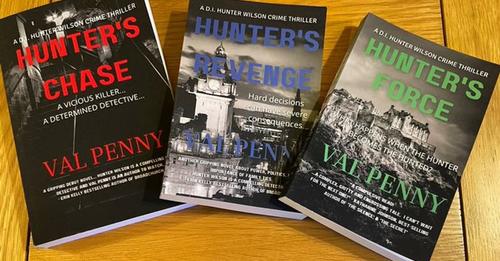
Thank you for inviting me to your blog today. Let me tell your readers about my novels and my main character, DI Hunter Wilson.

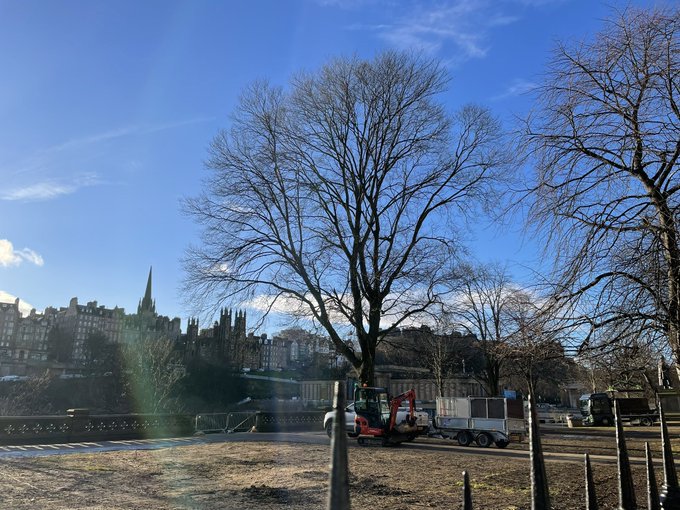
I write crime fiction set in Edinburgh, the capital city of Scotland. In every one of my books somebody is murdered. Now many tutors of writing advise their students to ‘write what you know’. I have only followed this advice to a certain extent. I have certainly never committed a murder, nor been involved in investigating such a crime. However, I do know Edinburgh well.

I decided to write crime fiction because that is the genre I most enjoy reading. I was also a lawyer for many years, a lifetime ago and met many of the types of people I write about.

When I was choosing where to set my books, I considered creating an imaginary Scottish town, much like Peter Robinson who created the fictional English town of Eastvale in the Yorkshire Dales. However, when I thought about it, Edinburgh is a small city (about 600,000 people) and it is a place many people know about through travel documentaries or have visited on vacation. It has a wide variety of types of housing, universities, a prison a beach and hills so why not base my stories here.

To tell my stories I needed a character that I and my readers could depend upon. Enter, DI Hunter Wilson.

I wanted a name that reflected the policeman’s job, fighting crime. One day when my husband and I were going to my mother’s house in Edinburgh, we passed a lawyer’s office. The name on the facia was Wilson Hunter. Perfect! However, my husband thought that I better not use that name, in case the lawyer objected, and so Hunter Wilson was born.

Although not consciously based on anybody in particular, when I drew up the biography for Hunter Wilson, I realised that his character reflected one of my uncles. He is an intelligent, hardworking man who is respected by his colleagues and has a wide circle of friends with whom he shares hobbies and interests and has deep love for his family.

Hunter, like my uncle, is loyal and determined. He is not pushy but does not shy away from difficult decisions, but perseveres with his work until he reaches a successful conclusion. Like my uncle, Hunter was denied promotion by a boss with whom he clashed. However, unlike my uncle, who has been married for over fifty years, Hunter is divorced. He also drinks strong coffee, my uncle is definitely a tea-jenny!

Hunter and his team are faced with many unpleasant characters and difficult situations in my novels. I am often asked if these are based on real events. The answer is a resounding, sometimes.

Authors are terrible thieves and grab ideas or characters from all sorts of places; a couple overheard in a coffee shop, a man talking in the phone in a train, or an event reported in a newspaper or on television. I have notebooks everywhere to jot down ideas or phrases as they come to me. Indeed, as I live in the very wet West of Scotland, one of the best presents I ever got was a waterproof notebook! You will often see me using this at bus-stops or in train stations during a sudden downpour.

Although my stories and characters are not autobiographical, there is definitely a lot of me and my life-experience in my novels and I hope that readers enjoy that and their visits with me to Edinburgh too.

Thank you again for inviting me to your blog today and allowing me to share some secrets about DI Hunter Wilson with your readers.

BIO

Val Penny has an Llb degree from the University of Edinburgh and her MSc from Napier University. She has had many jobs including hairdresser, waitress, banker, azalea farmer and lecturer but has not yet achieved either of her childhood dreams of being a ballerina or owning a candy store.

Until those dreams come true, she has turned her hand to writing poetry, short stories, nonfiction books, and novels. Her novels are published by SpellBound Books Ltd. Val is an American author living in SW Scotland. She has two adult daughters of whom she is justly proud and lives with her husband and their cat.

Contact Details

Val’s Books


To take part in this series, see the page That’s Not Me.

You don’t have to be an author to write a guest post. You might be a reader with views on the topic…

Categories
Books That's Not Me

That’s Not Me: Vanessa Couchman

It’s Friday, which means it’s time for the next post in the series That’s Not Me!, which examines how much of our fiction is autobiographical and why some authors try to insist there’s no link between their fictional characters and themselves.

Today’s post comes from Vanessa Couchman, writer of historical fiction and a fellow member of Ocelot Press. She brings up issues I hadn’t even thought of…


Now You See Me, Now You Don’t!

Thank you, Miriam, for inviting me to write about this thought-provoking topic.

I write historical fiction, in which the protagonist is usually a woman with barriers to overcome. The characters are often loosely based on real people who lived at the time. Since I don’t write contemporary fiction, people are less likely to see themselves or me in my novels. However, there are still some pitfalls to avoid.

Vanessa Couchman

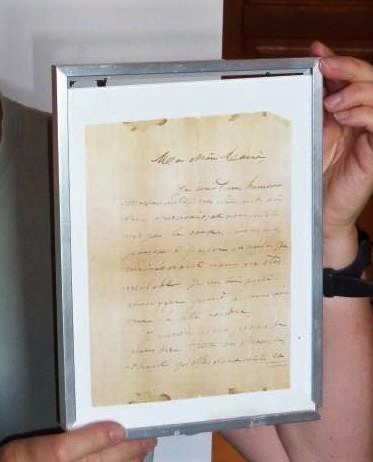
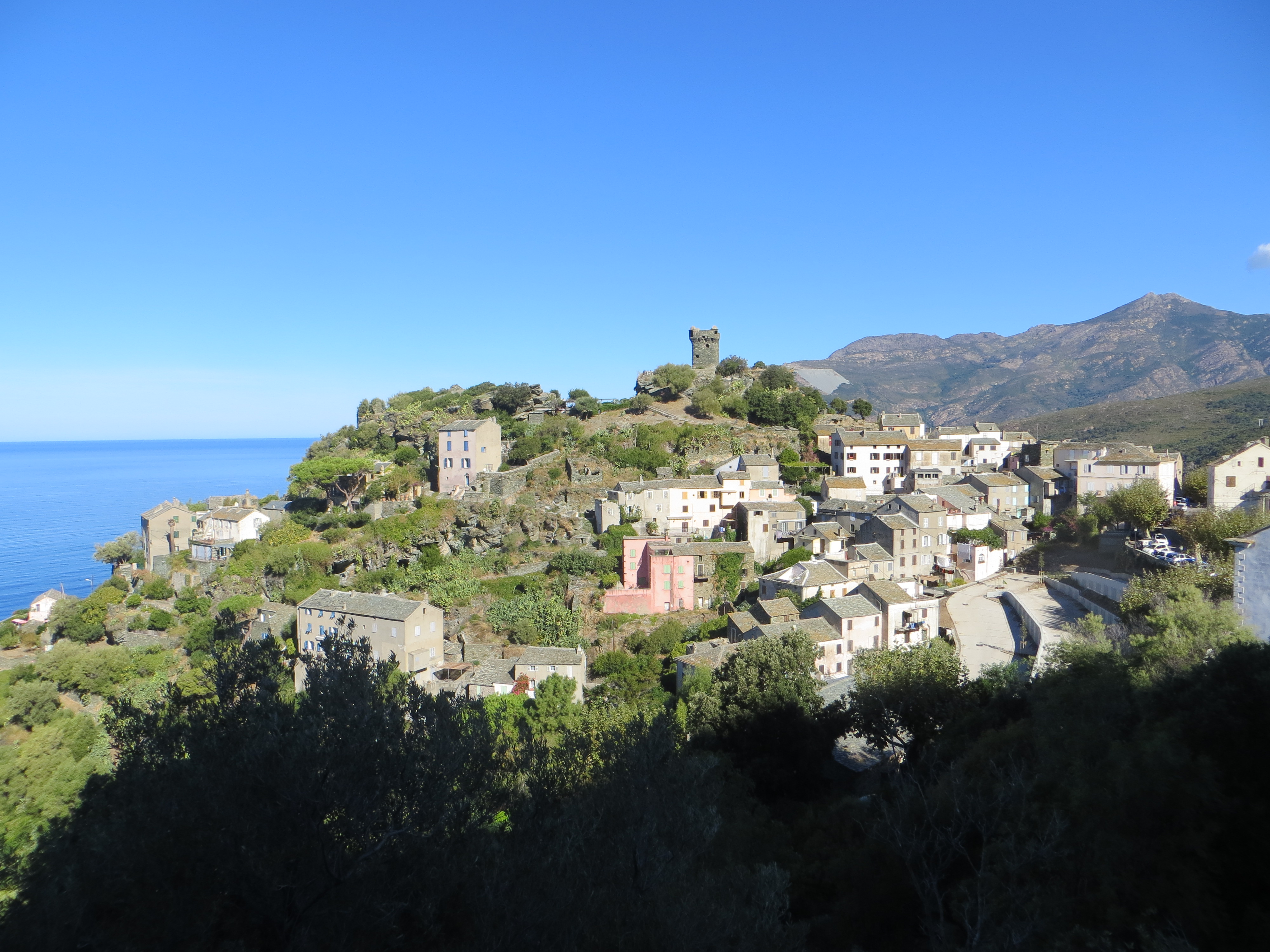
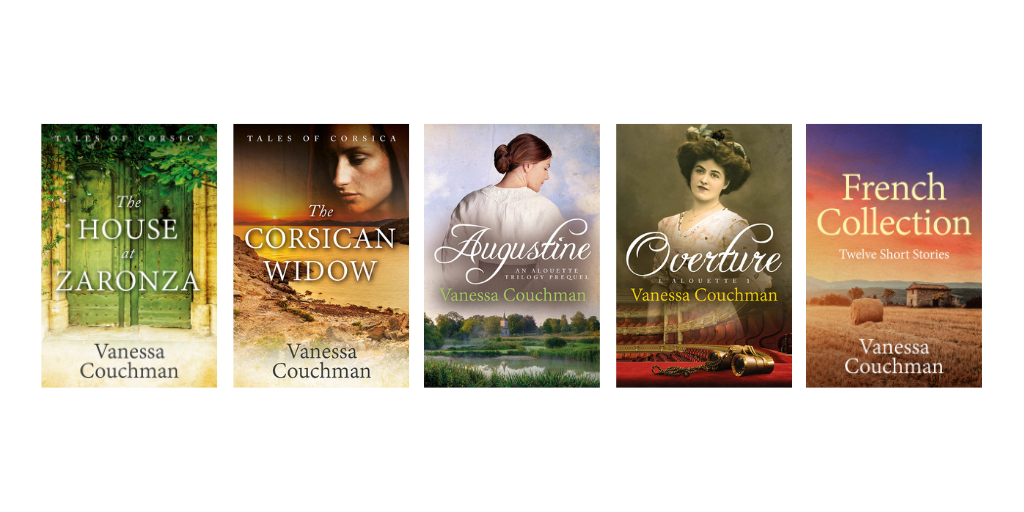
For example, I never use well-known historical figures as protagonists, although they might get a walk-on part. Why? First, I discovered the existence of the main characters in my Corsica novels, The House at Zaronza and The Corsican Widow, purely by chance. The first is recorded in letters hidden for over a century before coming to light. I used clues to her personality from those letters, but she is largely a made-up character. I found a brief reference to the second in an out-of-print history of Corsica, which supplied little detail. So she is a character built almost from scratch, too.

One of the letters that inspired The House at Zaronza
Nonza, the Corsican village that inspired Vanessa’s Corsica novels

Second, using completely, or mostly, fictional characters gives you carte blanche to develop the character without the constraints of knowledge about a documented historical figure. You still have to create a believable personality, e.g. how would this person behave in certain circumstances? Is their personality consistent with their upbringing/culture/society?    

Do I put myself into my characters? Not deliberately, but it’s inevitable that I share certain traits with some of my protagonists. Also, my stories might include topics I know about. My protagonist in Overture, set in Belle Époque France, wants to become an opera singer. I’ve never had ambitions in that line, but I do sing, and I am very fond of music. In fact, she is loosely based on a real-life opera singer who also came from modest origins and rose to the pinnacle of her profession.

It’s difficult to prevent people who know you from thinking that your characters are reflections of you and your opinions. I wrote The House at Zaronza in first person point of view (POV). Although I don’t believe the protagonist resembles me as a person, one reader said, “I couldn’t stop identifying her with you.” Nobody else has said that. Even so, I have written subsequent novels in close third person POV, partly as a reaction.

On another occasion, a couple I know read my short story anthology, French Collection. A few of the stories contain curse words, which are in character with the protagonists. The couple said, “We thought, ‘That doesn’t sound like Vanessa!’” They clearly don’t know me very well! Seriously, though, their reading of the book was influenced by knowing me personally.

Ultimately, as a writer you have to accept what comes with putting your work out there, while being aware of the potential downsides.

Bio

Vanessa Couchman has lived in Southwest France since 1997. A self-confessed ‘history nut’, she writes historical novels and short stories, frequently set in France or on the Mediterranean island of Corsica. Quirky true tales often find their way into her fiction, and she likes nothing more than pottering around ruined châteaux or exploring the lesser-known byways of France. Vanessa is a member of the author collective Ocelot Press.

Links to books

The House at Zaronza

The Corsican Widow

French Collection: Twelve Short Stories

Augustine (prequel to the Alouette trilogy)

Overture (Book 1 in the Alouette trilogy)

Amazon author page

Links to social media

Website    

Facebook

Twitter

Categories
Books That's Not Me

That’s Not Me: Joan Livingston

As promised, here is the very first post in the series: That’s Not Me!, which examines how much of our fiction is autobiographical and why some authors try to insist there’s no link between their fictional characters and themselves.

To start off the discussion, here’s Joan Livingston, author of thirteen published books, so far. Over to you, Joan.


That’s Not Me or Is It?

My motto in writing fiction is that I take what I know and have my way with it. That includes the setting for most of my books — the hilltowns of Western Massachusetts in the U.S. — and its characters. Thanks, Miriam, for this opportunity to explain.

Since I was a kid, I’ve always been a curious and attentive person who pays attention to what is happening around me, especially what others are doing. I can thank my mother for that. When Hank and I moved our family to the sticks of Western Massachusetts, I had an opportunity to immerse myself in rural life. That was enhanced when I became a reporter covering this part of the world for a local newspaper. I listened to the way people talked and observed what they did. These were great experiences that prepared me for writing fiction.

Now the ultimate question: are any of these characters based on people I know? In my latest book, Northern Comfort, I can honestly say no. Willi Miller and her boy are a charity case in a rural NE town. One snowy day, Cody’s sled slides into the path of Miles Potter’s truck. Until that tragic accident, they are separated by their families’ places in town. Cody’s death also has an impact on the father who abandoned him. Because of my experiences and observations, I believe I created authentic characters who deal with this situation.

I will admit there is a lot of me in the main character of my Isabel Long Mystery Series. Like me, Isabel was a former long-time journalist. She’s an older woman on the sassy side. But I didn’t pursue being a P.I. after losing a job as editor-in-chief. My husband also didn’t die. (When we visit the town of Worthington, where we lived 25 years, people will joke that Hank’s still alive.) My mother doesn’t live with me, and I have six adult kids, not three. I also don’t work part-time at the local watering hole — although I did that long ago when we were building our house and needed the extra cash — or have a love relationship with its owner.

Isabel’s mother was inspired by my own mother, Algerina, who is now 99. Yes, she’s a big reader, nosy, and a fan of gambling like Isabel’s mom. I created that character as a tribute to her. Isabel’s kids are based loosely on three of my kids. I will let them figure that out.

The rest of the characters? They were born inside my head and I’ve grown to love them, even the bad ones. It is humorous when people I know try to guess who my characters “really are.” Sorry, no, you’re wrong.

By the way, I am just about ready to send Missing the Deadline, no. seven in the series to my publisher, darkstroke books. That will be the 14th of my published books.

I still have one unpublished adult novel — The Swanson Shuffle. This one was inspired by my experiences living and working in a psychiatric half-way house. But it’s not autobiographical.

By the way, I once had an agent who wanted me to write a tell-all memoir about hilltown life. I tried a few chapters but he wanted more dirt. A lot more. I stopped. I couldn’t do that to the towns I so loved.

Has my fiction ever got me into trouble? Once, for the first book I self-published, Peace, Love and You Know What. Here’s the plot: Turn on, tune in, and then what? That’s the question facing Tim and Lenora. But first they’ll escape to a three-day graduation bash put on by Tim and his roommates at their funky, hippie pad. A few college friends thought I portrayed people we know unfavorably. Huh? This was definitely not a memoir, not even close. It was a case of taking what I know … oh, you know the rest by now.

Bio

Joan Livingston grew up near the ocean in Massachusetts, where her grandparents arrived from the Azores and Madeira islands. Her childhood was steeped in all things Portuguese — from saintly aspirations to festas down the street. (Don’t let her last name fool you.)

Her mother taught her to love reading with twice-weekly trips to the public library. Her teachers inspired her to write. She longed for straight hair and popularity but settled for being smart instead. She was the first of her family to graduate from college.

For a very long time, she was too busy raising six kids to write much. She started with poetry but found her way to prose when she began reporting on the hilltowns of Western Massachusetts for a daily newspaper. She covered meetings, disasters, and small town scandals. She profiled such people as the woman who kept a pet porcupine and the farmer who became Bill Clinton’s national security advisor.

She worked as a journalist for 35 years, including managing editor of the award-winning newspaper, The Taos News in New Mexico. Her editorials won state and national awards, and she’d like to think, brought positive change. More recently, she was editor-in-chief of three daily newspapers in Western Massachusetts, where she lives. But she has left journalism to concentrate on her own writing.

Links to books

Links to social media:

Categories
Books That's Not Me

Announcing a New Series

Friday is the day for a new and exciting series of posts I’m calling:

That’s Not Me!”

To start off the series, I’m delighted to host Joan Livingston, author of thirteen books so far, whose post will appear on this blog next Friday, 4th August.

Here are the ideas behind the series:

Why do some writers of fiction get upset at the suggestion that one of their characters might be autobiographical? Do we think that fiction ought to be pure fiction? That every character must be totally made up and not based on ourselves or anyone we know or have crossed paths with? Do we feel it’s cheating to insert a bit of real life into our stories?

And yet, we want readers to see themselves or others in our fiction. Because that will help them to empathise with the protagonists, and empathy will help to connect them to the story. And they’re more likely to see themselves if characters are based on real people.

Write what you know” is a tip often doled out to writers. What you know can be something you’ve researched well. But more often than not, it’s something you’ve experienced.

What’s wrong with writing about our own experiences? Why do some writers become defensive at the very suggestion?

I think all fiction contains a bit of the writer, whether intentionally or not. I don’t see a problem with that.

Of course, the experience or character that the author shares with their fictional story might be something or someone the author would prefer to keep private. If so, the author would be hard put to answer the question, “How much of xxx is autobiographical?” Even a refusal to answer it could lead to unwanted assumptions.

This is the basis for That’s Not Me, a series of guest posts from writers of fiction.

If you want to contribute a post for the series, please let me know via Contact me above or Twitter or Facebookafter reading the rest of this post.

What can be in a post

  • A personal account
  • A fictional story
  • A historical account
  • A relevant extract from your fiction

What can’t be in a post

  • Politics
  • Racism
  • Sexism
  • Intolerance