Categories
Israel

Why, Oh Why?

Catdownunder, in her blog post today, talks about the brain and our lack of knowledge of it. She ends her post:

And perhaps that is one reason why living things are so interesting and why we have so many people interested in trying to find out more. It is because we do not know – and that can be the most interesting thing of all.

In Israel, today, a lot of people want to understand how a man can walk into a bank and kill four innocent people and injure others – all because he couldn’t withdraw money from his account, which was 6,000 shekels overdrawn – not much at all.

Clearly, there was more to it than that. It seems he’d sunk into depression since being dismissed from his job as security officer ten years ago. He was dismissed because of poor relations with his colleagues (but, surprisingly, allowed to keep his gun). Neighbours described him as a loner. Of course.

***

I have to file this post under “Everyday life in Israel.” I started that category because I wanted to write about everyday life rather than the violence you hear about on the news. But this crime is far from usual. It’s the sort of crime we hear about in the US or elsewhere. Not here in Israel. We don’t do that sort of thing.

And that’s why ordinary people in Israel are shocked today. To think that even here there are people who are capable of shooting innocent bystanders for such an apparently trivial “reason,” or for any reason at all.

One more thing I have to say: There are many loners in the world. There are many people who suffer from depression. Very, very few of them could even contemplate committing a crime like this.

Categories
Israel

Eilat

I hadn’t been to Eilat for a long time. It’s down in the very south of the country, on the Red Sea, about four hours’ drive from Jerusalem.

We couldn’t see everything in two half-days, but we saw quite a lot, starting with the dolphin reef.

Eilat: Dolphin Reef
Eilat: Dolphin Reef

We also saw saw flamingoes and other birds, the botanical gardens,

Eilat: Botanical Gardens

.

.


.

.

.

.

.

.

Eilat: Botanical Gardens

.

.

.

.

.

.

.

.

.

and the new skating rink.

We also tried to go out on a boat, but there wasn’t one sailing just then. Maybe next time.

Categories
Israel

Train Talk

The first thing I noticed was the youngish man who stood up and said, “I’ll tell the driver.”

Tell the driver? Was he crazy? He sounded like the old woman the other day who called out “Rega!” as she made for the open door, causing me to smile. Rega, literally moment, is what an Israeli passenger calls to the bus driver to warn him not to close the door because the passenger wants to get off. Despite eighteen months of living with the light railway, Jerusalemites are still not completely used to this mode of transport. Some of them, for instance, still think they should be able to buy the ticket on the train.

But this man, it turned out, wasn’t crazy. He knocked on the glass that separated our front carriage from the driver’s compartment. When the driver turned round, the man spoke to him.

“Someone’s dropped a Rav Kav between the train and the platform. I’ll try and get it. Don’t move the train.” A Rav Kav, I should explain, is Jerusalem’s version of London’s Oyster card. You can fill it up and use it to travel on trains and buses within the city.

The man reached down, retrieved the card and handed it to the grateful old man who had dropped it. The younger man returned to his seat and the older man touched his card on the machine and sat down, too. The train doors closed and the train pulled away from the station. I glanced at my watch. Almost one o’clock. A popular time for old people to travel, I thought, looking around.

Suddenly an old man with a knitted yarmulke stood up. There is a dress code here as far as men’s headgear goes. A knitted yarmulke means orthodox. A black one means more orthodox. A black hat  means ultra-orthodox. The old man with the knitted yarmulke said, “I lost my Rav Kav.” He took a pile of papers out of his pocket and started to go through them.

Another old man, with white curly hair and no yarmulke, said, “So it’s yours?”

There followed a convoluted conversation between Knitted Yarmulke and No Yarmulke, during which each tried to make sense of the other’s words. All the while Knitted Yarmulke went through the same pile of papers over and over, opening and refolding pages of newspaper and searching inside a wallet.

“Was it a Rav Kav?”

“What?”

“What sort of card did you lose?”

“A card for the train.”

“A single ticket or a whole card?”

“A card – a Rav Kav.”

“Someone over there found a Rav Kav. Maybe it’s yours.”

Knitted Yarmulke went to ask. “I heard someone found a Rav Kav and I just lost one. Maybe it’s mine.”

“No,” said the lucky old man whose Rav Kav had been retrieved for him by the younger man. “I dropped my Rav Kav and this man picked it up for me. But it’s mine, I promise.”

“I believe you. I’m not accusing you.”

They parted amicably and Knitted Yarmulke returned to his seat minus a Rav Kav.

“You can get another one,” said No Yarmulke.

“I know, I’ve lost it before,” said Knitted Yarmulke. “But I’m going home now, in the other direction.”

“Right, but another time you can buy a single ticket and go to get a new Rav Kav.”

“Right.”

I was glad that was all finally cleared up.

Categories
Books Israel

Not such a backwater

I’d always thought not much happens in my home town as far as literary events go, but this month has been quite a revelation.

First, there was the excellent two-day seminar I wrote about here.

Then there was the Kisufim Writers’ Conference, of which I attended one session, a discussion about memory in literature.

And now, there’s the biennial International Book Fair, which I attended yesterday and where I heard three interesting talks/discussions. The first was a discussion of the works of the Israeli author, Leah Goldberg. The second was a talk by an Israeli author whose name I didn’t catch. I enjoyed hearing about his path to becoming an author and why he writes what he writes. “I don’t know why,” he said several times, but that didn’t stop him from saying plenty on the subject.

Thirdly, in a large, packed hall that I was lucky to get into as many were turned away, I heard the Chief Rabbi of Britain, Lord Jonathan Sacks. He is an excellent speaker. He kept the audience enthralled with anecdotes, while holding on to his message: not assimilation and not segregation. We have something to give to the world and can do it proudly.

What did this have to do with literature? Lord Sacks has written fifteen books. At least, I think that’s what they said, although here I see he’s written twenty-four. That’s quite an achievement!

So it seems Jerusalem isn’t such a literary backwater after all.

Categories
Israel

It’s a holiday!

Yes, today is a public holiday. No, it’s not Purim yet – our day for dressing up. And Tu B’shvat, the new year for trees, had not been brought forward. (Besides, neither of those are public holidays.)

Today is election day. After all these years of living here, the reason why  it is a public holiday still eludes me. Still, it’s warm and sunny today, so why not let people relax and enjoy themselves.

In Britain, today would be called a bank holiday; no doubt that has historical significance. In Israel, it’s called a shabbaton, which comes from the word for sabbath: day of rest. It certainly seems like a day of rest today.

As we walked round to our local voting station, we couldn’t fail to notice the lack of traffic on the roads and the unusual calmness of the people we saw. In the station itself, usually a school, the same calm atmosphere was apparent, as you can see.

Voting

There was no queue, no problem. We voted and left.

Afterwards, in hot sunshine, I sat on a bench in the little park opposite the voting station. Some election leaflets littered the grass. Occasionally one or two of them got up and moved to a position nearby, helped by a breeze. I watched two men quietly putting up yet another election poster, fixing one side to a sign indicating disabled parking and the other to a branch. People ambled by on their way to vote, one talking to a mobile phone. Children rode bikes. A woman held a dog on a leash while her partner went to vote.

Ordinary people exercising their right to vote. When I lived in Britain, I took that right for granted. Here in Israel, it means more, knowing that not one of our neighbours really has that right.

Categories
100-word stories Israel

100 Word Challenge – Week #74

100 Word Challenge
Click to join in the fun

The challenge: 104 words including:

the extreme weather meant

I’m throwing fiction to the elements this week. We had our extreme weather about a week before most of you.

So near and yet so different

In Tel-Aviv, the extreme weather meant flooding, road closures and terrible traffic jams.

In Modi’in, a shopping centre was flooded, giving rise to the picture of a restaurant, the diners with their feet in water, that appeared on Facebook. Another interesting picture compared the shopping mall to Venice. They did look rather similar.

In Jerusalem, the extreme weather meant a traffic shutdown, a welcome holiday, snowmen, snowballs and beautiful, silent whiteness. What a difference a few kilometres and a few hundred metres make!

A week later, we sat lazing on the grass in warm sunshine, not a trace of extreme weather in sight.

Frozen pond
Frozen pond
Categories
Israel

Root Finder

I’ve been meaning to get back to the windmill for a long time. The thousand words a day writing challenge, 100k in 100 days, is pushing me to do it today. That’s what writing challenges do.

Last April, as part of another challenge – the A-Z Challenge – I wrote about the windmill in the Mishkenot Sha’ananim neighbourhood of Jerusalem. I posted a picture taken a few years ago:

Montefiore's Windmill
Montefiore’s Windmill, 1999

and another one taken when I wrote that post:

Montefiore's Windmill
Montefiore’s Windmill, 2012

Yes, the old windmill was undergoing renovation to turn it back into what it used to be – a working windmill.

I also mentioned that the windmill, built in 1857 by the British Jewish philanthropist, Sir Moses Montefiore, was hardly used, mainly because Sir Moses and friends failed to take local conditions into account: there was not enough wind on most days to turn the sails.

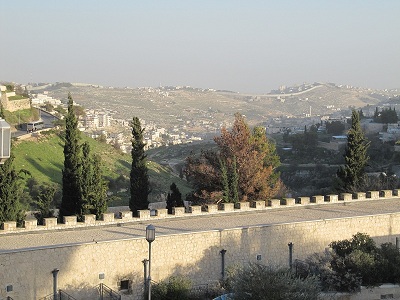
That’s the story I’d always heard and read. It’s the one I heard told yesterday by a guide to a group of tourists on Segways while I photographed and wrote about the view.

View from Mishkenot Sha'ananim
View from Mishkenot Sha’ananim

But when I was in London last summer, I heard a different and more colourful explanation of why the mill was hardly used.

I joined a tour of the Jewish East End, the East End as it used to be at the beginning of the last century. I was particularly interested because my father grew up there, but the tour was fascinating and anyone interested in history would enjoy it. Our guide, Judy, was excellent. We learned many things – even the origin of the word: curfew.

Towards the end of the tour, we entered the Bevis Marks Synagogue to hear from another excellent guide, Maurice. This one, while telling us all about the history of the synagogue, pointed out the seat that used to belong to Sir Moses Montefiore, who, it turned out, was responsible for initiating and provided funding for various projects around the world. One such project was to set up the two adjoining neighbourhoods of Mishkenot Sha’ananim and Yemin Moshe, among the first to be built outside the city walls. Yemin Moshe was named after him, Moshe being the Hebrew for Moses.

This is the story that Maurice told – an alternative to the “lack of wind” story. Despite the challenging modes of transport available at that time and his advancing age, Sir Moses Montefiore frequently travelled to the holy land. On one visit, the residents of Yemin Moshe told him of their difficulties in obtaining flour. There were several flour mills in the area, but they had all hiked up their prices recently and the people couldn’t afford them. Montefiore announced that he would build a number of windmills to grind flour and that he would give away the flour to the residents. He had the first one built in Yemin Moshe. The mill began to work, the people received free flour and the other flour mill owners panicked and reduced their prices. Having achieved his goal, Montefiore didn’t need to build any more windmills and the one he did build was no longer needed.

I don’t know which story is true, but the second one turns Montefiore from a fool into a very clever man, and I don’t think he could have done all that he did and be stupid.

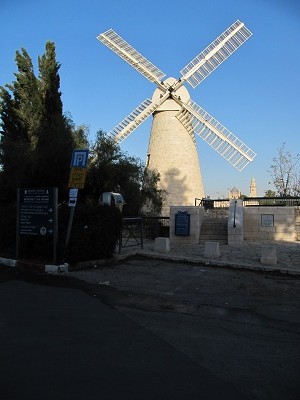
So, the windmill has been restored and now looks like this:

Mishkenot Sha'ananim Windmill, 2013
Mishkenot Sha’ananim Windmill, 2013
Mishkenot Sha'ananim Windmill, 2013
Mishkenot Sha’ananim Windmill, 2013

.

.

.

.

.

.

.

.

.

.

.

I hope it works!

Categories
Israel

It’s Snowing!

Snow is falling in Jerusalem. I can see white flakes coming down silently as I write this.

OK. I know. Many of you are so used to snow that you don’t see it as anything special. But in Jerusalem it’s very special. We don’t get snow every year. Last year it snowed a bit one day, but it had hardly settled when it melted. This time, we have real snow.

And besides, how many of you have seen a palm tree in the snow?

Palm tree in snow
Palm tree in snow

Most homes in this country never see snow. People travel to Jerusalem to see it – if they manage to get here when the roads are closed.

So forgive me my excitement on this unusual day. Tomorrow, when the snow has melted, we’ll think about how to clear the path to the front garden.

Where's the path gone?
Where’s the path gone?

Update: I had to add this photo of our pond taken by my son.


Frozen pond
Frozen pond
Categories
Israel

Swaying News

The terrible shooting disaster in Conneticut spawned Mapelba’s post. Her questions at the end spawned mine.

What news event do you remember from your childhood? Any story from the news ever have any lasting effects?

I thought about the big events from my childhood. The assassination of President Kennedy, the death of Winston Churchill, the Aberfan mining disaster, the moon landing. Yes, I’m that old. I remember watching all of those on television as they unfolded. But none of those events had any lasting effect on me.

Then I remembered one that did. The Six Day War. It was the first time I’d thought much about Israel and here were these people on the TV showing maps of this tiny, nineteen-year-old country surrounded by enormous enemies. The way they showed it, Israel had no chance and would be wiped out. Yet, in the end, Israel won.

I didn’t hear any criticism in Britain and I don’t think there was much. Israel, which had clearly been the underdog, won against all odds. I think that must have been the first of many factors that made me decide to come and live here.

I thought about writing some of this as a comment on Mapelba’s blog, but decided not to. Times have changed. At most, I’ll post a link to this post.

Categories
Israel

The search for doughnuts

This evening we lit the Chanukah candles for the last time for this year. Over the eight-day festival, I went out looking for doughnuts – the traditional food for Chanukah – and found them in four different bakeries. One of them, I think we all agreed, made the most tasty doughnuts, but a different bakery made the most colourful ones.

Chanukah, 2012. Sufganiot

What a shame they’ve all gone.

There’s a picture of me with the candles, but I’m saving that for Tuesday’s office party.