
There are many similarities between the Arabic and Hebrew languages. One of them is the word for market. Hebrew: shuk, Arabic: souq.

Author, editor, attempter of this thing called life. Social anxiety warrior. Re-Connections, a collection of short stories, published with Ocelot Press, 15/10/2025.
There are many similarities between the Arabic and Hebrew languages. One of them is the word for market. Hebrew: shuk, Arabic: souq.
I’ve never tried this before, but I noticed the challenge this time is to write a 14-line sonnet and felt like trying this afternoon.

It came out a little weird, but here it is:
There was a boy whose name was George.
He was so very bored that all
The cream cakes he did gorge and gorge
Until he was as round as a ball.
His father, despairing, bought him a dragon,
Which ate all the cakes and breathed out fire.
When George went to school he hung his bag on
The dragon’s tail and pulled him with wire.
The dragon became the boy’s only friend.
George’s days the dragon did fill
’til his father, worried, said, “This is the end.
That dragon” – and he pointed – “you must kill.”
If you want to know what George does of late,
He gorges his way through cream cakes on a plate.
Back to the A-Z challenge tomorrow….

The Wohl Rose Park is a public garden located between the Knesset and the Supreme Court and is one of the few such parks in the Middle East. Over 400 varieties of roses are grown here.

The park’s Garden of Nations consists of sections donated by other countries. Each section contains roses that grow in the relevant country.

When I returned home with my camera after visiting the park, I had to snap the roses in our garden. Sorry I can’t post their heavenly fragrance.
.

.

.Sorry

The Jerusalem House of Quality is, according to its website, “a unique artisans center featuring arts and crafts in Jerusalem.”
The Society for the Protection of Nature in Israel (SPNI) works to preserve plants, animals and natural environments.
.
.
.
.
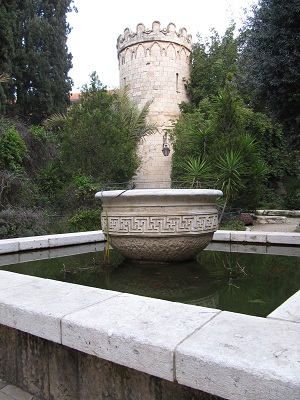
Its office in Jerusalem is in a beautiful garden – part of the Russian Compound that arose in the nineteenth century and expanded to accommodate the many Russian crusaders in Jerusalem at the time.
.
.
.
.
.
.
.
.
.
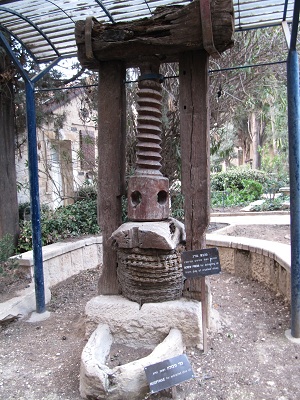
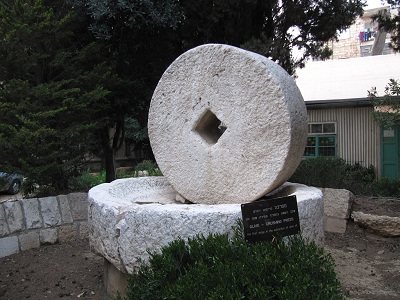
Today the garden contains a permanent display of old agricultural equipment.
.
.
.
.
.
.
.
.
.
.
.

The old city of Jerusalem has been populated for well over three thousand years. During that time it has been ruled by many different people. As the map shows, there are now four quarters: Muslim, Christian, Jewish and Armenian.
The walls of the old city, built in 1538 by Suleiman the Magnificent, contain eleven gates, seven of which are currently open. At the risk of sounding like a tourist guide, I recommend the rampart walk, which provides great views of the old city, as well as areas further afield.
Edit: The map has a mistake that’s very common here. People find it hard to believe that if there’s more than one lion you still say, “Lion Gate.” English!
Overcrowding in the old city of Jerusalem caused residents to venture out of the city walls.
.
.
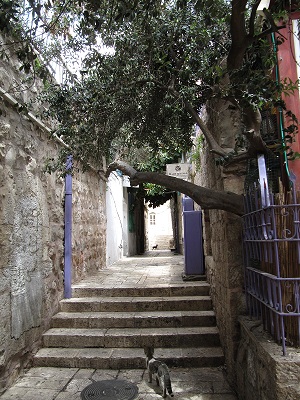
Nahalat Shiva was the third neighbourhood to be built outside the walls and was founded in 1869. Its name means the land or heritage of the seven and refers to the seven people who joined forces to buy the land.
All the residents of a neighbourhood would have known each other and would have been very suspicious of strangers – rather like this dog and cat.
.
.
.
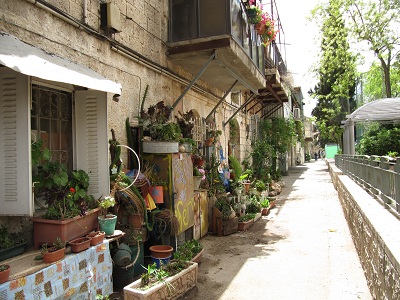
Nachlaot consists of a cluster of neighbourhoods. The first, Mishkenot Yisrael, was built in 1875. All the neighbourhoods were originally intended for specific communities – Jews from different lands. Nowadays, no such separation is necessary.
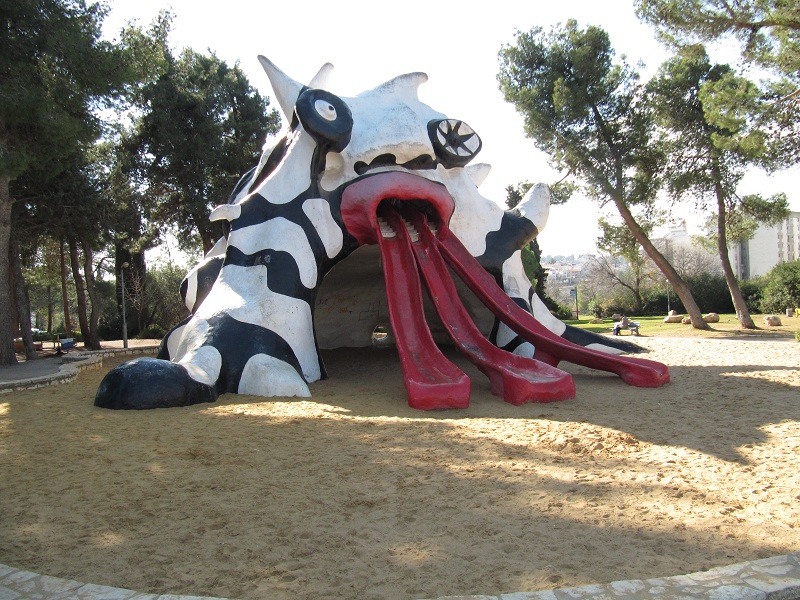
The Monster (Hebrew: Mifletzet, which also begins with M) is a well-known landmark in Jerusalem and one that is enjoyed by children, who love to slide down its three-pronged tongue. It was sculpted in 1971 by French artist Niki de Saint Phalle.
Plans were approved in the 1990s. Construction began in 2002. It was supposed to start functioning in 2005, then 2006, then…. When trains began running in August 2011, there were many teething problems.
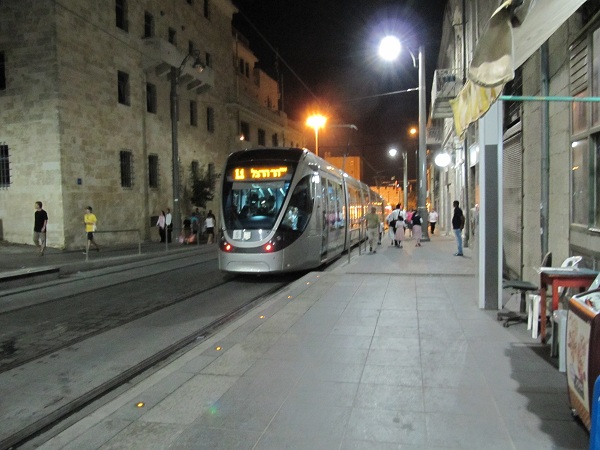
But now it’s working well and
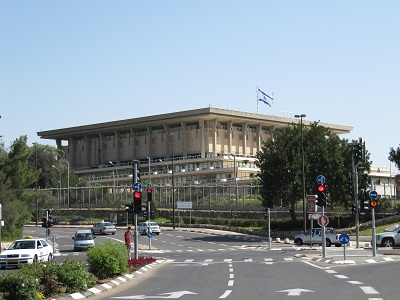
The Knesset is the name for Israel’s parliament. The name means gathering or assembly. The same word is used in the Hebrew term for a synagogue.
The current Knesset building was inaugurated in 1966. There is so much information about it that it’s hard to pick out anything in particular. The Chagall mosaics and tapestries, the seating arrangement for the 120 members shaped like a lamp, the Eternal Flame, the gates made of iron and steel ….
I’m taking a short break. Back soon with L for Light.
Have a WordPress.com account? Log in now.

