Categories
Books

Indie Authors Appreciation Week

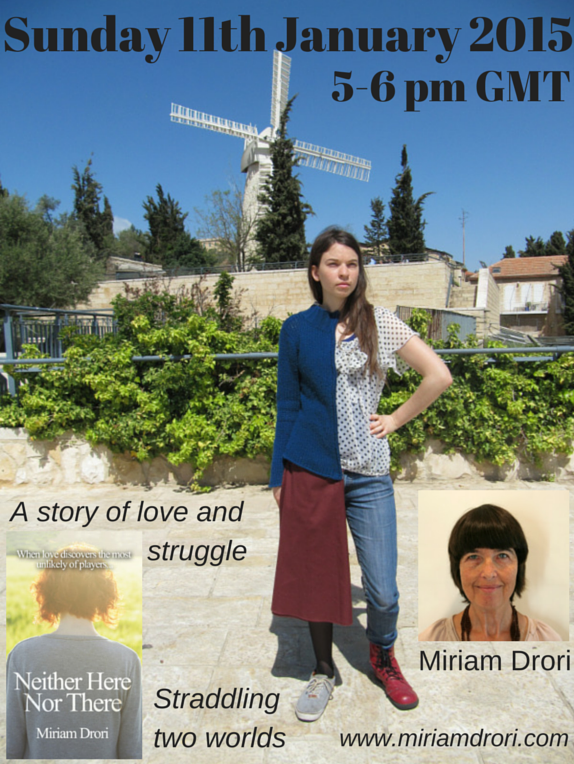
TomorrowPosterThe wonderful Carmilla Voiez has done an amazing thing. She’s set up a whole week for you to get to know 60 authors and their books. Each author has an hour’s spot, during which they will tell you about themselves and their books, post excerpts, run competitions, answer questions and much more.

On top of that, Carmilla has arranged sponsors for the event, enabling her to offer bigger prizes.

I would never have been able to organise such an event, but I’m delighted to be able to take part. The event starts tomorrow (Friday). My spot is on Sunday at 5:00pm GMT and I’d love you to be there. You can sign up for the whole event at https://www.facebook.com/events/393175627502030/permalink/409764545843138/.

Indie Authors Appreciation Week Poster

Categories
Holidays

People of India

I want to tell you about a few of the people we met in India, starting with Sarat Acharya of Discover Tours, who made our stay in India so pleasant. He arranged our three-week tour of Orissa and Chhattisgahr perfectly. We travelled in comfortable cars with excellent drivers and stayed in some special places, including three palaces. Sarat accompanied us for the whole trip, sharing with us his extensive knowledge. He also brought along two other excellent guides for different parts of the trip.

Sarat

On top of that, he knew how to handle the noisy members of the group. He did his best to accomodate all requests, but was able to stand up to those whose requests were impossible to meet.

Sarat told stories. No, he didn’t just tell the stories. He acted them out, using volunteers. The story for which I volunteered involved Sarat pulling my hair hard. It hurt! But I’ve got over it now. All in all, Sarat provided a wonderful tour and gave me a taste for more. (But I might not volunteer again so readily!)

In the many tribal villages we visited, we were introduced to the residents, who seemed content and happy.

Village peopleSome of them danced for us.

DancersInChhattisgarhAnd some of us joined in.

Then there were all the people who wanted to take our photos together with them.

05GroupPhotoAnd the maharajas and maharanis, whose palaces we stayed in.

IMG_1119Last but not least, the friendly drivers, who also cooked several delicious meals for us.

20141220_124640

Categories
Rhymes

Three Years a Year

Surprise! This isn’t about India. I forgot I’d promised to post this little rhyme I wrote for Crooked Cat’s Christmas extravaganza (see below).

Three Years a Year

I pity the people with only one year,
Who end it all merry, never shedding a tear.
They have to say so many things in one go,
To one year goodbye, to another hello.

They try to reflect on the year that has passed,
While also looking forward to the one that is fast
Approaching… nearly… almost… it’s here!
Resolutions transferred from yesteryear.

In Israel, you see, we celebrate three
And each, in its character, is solitary.
Different, special and unique,
They make us happy, thankful and… meek?

Rosh Hashana is one of those.
With all its rules, it keeps us on our toes,
Requesting forgiveness for our sins.
That’s “our” for humanity; not just kins.

Then we join with the world and celebrate, too,
Although some disagree and think it’s taboo.
Sylvester, it’s called, I used to know why.
It matters not when I’m feeling high.

What, you may ask, is number three?
It’s the one that marks the year of the tree.
Goes under the name of Tu B’Shvat.
We plant more trees, sing songs. That’s that?

Well no, we give presents of nuts and fruit,
And we eat same with much relish to boot.
So whatever New Year is appropriate for you,
I hope it is happy and fulfilling, too!

To see all the other Crooked Cat stories, poems, giveaways and more during the six-week event, join our Facebook group.

Neither Here Nor There, my romance with a difference, is available from Amazon, Smashwords and The Book Depository.

Categories
Uncategorized

News

I have a guest post on the lovely and unique blog of Seumas Gallacher. It may be humorous, but it also poses a serious question: do I need a brand? Any answers?

My next post will, I think, be about the good things of India. Because I prefer to remember them, and I also need to think about these for a forthcoming speech (see below). The less good things will appear in a later post.

That speech. Oh dear. When I agreed to do it, I expected to have more time to prepare. I expected to write it at least a week ahead, giving me plenty of time to practise it. It’s now Friday and it’s due to be given on Tuesday evening, and I haven’t started writing it. I’m getting worried. If I leave it any later, the only thing that can save me is if the snow forecast for Wednesday comes a bit earlier. Any chance of that, powers that be?

Categories
Blogging

2014 in review

The WordPress.com stats helper monkeys prepared a 2014 annual report for this blog.

Here’s an excerpt:

A New York City subway train holds 1,200 people. This blog was viewed about 4,300 times in 2014. If it were a NYC subway train, it would take about 4 trips to carry that many people.

Click here to see the complete report.

***

A big THANK YOU to everyone who commented in 2014, especially the winner: Angela Brown. I… don’t know what she’s won apart from my gratitude and hope that she and all the other commenters will continue to comment in 2015. Do let me know if there’s anything you want to read about on this blog. And most of all, have a great 2015!

Happy New Year

Categories
100-word stories

100 Word Challenge – Week #161

Click on the image to join in the challenge

.

.

.

I haven’t done this challenge for ages, due to a lack of time, but couldn’t resist this one: the good parts of 2014. Actually, on rereading the instructions, I see this wasn’t exactly what Julia meant. Sorry. I couldn’t leave anything out.

.

.

.

2014 in 100 Words

On 1st January, I had my hair cut short, hoping this would herald an even better year. It did. Three wonderful holidays, short stories published online and podcasted, two speeches accomplished at Toastmasters, lots of folk dancing, a successful book reading, finding myself in the safest part of the country when things went pear-shaped, the forest fire stopping just short of our house, lots of sunshine and much-needed rain, family healthy and doing well. But the best thing of all: my romance, Neither Here Nor There, published by Crooked Cat Publishing on 17th June. All in all, a fantastic year.

PS My book, like many other Crooked Cat books, is currently on sale on Amazon for a short time only. Here.

Categories
Holidays

Photo Opportunity

Welcome back to my blog, all you wonderful readers! I hope you’ve been having fun without me. I have been away on a very special trip – my third to India.

Our three-week trip was packed full of experiences and included no time for reflection. Now that I’m back – despite my time here being limited, too – I want to go over my notes and photos carefully, and try to make sense of all that I saw, heard, smelled, tasted and felt.

The one point I will mention now is about photos. As always, we visitors took photos. We photographed places and people (with their agreement). As before, children asked to have their photos taken, because they wanted to see their faces on our screens. That cheeky-looking boy in the middle requested several photos.

VillageChildrenBut this time there was a new phenomenon. People approached us to ask if they could take pictures of them together with us. More than ever, we became attractions. Probably we seemed more strange to them than they did to us.

This change came about, of course, because there are now so many mobile phones. In the old days, even those who had cameras wouldn’t have carried them around with them. Nowadays, anyone can whip out a mobile phone and snap away. Even in remote villages that have never had telephone lines, mobile phones are coming into use.

MeAndTheTribe
Dancing together.

The world is changing. Some of the changes are good.

Categories
Israel

Chanuka Meanderings

Chanuka2012MiriamIt is said that all Jewish festivals can be described in the same way:

  • They tried to get rid of us.
  • We survived.
  • Let’s eat.

Chanuka is one of those. It’s not the most important festival, but it’s fairly well known because it comes at about the same time as Christmas.

SvivonimI looked for a short explanation of Chanuka, and found one on Lisa’s beautiful blog (Blogger wouldn’t link to the post itself):

Chanukah commemorates two miracles which occurred on behalf of the people of Israel. The first miracle was the military victory of a handful of Jewish warriors against the mighty armed forces of the Syrian-Greek army. The second miracle was that while going through the ruins of the destroyed holy temple only sufficient oil to light the menorah for one day was found, yet the oil miraculously burned for eight continuous days. That is why Chanukah lasts eight nights.

SvivonimThere are three main traditions for Chanuka:

  • To light candles – one, two… up to eight on each night of the festival and sing Maoz Tzur.
  • To play with a sevivon/dreidel/spinning top.
  • To eat foodstuffs fried in oil.

The sevivon has four letters on it. One of the letters is different in Israel from sevivonim found in the rest of the world. There, the letters stand for (A) Great Miracle Happened There. Here, they stand for (A) Great Miracle Happened Here.

SvivonimThe candelabra (I see the correct word is: candelabrum) used to light the candles is called a chanukiya. In other countries it is often called a menorah. This is incorrect. The menorah has six branches and was used in the Temple. The chanukiya has eight branches (or nine). The extra one is for the shamash, the candle used to light all the others.

SvivonimFood. We Ashkenazi Jews, who migrated via Europe, eat levivot (potato pancakes) and sufganiyot (doughnuts). Sephardi Jews, who migrated via Arab lands, and some via Spain and Portugal, eat other fried foods. Bimuelo, ma’akouda and mofleta are some of the names I found.

SvivonimIn London, where I grew up, I attended a Jewish primary school and a “secular” secondary school. In those days, secular secondary schools celebrated Christmas and it was impossible to opt out altogether.

I loved the tunes of the Christmas carols, but didn’t feel comfortable with all the words. When I had to sing one, solo, that fact caused me to sing it quietly, and the teacher probably thought I was nervous or didn’t have a good singing voice. I was never chosen to be in the choir.

In an art lesson in the first year, we were told to draw something for Christmas. There was an option for drawing Chanuka objects, but it wasn’t encouraged and I, of course, was always trying not to stand out. However, I had no idea what one drew for Christmas. So I looked over someone’s shoulder and tried to copy her work.

We gave each other presents and cards. That was all right, although I was always aware that it wasn’t really my festival.

My children don’t know about any of these feelings, and I’m glad of that. They missed out on the Christmas carols, but they got Chanuka songs instead.

SvivonimHappy holidays!

SvivonimTo see all the other Crooked Cat stories, poems, giveaways and more during the six-week event, join our Facebook group.

Neither Here Nor There, my romance with a difference, is available from Amazon, Crooked Cat Books, Smashwords and The Book Depository.

Categories
Books

Who’s Santa?

Chanuka with the Crooked CatsThe authors of Crooked Cat, publisher of my romance with a difference: Neither Here Nor There, are holding a six-week extravaganza of stories, poems, free giveaways and more, called: CHANUKA WITH THE CROOKED CATS, or something like that!

In honour of this unique event, I am publishing, here on my blog, my Christmas story with a difference. The story clearly takes place in a year that isn’t this year, because this year Chanuka ends on Christmas eve, whereas in the story there is a gap between the end of Chanuka and the beginning of Christmas.

If you want to discuss anything in the story, you’re welcome to do so in the comments below. Please comment promptly because I’m going away in a few days and might not be available to respond.

By the way, while there are about fifty ways of writing Chanuka in Latin letters, there is only one in Hebrew: חנוכה.

Who’s Santa?

Everything I hear and everything I see seems to have something to do with Christmas. On the TV and the radio, and in magazines. Everywhere. They talk about it and sing about it and have pictures about it. I think it’s boring. When I turned on my favourite TV programme – Doctor Who – and found that was all about Christmas, I was so fed up that I actually switched off and even read my library book instead.

At school, we only talk about Christmas a bit of the time. Keith said we must never write Xmas, even though it’s easier to spell. That’s because the X stands for the cross and we don’t believe in that. Keith was also the one who told me I must never look for a rainbow in the sky when it’s raining and sun shining at the same time, because I don’t know the brocha for it. I think that’s a shame because rainbows are pretty and it’s nice to look at them. I’ll have to find out what the brocha is and memorise it. It’s probably something like, “Blessed art thou, O Lord our God, for giving us the rainbow.” I wonder how you say rainbow in Hebrew.

On Tuesday, when Mummy took me home from my piano lesson, it was dark. On the way back from the bus stop, we passed three houses with lots of little flickering lights. I knew what they were. Christmas again.

“Why do people have Christmas trees?” I asked Mummy.

“Oh, it’s part of celebrating Christmas,” she said. “And people put them where others can see them as they go past, just like we put our Chanukah menorah on the window sill for people to see.”

“Why is everyone talking about Christmas?”

“Well, Christmas is a big thing for Christians. It’s their most fun time of the year.”

“What’s our most fun time of the year?”

Mummy had to think about that one. “Maybe Purim.”

“So why doesn’t everyone talk about Purim like they talk about Christmas?”

“Because there are a lot more Christians than Jews. And lots of people celebrate Christmas, even if they don’t believe in it.”

I like to be happy and have fun. So I said, “Why can’t we celebrate Christmas?”

“Because we have our own religion and we’re happy with that.”

“But I want to have fun, too.”

“And you do. At Simchas Torah and Purim. Remember?”

Well, that’s true. I love all the singing and dancing in shul. And I love dressing up on Purim. I suppose what I meant was that I want to have fun now.

The next day, I met my friend, Johnny, in the street. I like Johnny because he’s only six and I’m seven, so I can tell him things. Once, I told him how many more Corn Flakes coupons he needed before he could send away for a football, because he didn’t know how to work it out. And another time, a big boy walked past us and Johnny wanted to know what it said on his shirt. “It said, ‘I came on Laura’,” I told him.

“What does that mean?” he asked.

So I told him. “It means that he made Laura hurry up.”

This time, it was the other way round. Johnny told me something I didn’t know. He said, “I want Santa to bring me a train set. What do you want him to bring you?”

“Santa?” I said. “Who’s that?”

“You know. Father Christmas.”

“Who’s Father Christmas?” It wasn’t that I hadn’t heard of Father Christmas. But I never really took much notice before.

He looked up at me and frowned. “You must know that. Everyone knows that. Father Christmas brings presents to all the children. He lives in a very cold place with lots of snow and ice, and on Christmas Eve he flies in the sky pulled by a reindeer and gives out all the presents.”

I didn’t know there were special deer that came out in the rain, but I didn’t like to say I didn’t know that, either.

Then Johnny said something else. “Father Christmas only gives presents to good children. Maybe you’re not good and you’ll go to that place where there are fires burning all the time.”

It didn’t seem bad to me to have fires burning. Especially if there was ice and snow there. Still, I punched Johnny in the tummy. Not a real punch – just a pretend one. “I’m good,” I said.

We played outside for a while, taking turns to ride my new scooter, which I got for Chanukah. It was while I was running after Johnny that I saw something small and flashy on the pavement. I stopped, picked it up and started to examine it. Johnny soon came back. “Hey! Why did you s…,” he started. Then he spotted my prize and his eyes widened. “My dad’s got one of them. It’s a cigarette lighter.” This business of Johnny telling me things was getting to be a habit I didn’t care for. “Try pressing that button quickly,” he said.

I pressed. Nothing happened. So I pressed again more quickly and a flame sprang up. “Cool.”

“Can I have it?” Johnny asked.

“No. I found it.” I put it into my pocket – after letting go of the button, of course.


Afterwards, on my own in my room, I decided to experiment with the lighter. The first thing I tried it on was my counterpane and… well, I decided not to try it out again, although it made a nice smell. I hope Mummy and Daddy don’t notice that pretty hole in the counterpane with the black edge. I wonder if Santa ever burns holes when he lights his fires. Anyway, while I was doing that, I thought about what Johnny had said about Santa giving out presents only to good children and all that. Maybe we were bad because we didn’t have a Christmas tree and that was why Santa didn’t bring me presents.

I was still worrying about it when I went downstairs and saw Daddy sitting on the sofa, reading the newspaper. So I asked him, “Why does Santa bring presents to Johnny and not to me?”

Daddy put the paper down beside him, laid his glasses carefully on the little table and pulled me onto his knee, like he always does when he wants to explain something to me. “Daniel,” he said. “There is no Santa. Santa is someone made up and Christian parents pretend that he brings presents for children. Really, the parents buy the presents.”

I was shocked. “You mean Johnny’s mummy and daddy lied to him?”

“No. It’s not a lie. It’s just a story they tell him, and when he gets older they’ll tell him it’s not true.”

“How do you spell Santa?” Spelling is my thing at the moment, and I bet Johnny doesn’t know how to spell it.

“S-A-N-T-A.”


I thought about that in bed. Daddy said it wasn’t a lie, but it did sound like one. I thought Johnny ought to know about it. Then I thought about that game – Scrabble – that my big sister, Rachel, often plays with Mummy and Daddy, and how I wanted to join in and they all told me I’m not ready for it. So, the day before, I asked Rachel how I could get ready for it and she said, “It’s all about making words from a group of letters.”

“How d’you do that?” I asked.

“Well, take the letters of my name: R-A-C-H-E-L.” She took a piece of paper and a pencil from the sideboard drawer and wrote down the letters. “You can make lots of words with those letters. Car, care, race, hear, heal, real, arch, larch and lots more.”

“Now do my name.”

“D-A-N-I-E-L. And, end, lid, line, dine. There’s even a word that uses all the letters: nailed.”

“I don’t like that one,” I said. “I wouldn’t like to be nailed to the wall; it hurts.”

She smiled. “OK, I see another one: denial.”

“What’s that?”

“It’s when you say no to everything.”

“I like that,” I said. “I’m always saying no to Mummy and Daddy.”

So when I was in bed, thinking about Santa, I wondered what the letters S-A-N-T-A could make. But I think I fell asleep without thinking of anything. When I woke up, I knew Santa was bad. I don’t know why – I just knew it. And I decided I had to tell Johnny about him.


That day, after school, Johnny came to my house to play with me and Mummy gave us tea. We drank hot chocolate and ate Mummy’s jam doughnuts. I love doughnuts, especially when I bite into a jammy bit and all the jam suddenly spurts out everywhere. I know Mummy thinks I get jam all over my face and hands on purpose, but I don’t. It just comes. Anyway, while we were eating and drinking, Mummy asked Johnny, “What do you want from Father Christmas?”

Johnny said, “A train set.”

I said, “There’s no such thing as Santa.”

Mummy said, “Of course there is.”

I said, “No, there isn’t. Daddy said so.”

Mummy ignored me completely. She turned to Johnny and said, “Don’t listen to him. He’s just being naughty.”

I was hurt. I wasn’t being naughty at all. I was being good and teaching Johnny something he needed to know.

After Johnny left, Mummy called me into the kitchen. I sat on the stool. She sat next to me on the folding chair and I saw the frown that always makes the wrinkles round her eyes show up more.

“Daniel, I’m sorry I had to say you were naughty, today,” she said. “It’s really very good that you teach Johnny things. But there are some things you shouldn’t teach him. If his mummy and daddy want him to believe in Santa now, you shouldn’t tell him he doesn’t exist. Johnny will find that out when he’s older. All right?”

“Yes,” I said.


It makes sense, I suppose. It would be confusing for Johnny if everyone told him different things. He wouldn’t know what to believe. So, for now he’ll carry on believing he gets presents from a man who lights fires to keep warm in the snow and ice, and is pulled along by deer that come out in the rain.

All this makes me wonder whether grown-ups have told me any lies. I wonder about the tooth fairy. And about Haman, the wicked man who wanted to kill all the Jews on Purim. There couldn’t really be someone who wants to kill all the Jews, could there?

WhosSantaTo see all the other Crooked Cat stories, poems, giveaways and more, join our Facebook group.

Neither Here Nor There, my romance with a difference, is available from Amazon, Crooked Cat Books, Smashwords and The Book Depository.

Categories
Books

Interactive Interview: Adam S. Leslie

Yes, I know I just said I was taking a break, but it’s not quite November yet and I have a special guest here today: Crooked Cat author, Adam S. Leslie.

AdamSLeslie

Hello Adam and welcome to my blog. Since joining the Crooked Cat clan, I have been introduced to several genres I hadn’t read before. Your novels sound like a genre of their own – a mixture of several others. After reading the descriptions, I’m teetering on the brink, wondering if I dare to delve into them, hoping this interview will help me decide.

Could you begin by telling us something about the books?

Hi Miriam, and thank you! That’s a good way of putting it – I’m a bit of a restless soul, and I do like to mix the genres up over the course of a full-length novel. I see genres as being like cocktail ingredients: individually, they’re all quite familiar, but if you combine them in just the right quantities, you get a new and unique flavour.

Kaleidoscope, on the surface, is a dystopian satire in the mould of 1984, Brave New World or THX-1138; but it also sometimes acts as a spoof of that genre, and it’s an adventure romp too, a surrealist nightmare and at times a pitch-black comedy. So it’s quite familiar on one hand, but takes the formula to brand new and hopefully unexpected places along the way.

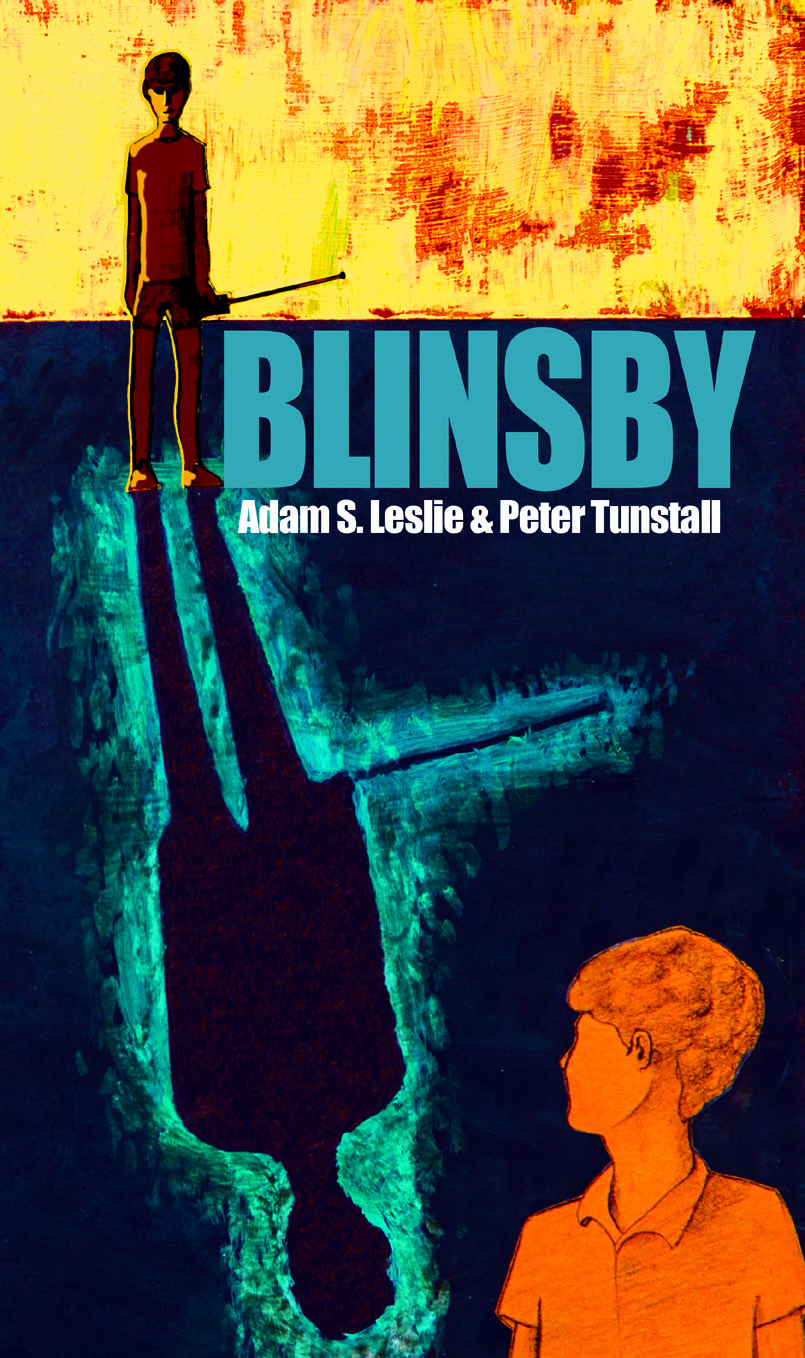
Blinsby, though, is a very personal book – quite different from Kaleidoscope, but I think is the more interesting of the two. I wrote Blinsby with a chap called Peter Tunstall, who I’ve known since we were about five years old. We grew up together in Lincolnshire, in one of the remotest parts of rural England. The book is a fictionalised account of our time at primary school as a pair of 10-year-olds during the mid-1980s, how it felt growing up at that time and how we saw the world.

But, of course, it’s not as straightforward as that. There’s also a conspiracy thriller plot about the disappearance of a new boy in class – who might be good or might be evil – and the way the school authorities are potentially implicated. The whole thing has a sort of hallucinatory feel, but it’s also an adventure yarn on top of that, and there are hopefully a lot of laughs along the way too.

That sounds like an unusual cocktail. Thriller, hallucinations, adventure and humour. I wonder how you combine all that. I suppose there’s only one way of finding out.

I’m interested in hearing how you and Peter worked together. How did you divide up the writing? Were there any arguments? Are you still friends? Would you do it again?

I think the fact that the story is told from a children’s eye view really helps bind the disparate elements together. That’s not to say that it’s all happening in their heads, or that what’s happening isn’t real; but we are very much in their world, and it’s as chaotic and colourful and undefined by adult rules as any 10-year-olds’.

I often pitch it as ‘Calvin & Hobbes meets Catch-22 meets Gormenghast’. Like Calvin (or Scottish comic strip icon Oor Wullie, one of my heroes growing up), our characters think like children but articulate like adults, which helps put the reader on their level and identify more with them, than if they spoke like authentic children. We as adults don’t feel that disconnect, which we might if we spent time with a real class of pre-teens.

Blinsby - AdamSLeslie

The book is structured like a school day. Apart from the opening chapter (which takes place during the summer holidays), it begins with morning assembly and runs through each of the lessons and playtimes – a chapter for each – until hometime. We really wanted to make the reader feel like they’d spent a day back at primary school.

So when Peter and I write together, we sort of treat each chapter as a short story in its own right. We spend hours and hours on the phone brainstorming the overall plot, and then go off and write whichever bit we feel like. And we do redraft each other’s material quite a lot too. Luckily, we have very a similar writing style, so it’s almost impossible to tell which bits are Peter’s, which bits are mine, and which bits we’ve both worked on!

Yes, I’m afraid there were lots of arguments. Rarely about the big stuff, it was almost always silly little details – a particular wording, or a particular way a character was acting. Peter has quite an experimental ethos, whereas I’m more rigorous about the rules we’ve established for the Blinsby universe. Luckily, we always found a way to make it work in the end.

We’d definitely do it again, and are planning to explore this world and these characters more in the future.

I suppose if you managed to agree in the end, that’s the main thing.

Do you still live in rural Lincolnshire? I ask with reference to writing about place. Some authors say they have to get away from a place in order to write about it. How do you feel about that?

I moved away during the late 1980s, not long after the book is set; Peter lived there during the writing of Blinsby, but has since married and now lives in the USA. Exotic stuff!

I can’t speak for Peter, but I certainly think having a certain nostalgia for the place helped me fictionalise it and turn it into something ‘other’, a sort of dream space where magic can happen. It’s tied to that period in my life; whereas for Peter, until very recently, it was a place he’s always lived.

It would be interesting to get Peter’s take on that as well, then.

I don’t think I’ve ever seen Peter interviewed, but I reckon it’d be a fascinating experience for all concerned.

Can you tell me anything about your next book?

I’m mainly concentrating on writing for film and television at the moment, but I would love to have the opportunity to explore the Blinsby characters and universe again sometime soon.

I just read your very interesting interview with Fiona Mcvie, and was surprised when I read your reply to the question about making changes to Blinsby if you could: “Only a couple of typos we’ve noticed since publication, but other than that we’re exceedingly happy with it, which is a bit sickening.” To me, being so satisfied with something you did sounds fantastic. Why do you feel you have to make a sort of apology for it?

Some of my awkward British modesty at play I think!

Yes, perhaps I notice it more, living away from Britain. Coming back to the setting, why did you make it fictional? What were the advantages of doing that? Were there any disadvantages?

It’s funny, we never really considered otherwise. We started writing the book 20 years ago, when we were around 19, and had previously written other adventure yarns based around ourselves and our environment. The sub-Tolkien stories we wrote as children, which I mention in Fiona’s interview, were a retelling of our own real-life adventures, but with added lopping off of orc heads and suchlike. And in those we renamed all the places and all the people. Peter was Vorogond and I was Culfindol, and our brothers were in there too. So we already had a bit of a history of our egomaniacal writing style!

But I think fictionalising the setting of Blinsby has really helped cut our imaginations loose from the geography and feel of Caythorpe – that’s the starting point, but Caythorpe is not really Blinsby. Blinsby is its own unique place. And so we could make Blinsby as surreal or as different as we liked.

Same with the characters. Writing for Erasmus and Frank, rather than Peter and Adam, gave us the freedom to diverge from ourselves wherever we needed to. They’re based on us, but they’re not really us. They both say and do some things which neither of us ever would, especially Erasmus I think. Erasmus goes on the biggest journey and has the biggest arc of any of the characters, by going through life-changing events Peter never had the chance to experience.

When it comes to the supporting characters, we also wanted to be quite sensitive about not saying “this character is based on this person”. So we played with archetypes a lot; and even when real people may have acted as a starting point for some of the characters, everyone is very heavily fictionalised by the time they reach the page. I think this is why readers have responded with such familiarity and positivity to the characters – no matter what your school environment, or where or when you went to school, everyone knew these people. Everyone remembers an Anastasia Krum or a Posy Flatfist or a Benedict Hornbeam or a Luke Carpenter.

Thank you so much for joining me on my blog, Adam, and for your thoughtful and comprehensive replies. I am now intrigued about Blinsby and looking forward to reading it.

Thank you for having me, it’s been fun!

~

Blinsby is available from Amazon, Crooked Cat Books and elsewhere.