Categories
Books That's Not Me

That’s Not Me: Jennifer C. Wilson

That’s right. Jennifer is back on That’s Not Me!, so that you can get more of her humour and words of wisdom.

This time she’s talking about another of her books.

That’s Not Me! examines how much of our fiction is autobiographical and why some authors try to insist there’s no link between their fictional characters and themselves. If you want to take part, have a look here and get in touch. You don’t have to be a writer. Readers also have views!

Over to you, Jen.


Well, if it was ridiculous to claim there was none of me in Kate, from The Last Plantagenet? (you can visit that blog here), it’ll be even more stupid to make such a statement about Lexie, in Twelve Dates ‘Till Christmas! Although apart from one scene, this time, it really wasn’t intentional.

Without giving the game away, Callum and Lexie are those friends who happily go along to each other’s formal events as a ‘plus one’ when required. And not just personal events, but the occasional corporate function too. It’s for one of these evenings where Callum springs it on Lexie that he’s entered them into a “Mr and Mrs” quiz. To say Lexie is unimpressed is an understatement…

Having never played the game myself, I took to the internet to find some good questions, and set about writing the scene. When it came to Lexie, I figured, why not add a sprinkling of ‘me’ in there? After all, ‘write what you know’ again, right? And although the questions give a good insight into Lexie, they aren’t anything too plot-essential; it’s about demonstrating how well Callum and Lexie know each other, after all, not necessarily about the answers themselves. So, when it came to Lexie having won a Young Environmentalist of the Year Award (and still treasuring the plaque she got for it), or wanting to meet Sir David Attenborough, well, that’s all me. Plain and simple. Even Callum’s responses have an element of me in them – I’d love to visit Australia, but the arachnophobe in me keeps me anxious…

Other than that bit of the story though, I didn’t think I’d taken that much of myself this time around. Perhaps a love of a fun social life, and hanging out with friends on a regular basis. Alright, maybe being taken on a date to the Natural History Museum’s ice-rink would be incredibly romantic (or at least it would be if I could skate, which I cannot). And fine, there’s certainly something in the comment that Lexie owns mostly lively prints rather than wearing the calm neutrals of her friend’s preference.

In my defence (if I need any), Twelve Dates was my first foray into completely contemporary fiction, having spent the majority of my writing life either in the 1400/1500s, or slightly cheating and writing about characters who were from that era, even if they were contemporary ghosts in my stories. Is it any real wonder then, that I reached out to what I know best, i.e. me? Lexie has a number of characteristics / lifestyle aspects that I don’t have (see above, re NHM), so there’s clearly an element of wishful thinking in the mix too. But is there any real harm in that?

When it comes to writing about real people, there’s always a risk. If somebody who considers you a good friend sees themselves in your antagonist, there’s potential to damage the friendship there. Even if they recognise some of their traits in your leading lady, or romantic hero, who’s to say they’ll be happy with the situation? Well, the one person whose reaction you know with 100% certainty is your own, isn’t it? (Or at least, you’d hope so – if not, you’ve really only got yourself to blame…). It makes some sense then, to look to your own traits, experiences and motivations, where they’re applicable. For me, that might not sit so well when writing about women packed off to arranged marriages in the 1400s, but for a twenties/thirties (alright, late-thirties!) professional woman, navigating modern personal and professional dramas? I have pretty good first-hand knowledge of how that works. And I might as well use it.

I might think twice if I ever write a toxic, manipulative witch though – can’t go being too obvious with giving my personality away!

Blurb

Callum and Lexie are perfect for each other – at least, that’s what everyone tells them. But they’re just good friends, aren’t they? And neither wants to ruin the solid friendship that’s treated them so well since university.

But when an old school friend of Callum’s asks Lexie for a date, and passions overflow on a work night out, could it be the trigger to show each of them what they have been missing out on all this time?

With twelve weeks until Christmas, that’s a lot of opportunity for romance – and for misunderstandings…

Buy link

Twelve Dates ‘Till Christmas

About Jennifer C. Wilson

Jennifer has been stalking dead monarchs since she was a child. It started with Mary, Queen of Scots, and now also includes Richard III. At least now it results in a story!

She won North Tyneside Libraries’ Story Tyne short story competition in 2014 (no dead monarchs, but still not a cheerful read), and has been filling notebooks and hard-drives ever since. Her Kindred Spirits series, following the ‘lives’ of some very interesting ghostly communities, is published by Darkstroke, and her historical / contemporary romances by Ocelot Press.

Social media links

Categories
Books That's Not Me

That’s Not Me: Sue Barnard

I’m delighted to host another author in the series That’s Not Me!

It’s Sue Barnard! Sue and I have been friends for a long time – ever since Sally Quilford brought us together in a romance workshop – romance writing, that is. But I digress. What about Sue’s fabulous stories? Are they based on real life?


THAT’S NOT ME

I’m often asked “Do you base your characters on real people?”  My answer is always the same: “I wouldn’t dare.  I’d have no friends left.”  But I can’t deny that some of my characters have quite a bit in common with me.

Having said that, my books have elicited polar opposite reactions, ranging from “As I was reading that, I could hear you saying it” to “Where on earth did that come from?”

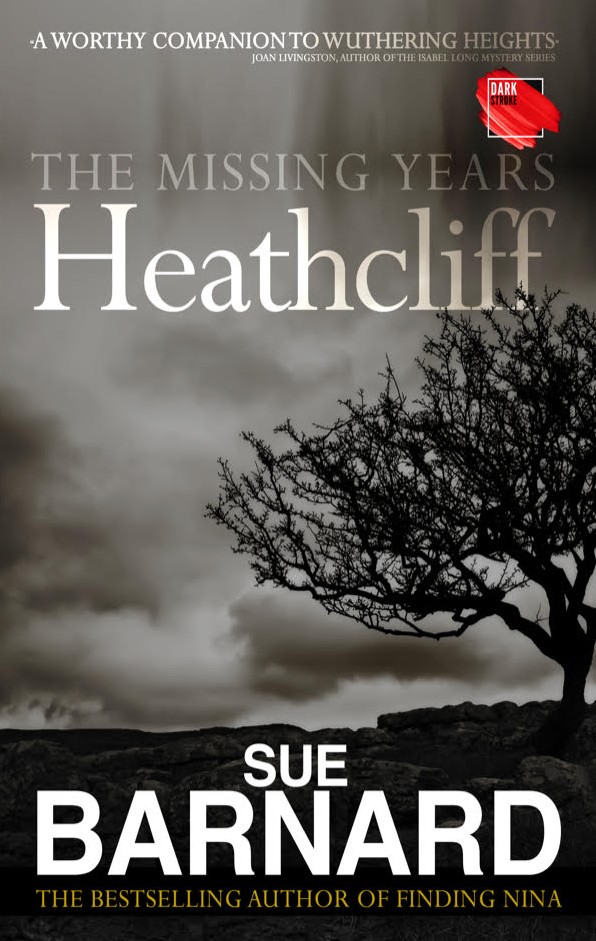
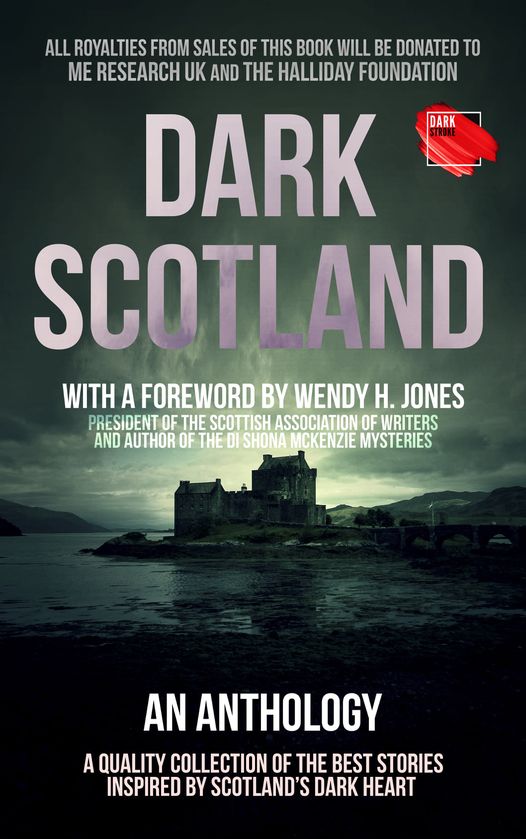
The latter has usually been in response to either or both of my novels which are based on existing works of literature: The Ghostly Father (Romeo & Juliet) and Heathcliff: The Missing Years (Wuthering Heights).  In those cases I’ve had to get inside the minds of, respectively, a sixteenth-century Italian monk and an eighteenth-century anti-hero of unknown provenance.  Neither of those left very much room for my own voice – but I didn’t find this to be a problem.  For a large part of the time I felt as though the characters were in the room with me, looking over my shoulder and telling me what to write.  This was certainly the case with my short story Doomed Youth – a fictionalised account of the meeting in 1917 between the war poets Wilfred Owen and Siegfried Sassoon – which can be found in the Darkstroke charity anthology Dark Scotland.

But there’s plenty of me to be found in the heroines of my other novels.  Sarah in The Unkindest Cut of All is frequently the mouthpiece for some of my own views, whilst Emily in Nice Girls Don’t and Stella in its companion story Finding Nina both share quite a bit of my own experiences as an adoptee.

Some scenes in those books are based on real-life episodes from my own family history.  These include the Somerset air raid tragedy, and the discovery that one character’s grandparents had celebrated their Golden Wedding a year early (anyone who can count up to nine should be able to understand why).  And my memories of working in an independent bookshop gave rise to the following scene in Nice Girls Don’t:

“We had a man come in [to the library] and ask us to find a book which he’d seen somewhere a few months ago.  He couldn’t remember the title or the author, and he only had a vague idea what the book was about.  The only thing he could remember for certain about it was that the printing on the pages was blue.”

Some elements are definitely not based on fact – most notably Alice’s backstory.  For the benefit of anyone who remembers my late adoptive mother (who died when I was nineteen), I must stress that the fictional character’s secret shady past is completely invented. That part of the story was derived from extensive research into the unforgiving attitudes towards illegitimacy in the years during and after World War Two.  I am particularly grateful to the true-life tales portrayed in Sue Elliott’s moving and fascinating memoir Love Child (Vermilion Press, 2005), which I can highly recommend to anyone who wants to find out more about this grim and little-known side of British history. 

Perhaps the story which is closest of all to the truth is the tale of the photograph, which is definitely stranger than any work of fiction.  A factual account of this can be found here on my blog, whilst an adaptation forms part of the plot of Finding Nina.  There are some things which simply cannot be made up…

BIO

Sue Barnard is a British novelist, editor and award-winning poet whose family background is far stranger than any work of fiction.  She would write a book about it if she thought anybody would believe her.

Sue was born in North Wales some time during the last millennium.  She speaks French like a Belgian, German like a schoolgirl, and Italian and Portuguese like an Englishwoman abroad.  Her mind is so warped that she has appeared on BBC TV’s Only Connect quiz show, and she has also compiled questions for BBC Radio 4’s fiendishly difficult Round Britain Quiz. This once caused one of her sons to describe her as “professionally weird”. The label has stuck.

Sue now lives in Cheshire, UK, with her extremely patient husband and a large collection of unfinished scribblings. 

Her books are published byDarkstroke and Ocelot Press

Blog   Facebook   Twitter   Instagram   Amazon  Goodreads  RNA

NOVELSThe Ghostly Father   The Unkindest Cut of All    Heathcliff: The Missing Years   Never on Saturday (also available in French as Jamais le Samedi)  Nice Girls Don’t   Finding Nina  

ANTHOLOGIESDark London Dark Scotland  Dark Paris  Dark Venice  (All royalties from the sales of these anthologies are donated to local charities)

AUDIOBOOKSThe Ghostly Father


Why not join in?

If you want to take part in this series, as a writer or as a reader, you can find out more under That’s Not Me!.

Categories
memories

David Drori and Walking

This is my second post about David Drori (1953-2023). Here’s the first. There might be more – no promises.

We met in the summer of 1973, at a guitar lesson. I was drawn to his shyness, making him refreshingly different from all the boys I’d met up to then. When we parted ways at Euston Underground Station, he gave me his phone number and said, “Give me a call sometime.”

So I did. I invited him to a ramble organised by the Zionist youth movement I belonged to. Little did I know how fitting that was. He was planning to live in Israel, and he loved walking. I liked walking, too, although my walks had been quite limited up to then. I hadn’t seriously considered emigrating to Israel; it was more of a dream at that point.

Over the years, we did lots of walking. We walked in various parts of the UK, in Norway, in Vietnam, in South Africa, in Israel and more. The country in which we enjoyed walking the most was Switzerland. There, we discovered, public transport is so good that hiring a car becomes a hindrance. Using public transport, we could ride to one place, walk all day, and return from another. If the weather forecast in the area where we were staying was unfavourable, we could easily travel to an area of sunshine. If it was too hot down in the valley, we could ride up to the cool air of the mountains.

Switzerland, 2014
Switzerland, 2018
Switzerland, 2021

David was always ahead of me, especially on climbs, and our final trip, to the UK in July, was no exception. He’d sprint up apparently effortlessly, and then wait for me to arrive, breathing heavily. When the children were small, he’d carry one – occasionally two, and still arrive before me.

Walking was the only exercise he did consistently. Neither of us ever wanted to belong to a gym or to do any exercise just for the sake of it. Walking is enjoyable. By walking, you see views you wouldn’t see from a car. You meet people you wouldn’t meet when stuck in a box. And, by chance, walking keeps you fit, too.

David imbued in me a love of walking, and I will continue to walk without him.

Categories
Books

That’s Not Me: Tim Taylor

It’s time for a change. This week’s episode of That’s Not Me! comes from friend, author and poet, Tim Taylor.

That’s Not Me! examines how much of our fiction is autobiographical and why some authors try to insist there’s no link between their fictional characters and themselves.

Having said that, Tim is going to focus not on his fictional stories but on his poetry. Poetry can be purely fictional, but that’s quite rare. Right, Tim?


Thank you very much for inviting me to participate in this very interesting blog series, Miriam. Though I do write fiction, today I’m going to talk primarily about poetry.

I think it’s true of most poets that they make full use of their own experience in their work. I certainly do this myself – when life presents you with something worthy of a poem, why would you not make the most of it? It is perhaps easier for poets, as opposed to fiction writers, to put themselves into their work, because a poem can be openly autobiographical in a way fiction cannot.

I know some poets whose work is almost exclusively inspired by their own experience – either by what happens to them personally, or by their reactions to things they encounter.  However – while it’s had its moments – I must admit that I’ve never felt that my life is sufficiently intereresting to be the sole source of inspiration for my poetic output.

I think it helps here to be a fiction writer as well. Except for that minority whose novels are thinly-disguised autobiographies, fiction writers must rely heavily on imagination to create characters and situations. I often do this in poetry too.  I’ve written many poems about purely imaginary people and situations, and  I would say that my best poems include some of these, as well as ones written from life. Even here, though, poetry (and fiction) still draw upon personal experience in a more indirect way: imagination moulds new things out of the mixing bowl of memories we acquire throughout our lives.

A good thing about poetry is that it doesn’t have to be either one thing or the other. We can write poems directly inspired by our own lives, but improve them by omitting, adding or altering details – ‘never let the truth get in the way of a good poem’ is a maxim I often use! Conversely, we can use real experiences and real things to add colour to an otherwise invented poem.

I’ll end with an example. The scene described in the following poem is entirely fictional. Yet the poem does, of course, articulate thoughts of mine about the power of objects as reservoirs of memory. And the cowrie shell is real – I did indeed acquire it on a childhood holiday in the late 60s.

So is this me?  You decide.  

The Cowrie Shell

“Just chuck ’em in the skip,” she said
as if each object in that box
were not once part of me:
attached by long sinews of stories,
fed by flimsy arteries
through which a child’s heart
once pumped them full of meaning.

The box took them when life moved on.
Now lifeless, so I thought
but peeling back the cardboard
I could sense the gasps for air.
Each object in its turn cried out;
the child in me woke up
and would not let them go.

Among the marbles and the model cars
I found a cowrie shell: smooth, mottled,
exuding still the faintest smell of salt.
“You remember me,” it said
– that holiday in 1969”. I felt
a flickering of what seemed like recall.
I dug deep for that memory,
found it rotted by the years.
I steeled myself, obeyed
the pitiless reminder:
“you cannot keep them all.”

Not quite big enough to be an ornament,
if fitted better in a smaller hand.
I put it down: out fell a single grain of sand.

From LifeTimes (Maytree Press 2022). Signed copies are also available from the author: tim.e.taylor@talk21.com.

Tim Taylor has published two poetry collections, Sea Without a Shore, and LifeTimes, both with Maytree Press, and two novels. His poems have won, or been shortlisted in, a number of competitions and appeared in magazines such as Acumen, Orbis and Pennine Platform and various anthologies. Tim lives in Yorkshire, UK, and teaches Ethics part-time at Leeds University. He enjoys playing the guitar and walking up hills (not usually at the same time).

Categories
memories

David Drori and Accuracy

David (1953-2023) and I met 50 years ago. We got married 45 years ago. He was 70 when he died, just a week after my 70th birthday.

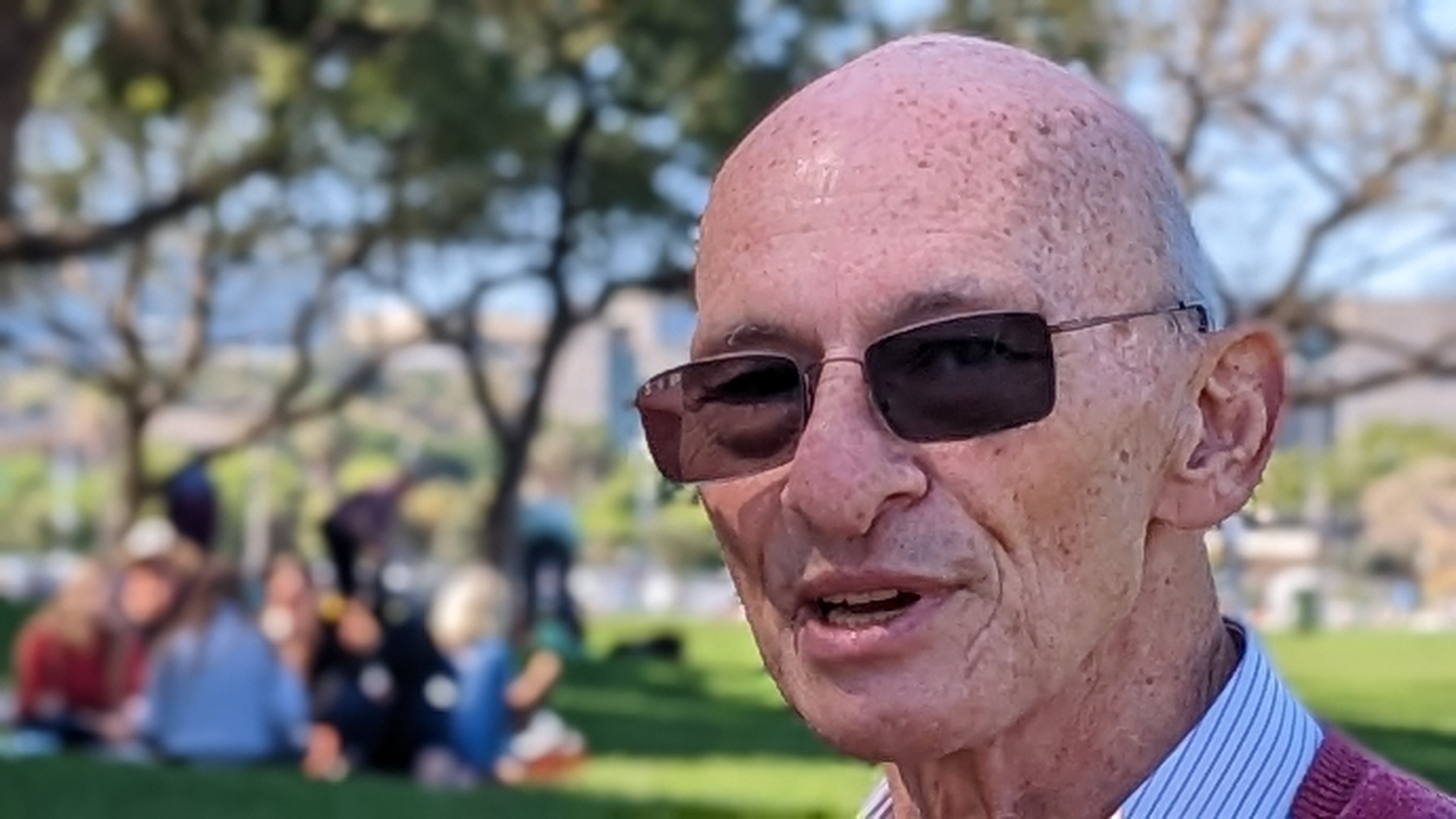
At David’s 70th birthday party.

There’s something special about those numbers. I wish the 70 could have been changed to 90 or even 100. I’d always imagined we would grow old together. But those 45 years were filled with happiness and I’ll always treasure the memories.

Talking of numbers brings me to accuracy, a trait often mentioned by those who came to console us during the shiva. David’s job as an electronics engineer was to design printed circuit boards. It’s a complicated process that involves taking numerous factors into account. Other engineers create the design, try it out, work on the bugs, try again, and so on until it eventually works. David considered all the problems in advance. His boards worked first time.

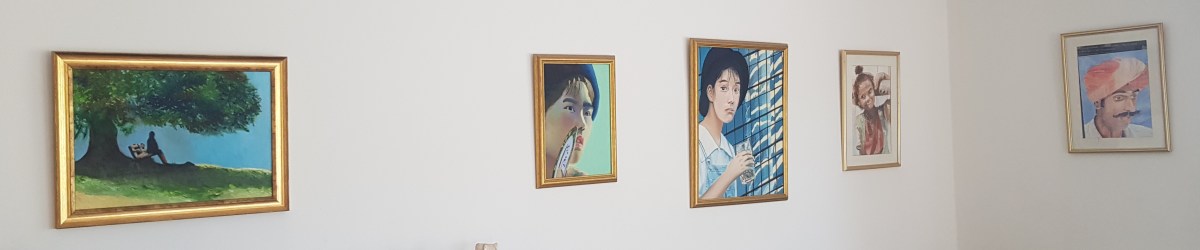
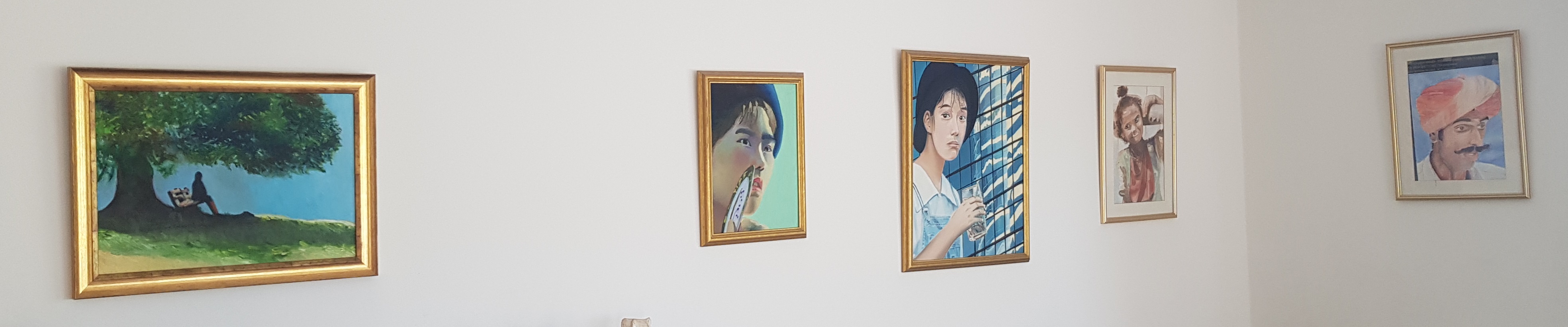
What about David’s hobby, art? He produced delightful paintings and sketches, as well as some sculptures. But art can surely be whatever you want to make it. I wasn’t even sure that accuracy was a term that could correctly be applied to art.

“Of course it can,” said the artist Anat Eshed, who taught David several years ago. She looked up to the wall with his paintings. “And David was very accurate. He had an eye for detail and drew exactly what he saw. He was a pleasure to teach.”

A wall of paintings by David Drori.

I might write more about David in subsequent posts. In the meantime, here’s a poem:

Shy Guy (a poem)
Drawn to a shy guy I met at a guitar lesson.
Afterwards, he invited me to give him a call.
Very soon after,
I
Did.

Diving in was not our thing.
Rather, we waited five years to marry.
Over the decades, our love grew. Now, I can only
Remember.
Initial letters of each line, you may have noticed, spell his name.
Categories
Books That's Not Me

That’s Not Me: Nancy Jardine

Next up on That’s Not Me! is…

…Nancy Jardine, multi-published author of novels set throughout the centuries, from Roman times to the present day, and fellow Ocelot Press member.

That’s Not Me! examines how much of our fiction is autobiographical and why some authors try to insist there’s no link between their fictional characters and themselves.


That’s Not Me!

Well actually, this one was…

I wrote a short story, some years ago, that was definitely about me as a child of around five years old. The incident might have been embellished just a tad since my memory of that time is disgustingly poor, though the gist of the story is definitely authentic. During the 1950s, in my birth city of Glasgow, Scotland, collections of foil milk bottle tops were made which raised funds for a charity for the blind. The story was about how my grampa, by then approaching 85, collected those foil tops for me to take to school. Similarly, on my own blog, there are a couple of short stories which are fictionalised tales about me in my primary classroom. Again, these are heavily embroidered to liven the events. Strangely enough, some of my best friends from that late 1950s era don’t remember the situations at all, or not quite as I remember them. Fickle memory makes for enhanced tales!

This definitely isn’t…

My Celtic Fervour Historical Series is set in a very distant culture of almost two thousand years ago during the Roman Iron Age in Britannia, so you will definitely not find me in any of those characters, or a reflection of any personal experiences I’ve lived through.

However, perhaps this novel does qualify? Just a little bit…

Topaz Eyes, my contemporary mystery/ thriller, is set mainly in fabulous European cities, with a few stops in the United States of America. Although there is nothing of me in any of the characters, there are definitely links to experiences I’ve lived through.

The plot of Topaz Eyes is essentially a treasure-hunt mystery, where third-generation cousins are brought together under mysterious circumstances to solve the disappearance of a collection of valuable emerald jewellery. The emeralds were once Mughal-Emperor owned but were scattered amongst family members around 1910. These ‘cousins’ have never met each other prior to the outset of the story. Some of them prove to be nice to each other though others are decidedly not, and there are those who have deadly intent. Strangely, there’s a cuckoo in the nest because Keira Drummond from Edinburgh is asked to join the hunt even though she’s not a family member.

Is this something that happened in my own family? Absolutely not. This part of the plot is wholly fiction but when I decided to widen the mystery globally, I used my own life experiences when I chose all but one of the locations used in the novel.

Spoiler Alert!!!

I lived in Holland from 1979 to 1981 and during that time I gave birth to two daughters. My children acquired a Dutch Oma and Opa (grandma and grampa) who were no relation to me at all but who became great friends of the family, and who visited us regularly when my husband and I returned to Scotland.

My elder daughter was a languages student who spent her final year of studies at the University of Heidelberg, a fantastic city which I re-visited while she was there. This is where I chose to begin Topaz Eyes.

And…apart from using those life experiences, Topaz Eyes is completely fictional!

p.s. During the writing of the novel, I thoroughly researched emerald jewellery – which I, regretfully, still do not own. Though, when I think about it, I once-upon-a-time owned a beautiful gold ring set with a stunning semi-precious stone. And…I extended my knowledge of a certain branch of art, but to give a spoiler on that research here would be way out of order!

Bio

An ex-primary teacher who published local history non-fiction projects, Nancy Jardine spends her retirement writing historical and contemporary fiction. All historical time periods appeal immensely but so far Roman Britain has been the focus of her published historical fiction. Victorian Scotland is the setting of her current writing-in-progress, an era which allows her to over-indulge in research, which she adores.

Links

Topaz Eyes Blurb

A frantic search for priceless jewels. Greed beyond reason. Shadowy characters, hired gunmen and treacherous villains abound.

A weird invitation to Germany involves Keira Drummond in an international hunt for a collection of extraordinary jewellery, originally owned by a Mughal Emperor. The last known owner was a Dutch family in 1910, but who can Keira rely on, since distrust is rampant among the living relatives that she meets?

Teun Zeger hasn’t met any of his third-cousins before his equally cryptic invitation to Heidelberg, and isn’t sure he’ll ever like them. Keira, is an altogether different matter, and she’s not his relative!

Who is the deadliest cousin, determined enough to hire thugs to tail Keira and Teun when they pair up to unearth the jewellery? And who has the ultimate mystery item that’s even more precious than the Mughal jewels?

Greed, suspicion and murder are balanced by growing family loyalty, trust and love.

Categories
Israel

Shiva

As some of you know, my husband of forty-five years died suddenly just over a week ago. I will write a post about his life, but first I want to tell you about the tradition called shiva, and how it works in Israel.

This was actually my first full shiva and the first in Israel. The one for my father was curtailed because of a festival. My mother didn’t have any friends left when she died at ninety-eight, and I also didn’t have any friends in England who’d be able to visit.

What is a shiva?

In Judaism, the shiva is the period of seven days (shiva means seven) during which the mourners sit at one of their homes and people come to pay their respects, give condolences and provide comfort. Those who knew the deceased add their memories.

The count of seven days begins on the day of the funeral and includes the Sabbath, even though the mourners don’t “sit shiva” on that day. In our case, the funeral was on Sunday and so the shiva lasted until Friday without a break.

The last photo of us together, taken at the celebration of my 70th birthday.

Who was present every day?

My three children; my brother-in-law, who hopped on a plane in London and arrived in good time for the funeral, which took place the day after the death; my daughter’s husband and me.

Who was present most days?

My son’s wife, who helped a lot, even though she had to care for their little daughter and also to work.

Where did the food come from?

So many people brought food – from cakes, sweet and savoury bites, and fruit to complete meals. We sat and indulged and wondered whether people tend to put on weight during a shiva. When it was over, I stuffed everything into cupboards and the fridge and didn’t want to eat anything. I still don’t want much.

Who came to visit?

There were several groups:

  • Close friends, who knew all of us well.
  • Family members, some close, others more distant.
  • Friends of each of us, who didn’t know my husband.
  • Work colleagues, who knew only him.

What did we learn?

  • What it was like to work with him.
  • Anecdotes.
  • The secret to living a long and healthy life. (One of my dancing partners is 95!)
  • What a lot of friends he had.
  • What a lot of friends I have.

What did we think of the shiva?

We were sceptical at the beginning, none of us having experienced this before. By the end, we all agreed that it works very well and provides the best possible transition between life before and after.

Categories
Books That's Not Me

That’s Not Me: Angela Wren

It’s Friday and time for another episode in the That’s Not Me! saga.

This week’s author, Angela Wren, is also an actor. How does that affect her skills when creating characters and making decisions about their behaviour? Let’s have a peep behind the curtain.


That’s Not Me!

As a writer and as an actor, I can say quite definitely that none of the characters I’ve created on stage or on the page are me.  I can be so specific because of the process I go through to create characters.  It doesn’t matter which media I’m using.

I’ve been working on stage since I was child, and I’ve played a myriad of characters from a chicken in a play about Old MacDonald, to a Rat in the Pied Piper right up to Raksha, the wolf mother of Moglie in Jungle Book.  I’ve played many human roles, too, in any number of productions from Roald Dahl’s The Twits (I was Mr Twit – and yes, I do mean Mr) to Puck in A Midsummer Night’s Dream.  I played a seven-year old at the age of 42 and an eighty year-old at the age of 25.  So, I’m only too well aware of how important it is to make the characters I play on stage appear real to the audience.  In that situation I need only enough of myself – 10% – to keep me breathing, moving and speaking so that I can convey the scritpwriter’s words in the right way.  Everything else, the costume, the make-up, the gait of the character, the mannerisms and the vocal quality are all the characters.  When I’m waiting for my cue in the wings, I think myself into my character.  That way I can be sure that at my first appearance in front of the audience, I’m my best version of the character I’m playing and, hopefully they will believe me to be the person in the script.

When I’m writing, I can see all my characters in my mind’s eye.  I’m with them for every moment in the story.  In a sense, then I’m both audience and actor.  The great benefit of writing is that I can stop the action at any point and make my characters go back and do something again but in a different way.  When I’m acting in front of a real live audience, that’s not possible!  Working with my characters when I’m writing is so much easier than when I’m on stage.  And there are no lines to learn – I just make them up as I go along!

But I do have to confess a couple of things.  There are times when I’ve overheard a conversation on a bus or a train or in a café and I’ve committed it to memory.  Those few words and phrases are then recycled and given to one of my characters.  Similarly with my newest creactions, Alice Tomlinson and her dad.  There are bits and pieces of conversation that took place between me and my dad that have remained in my mind and, finally, I’m finding opportunities to use a sentence here or a phrase there.  But Alice is nothing like me, either physically or in her inner self.  Just as Peter bears no resemblance to my real dad.  But it is fascinating exploring the dynamics between them as I move through my current story – a full-length murder mystery that is set in central France.

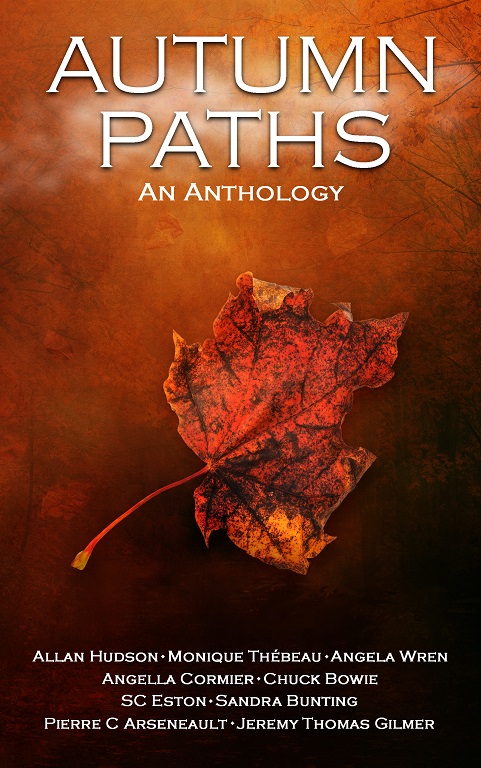
You can meet Alice and her dad, already.  They both appear in The Bookseller’s Secret Octavo, a short story that was published in an anthology called Autumn Paths.  The third book in that series, Spring Paths, is due to be published quite soon and Alice and Peter make it onto the page in that collection, too.  But there will be more about that in the coming weeks on my blog and my website.  In the meantime, I’m going to get back to my desk with my fictional world and its people and get my story finished.

Author Bio

Angela Wren is an actor and director at a small theatre a few miles from where she lives in the county of Yorkshire in the UK.  She worked as a project and business change manager – very pressured and very demanding – but managed to escape, and now she writes books and stories.

Her first published story was in an anthology created by ‘Ireland’s Own’ magazine in 2011.  She also works with eight other northern writers to create the series of Miss Moonshine anthologies.  Most recently, Angela has collaborated with eight Canadian/American writers to create the ‘Paths’ anthologies.

Her full-length novels are all set in France, where she likes to spend as much time as possible each year.

Blurb for Autumn Paths

Nine writers – Seasonal Collective – from both sides of the Atlantic, including best-selling and award-winning authors, have created this miscellany of stories.

These tales of family, mystery, intrigue, adventure, and suspense will take you across continents, through time and space in this world and others.  With a linking theme of autumn, discover new landscapes, encounter new and intriguing characters, uncover secrets and lies, and witness the resolution of old enmities.

Take the first step on this roller-coaster of an emotional journey, and you won’t be disappointed.

Links

Categories
Books That's Not Me

That’s Not Me: Mary Grand

It’s time for another guest post in the series, That’s Not Me!

That’s Not Me! examines how much of our fiction is autobiographical and why some authors try to insist there’s no link between their fictional characters and themselves.

Mary Grand and I first linked up online because of the similarity of our debut novels. Her book, Free to be Tegan, tells the story of a girl who grew up in a cult and then left it, showing the difficulties she faces on the outside. My novel, Neither Here Nor There, is about a girl who leaves the closed haredi community she grew up in. It’s not available now, but will hopefully be back one day in a new guise.

My knowledge of haredi life is only through observations from the outside, although a lot of the religious practices are familiar to me. How much did Mary know about living in and leaving a cult? And how similar are her main characters to her?


Thank you so much Miriam for inviting me on to chat about the fascinating and surprisingly controversial idea of whether or not any of the characters in my novels may contain ‘a bit of me.’

Now, I know writers who say that their characters appear to them fully formed, and, like strangers they met at a party, they slowly come to know and understand them as they write.  The character was not inspired by themselves or anyone they know.

 All I can say is that it’s not anything that has ever happened to me, and if I was to wait for my characters to just appear, I’d be waiting for a long time.  When I start writing a new novel, I often begin with a setting, or a crisis. The main character in all my novels is always a woman, and I may start with a characteristic of myself, for example, my age, or a phobia I possess, to start building the character in my novel.  Slowly a character will evolve, and she will become her own person. However, there will be something of me still there, maybe she will have a fear I understand, she may be my age, she may have been hurt in a way I can relate to. They are not a carbon copy of me, they become a person in their own right. However, I started with a feeling, a passion I understood, it helped me get under the skin of the person I am creating.

The first novel I wrote was called Free to Be Tegan, about a young girl trying to survive after being cast out of the cult where she’d grown up. Tegan leaves the cult to live with Welsh relations she has never met before, people who have no understanding of the cult.

The point of reference for me was the fear that had been instilled in Tegan during her time in the cult.  I was brought up in a strict religious sect and have had to unpack some of the damage done by the teachings I received as a very young child. I understood the psychological problems this background may give Tegan, the hyper vigilance and panic attacks that may result. However, Tegan was not me, this was not an autobiography. The situation she went to was completely fictional, as were the people she met, the romance, the mystery and secrets she became embroiled in.  I was able to write authentically about her inner life, which for me was a very important part of the story. Understanding this helped me imagine how she might cope with the situations she faced, but it was important that I wrote how Tegan not I would have reacted.

On a slightly lighter note, I am embarking on a murder mystery series where the central character is Susan Flynn. The parts of Susan that come from me are her age – she’s in her early sixties, her love of music, being a mother and her joy at living on the Isle of Wight. I have also given her my feeling that older women like myself are sometimes denied a past, and so she reminds her family and friends of the passions of her youth, her hurts and her achievements. She was at Greenham Common Peace Camp, fostered children and cared about a range of causes. Although I never did some of these things, the principal of reminding people she had an active and vibrant past was important to me.  Again, her present situation is very different to mine. Susan is recently divorced and for the first time in forty years she is living alone.  She is however fiercely independent and, in many ways, going back to her roots. She finds again her need to fight for justice, which in turn leads her to solving crime, in particular, murder.

I would say that starting with familiar elements to someone’s characters helps me understand them, keeps me grounded if you like. It is only a starting point though – a springboard from which I fly off into the unknown.

My Bio

I live on the Isle of Wight with my family. Before coming to the Island, I worked as a teacher of Deaf children in Hastings and Croydon.  I grew up in Wales and speak a smattering of Welsh, my first few novels are set in Wales.

 I began my writing career self-publishing three novels, Free to Be Tegan, Hidden Chapters, and Behind the Smile, alongside two anthologies of short stories, Catching the Light and Making Changes. I am now very excited to be working with Boldwood Books and to date have had four novels published with them – The House Party, The Island, Good Neighbours and Death at Castle Cove,  and these are all murder mysteries set on the Isle of Wight.

All my  books are available in eBook and paperback, are on Amazon, and available to order from libraries and bookshops.

Social Media Links

Categories
Books Reviews

A Gentle Nudge

I’m delighted to take part in the blog tour for:

A Gentle Nudge by Mason Bushell.

The blog tour is organised by the lovely Lynsey Adams of Reading Between the Lines.

About the Book

Stories to soothe your soul.

In a world drowning in negativity and dark events, we all need a little light and hope. With a little adventure, romance and even music, these short stories will give your hopes and dreams a nudge as they draw a smile.

A Gentle Nudge by Mason Bushell wraps you in calm.

LINKS TO BUY 

About the Author

Author Mason Bushell, is a naturalist, chef and writer from Norfolk in the UK. He loves nothing more than to write among the trees, near his home. He is an avid short story writer and is always working with his characters unless Lucy Dog steals his laptop for a walkies!

My Review

I’m sure many people have occasional days when they feel overwhelmed by events and only want to escape the real world with a book. What sort of book do you read in those circumstances? I’ve found romances to be eminently suitable for the purpose. But having read this book of short stories, I think they are just as good. The advantage of short stories over a novel is that the reader can dig into a story whenever they have a few minutes free, and never lose the thread or forget which character is which.

The stories in this collection are sweet. Some include romance; others involve children and animals. Sometimes disaster strikes, but I hope I’m not giving anything away when I say all the stories have happy endings.

The characters in these tales are kind. They often go beyond all expectations to help people in need of support. When bad characters appear, they always get their just deserts. The stories provide satisfaction.

The real world, as we know, is not always like this. It would probably be correct to say it’s not usually like this. But the world of these stories is one we should aspire to. If the real world were like this, we wouldn’t need these stories. As it is not, we very much do.