To make up for my recent lack of attention to this blog, I’m posting thoughts about Chanukah for each day of the eight-day festival. Today, I’m talking about:
STORY
Do you know the story of Chanukah?
The generally accepted (though disputed) story took place in the middle of the second century B.C.E (or B.C.) when the Second Temple stood in Jerusalem. The ruler of the Land of Israel at the time, Antiochus IV of Syria, led his soldiers to massacre thousands of Jews and desecrate the Temple. A rebellion was led by Mattityahu (Mattathias) and later his son, Yehuda (Judah) the Maccabee. The Jews drove the Syrians out of Jerusalem and set about cleansing the Temple.
The seven-branched candelabrum, representing knowledge and creation, was supposed to be kept burning every day, but there was only enough olive oil to burn for one day. By a miracle, the flames kept alight for eight days, leaving the people time to find a fresh supply of oil.
Jerusalem: a light show on the Old City walls.
The festival of Chanukah concentrates on the miracle and not on massacres. It’s a fun festival and also a minor one. In recent times, its proximity to Christmas (this year they coincide) has raised its status.
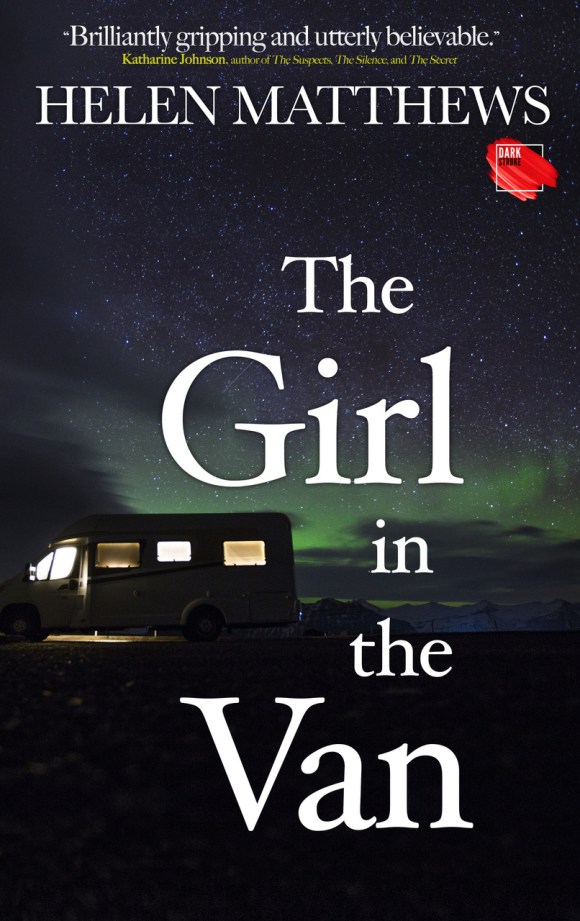
I’m delighted to welcome author Helen Matthews back to my blog. She’s going to tell us about a complex story with three plots… I may have got that wrong, but here she is to explain all.
Yes—oh dear yes—the novel tells a story.
That’s a quote I remember from my university days reading English. It’s from E M Forster’s Aspects of a Novel (1927). Forster goes on to give examples about the difference between story and plot. Plot needs an inciting incident and causality and a suspense novel, such as The Girl in the Van, needs extra ingredients. Complex characters to give it spice; a pinch of twists; a ladle of settings and a heaped tablespoon of time shifts to mix everything up.
But while we’re cooking up a plot, we mustn’t neglect story. While editing The Girl in the Van. I noticed how the characters’ stories were multi-layered and inter-locking. Some stories were true, and others were not. Some were full of missing pieces that had to be unearthed by the characters (or guessed by the reader) Some stories differed, depending on whose point of view we were following. All these stories were on a collision course towards jeopardy and huge danger for the characters. I imagine the hidden stories, nested like a Matryoshka (those wooden Russian dolls) inside one another, waiting to be revealed.
The Girl in the Van is a twisty page-turner with serious themes at its heart. The strapline is: A tormented mother, an abandoned girl, a deadly game of survival.
There are three interwoven plots (Laura’s story, Ellie’s story and Miriana’s story) and to begin with there’s some necessary confusion about which of them is ‘the girl in the van’. Perhaps there is more than one girl (or woman) in the van at different times. The main narrative is from the viewpoint of Laura, a former teacher, who’s lived a solitary existence since a life-changing event involving her sixteen year old daughter, Ellie. Escaping from Wales to London, Laura cuts all ties with her partner Gareth (Ellie’s father) and refuses to tell anyone her new address. For two years she struggles on in a mundane job before making an attempt to re-join the world. She buys an old campervan and joins a group holiday at a campsite in Tenby. Here, Laura’s path crosses with Miriana, a teenage girl who bears an uncanny resemblance to Ellie. As Laura discovers more about Miriana’s story – and who knows if that story is true? – chilling parallels to her own life emerge. Laura’s life is at risk because someone out there is determined to stop the truth about what happened to Ellie coming out.
The book poses the question: What happened to Ellie? Her mother, Laura, believes she knows but has blocked the story from her mind and doesn’t want to think about it. Her former partner, Gareth, (Ellie’s father) has exactly the same information as Laura but reacts differently. Refusing to accept it, he’s on a mission to investigate further. As Laura says: ‘He was like a vulture scavenging on roadkill, picking over every detail’.
Ellie’s story forms the scaffolding of the book and gradually unfolds as the stories progress.
When Laura leaves Wales and moves to London, she cuts herself off from everyone she knew in her old life, refusing to tell even her mother her new address. But why? Is it because her mother is close to Gareth and Laura can’t trust her not to reveal her whereabouts?
A further twist in Laura and Gareth’s story is the harassment they’ve suffered at the hands of the gutter press and social media. Like some real-life families we’ve heard about, at a time of crisis, they lost the support of their community because some people chose to believe vicious rumours or trolls on social media.
Who is Miriana, the girl with a thousand stories? When Laura first encounters her, she behaves as if she’s an elective mute, refusing to speak, holding up hand-scrawled notes asking for help. It’s as if she’s not yet sure what story to tell. She tries out a few. Some may be true. Others not. Or perhaps even Miriana doesn’t know what’s really going on.
Miriana trades stories about her family’s connections to an ‘old country across the sea’ though she was born in Croydon and has never been abroad. The stories her father told her about social norms and the position of women in that country terrify Laura. How could she fail to be moved when she hears about the exploitation the teenager has suffered? It seems as if Miriana is trying to win Laura’s compassion and protection. As Laura reflects:
I shiver. Not because my chair is in the shade, but because her offer to trade her story for safety brings the legend of Scheherazade to my mind. For a thousand and one nights Scheherazade fended off her execution by telling fascinating stories to her husband King Shahryar, and ending at dawn on a cliff-hanger. Is Miriana really in danger, or is she playing me? I used to be a good judge of character, but no longer. Her story had better be good.
If you enjoy a story, or several linked ones, you can discover what happens by downloading The Girl in the Van at this link:
Helen Matthews writes page-turning psychological suspense novels and is fascinated by the darker side of human nature and how a life can change in an instant. Her latest novel The Girl in the Van was published on 17 March by Darkstroke Books. Previous novels include suspense thriller After Leaving the Village, which won first prize in the opening pages category at Winchester Writers’ Festival, and was followed by Lies Behind the Ruin, domestic noir set in France, published by Hashtag Press. Her third novel Façade was published by Darkstroke Books in 2020.
Born in Cardiff, Helen read English at the University of Liverpool and worked in international development, consultancy, human resources and pensions management. She fled corporate life to work freelance while studying for a Creative Writing MA at Oxford Brookes University. Her stories and flash fiction have been shortlisted and published by Flash 500, 1000K Story, Reflex Press, Artificium and Love Sunday magazine.
She is a keen cyclist, covering long distances if there aren’t any hills, sings in a choir and once appeared on stage at Carnegie Hall, New York in a multi-choir performance. She loves spending time in France. Helen is an Ambassador for the charity, Unseen, which works towards a world without slavery and donates her author talk fees, and a percentage of royalties, to the charity.
This post is one of 26 I am writing for the A-Z Challenge on the subject of writing a memoir. I’m not an expert in writing memoirs, but I’m exploring the topic with thoughts about writing one, and am happy to share the fruits of my exploration.
—-0—-
In her book, The Situation and the Story: The Art of Personal Narrative, Vivian Gornick differentiates between these two easily-confused terms. Actually, it’s not the terms that people confuse, because as far as I know Gornick is the only one who uses them. It’s the concept that there are two things going on.
Gornick’s “situation” is the collection of scenes, the where, who and what. The story is the emotional journey the narrator travelled while traversing the scenes. This is what the reader really wants to understand. Without a story, the situation has no interest, or not much.
To illustrate a major point in the book, Gornick describes a speech that moved her while others didn’t. When she analysed the reasons why this particular speech was different from the rest, she came to the conclusion that the speaker was able to choose who she needed to be for the purpose of the speech. That is, out of all her roles in her life, she chose the one that fitted the theme of her speech and stuck to it. She says, “Because the narrator knew who was speaking, she also knew why she was speaking.”
Who am I for the purpose of my memoir? I think I have to be a person who has been affected by social anxiety. The fact that I’m a wife, a mother, a sister, a cousin, a friend, a maths graduate, a former computer programmer, a dancer, a chief cook and bottle washer and more is only relevant if any of these roles have some bearing on social anxiety, or if social anxiety has affected these roles.





 Miriam Drori, Author