Author, editor, attempter of this thing called life. Social anxiety warrior. Re-Connections, a collection of short stories, published with Ocelot Press, 15/10/2025.
The last stop in my blog hop is at the blog of Tim Taylor, who lives near Huddersfield. I had to look up Huddersfield and found it between Manchester and Leeds, in other words, for this ex-Londoner, “Oop north.” Tim is the author of Zeus of Ithome, a novel set in ancient Greece.
I talk about setting a novel where you live, and about setting a novel in a place you’ve never been to. Here.
I’ve been interviewed for the first time (as an author) by Nancy Jardine, author of Topaz Eyes, The Beltane Choice and After Whorl. Read about them here.
Thank you to all three people who went in for my competition. You all had some great ideas, which I really enjoyed reading.
The Answers:
Tsartsar — Cricket (the insect)
Bakbook — Bottle (from the sound of pouring)
Zimzoom — Buzzing
Rishroosh — Rustling
Tiftoof —Dripping
Girgoor — Gurgling
Gimgoom — Stuttering/stammering
Pkak — Cork
Pitzpootz — Crackling
The Winner
Technically, the winner is Sue who translated three of the words correctly. In second place is Jo, who was almost correct in two of her answers. But all the answers made me smile and I think all three deserve a prize. Congratulations! Let’s get in touch….
I listened to this week’s Last Word from BBC Radio 4. Sir Richard MacCormac, an architect who recently died (obviously, otherwise he wouldn’t be on Last Word) said, after explaining that his interest in architecture came from making things as a child:
I now feel an essential aspect of creativity is a kind of playfulness.
This is certainly true of writing. Writers enjoy playing with words. When penning my last post, I particularly liked the beginning paragraph:
These are the comments that halted me in my perusal of the Internet this morning and made me decide to pour out part of my inner world. Sorry if it makes a stain on your day.
Although I went on to some serious stuff, I had fun playing with the opening words.
My Scrabble partners, A, G and D, and my Boggle partners, D and D, will testify to my love of word games. Most writers play word games when they write, employing several techniques in the process. One of those is onomatopoeia.
In other words, I’m talking about words that sound like the things they represent.
Then I came across a list of Hebrew onomatopoeic words, which I have tried to transliterate as closely as possible:
Tsartsar
Bakbook
Zimzoom
Rishroosh
Tiftoof
Girgoor
Gimgoom
Pkak
Pitzpootz
So here’s the competition. Without looking anything up (I’ll have to trust you on that), can you guess what those words mean? Write your answers in the comments and I’ll decide who wins the prize of… well, it depends who wins and whether that person has read Neither Here Nor There, but it might well be the novel itself.
Hint: They are all nouns and most of them translate to “ing” words.
Rules:
The competition is open to anyone who doesn’t know Hebrew.
The competition will end when I decide to end it, so don’t tarry.
These are the comments that halted me in my perusal of the Internet this morning and made me decide to pour out part of my inner world. Sorry if it makes a stain on your day.
…writing helps us cope with our ‘inside world’ in a therapeutic way. It allows us to explore our innermost feelings, fears hopes etc, in a safe environment, safe because we can stop writing at any time we want.
Sometimes internal and external worlds blend, like knitting, and writing can help with the unravelling.
Some time ago, readers of my blog asked me to write about every day life in Israel – about ordinary life that doesn’t make its way to your newspapers. I created a new category and called it, “Everyday life in Israel.” I had no intention of ever writing about politics or to take sides in any conflict. There are plenty of blogs that do that. They are written by people who are much more knowledgeable than I and hold much stronger views.
Me and Jerusalem
That said, the very fact that I live here, and chose to live here, says something about my opinions. I’m always amazed at the surprise shown in the media at the fact that general opinion in Israel is so much at odds with general opinion around the world. The reasons for that are clear to me.
We’re fighting for survival. Ever since the State of Israel was created in 1948, we have fought those trying to destroy us. We continue to do that now no less than previously. Yes, the means we have to protect ourselves have increased over the years, but so have those of all the other sides. I realise the rest of the world doesn’t see this as a fight for survival, but we who live here do, and that makes us think in a different way.
And we know the media lies. We have husbands and sons who serve in the army, who risk their lives to protect us, who risk their lives in an attempt to protect the lives of the citizens caught up in the place – Gaza – that has become such a mess. Clearly the thoughts and opinions coming from this knowledge will be different from those who believe those reports in the media.
So what is life like in a time of war/conflict? I can’t tell you what it’s like for those living in the south of the country where there are constant rocket attacks. I can’t tell you what it’s like for people who have to carry sleeping babies out to relative safety in fifteen seconds, although I do remember a previous war when we did have babies. I can’t tell you what it’s like to lose a son or husband or other family member. I can only tell you what it’s like for me, in one of the safest parts of the country.
I went to folk dancing twice this week in two different places and run by two different people. In the first, we danced to the usual songs but the atmosphere was not as usual. During a break, I sat with a group of people and the conversation was all about the situation. Did we know about the tunnels? How much did we know? Did we know about the mega-attack planned for the eve of the New Year holiday? And someone mentioned something I remember, too. During the ’80s, people who lived in Ashkelon often used to visit nearby Gaza City. They especially liked to buy the furniture sold there. I remember going there too, once, along with friends who lived in Ashkelon. No one felt afraid of going there. Times change.
At the other folk dancing group, the instructor managed to create a lighter mood. I welcomed those few hours when my mind didn’t dwell so much on all this.
Wars and conflicts have changed for me over the years. In the past, we watched the news in the evenings and went to work during the day, where we naturally discussed what was happening but otherwise got on with work.
Now I’m at home, and now there’s social media. I see a lot more of what’s being said around the world and a lot of what I see makes me sad. I’ve often been upset by being misunderstood (which happens often) and I’m similarly upset when my country is misunderstood.
I’ve never written a story that involves this conflict. My romance, Neither Here Nor There, doesn’t mention it. I’ve always thought I wanted to keep away from it, but now I’m not so sure. Anyway, I’ve exposed a bit of my inner world here. It’s not everyday life in Israel, but everyday life in Israel in times of war.
There’s plenty more that I could say and probably some that I wouldn’t say. I’m not about to give out my phone number, for instance, or talk about those closest to me. If you want to ask anything, please do. If you want to pick a fight with me, please don’t. This is not the place for it. You can write your own blog post. You can comment elsewhere. Attacks here will be deleted.
Austerlitz by W. G. Sebald, translated by Anthea Bell
It takes decades for the man called Austerlitz to decide to uncover what he has been avoiding all this time: at the age of four, he was sent away from his home in Prague on the Kindertransport and given a new identity in “the little country town of Bala in Wales.”
Clearly, this is a very special book. It made me think and will make me continue to think. The introduction by James Wood (which I read at the end; otherwise it would have spoilt the novel for me) clarified some of its features for me. I can see reasons for the intentional randomness, the continuous prose, the perpetual distance of the main character, the anonymity of the narrator. I can discern parallels I didn’t notice at first. It’s quite possible this book deserves to be read a second time.
So it ticks a lot of boxes, but I found the format made it difficult to read and I’m not sure that it’s justified. The lack of chapters and for the most part even paragraphs meant that I didn’t know where to stop. I ended up making a rule for myself: I stopped at the first full stop after turning a page. This gave me too many possible stopping places. It also confused me, as I didn’t remember what came just before my starting place.
I’ve never read a book in one sitting, but I think that’s what this one needs.
Moving a little in a southerly direction, I’m visiting Sue Barnard, author of The Ghostly Father and Nice Girls Don’t. I have read both novels and heartily recommend them.
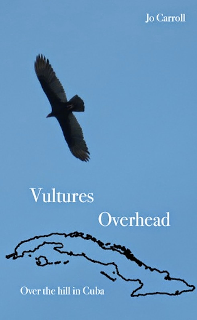
With vultures of our own overhead, I was happy to let Jo Carroll transport me to a place I’ve never been to and might never see. Even if I do go there, this book won’t reflect my experience. Jo makes this very clear. The book describes her journey around Cuba as a lone traveller in January 2014. Another visitor, travelling at a different time, in a group or even with one other, hiring a car, staying at different places, meeting different people, will experience something completely different.
Having read two of Jo’s previous travel books, I expected to be entertained, captivated and enthralled. I wasn’t disappointed. I was taken for rides on old buses, a horse and a bicitaxi. I met a wide variety of people – Cubans and tourists. With her usual perception, Jo paints a vivid picture of all she saw, peppering it with the thoughts and feelings of a brave, sincere and articulate woman.
You have to laugh to stop yourself from creating a poem by mistake!
Whatever the reason, you have to laugh sometimes.
So I was reading through my Facebook feed the other day. Missiles landing here. Missiles being deflected there. Buildings destroyed by falling missiles. Then I saw this:
It’s raining. The wet sort.
And I thought: good thing he qualified that.
We went to the Jerusalem Theatre to see a play that took place around the time of the Yom Kippur War. A notice went up before the play started:
During the performance, sounds of explosions and sirens will be heard.
To my friends around the word: thank you so much for your concern. We are hanging in there. It’s not easy but we know what we’re doing. We’ve been through this before and we know it will pass soon. All we can do is say a prayer that someday, Tel Aviv will not be so humid.
Benji is a comedian who has been doing a lot to keep us laughing. And sane.



 Miriam Drori, Author